What Does 0% Coinsurance Mean? Coinsurance Explained in Real Numbers
What coinsurance means: 0%, 20% and 100% coinsurance in health insurance, how it differs from a copay, and the property coinsurance clause.

Table of contents

Coinsurance is one of those insurance words that sounds technical and turns out to mean something simple: the percentage of a bill you pay after your deductible. A plan with 20% coinsurance means you pay 20% and the insurer pays 80%.
The confusion comes from three places. Plans show the percentage in different ways, so “0% coinsurance” and “100% coinsurance” can look like they mean the same thing. The percentage interacts with the deductible and the out-of-pocket maximum, so the number on its own tells you little. And property insurance uses the same word for something completely different.
This guide covers all three with real numbers: what coinsurance means in health insurance, what 0%, 20% and 100% coinsurance each mean, how coinsurance differs from a copay, and how the coinsurance clause works on a home or business property policy.
What is coinsurance in health insurance?
Health insurance splits your costs into stages across the plan year.
- The deductible. You pay the full allowed amount for most covered services until you have paid this much in the year.
- Coinsurance. After the deductible, you and the plan share each bill by percentage. This is the stage coinsurance describes.
- The out-of-pocket maximum. Once your deductible, coinsurance and copays for the year add up to this limit, the plan pays 100% of covered in-network care for the rest of the year.
Coinsurance is always calculated on the plan’s allowed amount, the negotiated price for an in-network service, not the provider’s original list price. If a hospital bills $9,000 and the plan’s allowed amount is $5,000, your 20% is $1,000, not $1,800.
If you want the full picture of those stages, our guides to health insurance terms and the deductible versus the out-of-pocket maximum cover them in detail. This article focuses on the percentage itself.
What does 0% coinsurance mean?
0% coinsurance means that after you meet your deductible, you pay nothing more for covered services. The plan pays 100% of the allowed amount.
In effect, for services subject to the deductible, a 0% coinsurance plan has a two-stage structure: you pay everything up to the deductible, then nothing. Your deductible is effectively your out-of-pocket maximum for those services, although copays for things like prescriptions or office visits may still apply and still count toward the true maximum.
That sounds ideal, and for someone expecting a large medical bill it often is. But the trade-off is usually somewhere else on the plan:
- Higher premiums for the same deductible, because the insurer is carrying more of every bill.
- A higher deductible, which is common on plans advertising 0% coinsurance. A $7,000 deductible with 0% coinsurance can cost you more in a moderate year than a $2,000 deductible with 20% coinsurance.
- Separate copays that still apply to office visits, urgent care or drugs.
What does 0% coinsurance after deductible mean?
It is the same thing, stated more precisely. Most plan summaries phrase it as “0% coinsurance after deductible” or “No charge after deductible.” Both mean you pay the deductible first and then nothing further for that service.
What does 20% coinsurance mean?
20% coinsurance means that after the deductible, you pay 20% of each covered bill and the plan pays 80%, until you reach the out-of-pocket maximum. It is the most common coinsurance level on employer and marketplace plans.
Take a plan with a $1,500 deductible, 20% coinsurance and a $6,000 out-of-pocket maximum, and a $5,000 allowed amount for an outpatient surgery, with no other medical costs so far this year.
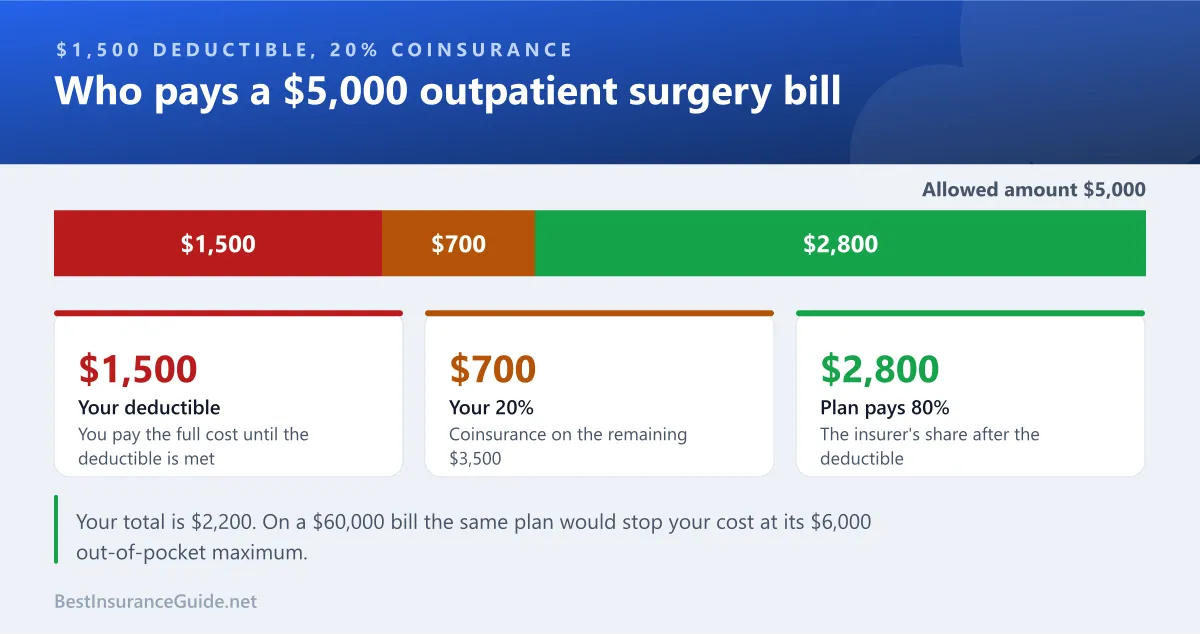
- You pay the first $1,500 as your deductible.
- That leaves $3,500. You pay 20% of it: $700.
- The plan pays the other 80%: $2,800.
- Your total: $2,200. The plan’s total: $2,800.
Now suppose the bill were $60,000 instead. The deductible is $1,500, and 20% of the remaining $58,500 would be $11,700. But the out-of-pocket maximum stops you at $6,000, and the plan pays everything above that. For large bills, the out-of-pocket maximum matters far more than the coinsurance percentage.
How the percentage changes what you pay
Here is the same $5,000 bill, with the same $1,500 deductible, at different coinsurance levels.
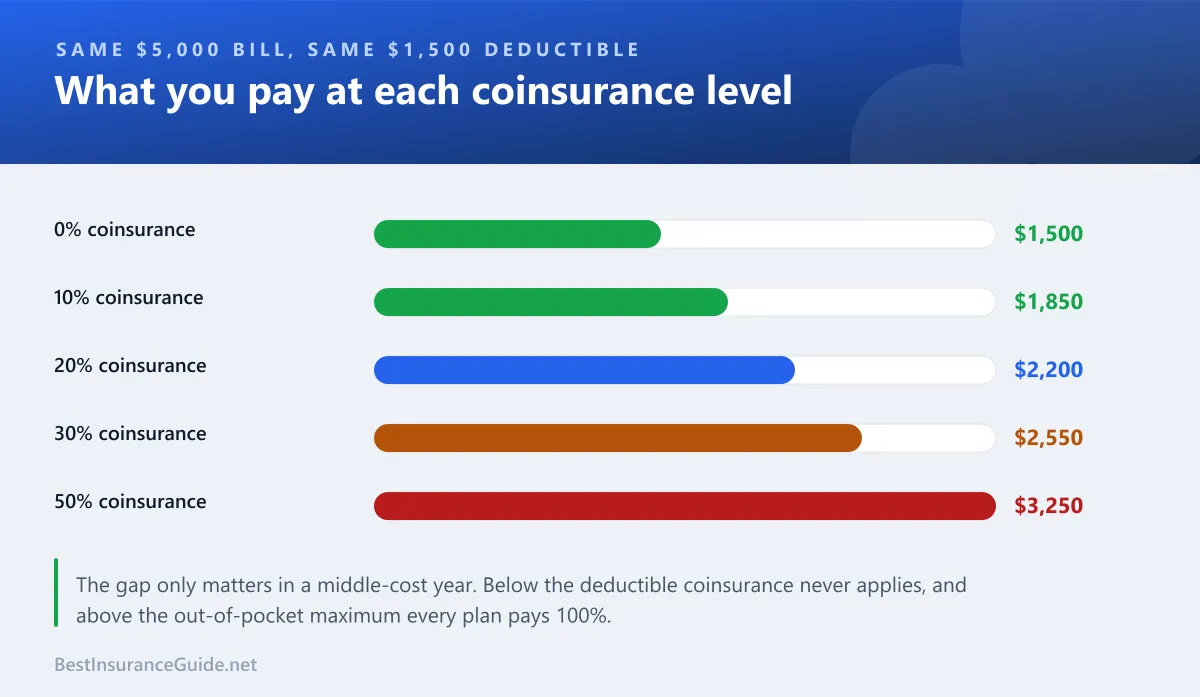
| Coinsurance | Deductible | Your coinsurance share | You pay in total | Plan pays |
|---|---|---|---|---|
| 0% | $1,500 | $0 | $1,500 | $3,500 |
| 10% | $1,500 | $350 | $1,850 | $3,150 |
| 20% | $1,500 | $700 | $2,200 | $2,800 |
| 30% | $1,500 | $1,050 | $2,550 | $2,450 |
| 50% | $1,500 | $1,750 | $3,250 | $1,750 |
The table shows why coinsurance deserves attention in the middle range of medical costs. In a quiet year, you never get past the deductible and coinsurance does not apply. In a catastrophic year, you hit the out-of-pocket maximum either way. It is the in-between year, a birth, a planned surgery, a few months of physical therapy, where the coinsurance percentage decides your bill.
What does 100% coinsurance mean?
This is the one that trips people up, because “100% coinsurance” is used in two opposite ways.
- Some plan summaries show the plan’s share. “100% coinsurance after deductible” in that style means the plan pays 100%, which is the same as 0% coinsurance for you.
- Most standardized summaries show your share. In the Summary of Benefits and Coverage that plans must provide, the figure in the “what you will pay” column is your share. “100% coinsurance” there means you pay the full cost. You will see it most often for out-of-network care on HMO and EPO plans, or for services the plan does not cover.
The fix is simple: look at the column heading. If it says what you pay, 100% is bad news. If a broker’s comparison sheet or an employer brochure shows what the plan pays, 100% is good news. When in doubt, look for the words “no charge after deductible,” which removes the ambiguity. For why out-of-network care so often lands at 100%, see what out of network means.
Copay vs coinsurance
People search for the difference between copay and coinsurance almost as often as they search for coinsurance itself, and the two often apply on the same plan.
| Detail | Copay | Coinsurance |
|---|---|---|
| Form | A fixed dollar amount | A percentage of the allowed amount |
| Typical example | $30 per primary care visit | 20% of a hospital bill |
| When it applies | Often before the deductible, for routine services | Usually after the deductible |
| Predictability | You know the cost in advance | Depends on the final allowed amount |
| Counts toward out-of-pocket maximum | Yes | Yes |
The practical difference is predictability. A copay tells you exactly what a visit will cost. Coinsurance leaves you exposed to the size of the bill, so it matters most for hospital stays, surgery, imaging and specialty drugs.
Where the out-of-pocket maximum fits
The out-of-pocket maximum is the ceiling on everything above. Deductible, coinsurance and copays for covered in-network care all count toward it, and once you reach it, the plan pays 100% for the rest of the plan year.
Under the Affordable Care Act, the out-of-pocket maximum for 2026 can be no higher than $10,600 for an individual and $21,200 for a family, and many plans set it lower. Premiums, out-of-network costs on most plans, and services that are not covered do not count. For what happens once you pass the deductible and head toward that ceiling, see what happens when you meet your deductible.
Coinsurance in Medicare
Original Medicare Part B generally pays 80% of the approved amount for covered services after the Part B deductible, leaving you with 20% coinsurance. Unlike marketplace and employer plans, Original Medicare has no out-of-pocket maximum on that 20%. That is the main reason many people buy a Medigap supplement or choose a Medicare Advantage plan, which does have an annual cap. Our comparison of Medicare and Medicaid covers how the two programs share costs.
How to choose between coinsurance levels
When you compare two health plans, the coinsurance percentage is one input among four. A quick way to compare them is to price three kinds of year.
- A quiet year. A few check-ups and a prescription. Add up the premiums plus any copays. Coinsurance usually never applies, so the cheaper premium wins.
- A middle year. Pick a realistic figure for your household, such as $8,000 of allowed charges from a planned procedure or a pregnancy. Work through the deductible, then the coinsurance, and add the premiums. This is where 0% and 30% coinsurance plans separate.
- A bad year. Assume you hit the out-of-pocket maximum. Add it to the annual premiums. The plan with the lower maximum usually wins here, whatever its coinsurance.
If one plan wins two of the three scenarios, and you can afford the worst case of the other, that is usually your answer. If you have a condition that makes the middle year likely, weight that scenario most heavily. Our guide to what a deductible is walks through the first stage of the same calculation.
The coinsurance clause in property insurance
Property insurance uses the word coinsurance for a completely different idea. Here, coinsurance is a condition requiring you to insure a building to a minimum percentage of its value, commonly 80%, 90% or 100%. If you carry less, the insurer reduces payments on partial losses in proportion to how underinsured you were.
The standard calculation is:
(Insurance carried ÷ Insurance required) × Loss − Deductible = Payment
A worked example
A small business owns a building that would cost $1,000,000 to rebuild. Its property policy has an 80% coinsurance clause, so it is required to carry at least $800,000. To save premium, it carries $600,000. A fire causes a $200,000 loss, and the deductible is $5,000.
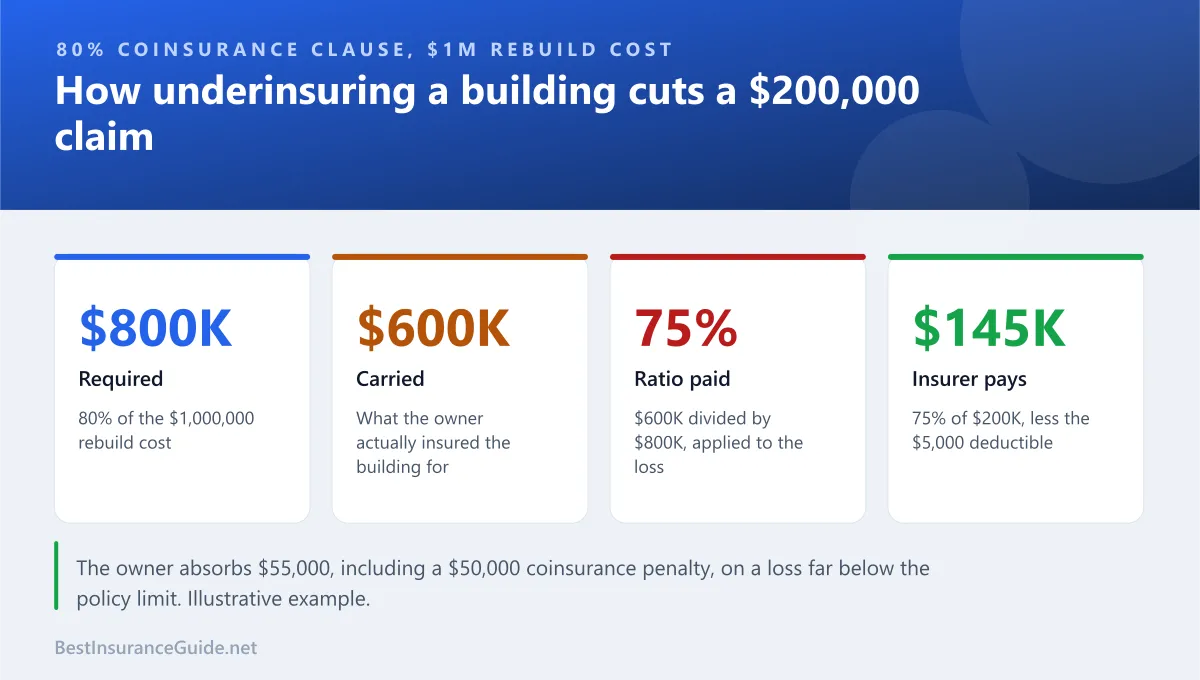
- Required: 80% × $1,000,000 = $800,000
- Ratio: $600,000 ÷ $800,000 = 0.75
- Payment: 0.75 × $200,000 − $5,000 = $145,000
The owner absorbs $55,000: the $5,000 deductible plus a $50,000 coinsurance penalty, even though the loss was well under the $600,000 limit. Had the building been insured for $800,000 or more, the payment would have been $195,000.
That is the trap. People assume that as long as a loss is below their limit, they will be paid in full. With a coinsurance clause, a partial loss is only paid in full if you carried enough insurance on the whole building.
Homeowners insurance has a version of this too
Standard homeowners policies do not usually call it a coinsurance clause, but most contain a similar 80% rule for dwelling claims. If your dwelling limit is at least 80% of the home’s full replacement cost at the time of the loss, partial losses are paid on a replacement cost basis. If it is less, the insurer can pay a reduced amount, often the actual cash value after depreciation. Our guide to what home insurance covers explains how that settlement works.
How to avoid a coinsurance penalty
- Insure to full replacement cost, not market value or purchase price. Rebuild cost is what the clause measures.
- Update the value after renovations and when construction costs rise. Many policies include an inflation guard that increases the limit automatically each year.
- Ask about agreed value. On commercial property policies, an agreed value option suspends the coinsurance clause for the policy period, in exchange for a signed statement of values.
- Get a professional valuation for commercial buildings or high-value homes, especially after several years of construction cost inflation.
The bottom line
In health insurance, coinsurance is the percentage you pay after the deductible. 0% means you pay nothing more after the deductible, 20% means you pay a fifth of each bill until you hit the out-of-pocket maximum, and 100% means either nothing or everything depending on whose share the document shows. Judge a plan on the combination of premium, deductible, coinsurance and out-of-pocket maximum, never on one number.
In property insurance, coinsurance is a minimum insurance requirement, and the penalty for ignoring it lands on partial losses you would otherwise expect to be paid in full. The protection is simple: insure the building for what it would cost to rebuild.
BestInsuranceGuide.net is an independent publisher and is not affiliated with any insurer. Worked examples are illustrative. The 2026 out-of-pocket maximum is the federal limit for ACA-compliant plans; check your own plan’s Summary of Benefits and Coverage for its actual figures.