Insurance Claim Denied? What to Do Now, as Senators Probe $0 Claim Payouts
Insurance claim denied? Why insurers close home and auto claims without payment, how to appeal step by step, and how to file a complaint.

Table of contents
Did your insurance company close your claim without paying a cent? You’re not alone, and Congress has noticed. In letters dated October 2, 2026, Senators Elizabeth Warren (D-Mass.) and Josh Hawley (R-Mo.) asked six of the country’s largest insurers to explain the growing share of home and auto claims that end with no payment.
The six insurers are:
- State Farm
- Allstate
- USAA
- Farmers
- Liberty Mutual
- American Family
The senators asked for data on unsuccessful claims, the factors behind them, and any major changes to claims-handling policies over the past decade. According to Insurance Journal and Bloomberg, which first reported the letters, they wrote that the growing share of zero-payment claims “raises questions about whether consumers can trust their insurance companies.”
Here’s what we know about the probe, why claims really get denied, and exactly what to do if yours was.
This site is independent and not affiliated with any insurer or government agency.
What the numbers show
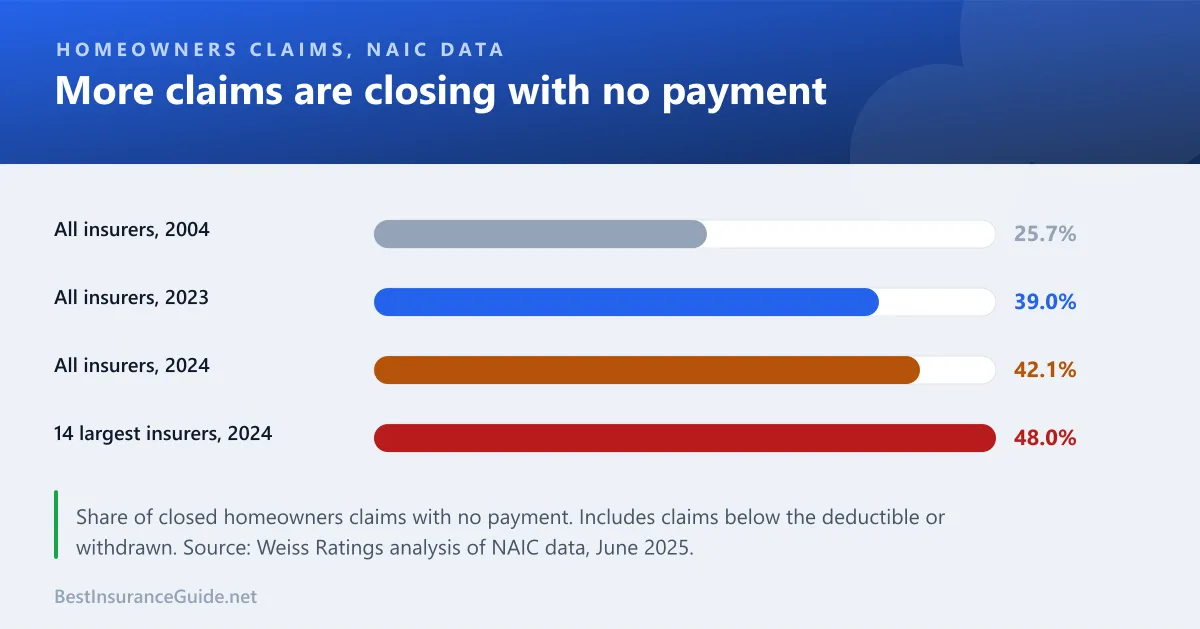
The probe follows an analysis by Weiss Ratings, based on data insurers report to the National Association of Insurance Commissioners (NAIC):
- 25.7% of homeowners claims were closed without payment in 2004.
- That rose to 39.0% in 2023 and 42.1% in 2024 across all reporting insurers.
- The 14 largest homeowners insurers averaged 48.0% in 2024. Rates ranged from 40.1% to 50.9% of claims.
The squeeze comes as costs climb. Insurance Journal, citing a Federal Reserve Bank of Dallas report, notes that homeowners premiums rose about 70% between 2019 and 2025. The senators questioned whether “increasingly aggressive claims-handling practices” are adding to insurers’ margins.
What insurers say
“Closed without payment” doesn’t always mean “wrongly denied.” State Farm told reporters that each claim is evaluated on “the facts and the coverage purchased.” It said claims can close without payment for several reasons, such as when the damage is below the customer’s deductible or the customer withdraws the claim. USAA said its focus is on handling claims “fairly, promptly.”
Both things can be true: many zero-payment claims are routine, and some are worth fighting. The steps below help you work out which kind you have.
Why insurance claims get denied
| Reason | What it means | Can you push back? |
|---|---|---|
| Below the deductible | Repair costs less than your deductible | Rarely. Check that the estimate includes all damage |
| Excluded peril | Flood, earthquake, wear and tear, mould or maintenance issues | Sometimes, if the cause is disputed |
| Policy lapsed | A missed premium payment ended coverage | Sometimes, if there was a grace period or notice problem |
| Late notice | You reported the loss too late under the policy | Sometimes, especially if the delay didn’t hurt the insurer |
| Insufficient documentation | Not enough proof of loss or value | Often. Send more evidence |
| Pre-existing or gradual damage | Insurer says damage happened over time | Often, with an independent inspection |
| Misrepresentation | Insurer claims the application was inaccurate | Get legal advice |
For homeowners, the biggest surprises are usually flood (not covered by a standard policy; see do I need flood insurance?), wear and tear, and separate wind or hail deductibles. Our guide to what home insurance covers explains the standard exclusions.
For drivers, claims are often denied when you only have liability coverage and are trying to repair your own car, when an excluded driver was behind the wheel, or when the car was used for delivery or rideshare work without the right endorsement.
What to do if your claim is denied: 7 steps
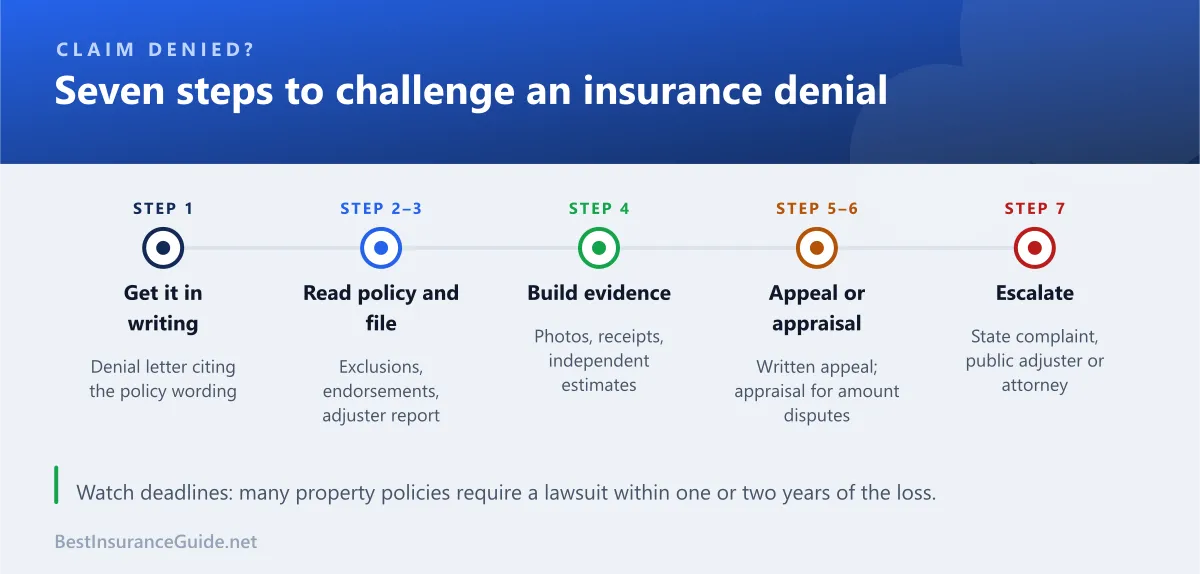
1. Get the denial in writing
If an adjuster tells you over the phone that the claim won’t be paid, ask for a written denial letter. It should cite the specific policy provisions the insurer is relying on. Most states’ unfair claims settlement laws require insurers to explain denials. Without the reason in writing, you can’t challenge it.
2. Read your policy, not the summary
Find the exact language cited in the denial. Check:
- The declarations page: your coverages, limits and deductibles
- The exclusions section: what’s carved out
- Endorsements: add-ons that may restore coverage, such as water backup
- Definitions: words like “sudden,” “accidental” and “collapse” often decide claims
3. Request your claim file
Ask for copies of the adjuster’s report, photos, engineer or contractor estimates, and any recorded statements. You need to see what evidence the insurer relied on before you can answer it.
4. Build your own evidence
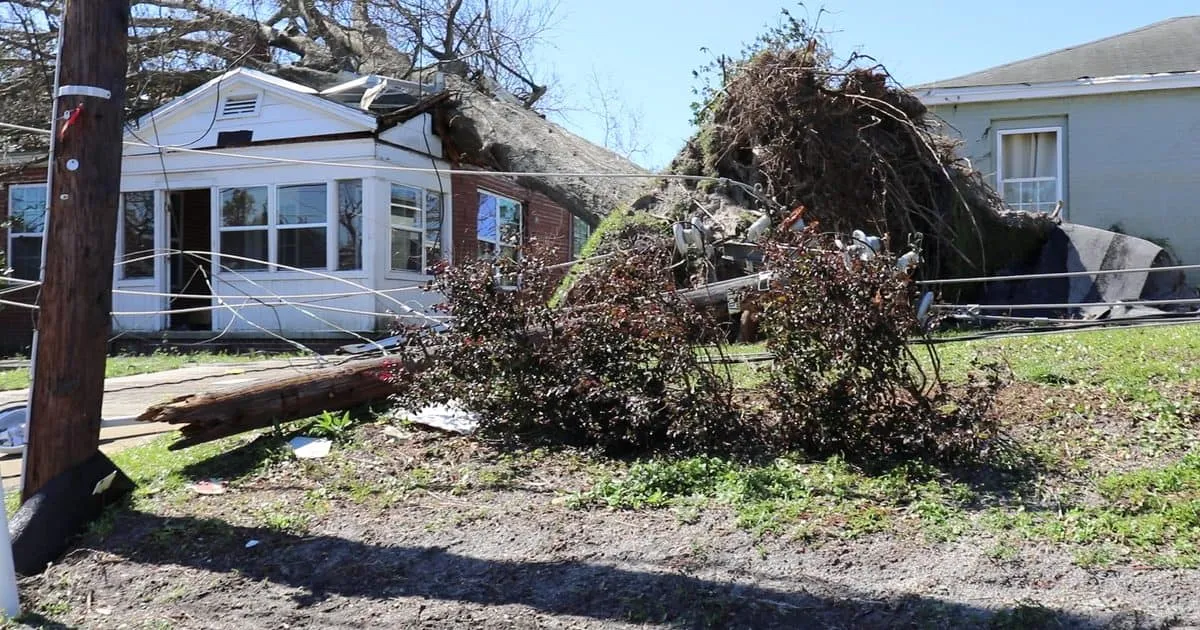
Photo: FEMA / John Ficara, public domain, via Wikimedia Commons.
- Photos and video of the damage, dated if possible
- Receipts for repairs, temporary housing and damaged items
- Independent estimates from licensed contractors
- Expert reports, such as a roofer, plumber or structural engineer, especially if the insurer blames wear and tear
- Weather records for storm claims, showing hail or wind on the date of loss
- A written timeline of every call, email and inspection
5. Appeal in writing
Write a clear, factual letter asking the insurer to reconsider. Quote the policy language that supports coverage, attach your new evidence, and ask for a written response by a specific date. Send it in a way you can track, and keep copies of everything.
6. Use the appraisal clause for disputes over money
If the insurer agrees the damage is covered but won’t pay enough, check for an appraisal clause, which most homeowners policies include. Each side hires an appraiser, the two pick an umpire, and an agreement by any two of the three generally settles the amount of the loss. Appraisal usually can’t decide whether something is covered, only how much it’s worth.
7. Escalate: complaint, public adjuster or attorney
- File a complaint with your state insurance department. It’s free, usually online, and the insurer must respond. Regulators track complaint patterns.
- Hire a public adjuster. A licensed public adjuster works for you, not the insurer. Fees are typically a percentage of the claim payout, often around 10% to 20%, and some states cap them.
- Talk to an insurance attorney if the claim is large, the insurer alleges fraud or misrepresentation, or you believe it acted in bad faith, for example by unreasonably delaying or refusing payment without investigating. Many work on contingency.
Watch the clock. Many property policies require any lawsuit to be filed within one or two years of the loss, and some state deadlines are shorter. Check your policy’s “suit against us” clause.
What to put in your appeal letter
You don’t need a lawyer to write a strong first appeal. Keep it short, factual and organised:
- Your details: name, policy number, claim number and date of loss.
- What happened: two or three sentences describing the loss.
- The denial: the date of the denial letter and the reason the insurer gave.
- Why you disagree: quote the policy language that supports coverage, and explain how your evidence answers the insurer’s reason. For example, a roofer’s report showing hail damage rather than wear and tear.
- What you’re attaching: list each document, photo and estimate.
- What you want: reconsideration and payment of a specific amount, with a written response by a reasonable date, such as 30 days.
Stay polite and stick to facts. Your letter may later be read by a regulator, an appraiser or a judge.
Auto claim denied? Check which insurer you’re dealing with
Car insurance disputes depend on whose policy you’re claiming against:
- Your own policy (first-party claim). Collision and comprehensive claims follow your policy’s terms and deductibles, and the steps above apply. Hit an animal? See our guide to comprehensive deductibles.
- The other driver’s policy (third-party claim). Their insurer may deny liability and blame you. You can claim through your own collision coverage instead and let your insurer pursue the other company. This is called subrogation, and you may get your deductible back if it succeeds.
- The other driver has no insurance. Uninsured motorist coverage, if you have it, may pay for injuries and, in some states, vehicle damage.
If fault is disputed, a police report, witness statements and dashcam footage carry a lot of weight. Request the report as soon as it’s available.
Denied health insurance claim? The rules are different
Health plans follow separate federal appeal rules. For most plans covered by the Affordable Care Act:
- Internal appeal: you generally have 180 days from the denial notice to ask your insurer to reconsider.
- External review: if the insurer upholds the denial, you can ask an independent reviewer to decide, generally within four months of the final denial. The insurer must follow the external reviewer’s decision.
- Urgent care: expedited appeals are available when waiting could seriously harm your health.
Coding errors, missing prior authorisation and out-of-network billing cause many health denials, so call your doctor’s billing office first. A corrected claim can resolve it without an appeal. See health insurance terms explained for the vocabulary.
How to avoid a $0 claim in the first place
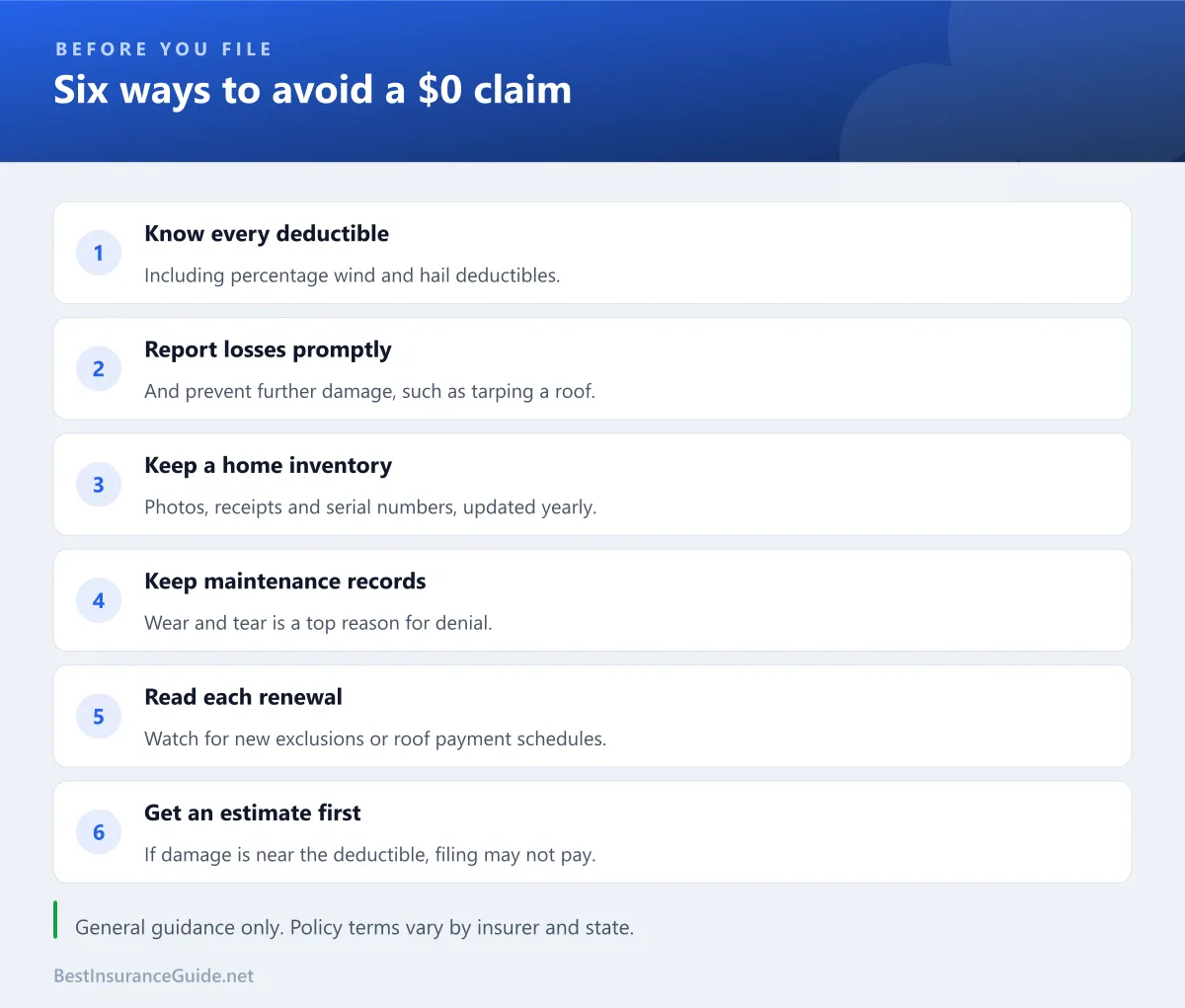
- Know your deductibles, including percentage wind or hail deductibles. If the damage is close to the deductible, get a contractor estimate before you file. Our homeowners insurance deductible guide explains the trade-offs.
- Report losses promptly and take steps to prevent further damage, such as tarping a roof or shutting off water.
- Keep a home inventory with photos and receipts, updated each year.
- Maintain your home and keep records. Gradual damage and neglect are among the most common exclusions.
- Review your policy at every renewal for new exclusions, roof schedules or lower limits.
- Consider whether to file at all. Small claims can raise your premium. See can you cancel an insurance claim?
What happens next with the Senate probe
The letters are a request for information, not a lawsuit or regulatory action. Insurers aren’t legally required to change anything because of them. What to watch:
- Insurer responses. Whether the six companies provide claim data, and whether it is made public.
- Possible hearings or legislation on claims transparency. Warren and Hawley have worked together on consumer issues before.
- State regulators, who oversee claims handling and could expand market-conduct reviews.
We’ll update this article as the insurers respond.
Related reading
Thinking of withdrawing a claim instead of fighting it? Read can you cancel an insurance claim? first, because a withdrawn claim can still appear on your record.
Sources and notes
- Insurance Journal, “Warren, Hawley Press Insurers Over Closed, Unpaid Claims,” October 6, 2026; Bloomberg, October 5, 2026: letters dated October 2, 2026 to six insurers; insurer statements; Federal Reserve Bank of Dallas premium figure.
- Weiss Ratings, “14 Large U.S. Insurers Closed Nearly Half of Homeowner Claims with No Payment in 2024,” June 11, 2025, based on NAIC data.
- U.S. Department of Health and Human Services / HealthCare.gov: internal appeal and external review rules for ACA-covered plans.
- Featured photo: FEMA / Susie Shapira, public domain, via Wikimedia Commons.
This article is general information, not legal advice. Claims rules and deadlines vary by state and policy. For a significant claim dispute, consult a licensed attorney or public adjuster in your state.