Dental Insurance With No Waiting Period: What Is Real and What Is Marketing
Dental insurance with no waiting period: employer plans, prior-coverage waivers, immediate-coverage plans and discount plans, with the trade-offs.

Table of contents

Almost nobody shops for dental insurance on a quiet day. People usually start looking because a tooth hurts, a crown has cracked, or a dentist has just handed them a treatment plan. That is exactly when waiting periods bite: a new individual plan often pays nothing toward fillings for months and nothing toward crowns for up to a year.
Dental insurance with no waiting period does exist. But “no waiting period” means different things on different plans, and the plans that cover major work immediately usually pay for that somewhere else. This guide explains the real options and how to judge them.
Why waiting periods exist
Insurers use waiting periods to prevent people from buying a policy, getting expensive work done, and cancelling. Without them, dental insurance would mostly be bought by people who already knew they needed a crown, and premiums would rise for everyone.
That logic explains where waiting periods are found and where they are not. They are common on individual plans, where each buyer chooses whether and when to join, and rare on large employer group plans, where everyone joins on the same terms regardless of their teeth.
Typical waiting periods
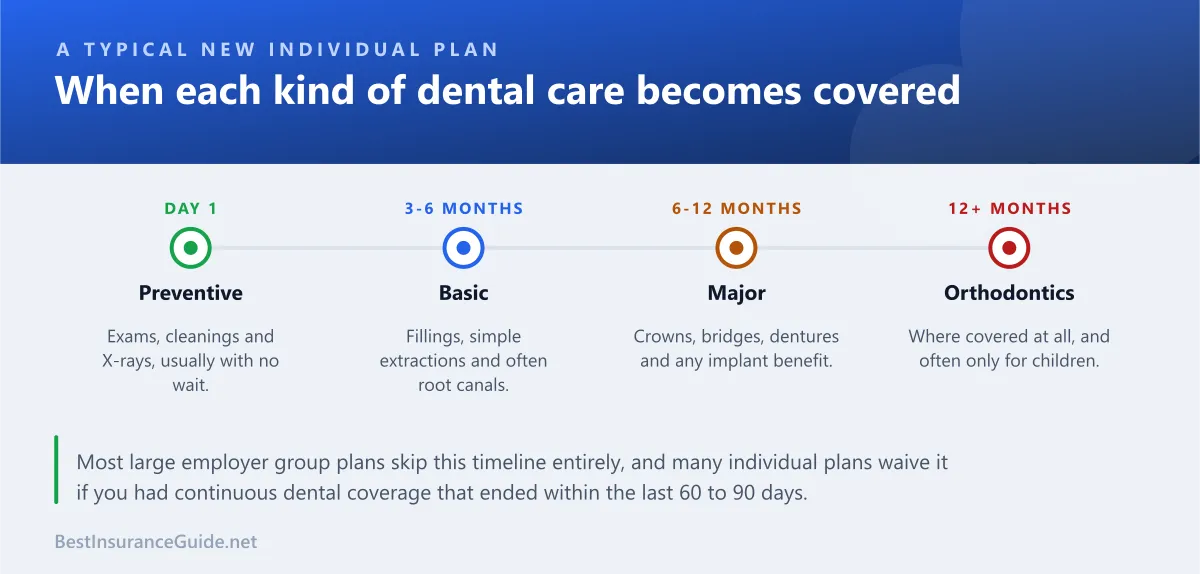
On individual plans, typical waiting periods look something like this:
Preventive care — exams, cleanings, X-rays: usually none.
Basic services — fillings, simple extractions, often root canals: commonly three to six months.
Major services — crowns, bridges, dentures, implants: commonly six to twelve months, sometimes longer.
Orthodontics: commonly twelve months or more, where covered at all.
The four legitimate ways to avoid waiting periods
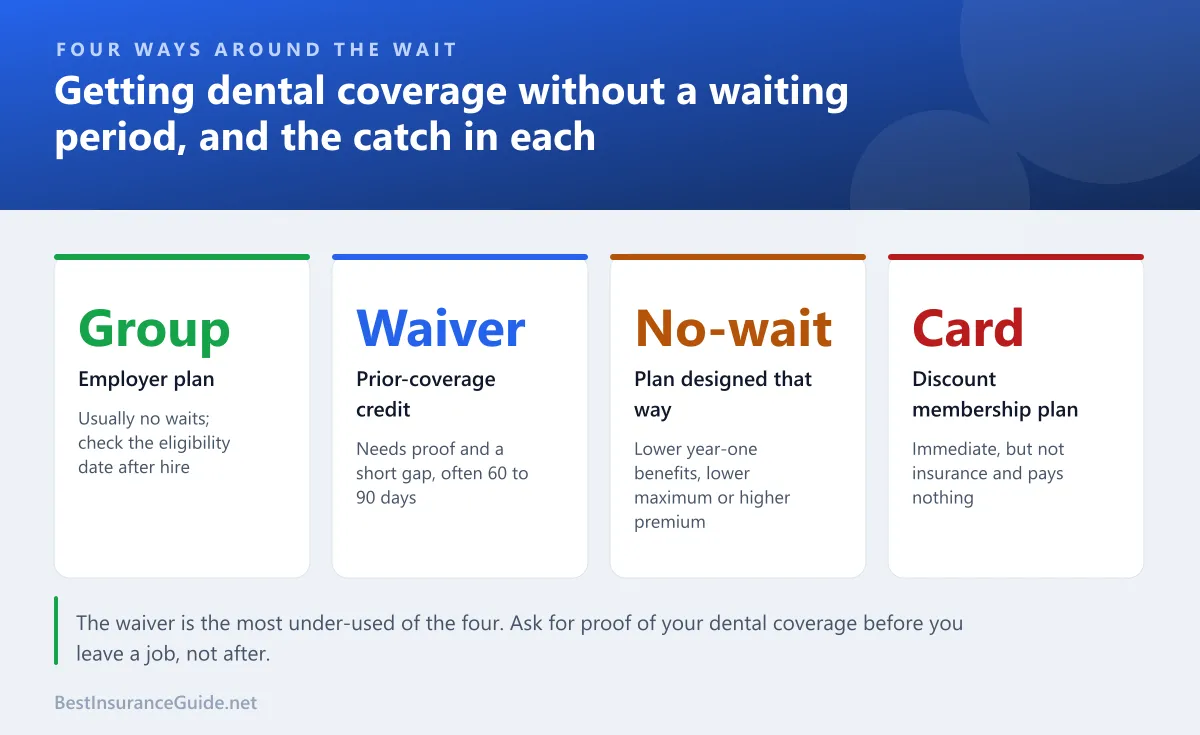
1. An employer group plan
Most large employer dental plans have no waiting periods, which makes them the single best source of immediate coverage. If you or your spouse has access to one, check it first. If you are joining outside the normal enrolment period, check whether a qualifying life event, such as a marriage or new job, opens a special enrolment window.
2. A waiver for prior coverage
Many individual plans waive some or all waiting periods if you had continuous dental coverage that ended recently. Typical conditions include coverage that ended within the last 60 to 90 days and that lasted at least twelve months, though every insurer sets its own rules.
This is the most under-used option. If you are leaving a job, getting a certificate or letter confirming your previous dental coverage and its dates can save you months of waiting on your next plan.
3. A plan with no waiting period by design
Some individual plans advertise no waiting periods, including for major services. They are genuine insurance and can be the right answer. They usually compensate in one or more ways:
Lower coinsurance in the first year — for example, major services at 10% or 20% in year one, rising to 50% later.
A lower annual maximum, or a maximum that increases with time on the plan.
A higher premium.
Exclusions such as the missing tooth clause, which excludes replacing a tooth lost before coverage began.
The headline “no waiting period” is true. Whether the plan is good value depends on these other terms.
4. A dental discount plan
A discount plan has no waiting period because it is not insurance. You pay a membership fee and receive reduced fees at participating dentists; the plan pays nothing toward the bill. It can be the fastest route to lower costs, but it is not coverage.
A worked example: a crown needed next month
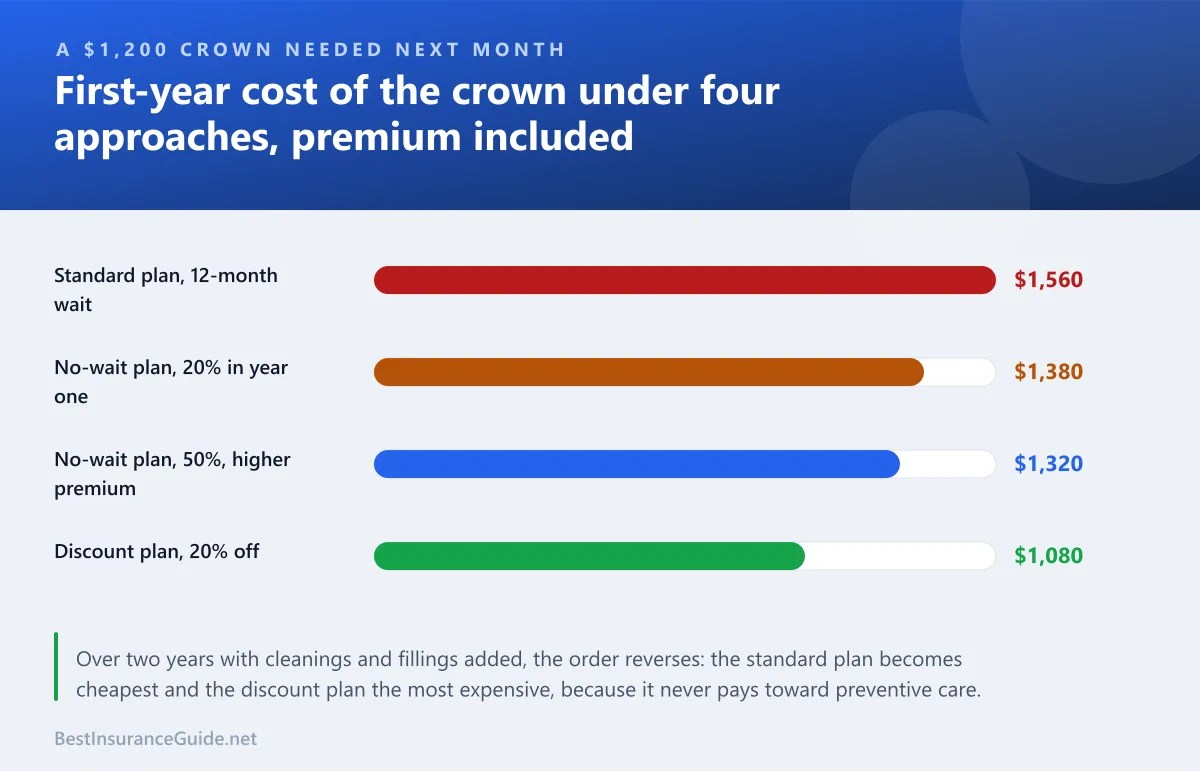
A person with no current coverage needs a crown within the next month. Assume a fee of $1,200, and compare four choices over the first year, ignoring deductibles for simplicity.
| Detail | Standard plan, 12-month wait on major | No-wait plan, 20% major in year one | No-wait plan, 50% major, higher premium | Discount plan, 20% off |
|---|---|---|---|---|
| First-year premium | $360 | $420 | $720 | $120 |
| Plan pays toward crown now | $0 | $240 | $600 | $0 |
| You pay the dentist | $1,200 | $960 | $600 | $960 |
| First-year total cost | $1,560 | $1,380 | $1,320 | $1,080 |
In this example the discount plan is cheapest for this crown alone, and the standard plan is the most expensive, because it pays nothing for the crown while you pay the premium. The richer no-wait plan beats the cheaper one, because its higher benefit outweighs its higher premium.
The picture changes over a longer horizon. If you expect more work next year, an insurance plan starts to earn its premium, whereas a discount plan never pays anything. The right answer depends on your next two years of dental care, not just the next month.
Reading “no waiting period” marketing carefully
“No waiting period on preventive care” is standard and is not a distinguishing feature.
“Immediate coverage” may mean coverage begins immediately, while benefits for basic and major services are still reduced or delayed. Read the benefit schedule by year.
“Coverage starts tomorrow” refers to the effective date, not to the waiting periods.
“Save up to 60%” is typical discount-plan language. If a product describes savings rather than coverage, check whether it is insurance at all.
Questions to ask before buying
What are the waiting periods for basic, major and orthodontic services?
Are they waived for prior coverage, and what proof is needed?
What coinsurance applies to the treatment I need in year one, and in later years?
What is the annual maximum in year one?
Is there a missing tooth clause?
Is this insurance or a discount plan?
If I cancel and rejoin later, do the waiting periods start again? On most individual plans they do, which is a reason to think twice before dropping coverage in a quiet year to save a few months of premium.
Does the plan have a minimum enrolment period? Some individual plans require you to keep coverage for twelve months, or charge a fee for cancelling early, which matters if you are buying for one treatment.
Timing tips if you can wait a little
Get the preventive visit done first. Preventive care is usually covered immediately, and an exam gives you an accurate picture of what you need before choosing a plan.
Ask your dentist which treatments can safely wait. Some work genuinely cannot wait; some can. A dentist can often stage a treatment plan so the urgent parts are done now and the rest after a waiting period ends.
Never delay treatment for a spreading infection to fit a waiting period. Facial swelling, fever or difficulty swallowing are medical emergencies.
Looking two years ahead
The one-crown comparison above rewards the discount plan, because it looks only at the immediate need. Most people need more than one thing over two years. Extend the example: the same person needs the crown now, two fillings in the second year, and routine cleanings throughout. Use a filling fee of $200 each and cleanings and exams of $400 a year.
| Detail | Standard plan, 12-month wait on major | No-wait plan, 50% major, higher premium | Discount plan, 20% off |
|---|---|---|---|
| Two years of premiums | $720 | $1,440 | $240 |
| Crown now: you pay | $1,200 | $600 | $960 |
| Two fillings in year two: you pay | $80 | $80 | $320 |
| Two years of cleanings: you pay | $0 | $0 | $640 |
| Two-year total | $2,000 | $2,120 | $2,160 |
Over two years the standard plan, which looked worst for the crown alone, becomes the cheapest, because preventive care and fillings are covered and the premium is low. The discount plan, cheapest at first, becomes the most expensive, because it never pays anything toward cleanings. The difference between the three is small, which is itself a useful conclusion: the choice depends on the details of your own treatment, not on the headline.
How a prior-coverage waiver works in practice
If you are moving from one dental plan to another, a waiver can be worth hundreds of dollars. The process is usually simple, but it has to be done at the right time.
Before your old coverage ends, ask your employer or insurer for a letter or certificate confirming the dates of your dental coverage and the type of plan.
Compare new plans that offer waivers, and check the conditions: how recently the old coverage must have ended, how long it must have lasted, and which service tiers the waiver applies to.
Apply within the gap allowed. Many insurers require the new plan to begin within 60 to 90 days of the old one ending. Let the gap run longer and the waiver is lost.
Submit the proof with the application, or as soon as the insurer asks for it. Waivers are rarely applied automatically.
Confirm in writing that the waiver has been applied, before booking treatment.
This is the single most effective way to avoid waiting periods on an individual plan, and it costs nothing.
Changing jobs without restarting the clock
A job change is the most common way people end up facing a waiting period they did not need to face. Three options keep coverage continuous.
Start the new employer plan promptly. Most employer plans have no waiting periods, but many have an eligibility period before coverage begins — often the first of the month after hire, sometimes longer. Check the date and plan any treatment around it.
Use COBRA for the gap. COBRA lets you keep your old employer’s dental plan, generally by paying the full premium, and dental can usually be continued on its own. Keeping it for a month or two to bridge a gap can be cheaper than paying for treatment outright. See how long COBRA coverage lasts.
Ask for the certificate of coverage before you leave. If you will buy an individual plan instead, proof of your employer coverage is what qualifies you for a waiver.
Specific situations
A root canal needed now. Root canals are often classified as basic services, so the wait may be shorter than for a crown — but the crown that often follows is major. See dental insurance for a root canal.
An implant. Implants are major services and are frequently excluded. Implant treatment often spans months, which can absorb a waiting period. See dental insurance for implants.
Children. Many family plans cover children’s preventive care immediately, and Medicaid and CHIP have no waiting periods. See dental insurance for kids.
Seniors. Medicare Advantage dental benefits generally apply from the plan’s start date, though with annual maximums. See dental insurance for seniors on Medicare.
The short version
Dental insurance with no waiting period exists in four forms: employer group plans, prior-coverage waivers, individual plans designed without waiting periods, and discount plans, which are not insurance.
Plans that cover major work immediately usually pay for it through lower first-year coinsurance, lower annual maximums, higher premiums or exclusions. The best one for you is the plan that pays more toward the treatment you need, within the time you have, than it costs you in premium.
For state-specific options, see our guides to dental insurance in Florida, Texas and Illinois.
A note on scope
This guide is general information rather than advice about any specific plan. Waiting periods, waivers, coinsurance schedules and annual maximums vary by plan and are set out in your plan documents, which override any general description. Your state insurance department regulates dental insurers and discount plans. This site is independent and not affiliated with any insurer.