Secondary Dental Insurance: Is a Second Plan Worth Paying For?
Secondary dental insurance: coordination of benefits, the birthday rule, non-duplication clauses, two annual maximums and when it is worth it.

Table of contents

Two dental plans sounds like it should mean free dentistry. It rarely does. Secondary dental insurance can be genuinely valuable, especially in a year with expensive work, but the way two plans coordinate means the second plan often pays far less than people expect — and in a quiet year it may pay nothing worth its premium.
This guide explains how secondary dental coverage works, which plan pays first, the three coordination rules you will meet, and a simple way to decide whether a second plan is worth having.
How secondary dental insurance works
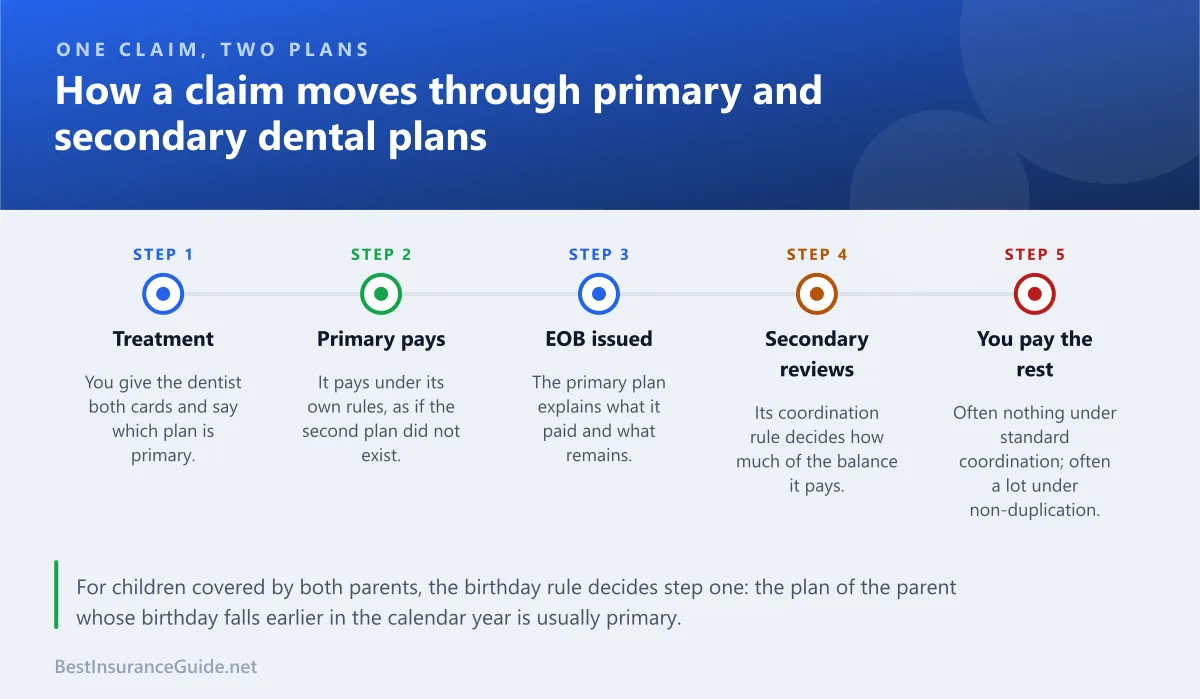
When you have two dental plans, one is primary and one is secondary. The dentist bills the primary plan first. The primary plan pays according to its own rules, exactly as if the second plan did not exist. The dentist then sends the bill, together with the primary plan’s explanation of benefits, to the secondary plan.
The secondary plan then decides what, if anything, to pay toward the remaining balance. That decision is governed by its coordination of benefits provision, and this is where the differences between plans become important.
Most US states base their coordination rules on a model regulation published by the National Association of Insurance Commissioners, which is why the order-of-payment rules below are broadly consistent across insurers.
Which plan is primary
The rules are simple for most households.
Your own plan is primary for you. If you have coverage through your employer and are also covered as a dependant on your spouse’s plan, your employer plan pays first.
For children covered by both parents, the birthday rule usually applies. The plan of the parent whose birthday falls earlier in the calendar year — month and day, not year of birth — is primary. If both parents share a birthday, the plan that has covered the parent longer is usually primary.
For children of separated or divorced parents, a court order that makes one parent responsible for health or dental coverage generally decides the order. Without one, plans usually look to the custodial parent’s plan first.
Active employment beats retiree and COBRA coverage. A plan covering you as an active employee generally pays before one covering you as a retiree or under continuation coverage.
The three coordination methods
This is the part that decides whether dual coverage pays off, and it is almost never explained at the point of sale.
Standard coordination
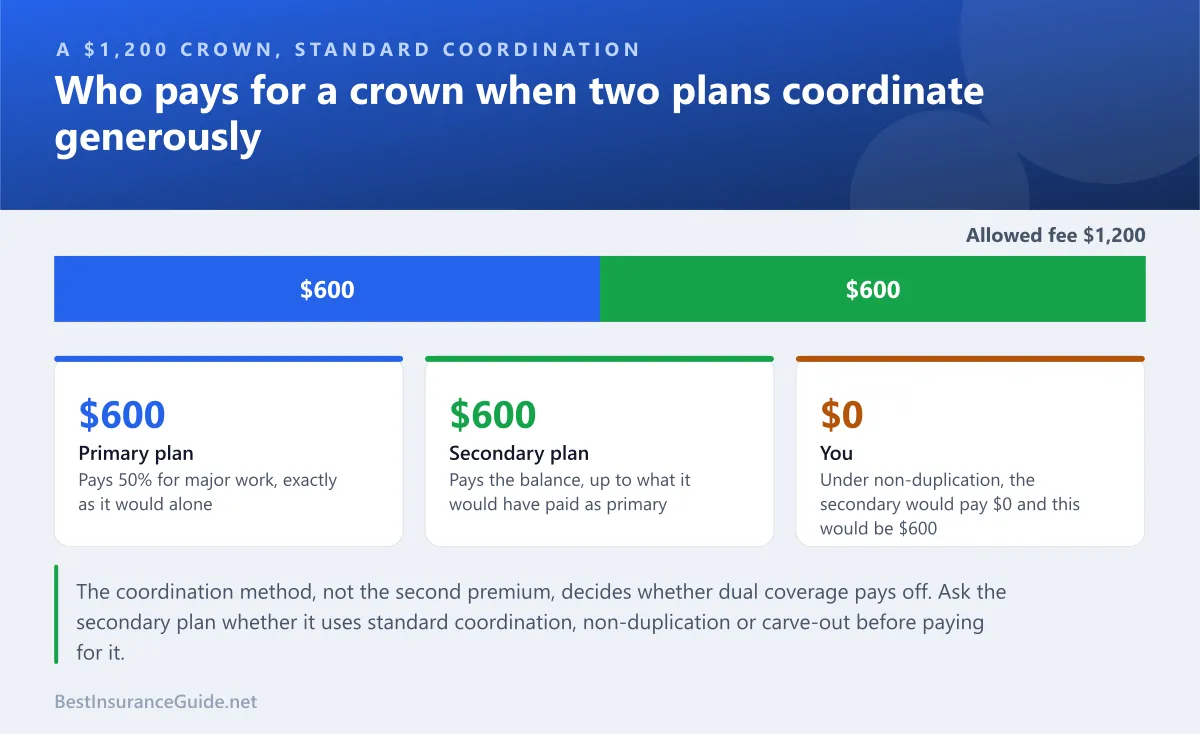
The secondary plan pays up to what it would have paid as primary, but no more than the remaining balance. In many cases this results in little or nothing left for you to pay. It is the most generous method and the one people assume they have.
Non-duplication
The secondary plan works out what it would have paid as primary and subtracts what the primary plan already paid. If the primary plan paid as much as or more than the secondary plan would have, the secondary pays nothing.
Where both plans have the same coinsurance for the procedure — both pay 80% for a filling, say — a non-duplication secondary plan will usually pay nothing at all. This is the single most common reason people are disappointed by dual coverage.
Carve-out
Similar in effect to non-duplication: the secondary plan calculates its normal benefit and carves out what the primary plan paid. The terminology differs between insurers, but the practical result is close to non-duplication.
A worked example
Take a filling with an allowed fee of $200, and a crown with an allowed fee of $1,200. Both plans pay 80% for basic work and 50% for major work, and deductibles are ignored to keep the arithmetic clean.
| Detail | Primary pays | Secondary pays: standard | Secondary pays: non-duplication | You pay: standard | You pay: non-duplication |
|---|---|---|---|---|---|
| Filling, $200 | $160 | $40 | $0 | $0 | $40 |
| Crown, $1,200 | $600 | $600 | $0 | $0 | $600 |
With standard coordination the second plan eliminates the out-of-pocket cost completely. With non-duplication it contributes nothing, because the primary plan already paid what the secondary plan would have paid.
Now change one variable. Suppose the secondary plan pays 80% for crowns while the primary pays 50%. Under non-duplication the secondary plan would pay $960 minus $600, which is $360, and you would pay $240. The rule matters, but so does the gap between the two plans’ coinsurance.
Where a second plan earns its keep
Dual coverage is most valuable in four situations.
A heavy treatment year. Each plan has its own annual maximum. If your primary plan caps at $1,500 and you need three crowns, the secondary plan’s maximum picks up where the first leaves off. This is the clearest financial case for two plans, regardless of coordination method.
Different coinsurance levels. If the secondary plan pays a higher percentage for the treatment you need, even non-duplication leaves a meaningful contribution.
Orthodontics. Orthodontic benefits usually have a lifetime maximum rather than an annual one. Two plans with separate lifetime orthodontic maximums can meaningfully reduce the cost of braces for a child.
A spouse’s employer pays most of the premium. If adding you as a dependant costs little, even a modest secondary contribution may be worth it.
Where it usually does not
A preventive-only year. Most plans already cover cleanings and exams at or near 100%. A secondary plan adds nothing, and some limit cleanings to two a year across both plans combined.
A non-duplication secondary with the same coinsurance as the primary. As the table shows, it often pays zero.
A newly bought individual plan used as secondary. It will usually carry its own waiting periods, so it may not contribute to major work for six to twelve months.
Frequency limits. Plans limit how often certain services are covered — two cleanings a year, one set of bitewing X-rays, a crown on the same tooth once every five years. A second plan does not generally reset those limits.
A quick test before paying for a second plan
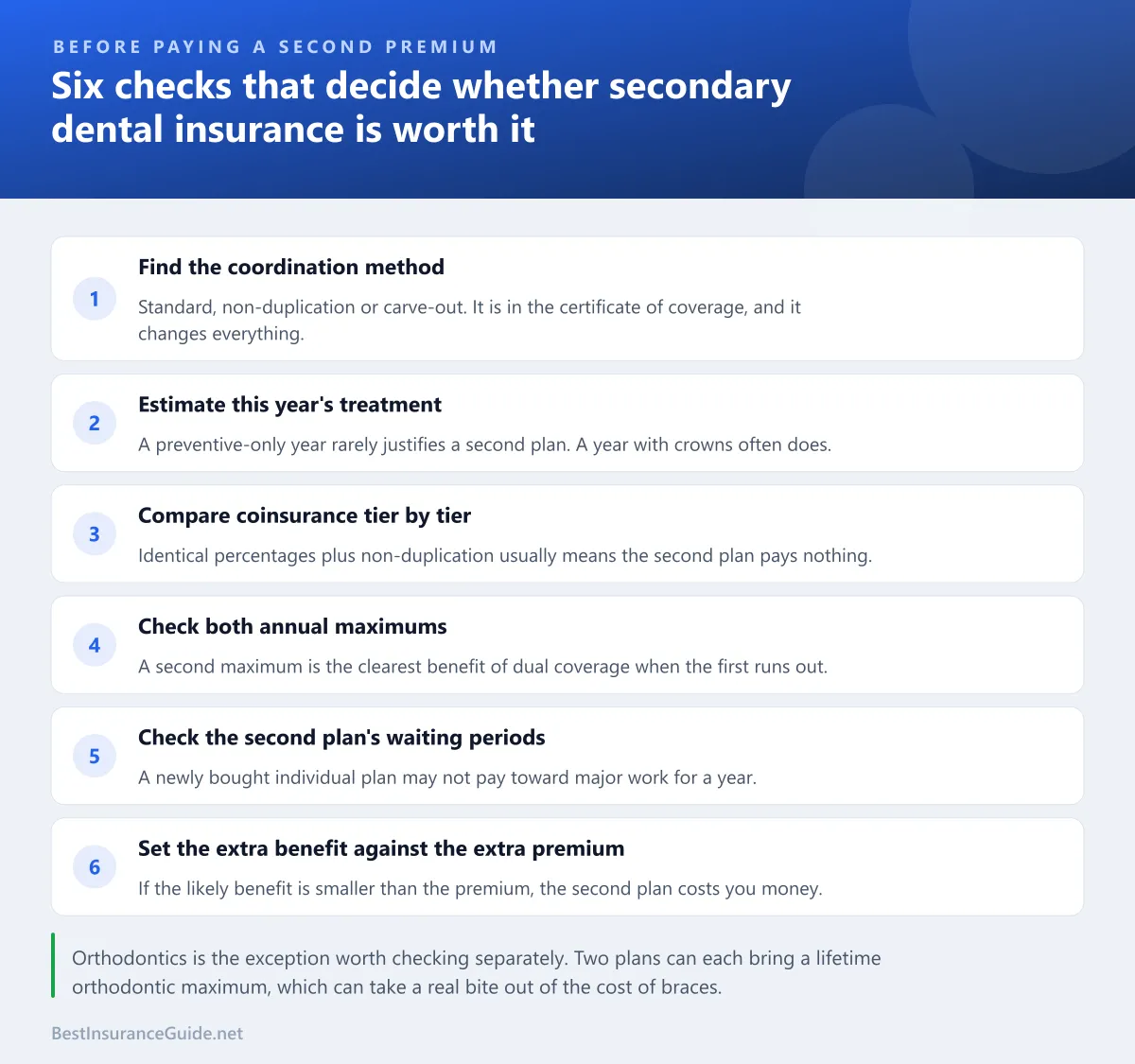
1. Find out the coordination method. Ask the secondary plan, or read the certificate of coverage, for the words “standard”, “non-duplication” or “carve-out”.
2. Estimate the treatment you expect this year. Check-ups only, some fillings, or major work.
3. Compare coinsurance by tier on both plans. Same percentages plus non-duplication is a warning sign.
4. Check both annual maximums. A second maximum matters most if you expect to exceed the first.
5. Check waiting periods on the second plan, especially for major work.
6. Add up the second plan’s annual premium and compare it with the likely extra benefit. If the benefit is less than the premium, the second plan is costing you money.
Billing both plans without headaches
Give your dentist both cards and tell them which plan is primary. Most offices handle coordination routinely.
Keep both explanations of benefits. If the secondary plan asks for information, the primary plan’s EOB is usually what it wants.
Update both plans when anything changes. Many plans send a coordination of benefits questionnaire each year; not returning it can put claims on hold.
Ask for a pre-treatment estimate from both plans before major work. The dentist can submit the treatment plan to the primary and then to the secondary to confirm the combined position before you commit.
Worked example: a couple with two employer plans
Take a married couple who both work and both have employer dental plans, and who are deciding whether to cover each other as dependants. Each plan has a $1,500 annual maximum and pays 100/80/50. Adding the spouse costs $300 a year on each plan. The first spouse expects three crowns this year at $1,200 each.
| Detail | Only own plan | Own plan plus spouse’s plan (standard coordination) | Own plan plus spouse’s plan (non-duplication) |
|---|---|---|---|
| Crown fees | $3,600 | $3,600 | $3,600 |
| Primary plan pays (50%, capped at $1,500) | $1,500 | $1,500 | $1,500 |
| Secondary plan pays | $0 | $1,500 (up to its own maximum) | $300 |
| Extra premium | $0 | $300 | $300 |
| Out-of-pocket plus extra premium | $2,100 | $900 | $2,100 |
Under standard coordination, the second plan saves $1,200 after its premium, because it pays up to its own $1,500 maximum. Under non-duplication, it pays only the difference between its normal benefit for three crowns, $1,800, and the $1,500 the primary plan paid — $300 — which exactly offsets the premium.
The example shows that a second annual maximum is valuable when the primary plan runs out, but only as valuable as the coordination method allows.
The yearly coordination of benefits questionnaire
Many dental plans send members a short coordination of benefits questionnaire, often once a year, asking whether anyone in the family has other dental coverage. It looks like junk mail. It is not.
If the questionnaire is not returned, some plans suspend claim payments until it is, which can leave a treatment unpaid for weeks. Return it promptly, and update both plans when anything changes — a new job, a divorce, a child ageing off a plan, or a spouse retiring.
Paying the balance after both plans
Whatever is left after two plans have paid can often be paid from a health savings account or a flexible spending account with pre-tax money, which effectively reduces the balance by your tax rate. Combined with a second plan’s annual maximum, that can make a heavy treatment year much more manageable.
Secondary dental insurance and Medicare
Original Medicare generally does not cover routine dental care, so it does not act as a primary dental plan for cleanings, fillings or crowns. For retirees, the real choice is usually between a Medicare Advantage plan with a dental benefit, a stand-alone dental plan, or both. We cover this in detail in our guide to dental insurance for seniors on Medicare.
Secondary coverage for children
Children are the most common reason families carry two dental plans, because both parents often have employer coverage. The birthday rule decides which plan is primary, and it is worth knowing in advance which plan that is so the dentist bills correctly the first time. For the wider picture of children’s coverage, including the Affordable Care Act’s pediatric dental benefit and CHIP, see our guide to dental insurance for kids.
The short version
Secondary dental insurance pays after your primary plan, using its own coordination rules. With standard coordination it can eliminate most of your out-of-pocket cost. With non-duplication or carve-out, it often pays nothing when both plans have the same coinsurance.
The strongest case for two plans is a year with expensive work, because each plan brings its own annual maximum. The weakest case is a preventive-only year or a newly purchased plan still inside its waiting periods.
Before paying for a second plan, find out its coordination method, compare coinsurance by tier, check both annual maximums, and set the extra benefit against the extra premium. For the terminology, see health insurance terms and deductible versus out-of-pocket maximum.
A note on scope
This guide is general information rather than advice about any specific plan. Coordination rules, coinsurance, annual maximums and waiting periods are set by each plan within the framework of state insurance law, and the details in your certificate of coverage override any general description. Your plan administrator and your state insurance department are the authoritative sources. This site is independent and not affiliated with any insurer.