Dental Insurance in Illinois: Plans, Programs and What They Cover
Dental insurance in Illinois: PPO vs HMO plans, Get Covered Illinois, Medicaid adult dental, All Kids, school dental exams and a buyer checklist.

Table of contents

Illinois dental coverage has changed more in the last few years than in most states. The state now runs its own insurance marketplace, adult Medicaid includes a real dental benefit, and school dental exam rules mean families with children run into dental costs on a fixed timetable. Add the gap between the Chicago area and downstate networks, and choosing a plan here deserves a bit more thought than simply picking the lowest premium.
This guide covers where Illinois residents get dental coverage, what each source includes, and how to choose a plan that pays for the care you expect.
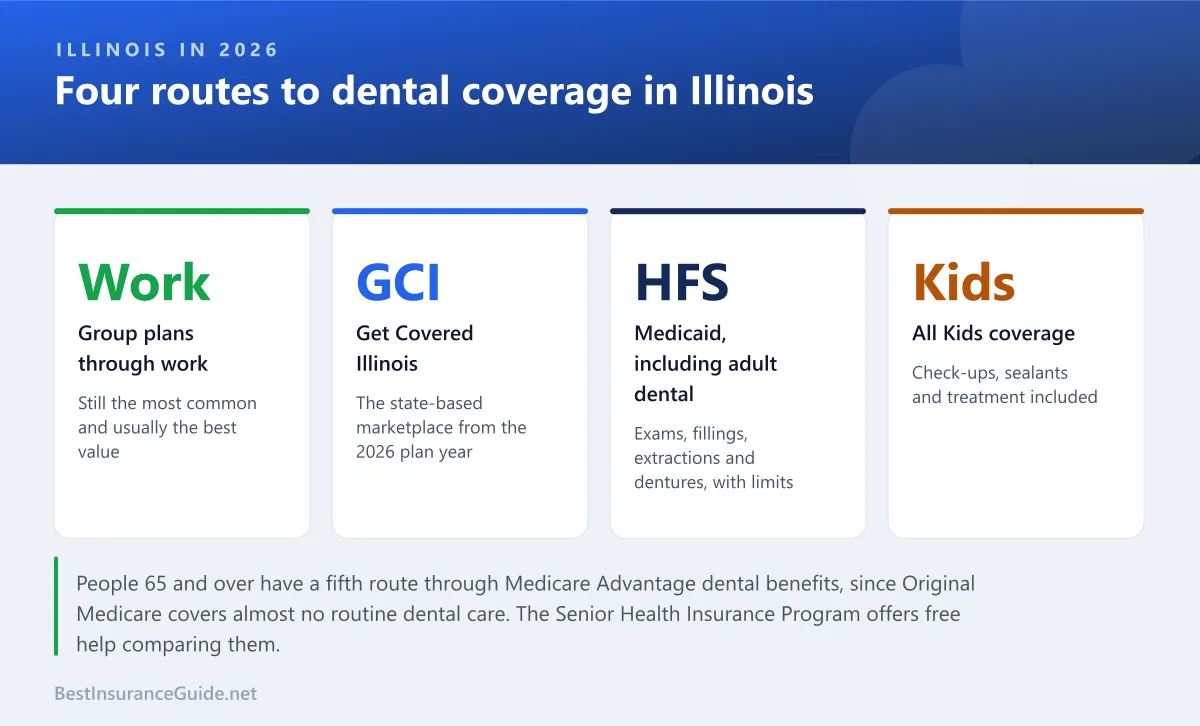
Where Illinois residents get dental coverage
Employer plans remain the most common source, and usually the best value because employers subsidise premiums and group plans often waive waiting periods.
Individual plans bought directly from an insurer or through a broker, for the self-employed, early retirees and anyone without workplace coverage.
Get Covered Illinois, the state’s own marketplace. Illinois moved from HealthCare.gov to a state-based marketplace for coverage starting in 2026, and stand-alone dental plans are available there during open enrolment. Pediatric dental is an essential health benefit for children under 19; adult dental is optional.
Medicare Advantage plans that include dental, for people 65 and over. Original Medicare covers almost no routine dental care; see dental insurance for seniors on Medicare.
Illinois Medicaid and All Kids, administered by the Department of Healthcare and Family Services.
Chicago versus downstate
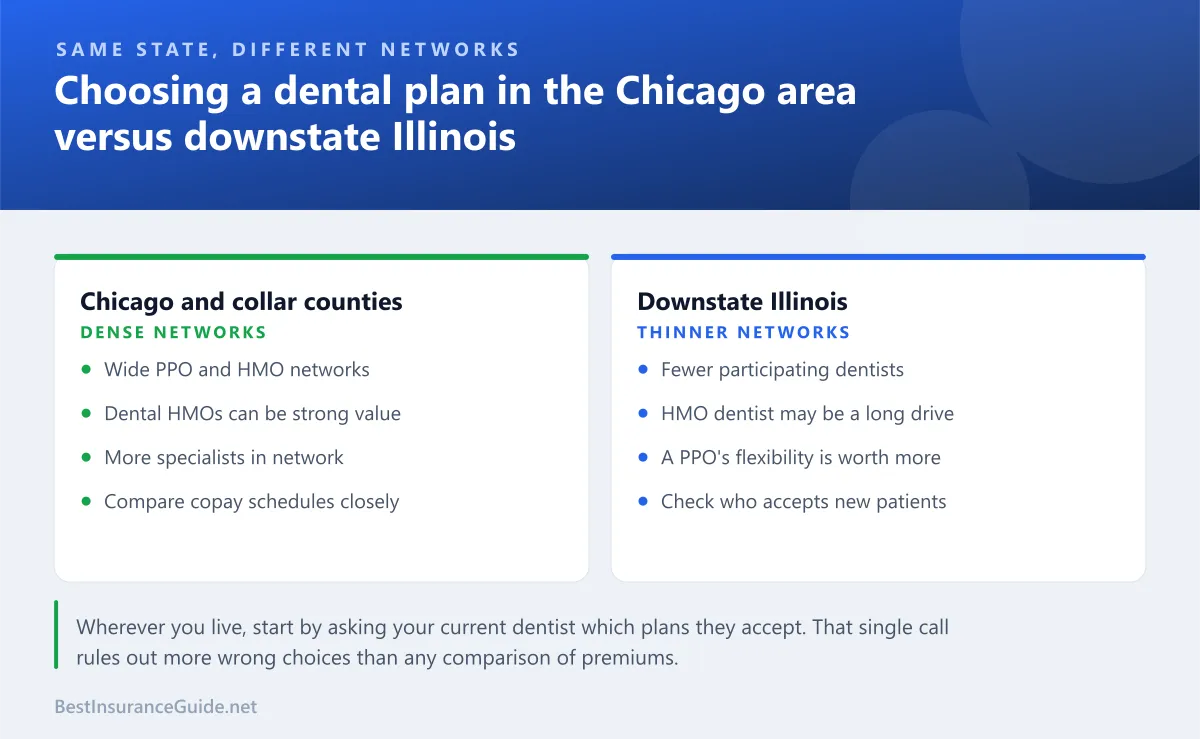
Network depth varies across the state. The Chicago metropolitan area, including the collar counties, has dense dental networks for both PPO and HMO plans. Downstate — the Metro East, Peoria, Springfield, Champaign-Urbana and rural southern Illinois — tends to have thinner networks, particularly for dental HMOs.
The practical consequence is the same as in any large state: a dental HMO can be excellent value in Chicago and inconvenient in a rural county. A PPO’s ability to pay something toward any licensed dentist is worth more where networks are sparse.
The plan types
Dental PPO
The most common individual plan. You can see any dentist but pay less in network. Most follow a pattern of preventive care at or near 100%, basic care at around 80% and major care at around 50%, with a deductible, an annual maximum, and waiting periods on individual plans.
Dental HMO
You choose a primary dentist from the network and pay fixed copays per procedure, generally with no deductible and no annual maximum. Out-of-network care is generally not covered.
Indemnity
Freedom to see any dentist, reimbursed at a percentage of an allowance. Less common and usually more expensive.
Illinois Medicaid dental
Illinois is one of the states that provides a genuine adult dental benefit under Medicaid. Covered services for adults include exams, cleanings, fillings, extractions and dentures, with limits on frequency and some services requiring prior approval. The benefit has been expanded in recent years, and details can change, so the member handbook of your Medicaid plan is the authoritative source.
Children and young people under 21 receive comprehensive dental care under the federal EPSDT requirement, which applies in every state.
Finding a participating dentist can still be the harder part. Ask your plan directly for dentists currently accepting new Medicaid patients rather than relying on an online directory.
All Kids
All Kids is the umbrella name for Illinois’s health coverage for children, including Medicaid and CHIP coverage. Dental care is included, covering check-ups, cleanings, sealants, fluoride and treatment. Families whose income is too high for standard Medicaid should still check All Kids eligibility, since some levels involve modest premiums and copays rather than none.
School dental exams in Illinois
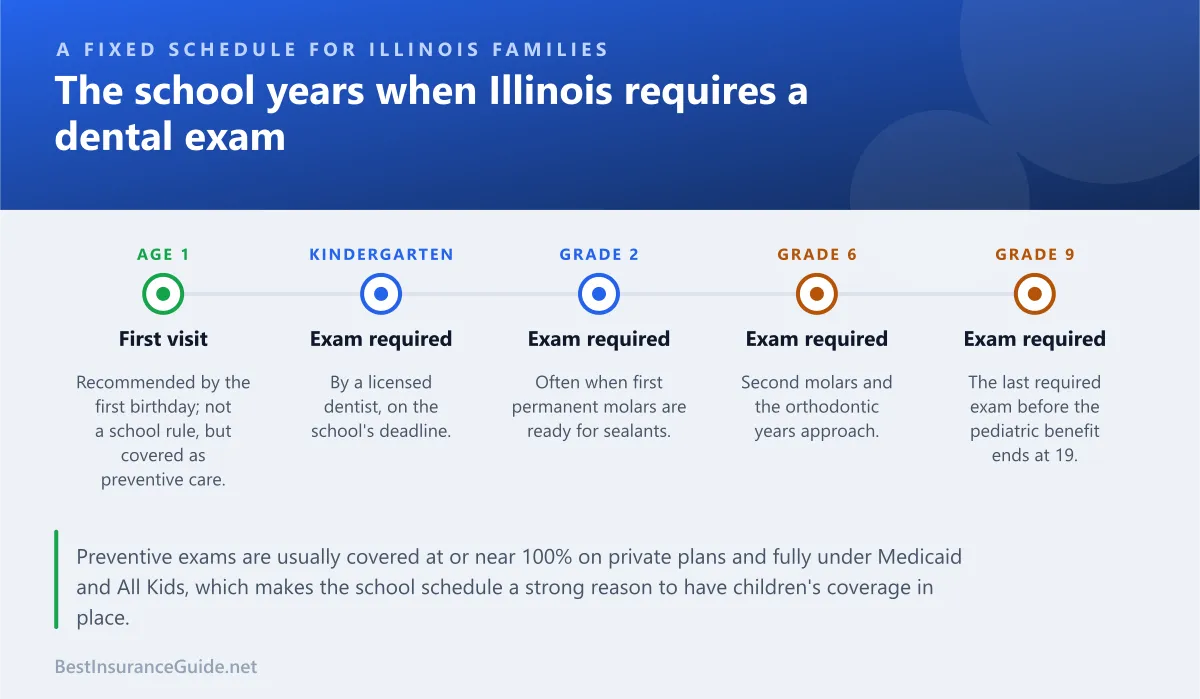
Illinois requires a dental examination for children entering kindergarten and second, sixth and ninth grades, performed by a licensed dentist. Schools can grant a waiver in certain circumstances, but for most families the exam is a fixed cost on a fixed schedule.
That is one of the strongest arguments for having children’s dental coverage in place. Preventive exams are typically covered at or near 100% on private plans with little or no waiting period, and they are covered under Medicaid and All Kids. For the wider picture, see dental insurance for kids.
A worked example: a family in Naperville
A family of four — two adults, two children aged 6 and 11 — is choosing between a family PPO and paying out of pocket. For illustration, assume the following expected year: two cleanings and exams each for all four people, a filling for one adult, sealants for the 6-year-old, and one crown for the other adult.
| Expected care | Illustrative fee | PPO pays | Family pays |
|---|---|---|---|
| 8 exams and cleanings | $1,600 | $1,600 | $0 |
| 1 filling | $200 | $120 (80% after $50 deductible) | $80 |
| Sealants for one child | $200 | $160 (80%, deductible waived) | $40 |
| 1 crown | $1,200 | $575 (50% after $50 deductible) | $625 |
| Totals | $3,200 | $2,455 | $745 |
With a family premium of, say, $1,560 a year, the family’s total cost would be $2,305 against $3,200 without coverage — a saving of close to $900. Remove the crown and the saving shrinks sharply; the plan’s value comes largely from preventive care for four people and one major procedure.
This is illustrative arithmetic, not a quote. It shows the method: list the care you expect, apply the plan’s terms, and add the premium.
How to choose
1. Check your dentist’s networks before anything else.
2. If you live downstate, check DHMO network depth before assuming a DHMO is the cheaper choice.
3. Estimate the year’s care, including any school exams for children.
4. Compare waiting periods against what you need, particularly for crowns and root canals; see dental insurance for a root canal.
5. Compare annual maximums if you expect major work.
6. Check whether your children qualify for All Kids before buying private children’s coverage.
7. Compare total annual cost — premium plus expected out-of-pocket.
Common mistakes
Buying a plan in the autumn for a crown needed in winter, and running into a twelve-month waiting period for major work.
Assuming Medicare covers dental at 65.
Confusing a discount plan with insurance. Discount plans reduce fees at participating dentists but do not pay any part of the bill.
Forgetting to check both parents’ plans for children. If both parents have coverage, the birthday rule decides which plan is primary; see secondary dental insurance.
Dental coverage for Illinois seniors
Illinois residents turning 65 face the same gap as everyone else: Original Medicare does not cover routine dental care. The realistic options are a Medicare Advantage plan with dental benefits, a stand-alone dental plan, or both.
Medicare Advantage plans in Illinois vary widely in their dental benefits, both between the Chicago area and downstate and between plans in the same county. Read the dental section of each plan’s Evidence of Coverage for the annual maximum and the network.
Illinois residents eligible for both Medicare and Medicaid may have access to the adult Medicaid dental benefit, which can make a real difference for dentures and extractions.
The Senior Health Insurance Program — Illinois’s free Medicare counselling service — can help compare Medicare Advantage dental benefits.
If you are self-employed in Illinois
Self-employed people usually buy an individual dental plan, either directly or through Get Covered Illinois. Three points are worth knowing.
Premiums may be deductible. Self-employed people can often deduct health insurance premiums, including dental, subject to federal tax rules. Check with a tax professional.
A health savings account paired with an eligible high-deductible health plan can pay for dental treatment with pre-tax money, even though the dental plan itself is separate.
Waiting periods apply to most individual plans. If you are leaving a job with dental coverage to become self-employed, keep proof of that coverage; some insurers waive waiting periods for recent prior coverage. See dental insurance with no waiting period.
Illinois dental coverage at a glance
| Who you are | Most likely route | Key thing to check |
|---|---|---|
| Employed with benefits | Employer group plan | Whether your dentist is in network |
| Self-employed or between jobs | Individual plan or Get Covered Illinois | Waiting periods and prior-coverage waivers |
| Low income adult | Illinois Medicaid | A dentist currently accepting new Medicaid patients |
| Child in a low- or moderate-income family | All Kids | Eligibility level and any premium |
| 65 or over | Medicare Advantage dental or stand-alone plan | Annual maximum and network |
| Veteran | VA dental, VADIP or FEDVIP | Eligibility; see dental insurance for veterans |
Changing jobs in Illinois without losing dental coverage
Leaving a job usually ends employer dental coverage at the end of the month or on your last day. There are three ways to avoid a gap.
COBRA continuation. Employers with 20 or more employees generally must offer COBRA, which lets you keep the same dental plan, usually for up to 18 months, by paying the full premium plus a small administrative charge. Dental can often be continued on its own, without the medical plan.
Illinois state continuation. Illinois has its own continuation law for some group health coverage from smaller employers not subject to COBRA. Whether it applies to a stand-alone dental plan depends on the plan; ask the employer or insurer.
A new individual plan with a prior-coverage waiver. Buying an individual plan soon after the employer plan ends, with proof of that coverage, may avoid waiting periods; see dental insurance with no waiting period.
Compare COBRA’s full premium with an individual plan’s premium before choosing. For the wider rules, see how long COBRA coverage lasts.
Low-cost care if you have no coverage
Dental schools. Illinois has dental schools in the Chicago area and downstate whose supervised clinics offer care at reduced fees.
Federally qualified health centres. Many offer dental services on a sliding fee scale based on income, in both urban and rural areas.
Local health departments. Some county health departments run dental clinics or can refer residents to low-cost providers.
Complaints and help
The Illinois Department of Insurance regulates dental insurers and handles consumer complaints about private plans. For Medicaid and All Kids, the Illinois Department of Healthcare and Family Services administers the programmes, and your managed care plan’s member services handles day-to-day questions and appeals. Get Covered Illinois provides help with marketplace enrolment.
The short version
Illinois residents can get dental coverage through employers, individual plans, the state’s own marketplace at Get Covered Illinois, Medicare Advantage, Medicaid and All Kids. Illinois Medicaid includes a genuine adult dental benefit, and All Kids covers dental for children.
The state’s school dental exam requirement makes children’s coverage particularly useful for Illinois families. For adults, choose by your dentist’s network, the waiting periods and the annual maximum before comparing premiums, and remember that network depth outside the Chicago area can make a PPO the more practical option.
A note on scope
This guide is general information rather than advice about any specific plan or insurer. Premiums, networks, waiting periods and benefit limits vary by plan and location, and Medicaid, All Kids and marketplace rules are set by the state and can change. The Illinois Department of Insurance, the Department of Healthcare and Family Services and Get Covered Illinois are the authoritative sources. This site is independent and not affiliated with any insurer.