Best Dental Insurance in Texas: How to Find the Right Plan
Dental insurance in Texas: dental HMO vs PPO, rural network gaps, Texas Medicaid and CHIP dental, discount plans and a buyer checklist.

Table of contents

Texas is big enough that “the best dental insurance in Texas” means something different in Houston than it does in the Panhandle. A dental HMO that is outstanding value in Dallas can be almost useless in a county with two participating dentists, and a PPO that looks expensive in Austin may be the only sensible choice in West Texas.
This guide explains how dental coverage works in Texas, the plan types you will be offered, what the state programmes cover, and a straightforward way to decide which plan is best for your situation — without pretending one insurer is right for everyone.
Why “best” depends on where you live
Texas has large, dense dental networks in its major metros — Houston, Dallas–Fort Worth, San Antonio, Austin and El Paso — and much thinner ones across rural counties. That affects the choice more than anything else.
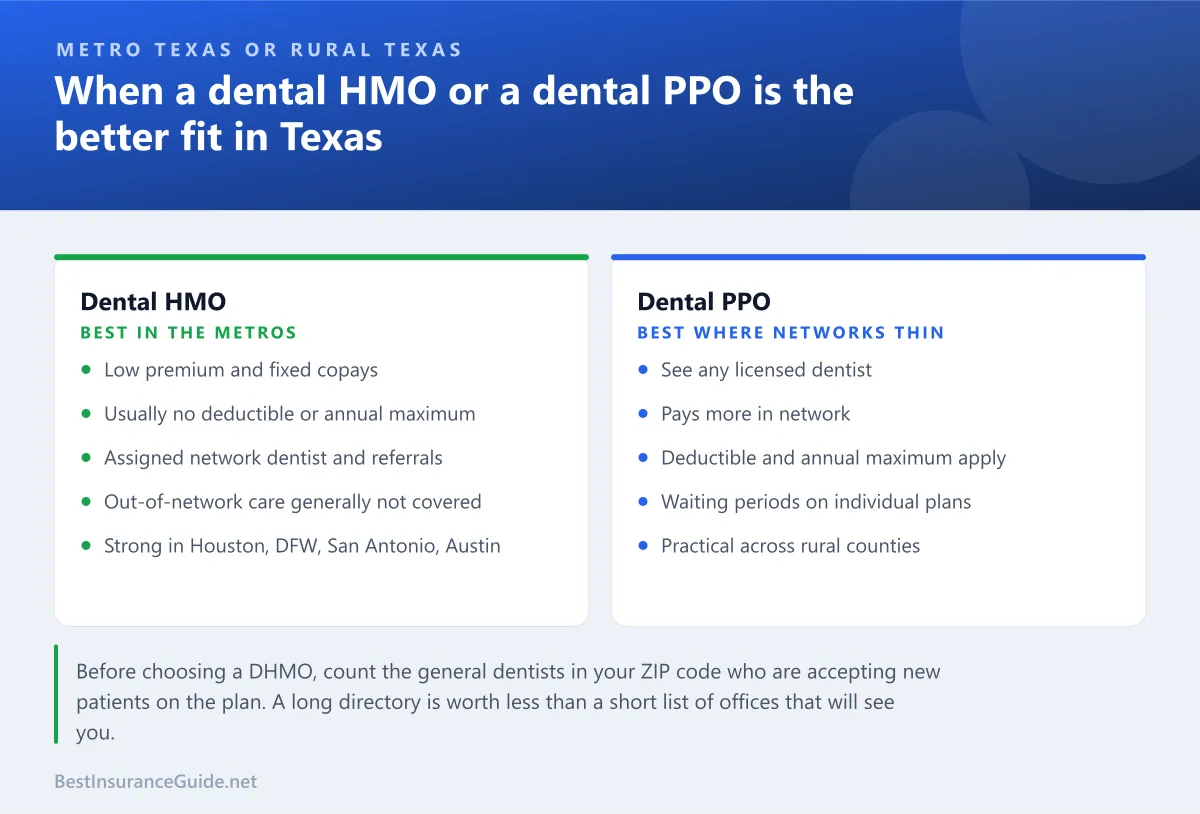
In the big metros, network choice is wide, and dental HMOs can offer low premiums, fixed copays and no annual maximum with plenty of dentists to choose from.
In rural Texas, the nearest in-network dentist on a DHMO may be an hour away. A PPO, which pays something toward any licensed dentist, is usually the more practical choice.
Along the border, some residents use dentists in Mexico for major work. Most US dental plans do not cover care outside the United States except in limited emergency circumstances, so that decision sits outside insurance entirely.
Dental HMOs in Texas
Texas has an unusually active dental HMO market, and DHMO plans are common both in employer benefit menus and on the individual market.
How they work. You choose a primary dentist from the network. That dentist provides most care and refers you to network specialists when needed. The plan publishes a schedule of copays: a filling might cost a fixed amount, a crown a larger fixed amount, and so on.
What is good about them. Usually no deductible, no annual maximum and low premiums. For someone who needs several crowns in a year, the absence of an annual maximum can be worth more than anything else in the plan.
What to watch. Out-of-network care is generally not covered. Changing your assigned dentist may require notice. And the copay schedule, not a percentage, determines what you pay — so read it for the procedures you expect.
Dental PPOs in Texas
A PPO lets you see any dentist and pays more when you stay in network. Most follow the familiar pattern of preventive care at or near 100%, basic care around 80% and major care around 50%, with a deductible and an annual maximum.
The annual maximum is the PPO’s weak point. Maximums of $1,000 to $2,000 are common, and one or two crowns can exhaust the lower end. Waiting periods of several months for basic care and up to a year for major care are standard on individual plans.
A worked example: two crowns in Houston
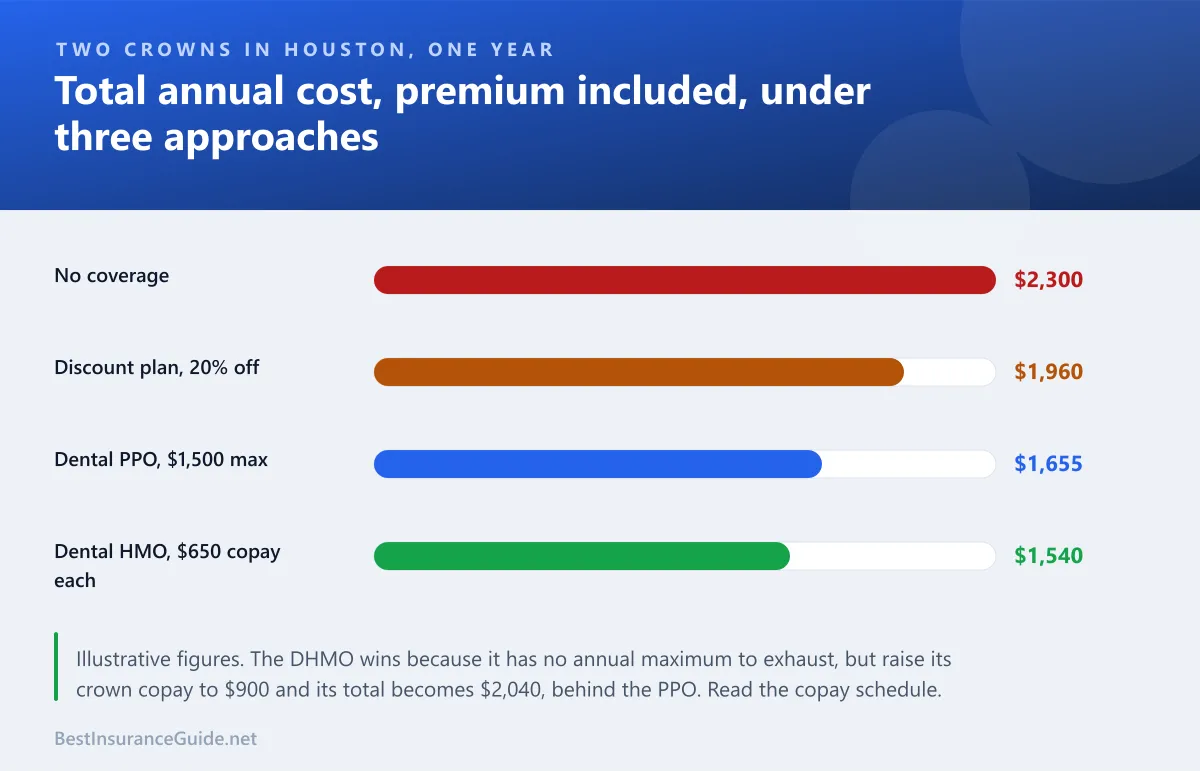
Take a Houston resident who needs two crowns in the same year. For illustration, assume a PPO in-network fee of $1,150 per crown, and a DHMO copay of $650 per crown.
| Detail | Dental HMO | Dental PPO |
|---|---|---|
| Annual premium | $240 | $480 |
| Deductible | $0 | $50 |
| Plan payment for two crowns | Copay schedule applies | 50% after deductible = $1,125 |
| Annual maximum | None | $1,500 |
| You pay the dentist | $1,300 | $1,175 |
| Total annual cost | $1,540 | $1,655 |
The DHMO wins here, and it would win by more with a third crown, because it has no maximum to exhaust. The PPO wins if your dentist is not in the DHMO network, or if you live somewhere the DHMO network is thin.
Change one assumption — the DHMO’s crown copay rises to $900 — and the DHMO’s total becomes $2,040, making the PPO better value. The copay schedule is the heart of a DHMO; read it for the procedures you need.
Texas Medicaid dental
Children. Children on Texas Medicaid receive dental care through Texas Health Steps, the state’s version of the federal EPSDT benefit, delivered by dental maintenance organisations under contract with the Texas Health and Human Services Commission. Coverage includes regular check-ups from infancy, cleanings, fluoride, sealants and medically necessary treatment.
Adults. Adult dental coverage under Texas Medicaid is very limited, largely restricted to emergency services such as treatment for dental infections or trauma. Some Medicaid managed care plans offer a limited adult dental benefit as an added value service, which varies by plan and year. If you are an adult on Medicaid, the member handbook of your specific plan is the place to check.
Texas CHIP dental
Children enrolled in CHIP in Texas receive dental coverage through a CHIP dental plan, covering preventive care and many treatments, subject to an annual benefit limit. Families whose income is too high for children’s Medicaid should check CHIP eligibility before buying a private plan for a child. See dental insurance for kids for how children’s coverage works more broadly.
Buying on the marketplace
Texas uses HealthCare.gov. Stand-alone dental plans are available during open enrolment, and pediatric dental is an essential health benefit for children under 19. Adult dental through the marketplace is optional, and premium tax credits generally do not apply to stand-alone adult dental plans.
Discount health care programmes
Dental discount plans are widely sold in Texas. You pay a membership fee and receive reduced fees at participating dentists, with no waiting period and no annual maximum. The programme pays nothing toward the bill.
The Texas Department of Insurance regulates discount health care programmes, which must make clear that they are not insurance. A discount plan can be a sensible bridge for immediate work, but for ongoing care, check whether a DHMO in your area delivers the same or better savings with actual coverage.
How to decide which plan is best for you
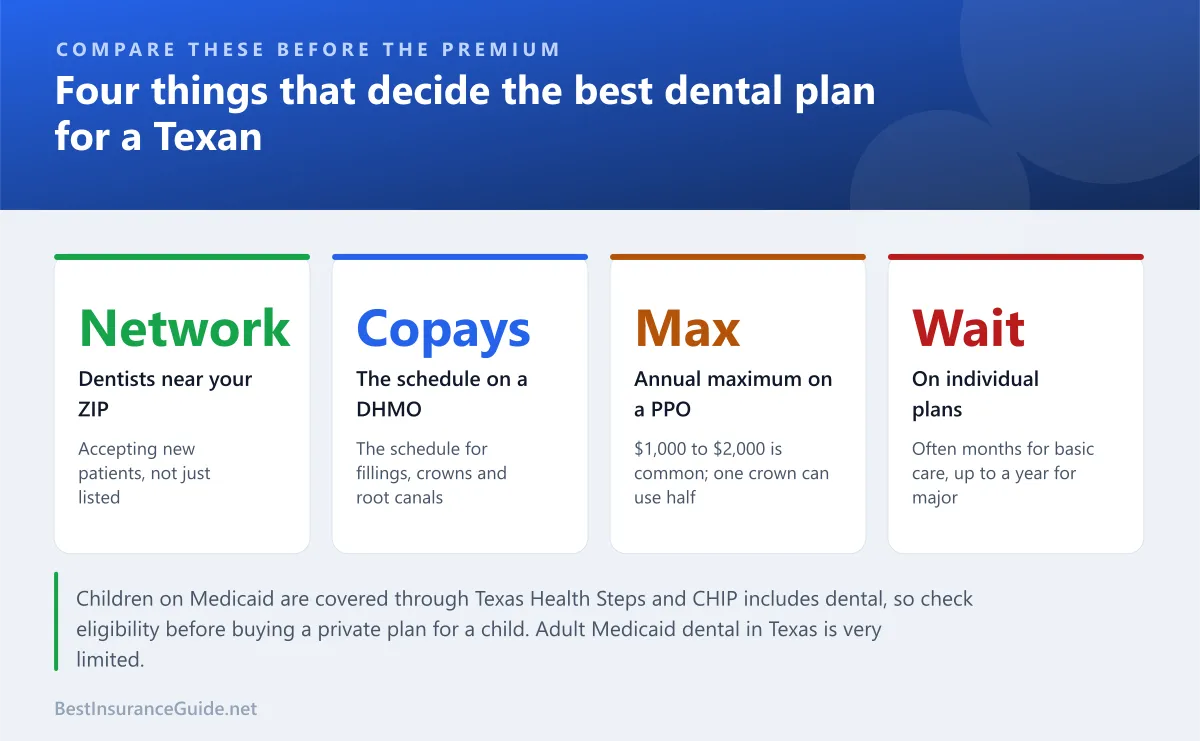
1. Check your dentist’s participation. If you want to keep your dentist, ask which plans they accept. This settles the decision for many people.
2. If you are open to changing dentists, check DHMO network depth in your ZIP code. How many general dentists are within a reasonable drive, and are they accepting new patients?
3. Estimate your year. Preventive only, some fillings, or crowns and root canals.
4. For a DHMO, read the copay schedule for the procedures you expect.
5. For a PPO, check the annual maximum, the coinsurance tiers and the waiting periods. Check in particular whether root canals are classified as basic or major; see dental insurance for a root canal.
6. Compare total annual cost, premium plus expected out-of-pocket.
Questions to ask before joining a Texas DHMO
A dental HMO lives or dies by its network and its copay schedule. Before enrolling, ask:
How many general dentists in my ZIP code are accepting new patients on this plan? A long directory list is less useful than a short list of offices that will actually see you.
What are the copays for the procedures I expect? Ask specifically about fillings, root canals, crowns and extractions. Some plans also charge more for particular crown materials.
How are specialist referrals handled? Many DHMOs require a referral from your assigned dentist before you see an endodontist, oral surgeon or periodontist, and some specialist copays are higher.
Can I change my assigned dentist, and how quickly? Some plans allow changes monthly; others less often.
What happens in an emergency away from home? Most DHMOs offer limited out-of-area emergency benefits. Know the rule before a road trip across the state.
Texas seniors and dental coverage
Texas has a large and growing population over 65, and many residents discover at retirement that Original Medicare does not cover routine dental care. Many Texas Medicare Advantage plans include a dental benefit, and DHMO-style dental networks are common inside them. The same trade-offs apply: a low or no extra premium, a network, and an annual maximum that may be modest. Our guide to dental insurance for seniors on Medicare walks through the choice in detail.
HICAP, the Texas Health Information, Counseling and Advocacy Program, offers free Medicare counselling and can help compare dental benefits between plans.
Self-employed and gig workers
Texas has a large self-employed workforce, and most of these workers buy individual dental plans. Three practical points:
Plan for waiting periods. Individual plans commonly delay basic and major coverage. If you are leaving a job with dental coverage, keep proof of it to ask for a prior-coverage waiver; see dental insurance with no waiting period.
Consider premium deductibility. Self-employed people can often deduct health insurance premiums, including dental, subject to federal tax rules.
Use tax-advantaged accounts where available. A health savings account paired with an eligible high-deductible health plan can pay for dental treatment with pre-tax money.
Keeping dental coverage between jobs
Texas workers who change jobs often lose dental coverage for a month or more. COBRA lets employees of employers with 20 or more workers keep the same dental plan, usually for up to 18 months, by paying the full premium; dental can generally be continued without the medical plan. Texas state continuation rules cover some group health plans from smaller employers, though whether they reach a stand-alone dental plan depends on the plan. Ask the employer, and compare the continuation premium with an individual plan that offers a prior-coverage waiver. See how long COBRA coverage lasts for the general rules.
Texas-specific traps
Assuming network coverage extends statewide. DHMO networks are often built around metros, and moving within Texas can leave you without a network dentist.
Buying a PPO with a long waiting period for work you need now.
Treating a discount card as insurance.
Assuming care in Mexico will be reimbursed. Most US dental plans do not cover routine care outside the United States.
Ignoring the DHMO’s specialist rules. If your assigned dentist does not refer you, a visit to a specialist may not be covered at all, even if the specialist is in the network.
Letting coverage lapse between jobs, and then restarting waiting periods on a new individual plan.
Complaints and help
The Texas Department of Insurance regulates dental insurers, dental HMOs and discount health care programmes, and operates a consumer helpline and complaints process. Appeal a denied claim with the plan first, keeping the explanation of benefits and your dentist’s records. For Medicaid and CHIP, the Texas Health and Human Services Commission and your plan’s member services handle questions and appeals.
The short version
The best dental insurance in Texas depends on where you live and what you need. In the metros, a dental HMO often gives the best value, with fixed copays and no annual maximum. In rural counties, a PPO’s freedom to see any dentist usually matters more.
Children on Medicaid are covered through Texas Health Steps, and CHIP includes dental. Adult Medicaid dental is very limited. Discount plans can bridge an immediate need but are not insurance.
Choose by your dentist, your network, your expected treatment and your total annual cost. If you are weighing two plans at once, read secondary dental insurance first.
A note on scope
This guide is general information rather than advice about any specific plan or insurer. Premiums, networks, copay schedules, waiting periods and annual maximums vary by plan and ZIP code, and Medicaid and CHIP benefits are set by the state and can change. The Texas Department of Insurance and the Texas Health and Human Services Commission are the authoritative sources. This site is independent and not affiliated with any insurer.