Insurance Broker vs Agent: Who Works for You, and How They Get Paid
Insurance broker vs agent explained: captive vs independent agents, who each represents, how insurance agents get paid, and how to choose the right one.

Table of contents

Every time you buy insurance through a person rather than a website, you are dealing with an insurance agent or an insurance broker. The two words are used interchangeably in advertising, on business cards and in everyday conversation. Legally and practically, they describe different relationships, and the difference matters when something goes wrong.
The short version: an agent represents the insurance company; a broker represents you. But there are two kinds of agent, the line between an independent agent and a broker is blurry in practice, and how each one gets paid affects what they recommend.
This guide explains the insurance broker vs agent distinction, captive versus independent agents, how insurance agents make money, and which one to use for different kinds of insurance.
What does an insurance agent do?
An insurance agent is licensed by the state and appointed by one or more insurers to sell their policies. That appointment means the agent acts on the insurer’s behalf. In most cases an agent can:
- quote the insurer’s policies and explain the options;
- take your application and submit it to the insurer’s underwriters;
- often bind coverage, meaning make it effective immediately, within the insurer’s rules;
- handle changes, renewals and billing questions;
- help you report and follow up on claims.
Because the agent represents the insurer, what the agent tells you, and what you tell the agent, is generally treated as if it were said to the insurer. That is one reason to put important information in writing.
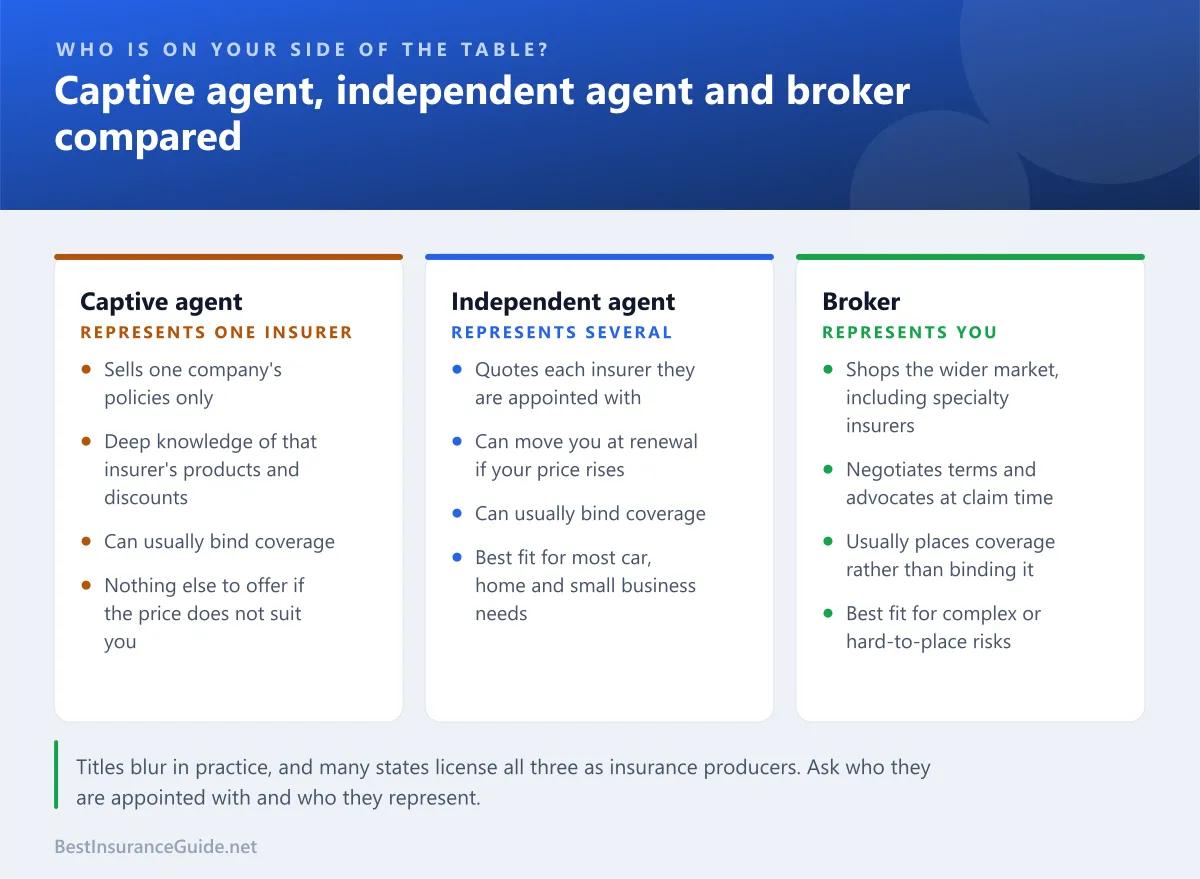
Captive agents
A captive agent, sometimes called an exclusive agent, sells for one insurance company only. Many of the largest personal lines insurers sell through their own branded networks of captive agents.
- Strength: deep knowledge of one company’s products, discounts and claims process, and often a local office.
- Limit: if that company’s price or appetite does not suit you, the agent has nothing else to offer.
Independent agents
An independent agent is appointed by several insurers and can quote each of them for you.
- Strength: one conversation, several quotes, and someone who can move you to another insurer at renewal if your current one raises the price.
- Limit: they can only offer the insurers they are appointed with, and they still legally represent those insurers, not you.
What does an insurance broker do?
An insurance broker represents the customer. Rather than selling a particular insurer’s product, a broker’s job is to understand your risk, take it to the market, negotiate terms and recommend the best option.
In practice brokers:
- shop your risk across many insurers, including specialty and surplus lines markets that independent agents may not access;
- negotiate coverage terms and pricing, especially on commercial risks;
- advise on limits, endorsements and contract requirements;
- advocate for you with the insurer at renewal and during claims.
A broker usually cannot bind coverage on their own authority. They place the risk with an insurer that then issues the policy, often through an agent or managing general agent appointed by that insurer.
Brokers are most common in commercial insurance, employee benefits and hard-to-place personal risks, such as very high-value homes, coastal property or drivers with serious violations.
Insurance broker vs agent at a glance
| Detail | Captive agent | Independent agent | Broker |
|---|---|---|---|
| Legally represents | One insurer | Several insurers | You, the customer |
| Choice of insurers | One | Those they are appointed with | Wide market, including specialty |
| Can usually bind coverage | Yes | Yes | Usually not directly |
| Typical focus | Personal car, home, life | Personal and small business | Commercial, complex or hard-to-place |
| Usually paid by | Insurer commission, sometimes salary | Insurer commission | Commission and sometimes a disclosed fee |
Why the line blurs
State licensing law increasingly uses a single term, insurance producer, for anyone who sells, solicits or negotiates insurance. Many independent agencies also act as brokers for some clients and some lines. And plenty of people who call themselves brokers are legally agents of the insurers they place business with.
What matters more than the title is the answer to two questions: who are you appointed with, and who do you represent in this transaction? Ask them directly.
How do insurance agents get paid?
Knowing how your agent or broker makes money helps you understand their recommendations.
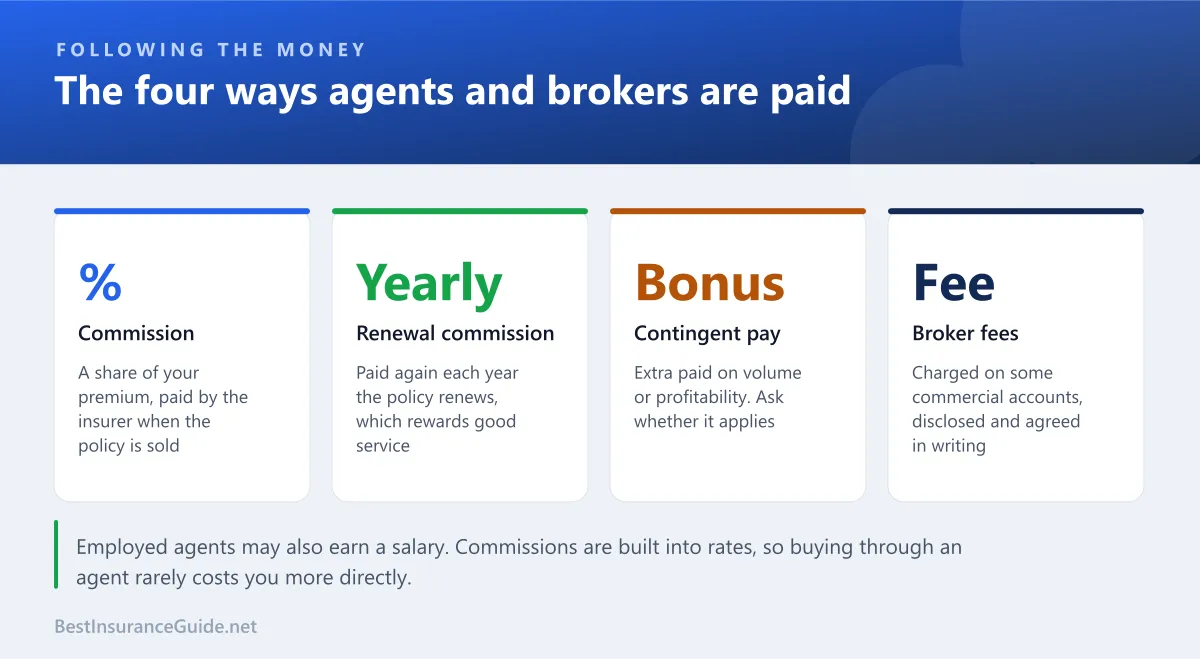
Commission. Most agents and brokers are paid a commission by the insurer, a percentage of the premium on each policy sold. Rates vary widely by type of insurance, by insurer and by whether the policy is new or renewing. Life insurance, for example, often pays a much larger first-year commission than car or home insurance, while ACA health plans commonly pay a flat amount per member.
Renewal commission. Many property and casualty policies pay a commission every year the policy renews. That gives agents a reason to keep you as a client, and to service the policy well.
Contingent or bonus commissions. Some insurers pay additional bonuses based on the volume or profitability of the business an agency places with them. These are a legitimate part of the industry, but they are also the main potential conflict of interest, which is why some states require disclosure.
Salary. According to the Bureau of Labor Statistics, agents employed by an agency or insurer may be paid a salary, salary plus commission or salary plus bonus. Independent agents may be paid entirely by commission.
Fees. Some brokers charge a fee for services, typically on commercial accounts, either instead of or in addition to commission. Where fees are allowed, states generally require them to be disclosed and agreed in writing in advance.
How much do insurance agents make?
The Bureau of Labor Statistics reports a median annual wage of $62,280 for insurance sales agents as of May 2025, across about 572,600 jobs, with employment projected to grow 3% from 2025 to 2035. Earnings range widely: an established independent agency owner with a large book of renewing business earns very differently from a new captive agent building a client base.
Do you pay more through an agent?
Usually not directly. Commissions are built into the insurer’s rates whether you buy through an agent, a call center or a website. Some direct-to-consumer insurers argue their pricing is lower because they avoid agent commissions, but in practice the rate differences between insurers are driven far more by how each one rates your particular risk than by distribution costs. The only way to know is to compare quotes properly.
Can you trust an agent’s recommendation?
Mostly, yes, but with open eyes.
- Captive agents can only recommend their own insurer’s products, so their advice is about which of those products suits you, not whether another insurer would be cheaper.
- Independent agents are paid by whichever insurer you choose, and commission rates can differ between insurers. A good agent will show you the options side by side and explain why they recommend one.
- Brokers represent you, but are still usually paid by the insurer they place you with.
It is entirely reasonable to ask any agent or broker how they are paid, whether they receive any bonus from the insurer they are recommending, and whether they charge any fee. Some states require producers to answer. New York, for example, requires insurance producers to disclose how they are compensated and to provide more detail on request.
Which should you use?
Use a captive agent when you already know you want a particular insurer, you value a local relationship with that company, or you want to bundle several policies with one insurer for the discount.
Use an independent agent when you want to compare several insurers without making several calls, you expect to shop again at renewal, or you have a small business with straightforward needs. For most people buying car, home and renters insurance, a good independent agent is the most efficient option.
Use a broker when your risk is complex or unusual: a growing business with employees, vehicles and contracts; a high-value or coastal home; a history of claims or violations; or a risk that several insurers have already declined. Our guide to what an insurance underwriter does explains why a broker’s market access matters most for exactly these cases.
Buy direct online when your needs are simple, you are comfortable choosing your own limits, and you are willing to compare several insurers yourself. You give up advice and advocacy in exchange for speed.
Three shoppers, three right answers
A first-time renter wants renters and car insurance as cheaply as possible. An independent agent who can quote four or five insurers in one call, or a careful comparison online, is the efficient route. A broker adds little for a simple, standard risk.
A family moving into a large coastal home has been declined by two insurers because of wind exposure. This is where a broker, or an independent agency with access to surplus lines markets, earns its keep. It knows which insurers still write coastal property, how to present the home’s roof and shutters, and how to combine a wind policy with a standard homeowners policy.
A contractor with six employees needs general liability, workers’ comp, commercial auto and an umbrella, and every client contract demands certificates and endorsements. A commercial broker or a specialist independent agency that understands construction contracts will save time and prevent gaps, and may negotiate the endorsements into the policy from the start. Our guide to business insurance by trade covers what that contractor typically needs.
Questions to ask before you buy
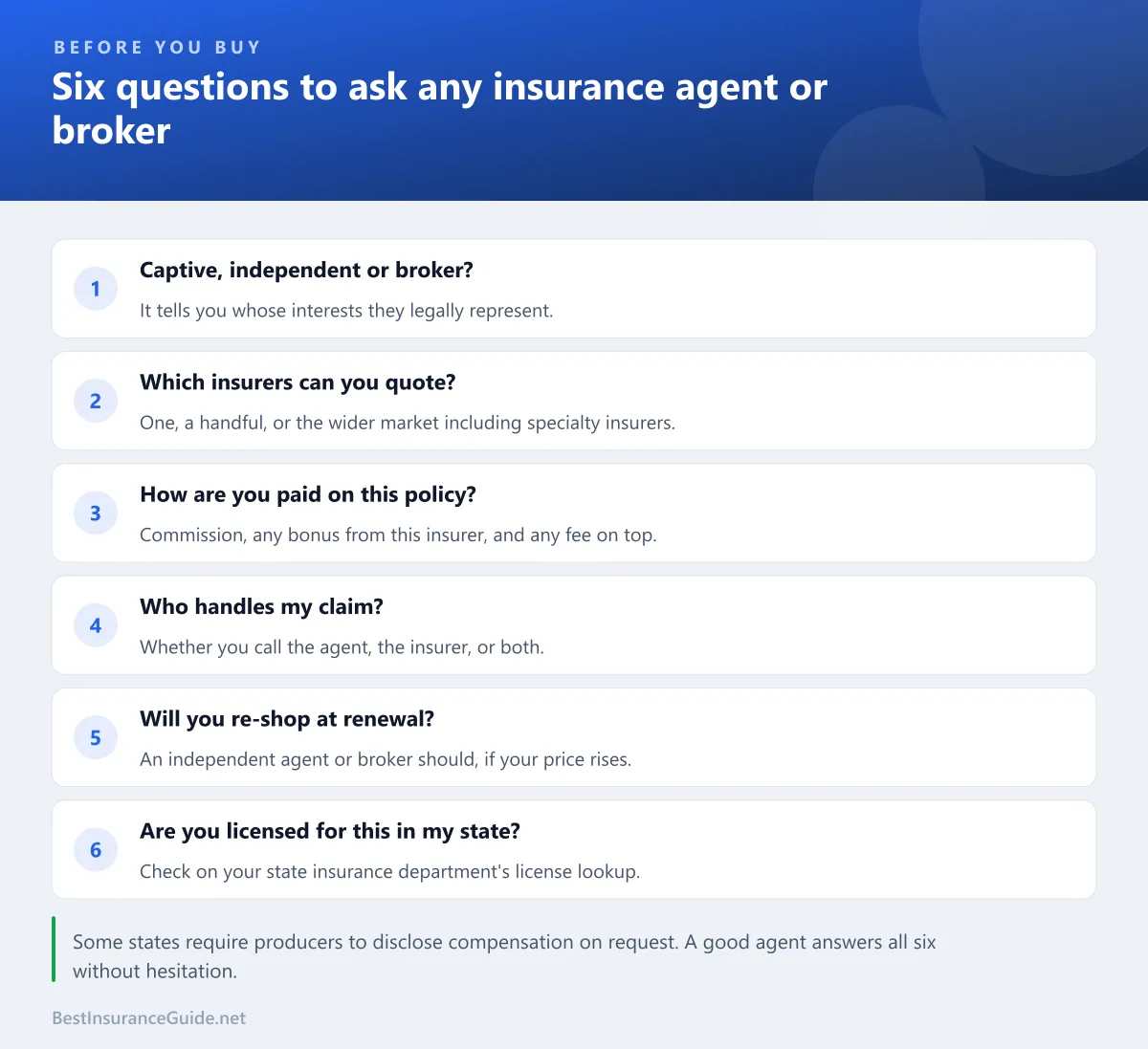
- Are you a captive agent, an independent agent or a broker?
- Which insurers can you quote for me?
- How are you paid on this policy, and do you receive any bonuses from this insurer?
- Do you charge any fees, and are they in writing?
- Who do I call when I have a claim, you or the insurer?
- Will you re-shop my policy at renewal?
- Are you licensed in my state for this type of insurance? You can confirm this through your state insurance department’s online license lookup.
Licensing: what every agent and broker needs
Anyone who sells, solicits or negotiates insurance must be licensed in each state where they do business. Licensing is usually split by line: property and casualty for car, home and business insurance, and life and health (sometimes called life, accident and health) for life, health and disability insurance. Getting licensed requires pre-licensing education in many states, a state exam, a background check and ongoing continuing education.
On top of the license, an agent needs an appointment from each insurer they sell for. You can usually check both the license and any disciplinary history on your state insurance department’s website, or through the National Insurance Producer Registry.
Related reading
Found a local agency online and not sure who they are? Mart Insurance: what people are searching for includes a ten-minute check that works on any agency.
The bottom line
The practical difference between an insurance broker and an agent is who they work for. Captive agents represent one insurer, independent agents represent several, and brokers represent you. All of them are usually paid by commission from the insurer, which rarely costs you extra, but it is worth understanding and fair to ask about.
For everyday personal insurance, an independent agent gives you most of the choice of a broker with less friction. For complex, high-value or hard-to-place risks, a broker’s reach and advocacy earns its keep. Whichever you use, compare at least three options and re-shop every couple of years. Our guide to switching car insurance without a gap covers how to do that safely when you find a better price.
BestInsuranceGuide.net is an independent publisher and is not affiliated with any insurer, agency or brokerage. Earnings and employment figures are from the US Bureau of Labor Statistics Occupational Outlook Handbook. Licensing and disclosure rules vary by state.