Did Florida Repeal PIP? Florida's No-Fault Law and PIP Insurance, Explained for 2026 and 2027
Florida did not repeal PIP: the 2026 no-fault repeal bill died in committee. How PIP insurance in Florida works, the 14-day rule, who pays for car damage, two PIP claims and 2027 outlook.

Table of contents
Every few months, the same rumor goes round Florida social media and even some law firm blogs: Florida is getting rid of PIP, and the state is switching to an at-fault system on January 1, 2027.
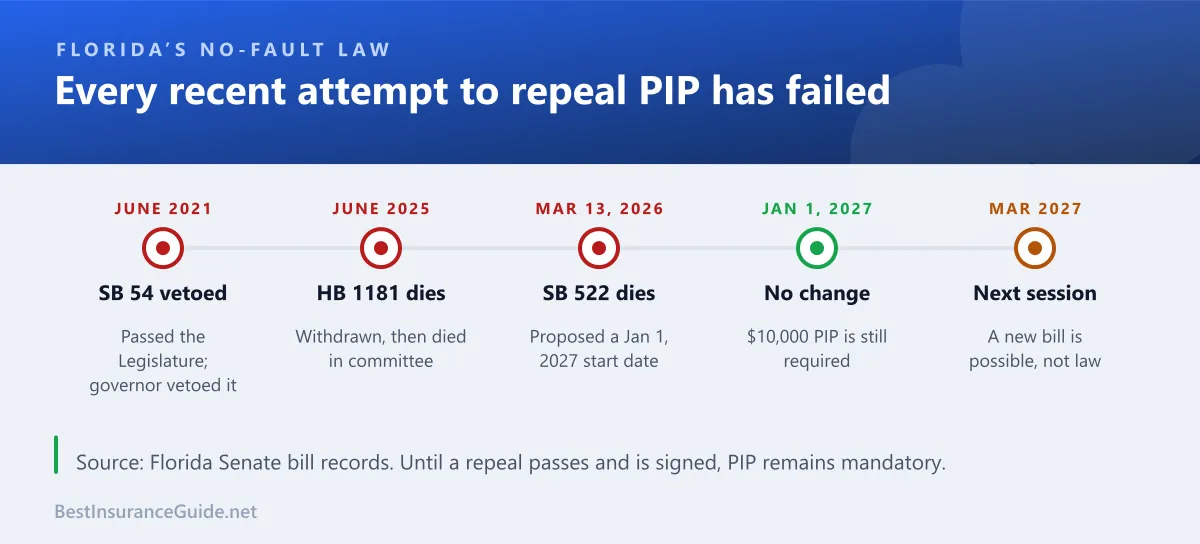
It isn’t true. Florida has not repealed personal injury protection (PIP). The 2026 bill that would have done it, Senate Bill 522, set a January 1, 2027 effective date, which is where the confusion comes from. But it died in the Senate Banking and Insurance Committee on March 13, 2026, according to the Florida Senate’s official bill record. A similar House bill in 2025, HB 1181, also died. As of October 2026, every Florida driver still needs $10,000 of PIP.
So the useful question isn’t whether PIP is going away. It’s how Florida PIP insurance actually works, and what to do so a crash doesn’t cost you more than it should. This guide covers the no-fault rules, the 14-day deadline, who pays for car damage, two PIP claims, and what the repeal fight could mean for your premium in 2027.
This site is independent and not affiliated with any insurer or the State of Florida. This is general information, not legal advice.
Did Florida repeal PIP? The short history
| Year | Bill | What happened |
|---|---|---|
| 2021 | SB 54 | Passed the Legislature to replace PIP with mandatory bodily injury liability; vetoed by Gov. Ron DeSantis on June 29, 2021 |
| 2025 | HB 1181 | Would have repealed the No-Fault Law; withdrawn and died in committee on June 16, 2025 |
| 2026 | SB 522 | Would have repealed the No-Fault Law effective January 1, 2027; died in committee on March 13, 2026 |
| 2027 | ? | The next regular legislative session begins in March 2027. A new repeal bill is possible, but nothing has passed |
Source: Florida Senate bill records.
Repeal supporters argue that PIP fraud and litigation drive up premiums and that mandatory bodily injury liability would protect people better. Opponents worry about higher costs for drivers and slower payment of medical bills. The debate isn’t over, but until a bill passes and is signed, nothing changes. If someone tells you that you can drop PIP, they’re wrong, and you would be driving illegally.
Is Florida a no-fault state?
Yes. Florida is one of about a dozen no-fault states. In a no-fault state:
- Your own PIP pays first for your medical bills and lost income after a crash, no matter who caused it.
- You can’t sue the at-fault driver for pain and suffering unless your injury crosses Florida’s tort threshold: a significant and permanent injury, significant permanent scarring or disfigurement, significant and permanent loss of an important bodily function, or death.
- Car damage is not no-fault (more on that below).
What does no-fault mean in Florida, in practice?
Say another driver runs a red light and hits you. You go to urgent care the same day and miss a week of work. In a no-fault state, you claim on your own policy’s PIP for those medical bills and lost wages. You don’t wait for the other driver’s insurer to accept blame. If your injuries are serious and permanent, you can still pursue the at-fault driver for more.
Is PIP required in Florida?
Yes. Florida’s minimum car insurance is:
| Coverage | Florida minimum |
|---|---|
| Personal injury protection (PIP) | $10,000 |
| Property damage liability (PDL) | $10,000 |
| Bodily injury liability | Not required for most drivers |
You must carry PIP if you own a vehicle with four or more wheels that is registered in Florida. Non-residents who have been in Florida for more than 90 days in the past 365 must also carry it. PIP isn’t required for motorcycles.
Florida is unusual because bodily injury liability isn’t required for most drivers. If a repeal ever passes, mandatory bodily injury liability would almost certainly replace PIP, as the 2021 and 2026 bills proposed. Our guide to Florida automobile insurance explains why carrying bodily injury liability and uninsured motorist coverage is wise either way.
What does PIP cover in Florida?
| PIP benefit | What it pays |
|---|---|
| Medical expenses | 80% of reasonable medical costs, within the $10,000 limit |
| Lost income | 60% of lost gross income, within the same $10,000 limit |
| Replacement services | Help with household tasks you can’t do because of your injuries |
| Death benefit | $5,000, in addition to the $10,000 |
Who PIP covers:
- You, in any car, and even as a pedestrian or cyclist hit by a car.
- Relatives who live with you and don’t have their own PIP.
- Passengers in your car who don’t have their own PIP.
- Florida residents hit by your car while walking or cycling, if they don’t have their own PIP.
The emergency medical condition rule
PIP pays up to the full $10,000 for medical care only if a qualified provider, such as a physician, physician assistant or advanced practice nurse, determines you had an emergency medical condition (EMC). Without that finding, PIP medical benefits are limited to $2,500.
Worked example: how a Florida PIP claim pays
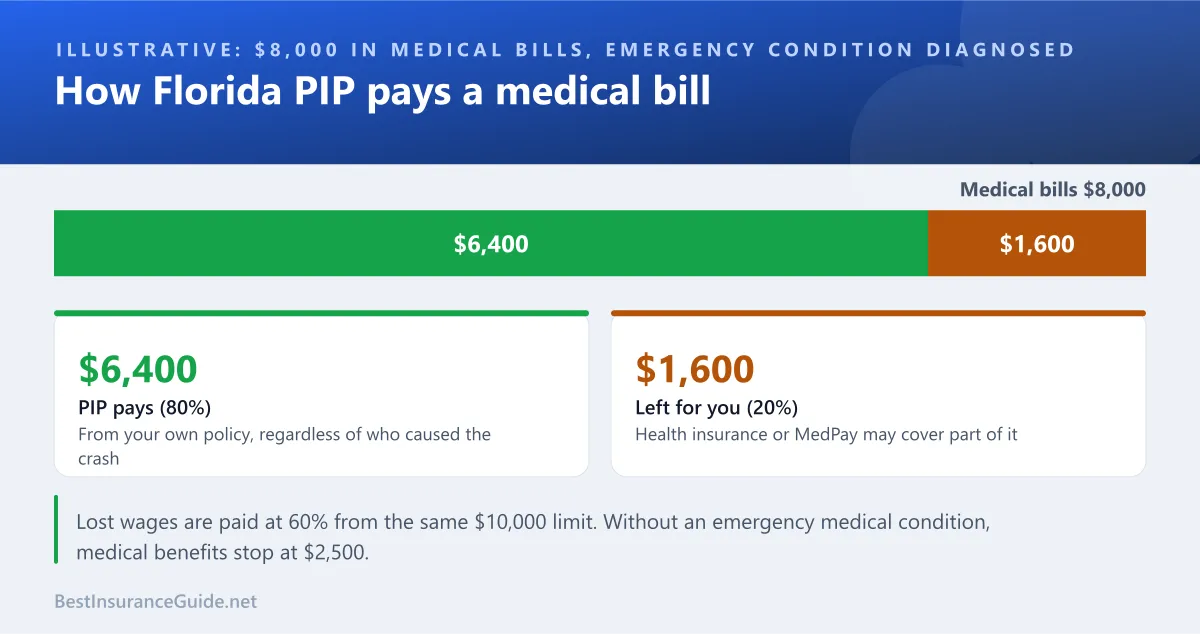
You’re rear-ended on I-95. You get care the same day, a doctor diagnoses an emergency medical condition, and your medical bills total $8,000. You have no PIP deductible.
- PIP pays 80%: $6,400.
- You owe the other 20%: $1,600. Your health insurance or medical payments coverage, if you bought it, may pick some of that up.
- You also miss two weeks of work and lose $2,000 in income. PIP pays 60% = $1,200, from the same $10,000 limit.
- Total PIP paid: $7,600. $2,400 of your $10,000 is left for any further treatment.
Illustrative. Deductibles, fee schedules and medical findings change the numbers.
The 14-day rule
This is the most important Florida PIP rule, and the one most people learn too late.
To use PIP medical benefits, you must get initial medical treatment within 14 days of the crash, from a qualifying provider such as a hospital, emergency room, physician or urgent care center. Miss the window and your PIP claim for medical bills can be denied outright.
Even if you feel fine, get checked. Neck, back and head injuries often show up days later, and by then the clock may have run out.
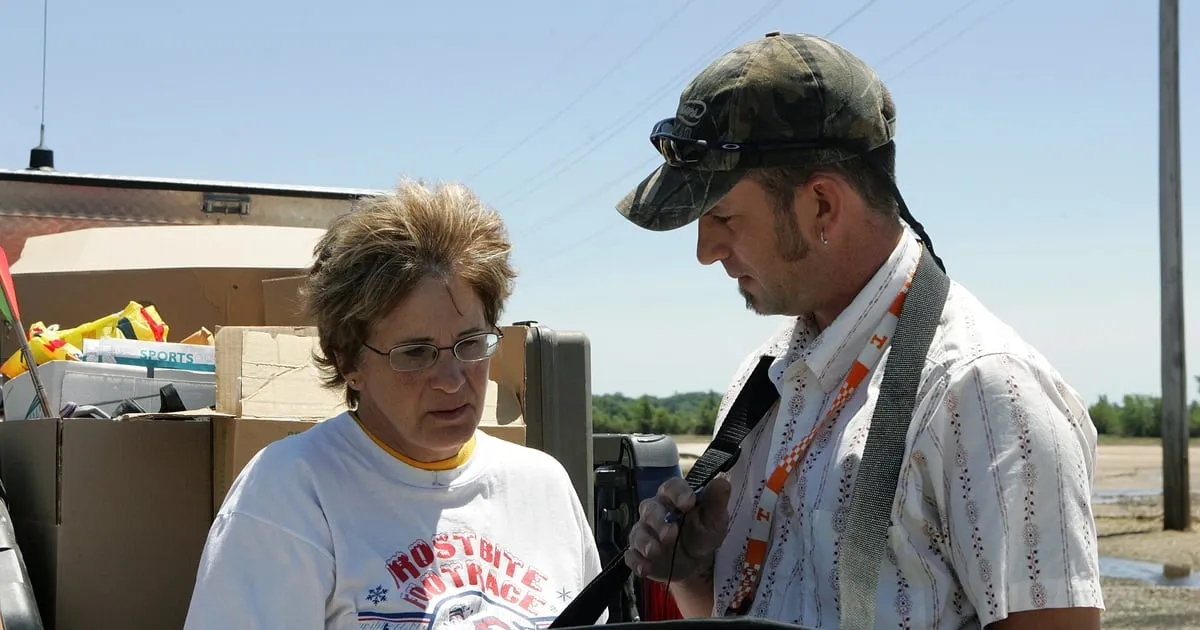
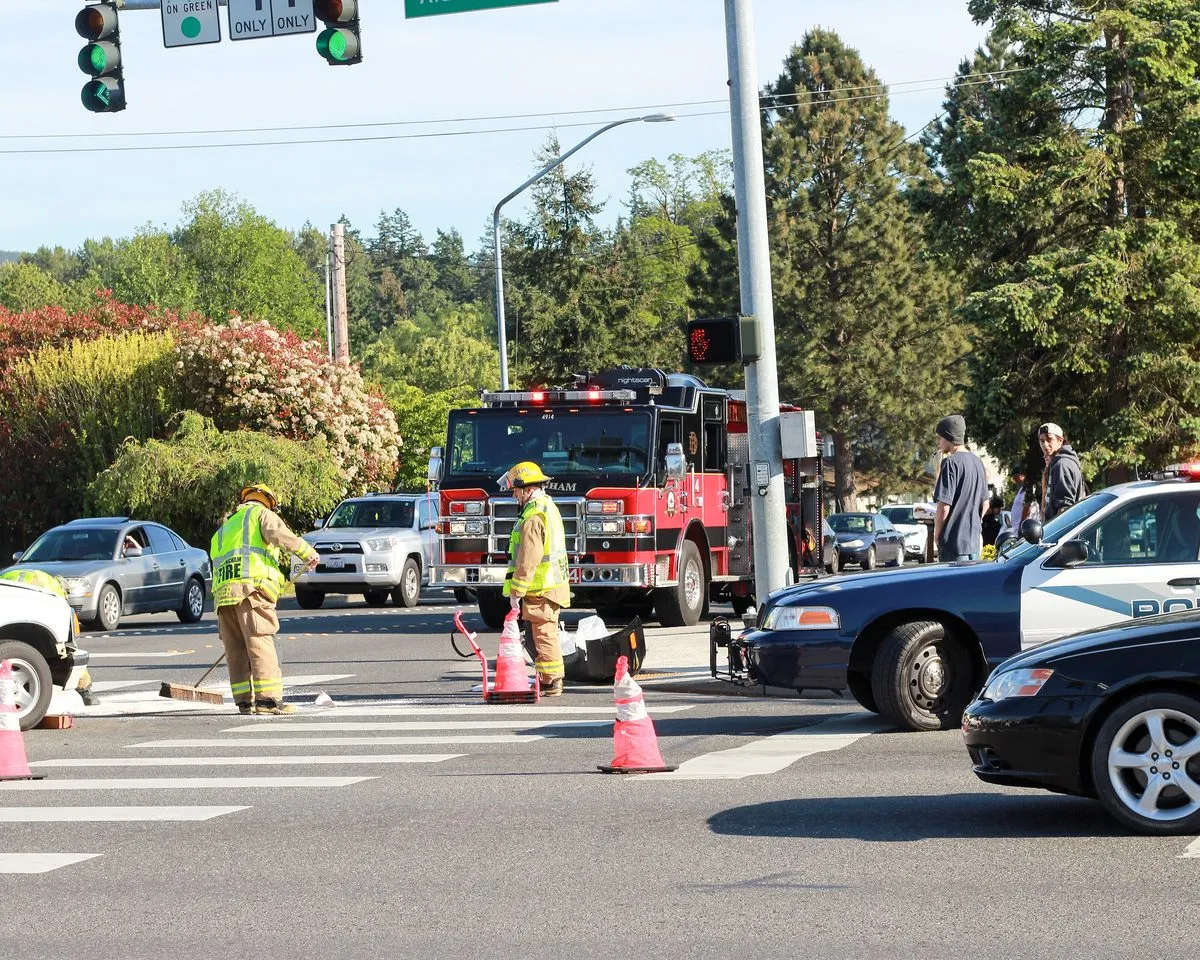 Photo: Alex Smith via Flickr (CC0).
Florida no-fault: who pays for car damage?
This trips up a lot of people. No-fault only covers injuries. Damage to vehicles is still handled based on fault:
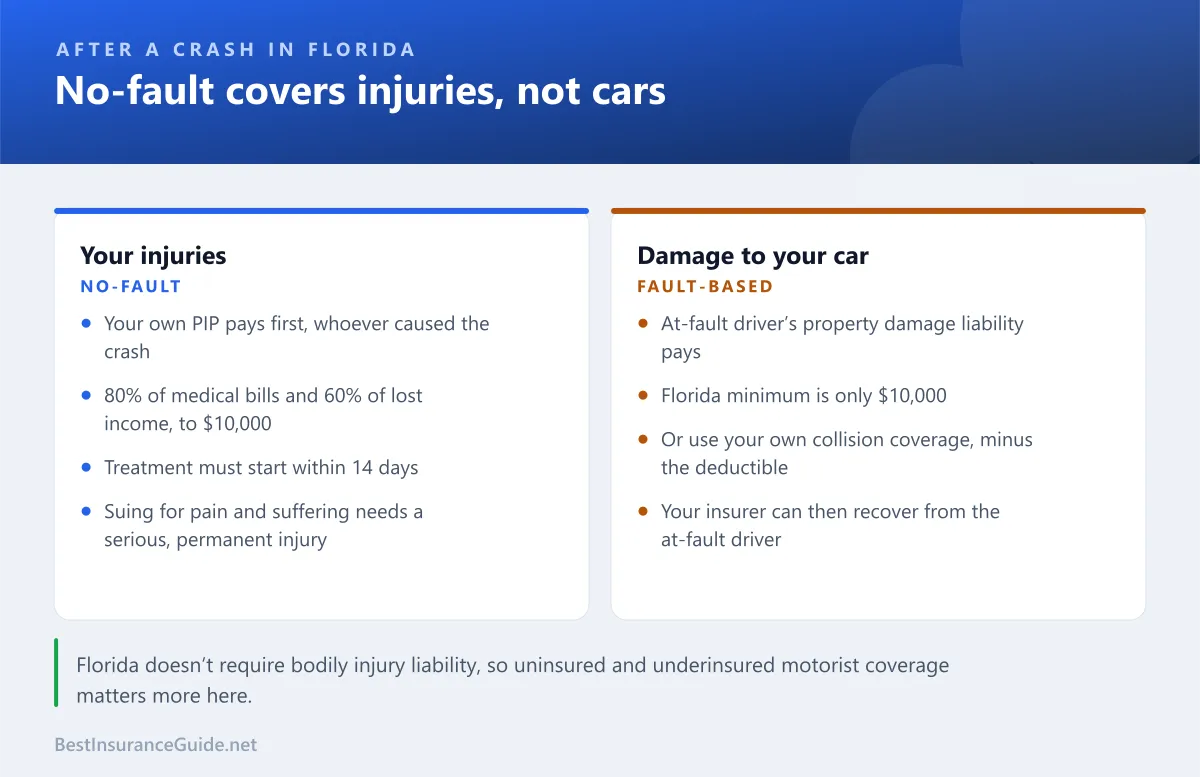
- If the other driver caused the crash, their property damage liability pays to repair or replace your car, up to their limit. In Florida, that may be only $10,000.
- If their coverage isn’t enough or they don’t cooperate, claim on your own collision coverage. You pay your deductible, and your insurer pursues the other driver and may get your deductible back.
- If you caused the crash, your property damage liability pays for the other driver’s car, and your collision coverage (if you have it) pays for yours.
- No collision coverage? You’d have to recover from the at-fault driver directly, or pay yourself if you were at fault.
After a Florida crash: a PIP checklist
Getting the first week right decides most PIP claims. In order:
- Call 911 if anyone is hurt. Florida law requires a crash report when anyone is injured or killed, among other situations.
- Swap details with the other driver: names, phone numbers, insurance companies and policy numbers, license plates. Photograph the scene, the cars and any injuries.
- Get medical care within 14 days, ideally the same day. Tell the provider you were in a car crash, and ask them to note whether you have an emergency medical condition.
- Report the claim to your own insurer promptly. Your PIP pays first, whoever was at fault.
- Keep every bill, receipt and pay stub. Lost-wage benefits need proof of income, and mileage to appointments may count as a medical expense.
- Open a separate property damage claim with the at-fault driver’s insurer, or with your own collision coverage.
- Talk to a lawyer before signing anything if your injuries are serious. That’s the situation where Florida’s tort threshold, and a claim beyond PIP, comes into play.
PIP for passengers, pedestrians and rideshare trips
- Passengers first claim on their own PIP, if they own a car. If they don’t, they claim on the PIP of the car they were riding in.
- Pedestrians and cyclists who are Florida residents and are hit by a car use their own PIP if they have it, and otherwise the striking car’s PIP.
- Rideshare passengers usually go through their own PIP first. Rideshare companies carry their own coverage for drivers and passengers, which can apply on top. Keep the trip receipt as proof.
Can you make two PIP claims in Florida?
Yes. PIP limits apply per accident. If you’re injured in two separate crashes, even in the same year, each accident has its own $10,000 PIP limit, minus any deductible. Each one also has its own 14-day rule.
Two things to know:
- Your insurer will investigate overlap. If treatment for the second crash is really for injuries from the first, PIP may dispute it.
- Multiple claims can raise your premium, especially at-fault accidents. Not-at-fault PIP claims usually affect rates less, but insurers look at your whole history at renewal.
Can you lower the cost of Florida PIP?
PIP is mandatory, but you have some control over its price:
- Choose a PIP deductible. Florida insurers offer deductibles, commonly up to $1,000, which lower your premium. You pay that amount before PIP kicks in.
- Exclude lost wages for yourself if you don’t work, for example if you’re retired, which can reduce the premium.
- Coordinate with health insurance. Some insurers offer cheaper PIP if your health insurance is primary for medical bills. Ask your insurer.
- Shop around. Florida auto rates are falling in 2026. The state’s five largest auto groups indicated an average change of about −8%. See car insurance refunds and 2026 rate cuts.
What could change in 2027
Nothing is scheduled. If the Legislature passes a repeal in the 2027 session and the governor signs it, expect:
- An effective date months later, not immediately.
- Mandatory bodily injury liability replacing PIP, probably at limits such as $25,000 per person and $50,000 per accident, as earlier bills proposed.
- Premium changes: higher for some drivers, lower for others, depending on how the bill is written.
We’ll update this page if a bill advances. For now, keep your PIP, add bodily injury liability and uninsured motorist coverage, and remember the 14-day rule.
Related reading
Florida automobile insurance is our full guide to Florida car coverage and costs. Car accident not your fault? explains what to do next, and does car insurance cover flood damage? matters in hurricane season.
Sources and notes
- Florida Senate, SB 522 (2026) bill history: “Died in Banking and Insurance”, March 13, 2026; proposed effective date January 1, 2027.
- Florida Senate, HB 1181 (2025) bill history: died in Judiciary Committee, June 16, 2025.
- Gov. Ron DeSantis veto of SB 54 (2021), June 29, 2021.
- Florida Statutes §627.733 (required security), §627.736 (PIP benefits, 14-day rule, emergency medical condition) and §627.737 (tort exemption and threshold).
- Florida Office of Insurance Regulation, January 2026 auto rate announcements.
- Photos: B137 (CC0) and Alex Smith (CC0), via Wikimedia Commons.
This article is general information, not legal advice. PIP rules are detailed and fact-specific. Talk to your insurer or a Florida attorney about a specific claim.