Does Renters Insurance Cover Mold? The Rule That Decides Every Claim
Renters insurance covers mold damage only when it follows a sudden, covered water loss, and usually caps payouts at $5,000. How the cause test works.

Table of contents
Mold is where renters insurance claims go to die, and almost always for the same reason.
The policy does not ask what the mold is. It asks where the water came from. Get that answer right and the claim is routine. Get it wrong, or answer it too late, and the denial letter writes itself.
So let us deal with the actual question. Does renters insurance cover mold? Conditionally, with a cap, and the condition does more work than most people expect.
The one test that decides everything
Every mold claim runs through a single question: was the water that caused this sudden and accidental, or was it gradual?
Sudden and accidental water is a covered peril on a standard renters policy. A supply line to the washing machine lets go. A pipe splits in a cold snap. The upstairs neighbour’s bath overflows. These are exactly the events the policy exists for, and the mold that follows within days is treated as part of that same loss.
Gradual water is not a peril at all. It is maintenance. A slow drip under the sink that ran for six months, humidity in a basement flat, condensation behind a wardrobe on an exterior wall, a roof that has been letting go a little at a time since last winter. None of that is an accident in insurance terms, so none of the mold that grows from it is covered.
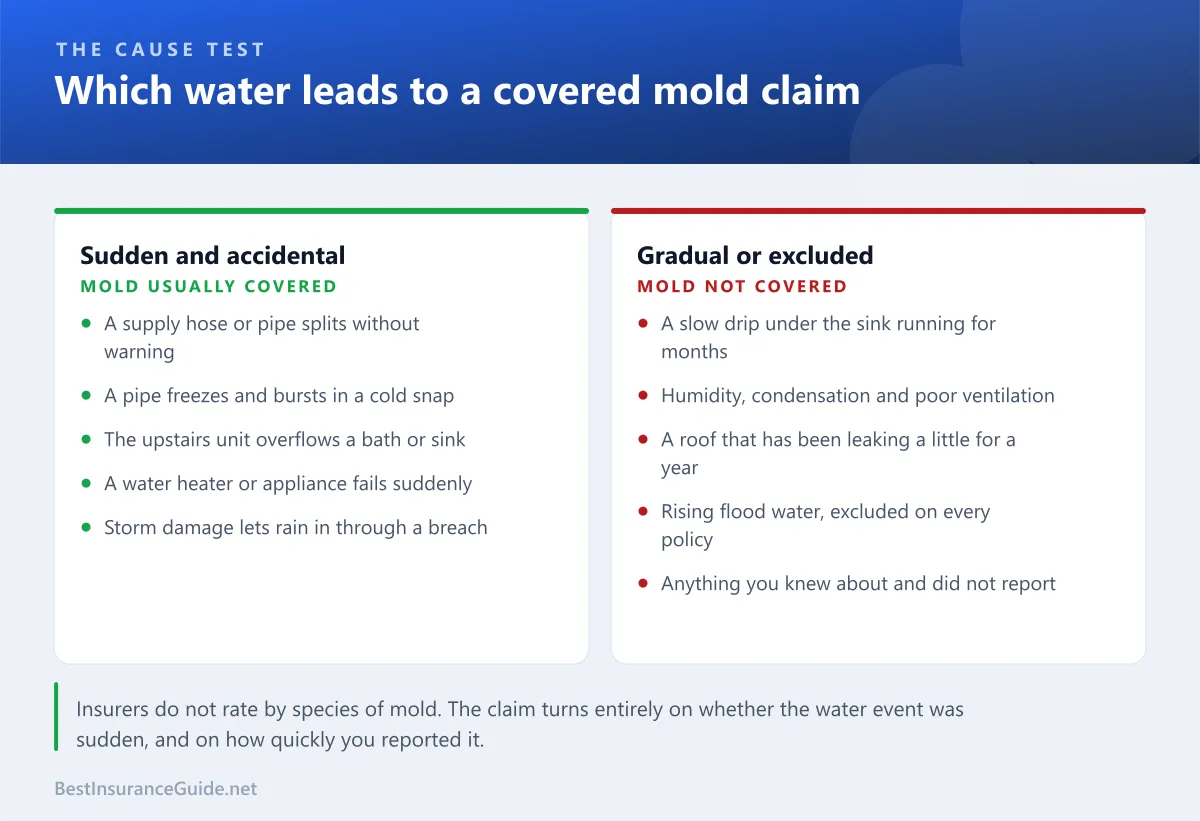
This is why two tenants with identical mold on identical walls can get opposite answers. The mold is not the claim. The water is.
Worked example: same bathroom, two outcomes
Two units in the same building, both with mold spreading across a bathroom wall.
| Detail | Unit 2B | Unit 4B |
|---|---|---|
| Source | Supply line behind the toilet split | Grout failure around the bath |
| How long before it was found | 2 days | Roughly 8 months |
| Classified as | Sudden and accidental discharge | Gradual seepage |
| Contents claim | Paid | Denied |
| Remediation | Paid to the sublimit | Denied |
| Tenant’s out of pocket | $500 deductible | $4,900 |
Unit 4B did nothing malicious. They just did not notice, and then did not report. That is enough.
Flooding is a different word than you think
This trips up more renters than anything else in the policy.
In insurance, flood means rising surface water: a river over its banks, a storm surge, water running across the ground and into the building. It is excluded from every standard renters policy in the country, and any mold that follows it is excluded with it.
What people usually mean by “my flat flooded” is a burst pipe or an overflowing appliance. That is not a flood. That is water discharge, and it is covered.
The distinction matters enormously for mold, because flood water sits, and mold after a genuine flood is both certain and uninsured. Renters can buy contents-only flood cover through the National Flood Insurance Program, which very few tenants realise is available to them. In a ground-floor or basement unit near any watercourse it is worth the quote.
The sublimit nobody reads
Here is the part that surprises people who do have a covered claim.
Mold does not draw on your full contents limit. It draws on a separate, much smaller mold sublimit buried in the policy, usually labelled “fungi, wet or dry rot, or bacteria.”
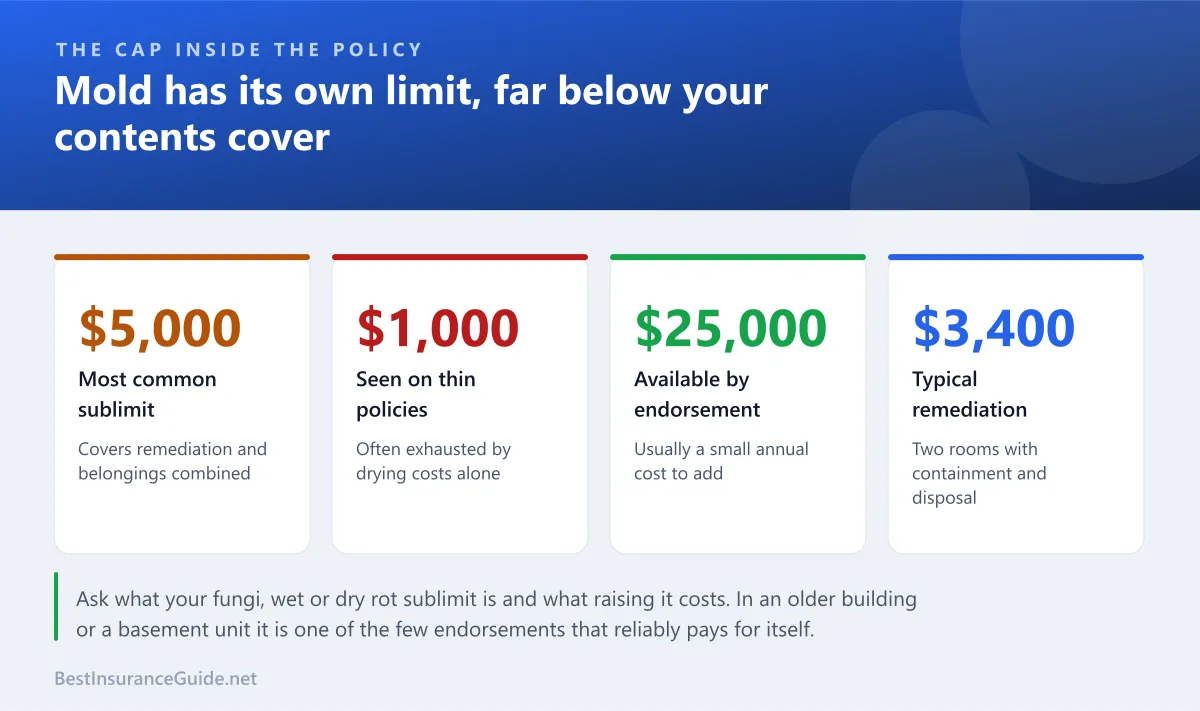
$5,000 is the figure you will see most often. Some policies write $1,000. Better ones, or ones with an endorsement, go to $10,000 or $25,000.
That cap has to cover remediation and your belongings, together. And professional remediation is not cheap.
Worked example: a covered claim that still ran out of room
A washing machine hose failed while the tenant was at work. Water ran for about six hours across a bedroom and hallway. Mold appeared on the skirting and behind the bed within four days. Everything below was accepted as covered.
| Item | Cost |
|---|---|
| Emergency water extraction and drying | $1,850 |
| Mold remediation, two rooms, containment and disposal | $3,400 |
| Mattress and bed base, unsalvageable | $1,100 |
| Clothing and soft furnishings from the affected wardrobe | $1,600 |
| Books, rug, two upholstered chairs | $900 |
| Total loss | $8,850 |
| Policy mold sublimit | $5,000 |
| Less deductible | $500 |
| Insurer paid | $4,500 |
| Tenant absorbed | $4,350 |
The claim was approved in full and the tenant still paid $4,350, because the sublimit ran out before the loss did.
The fix is boring and cheap: ask your insurer what your mold sublimit is, and what it costs to raise it. Going from $5,000 to $25,000 is usually a small annual amount. It is one of the few endorsements that reliably pays for itself in an older building.
Where the landlord comes in
A large share of mold in rented homes is structural: the roof, the exterior walls, the plumbing inside the walls, the ventilation. None of that is your property, and none of it is your policy’s problem.
If the mold traces back to something the landlord is responsible for maintaining, the claim is against them, through their liability cover, not through your contents policy. Your insurer will often tell you this directly and then pursue the landlord themselves through subrogation if they paid you first.
What this means practically is that the written notice matters more than the insurance does.
Tell your landlord in writing, dated, the day you find it. Email is fine and is better than a phone call because it timestamps itself. That single message is what later separates “the tenant reported it and the landlord sat on it” from “the tenant let it grow for eight months,” and those two stories have very different outcomes.
What to do in the first 48 hours
The window where a mold claim is winnable is short, and it closes on its own.
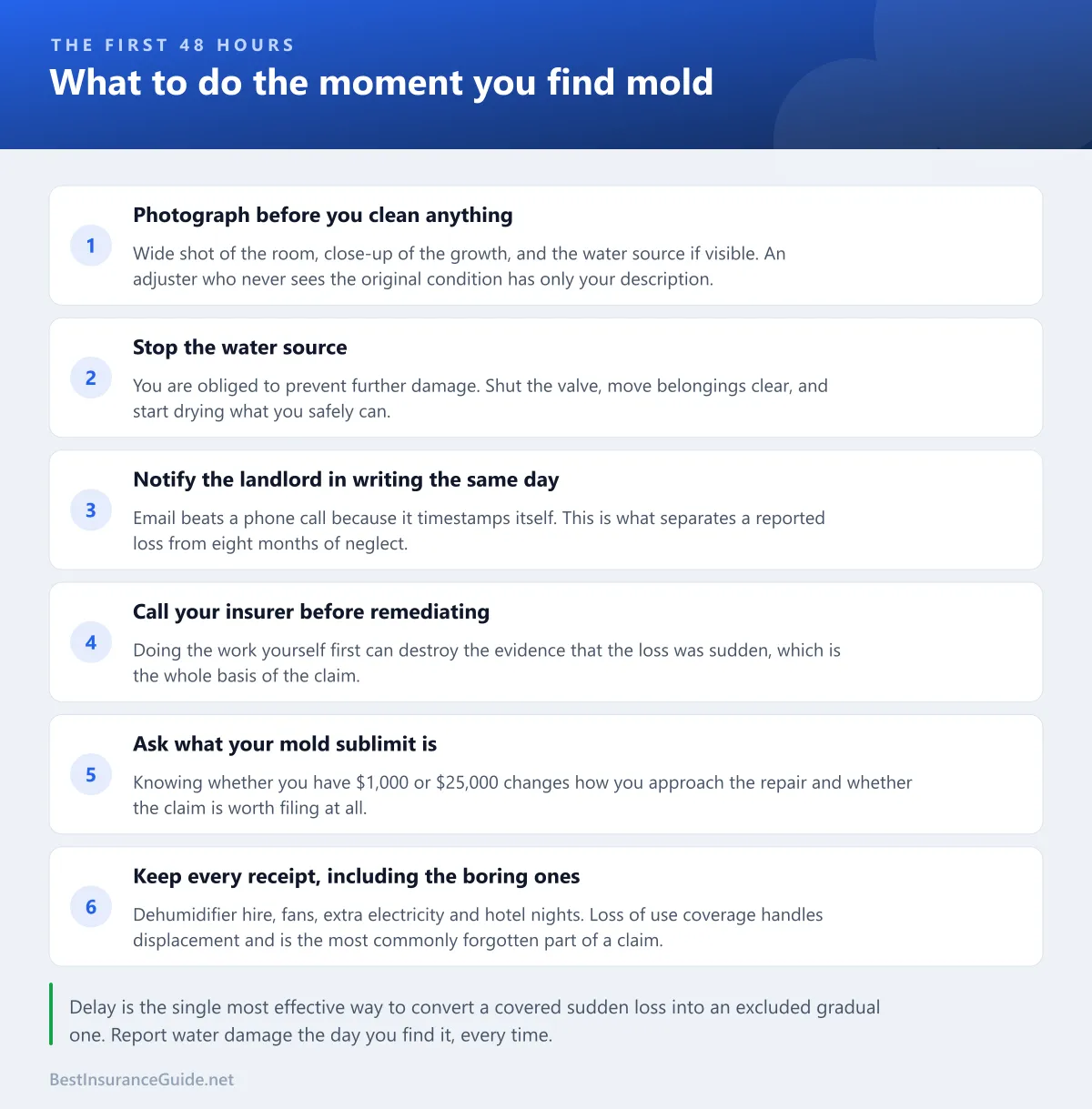
A few notes on that list, because the order matters.
Photograph before you clean. The instinct is to scrub it. Resist it for ten minutes. Wide shot of the room, close-up of the growth, and a shot of the water source if you can see it. An adjuster who never sees the original condition has only your description to work from.
Do not gut it yourself. You are obliged to prevent further damage, which means stopping the leak and drying what you can. You are not obliged to run remediation, and doing it yourself before the insurer inspects can destroy the evidence that the loss was sudden.
Keep the receipts, including the boring ones. Dehumidifier hire, fans, the extra electricity, a hotel if the unit is unliveable. Loss of use coverage handles displacement costs on a covered claim, and it is the coverage tenants most often forget to claim.
When it is not worth claiming
Not every mold problem should go through insurance.
A patch of surface mold on bathroom grout is a cleaning job, not a claim. It is almost certainly gradual, so it is not covered anyway, and a denied claim still sits on your CLUE record where the next insurer will see it when they quote you.
The rough test: if the remediation quote is close to or below your deductible, or the cause is obviously gradual, handle it yourself and put the effort into the landlord conversation instead.
Claiming makes sense when there was a clear sudden event, the damage crosses several hundred dollars, and you reported it promptly. That is the shape of a claim that gets paid.
Reducing the odds in the first place
Most of the mold in rentals is preventable by ventilation, which costs nothing.
Run the extractor fan during a shower and for twenty minutes after. Leave a gap between furniture and exterior walls so air moves behind it. Dry laundry outside or in a ventilated room rather than on a rack in a sealed bedroom. Check under the sink and behind the washing machine every few months, because that is where slow leaks start and slow leaks are the ones that are not covered.
If you are in a basement unit or a humid climate, a cheap hygrometer is worth having. Below 50% relative humidity, mold does not establish. Above 60%, it will find a way.
What to do if the claim is denied
A denial is a position, not a verdict, and a meaningful share of them are reversed.
Get the denial in writing with the specific policy language. Insurers must cite the clause they are relying on. “Gradual damage” is a conclusion; the wording is what you argue against.
Challenge the cause finding, not the coverage. Almost every mold denial turns on whether the water was sudden. If you have evidence it was, a plumber’s report, a dated photograph, a maintenance record showing the pipe was sound a month earlier, that is what moves it.
Ask for the adjuster’s report. In many states you can request it, and it often contains an assumption you can rebut directly.
Escalate before you litigate. Ask for a supervisor, then a formal internal appeal. If that fails, your state department of insurance takes complaints and insurers respond to them at a very different pace than they respond to policyholders.
Consider a public adjuster for larger claims. They work for you rather than the insurer, typically on a percentage. For a claim in the low thousands the fee rarely justifies it; above that it often does.
Keep in mind the deadline. Policies impose time limits on disputing a decision and on bringing suit, and those clocks start at the denial rather than at the loss.
A note on state variation
Mold coverage is one of the more state-variable areas of property insurance. Some states have taken a specific regulatory interest in mold sublimits and disclosure following periods of heavy claim activity, and required wordings differ.
The practical consequence is that a policy sold in one state may carry a materially different mold sublimit from an apparently identical policy sold in another, even by the same insurer. Your declarations page is the authority, and your state insurance department can confirm what is required locally.
Related reading
Pests follow the same gradual-damage rule as mold. See does renters insurance cover fleas?.
The short version
Renters insurance covers mold when it grows from a sudden covered water loss, up to a sublimit that is usually around $5,000 and is separate from your contents limit. It does not cover mold from humidity, slow leaks, neglect or flooding.
Three things do more than anything else to keep you on the right side of that line: report water damage the day you find it, ask your insurer what your mold sublimit is and whether you can raise it, and put every landlord notification in writing.
For the wider picture on what a renters policy does and does not do, our renters insurance guide walks through contents limits, liability and loss of use. If your question is about a storage unit rather than the flat itself, does renters insurance cover storage units deals with the off-premises limit specifically. And for how water damage is treated across the whole policy, what home insurance actually covers sets out the same rules from the owner’s side.