Do I Need Flood Insurance? How to Decide and How Much to Buy
Do you need flood insurance? When it is required, flood zones explained, risk outside high-risk areas, how much to buy and what drives zone AE rates.

Table of contents
“Do I need flood insurance?” is one of the most common questions people ask when they buy a home, and the honest answer has two parts. The first part is simple: in some cases your lender will require it, and you won’t get the mortgage without it. The second part is harder: even when nobody requires it, you may still need it, because floods don’t respect the lines on a flood map.
This guide covers both. It explains when flood insurance is required, how to read your flood zone, how to judge your risk if you’re outside a high-risk area, how much flood insurance you need, and what drives flood zone AE insurance rates under the NFIP’s current pricing system.
The short answer
- You must have flood insurance if your home is in a high-risk flood area (a zone starting with A or V) and you have a mortgage from a federally regulated or insured lender. That covers most mortgages, including FHA, VA and USDA loans and loans sold to Fannie Mae or Freddie Mac.
- You should seriously consider it if you live near water, in a low-lying area, below a dam or levee, in an area with heavy rainfall or poor drainage, or anywhere that has flooded before.
- You probably still want to price it if you’re in a moderate- or low-risk zone, because premiums there are usually much lower and flood damage is expensive whether or not your house sits inside a shaded area on a map.
One fact underlies all of this: standard homeowners and renters insurance does not cover flood damage. FEMA states it plainly: “Most homeowners insurance does not cover flood damage. Flood insurance is a separate policy that can cover buildings, the contents in a building, or both.” If you don’t buy a flood policy, a flood loss is paid out of your own pocket.
When flood insurance is required
The legal requirement comes from federal law and applies through your lender. It is known as the mandatory purchase requirement. In FEMA’s words, “Homes and businesses in high-risk flood areas with mortgages from government-backed lenders are required to have flood insurance.”
In practice, three things need to be true:
- The building is in a Special Flood Hazard Area, a high-risk zone labeled A, AE, AH, AO, AR, A99, V or VE on FEMA’s flood maps.
- The loan comes from a federally regulated or insured lender, or is backed by a federal agency or a government-sponsored enterprise. That describes most mortgages in the US.
- The community participates in the NFIP, which around 22,600 communities do. In high-risk areas of communities that don’t participate, federally backed loans are generally not available at all.
A few other situations can create a requirement:
- Your lender’s own rules. A lender can require flood insurance outside a high-risk zone if it sees a risk. That’s written into the loan agreement, not federal law.
- Past disaster assistance. If you received federal disaster assistance for flood damage, you may have to buy and keep flood insurance as a condition of that aid. If you let it lapse, you may not qualify for help after a future flood.
- Map changes. When FEMA updates a flood map and your home moves into a high-risk zone, your lender will tell you that coverage is now required.
If you own your home outright, no federal rule forces you to carry flood insurance, whatever your zone. The decision becomes yours, and it’s the same decision you’d face with any expensive but uncommon risk.
Understanding your flood zone
Your flood zone is the starting point, so look it up before you decide anything. You can find it on the FEMA Flood Map Service Center by entering your address. Your lender, your insurance agent or your local floodplain manager can also tell you.
The main zones fall into three groups:
| Zone | What it means | Annual flood chance | Required with a federally backed mortgage? |
|---|---|---|---|
| A, AE, AH, AO, AR, A99 | High-risk area, inland or riverine flooding | 1% or more (26% over 30 years) | Yes |
| V, VE | High-risk coastal area with wave action | 1% or more, plus storm waves | Yes |
| X (shaded), also called B | Moderate risk | Between 0.2% and 1% | No, but recommended |
| X (unshaded), also called C | Low risk | Less than 0.2% | No |
| D | Risk not yet determined | Unknown | No, but lenders may ask |
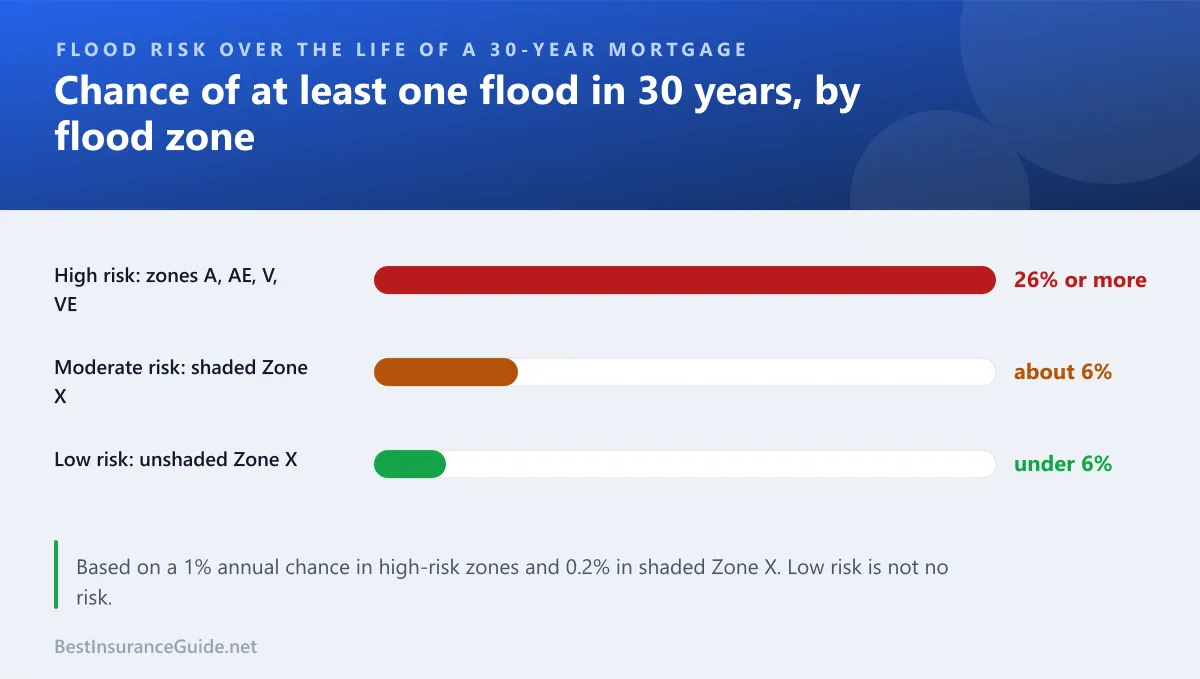
The “1% annual chance” sounds small. It isn’t, once you remember how long most people own a home. A 1% chance each year works out to roughly a 26% chance of at least one flood during a 30-year mortgage. For a shaded Zone X home, the 0.2% annual chance works out to about 6% over the same period.
Zone AE: the one most people ask about
Zone AE is the most common high-risk zone. The “E” means FEMA has calculated a base flood elevation (BFE), the height floodwater is expected to reach in a flood with a 1% annual chance. That number matters for insurance because it lets the insurer compare the height of your lowest floor with the expected flood height. A home whose first floor sits well above the BFE is a better risk than one that sits at or below it.
Do I need flood insurance if I’m not in a flood zone?
Strictly speaking, everyone is in a flood zone. “Not in a flood zone” usually means not in a high-risk zone. That distinction matters because a large share of flood claims come from outside those areas. According to FEMA’s FloodSmart program, nearly one-third (29%) of NFIP claims from 2014 to 2024 came from outside high-risk flood areas. If you’re in zone X, see our guide to flood zone X and flood insurance.
There are several reasons for this:
- Heavy rain overwhelms drainage. Intense downpours can flood streets and basements far from any river or coast.
- Maps lag reality. Flood maps are updated periodically, while development, paving and changing rainfall patterns alter how water moves.
- Levees and dams can fail or overtop. Areas behind them are often shown as lower risk, but the risk isn’t zero.
- Snowmelt and ice jams cause flooding in places that rarely see storm surge.
Because premiums in moderate- and low-risk areas are generally much lower than in high-risk zones, many homeowners find a policy is affordable enough to buy for peace of mind. Your agent can quote it in minutes, and the quote itself is often what settles the question.
Seven questions that answer “do I need flood insurance?”
If nobody requires you to buy it, work through these questions honestly. Two or more “yes” answers are a strong sign that a policy is worth pricing.
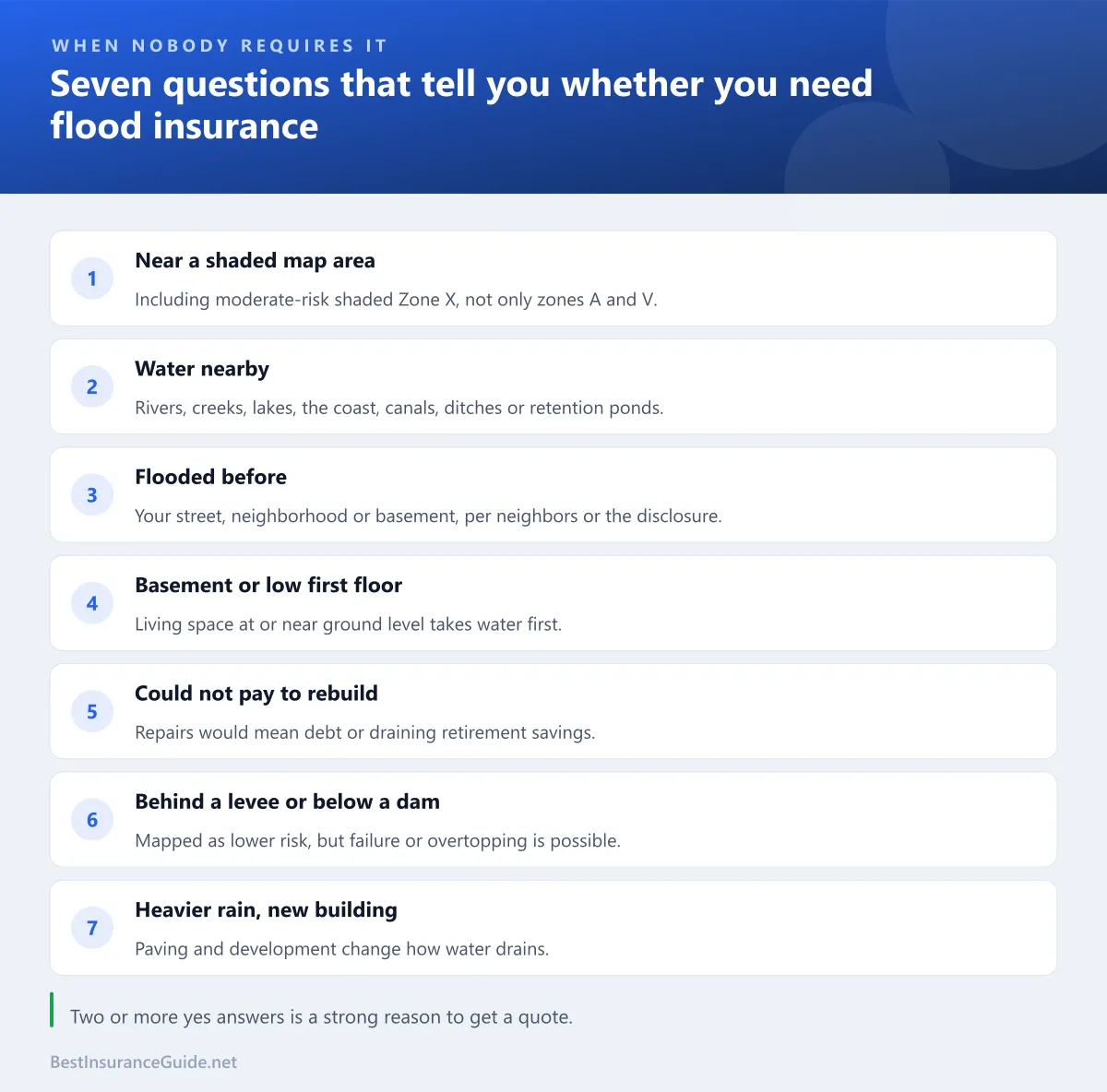
- Is your home in or near a shaded area on the flood map, including shaded Zone X?
- Is there water nearby? Rivers, creeks, lakes, the coast, canals, drainage ditches and retention ponds all count.
- Has your street, neighborhood or basement ever flooded? Ask neighbors and the seller, and check the seller’s disclosure.
- Do you have a basement or a first floor at or near ground level?
- Could you pay to repair or rebuild after a flood without taking on debt or draining your retirement savings?
- Do you live behind a levee or below a dam?
- Is your area seeing heavier rainfall or new development that changes how water drains?
Question five carries the most weight. The purpose of insurance is to protect you from losses you couldn’t absorb. If a flood would leave you unable to repair your home, the probability matters less than the consequences.
Why disaster assistance isn’t a substitute
For how the grants work in detail, including the current caps and how they fit with an insurance claim, see our guide to FEMA disaster assistance.
Some homeowners assume that if a major flood hits, the government will step in. That’s a risky assumption for three reasons.
- It needs a presidential disaster declaration. Many floods, including localized flash floods, never get one.
- Individual grants are limited. Federal assistance is generally designed to make a home safe, sanitary and habitable, not to restore it to how it was before the flood.
- Much of the help is a loan. A large share of post-disaster help comes as low-interest disaster loans, which have to be repaid on top of your mortgage.
A flood insurance policy, by contrast, pays for covered damage whether or not a disaster is declared, and it isn’t a loan.
How much flood insurance do I need?
Once you’ve decided to buy, the next question is how much. There are two parts to the answer: the building and your belongings.
Building coverage
Insure your home for what it would cost to rebuild it, not its market value. Market value includes the land, which a flood doesn’t destroy. Rebuilding cost depends on the size of the home, its finishes and local construction prices. Your homeowners policy’s dwelling limit is a reasonable starting point.
The NFIP caps residential building coverage at $250,000. If your home would cost more than that to rebuild, you have two options:
- Excess flood insurance, a separate policy from a private insurer that sits above the NFIP limit.
- A private flood policy that replaces the NFIP policy and offers higher limits on its own. Many lenders accept private flood policies that meet federal requirements, but confirm this with your lender before you switch.
Contents coverage
Building coverage doesn’t pay for your belongings. Contents coverage is separate, and on an NFIP policy it’s capped at $100,000 for a home. NFIP pays contents at actual cash value, meaning replacement cost minus depreciation, so older furniture and electronics are paid at what they’re worth now, not what new ones cost. Some private policies offer replacement cost on contents.
A quick home inventory is the best way to set the amount. Walk room by room, list the big items and estimate what it would cost to replace clothing, furniture, appliances and electronics. Most households are surprised at how quickly the total climbs.
A worked example
Consider a single-family home with a rebuild cost of $400,000 and about $80,000 of belongings.
- An NFIP building policy covers up to $250,000.
- An excess flood policy of $150,000 would cover the remaining rebuild cost.
- An NFIP contents policy of $80,000 would cover the belongings, at actual cash value.
- The homeowner pays the deductibles, which apply separately to building and contents on an NFIP policy.
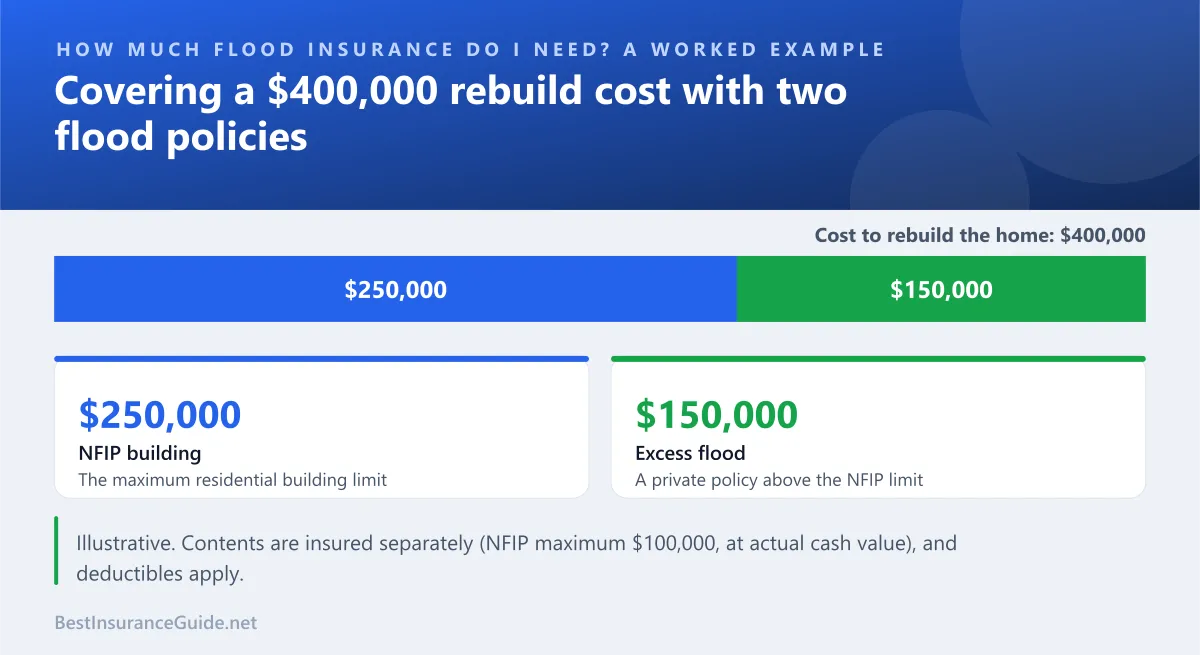
Without the excess layer, a total loss would leave a $150,000 gap between what NFIP pays and what it costs to rebuild. The figures here are illustrative. Your own numbers depend on your rebuild cost and what your belongings are worth.
Basement limits
If your home has a basement, it’s important to know that NFIP coverage below ground level is limited. Building coverage includes essentials such as the furnace, water heater, electrical panel, and foundation elements. Finished walls, flooring and most belongings stored in a basement are generally not covered. Keep valuables upstairs, and don’t count on a flood policy to pay for a finished basement.
Increased Cost of Compliance
A standard NFIP policy includes Increased Cost of Compliance (ICC) coverage of up to $30,000. It helps pay to bring a substantially damaged building up to current floodplain rules, for example by elevating it. This is separate from, and in addition to, your building limit, but it only applies when your community declares the building substantially damaged.
What affects flood insurance rates, including zone AE
Since the NFIP moved to its current pricing system, Risk Rating 2.0, premiums are based far more on the individual property than on the flood zone alone. That’s why two neighbors in the same AE zone can pay very different amounts. The main factors are:
- Distance to the water and the type of flood source, such as a river, the coast or heavy rainfall.
- Elevation, especially the height of your first floor compared with the base flood elevation.
- Rebuilding cost, because a more expensive home costs more to repair.
- Flood frequency in your area.
- Foundation type and number of floors.
- Prior flood claims on the property.
For existing policies moving to higher rates, federal law limits the increase. For most primary residences, premium increases are capped at 18% a year, so a policy whose full-risk price is higher rises gradually rather than all at once.
As a rough benchmark, an October 2026 Associated Press analysis found the average NFIP policy now costs about $1,100 a year, up roughly 90% over five years. A home in Zone AE with a low first floor will often pay much more than that, and a well-elevated home in a low-risk area can pay far less. Only a quote for your address will tell you your price.
Ways to lower the cost
- Get an elevation certificate. It isn’t required for every policy, but it can document that your home sits higher than the insurer would otherwise assume.
- Raise your deductible. A higher deductible lowers the premium, but make sure you could afford it after a flood.
- Mitigate. Elevating utilities and installing flood openings in enclosures can reduce the premium, and some communities earn discounts through FEMA’s Community Rating System.
- Compare private flood insurance. Private insurers price differently, and some are cheaper for certain properties. Check the coverage details as closely as the price.
Don’t forget the 30-day wait
A standard NFIP policy generally takes 30 days to begin after you buy it. FEMA notes exceptions for coverage bought because a lender requires it at closing, and for certain purchases connected to a flood map change. In practice, you can’t wait until a storm is in the forecast. By the time the rain arrives, the waiting period will still be running.
This is the strongest argument for making the decision now, while the weather is calm, rather than during hurricane season or spring snowmelt.
Renters and condo owners need flood insurance too
Flood insurance isn’t only for homeowners.
- Renters can buy contents-only flood coverage. The landlord’s policy covers the building, not your belongings. Our guide to whether renters insurance covers flood damage covers this in detail.
- Condo owners are usually covered by the association’s master flood policy for the building, but that often doesn’t cover the inside of your unit or your belongings. Unit owners can buy their own NFIP policy for their unit and contents.
- Mobile and manufactured home owners are eligible for NFIP coverage too, which matters because homeowners policies on these homes also exclude flood. See our guide to older mobile home insurance.
- Landlords should consider building coverage on rentals, since a standard landlord policy excludes flood just like a homeowners policy. Our landlord insurance cost guide explains what those policies do and don’t cover.
How to buy flood insurance
- Look up your flood zone on FEMA’s Flood Map Service Center.
- Estimate your rebuild cost and list your belongings.
- Ask your home insurance agent for an NFIP quote. Most NFIP policies are sold through private insurers under FEMA’s Write Your Own program, so your current insurer may be able to write one.
- Get at least one private flood quote for comparison, especially if your rebuild cost is above $250,000.
- Decide on building and contents limits and the deductible.
- Buy early so the 30-day waiting period doesn’t catch you out.
- Keep documents safe, including your policy, photos of your home and belongings, and receipts, stored somewhere a flood can’t reach, such as the cloud.
When you compare policies, ask how each one values a loss. Our guide to replacement cost vs actual cash value explains why that difference matters so much when you file a claim. It’s also worth reading what homeowners insurance covers so you know exactly where your standard policy stops and flood coverage begins.
The bottom line
You’re required to buy flood insurance if you have a federally backed mortgage on a home in a high-risk zone. You need it, in the practical sense, whenever a flood would cause damage you couldn’t pay to repair. That includes many homes outside the high-risk zones, where a significant share of flood claims occur.
Check your zone, price a policy, insure for your rebuild cost rather than market value, and don’t wait for a forecast to act. A flood policy costs far less than rebuilding a home without one.
BestInsuranceGuide.net is independent and not affiliated with FEMA or any insurer. Coverage limits and program rules described here reflect FEMA and NFIP information at the time of writing. Confirm details and pricing with a licensed agent or insurer before you buy.