Is Boat Insurance Required? State Laws, Lenders, Marinas and What It Costs
Is boat insurance required? Which states require it, when lenders and marinas do, the average cost of boat insurance and insuring older boats.

Table of contents
Is boat insurance required? For most boat owners, the law says no. Only a handful of states require it, and even those limit the rule to certain boats. But that’s only half the answer. When you finance a boat, keep it at a marina, or rent a slip at a state-run harbor, someone else is very likely to require it, and the cost of an accident on the water can far exceed the value of the boat itself.
This guide explains which states require boat insurance, the other places where you’ll be asked for proof of coverage, the average cost of boat insurance, why your homeowners policy probably isn’t enough, and what to know about insuring an older boat.
The short answer
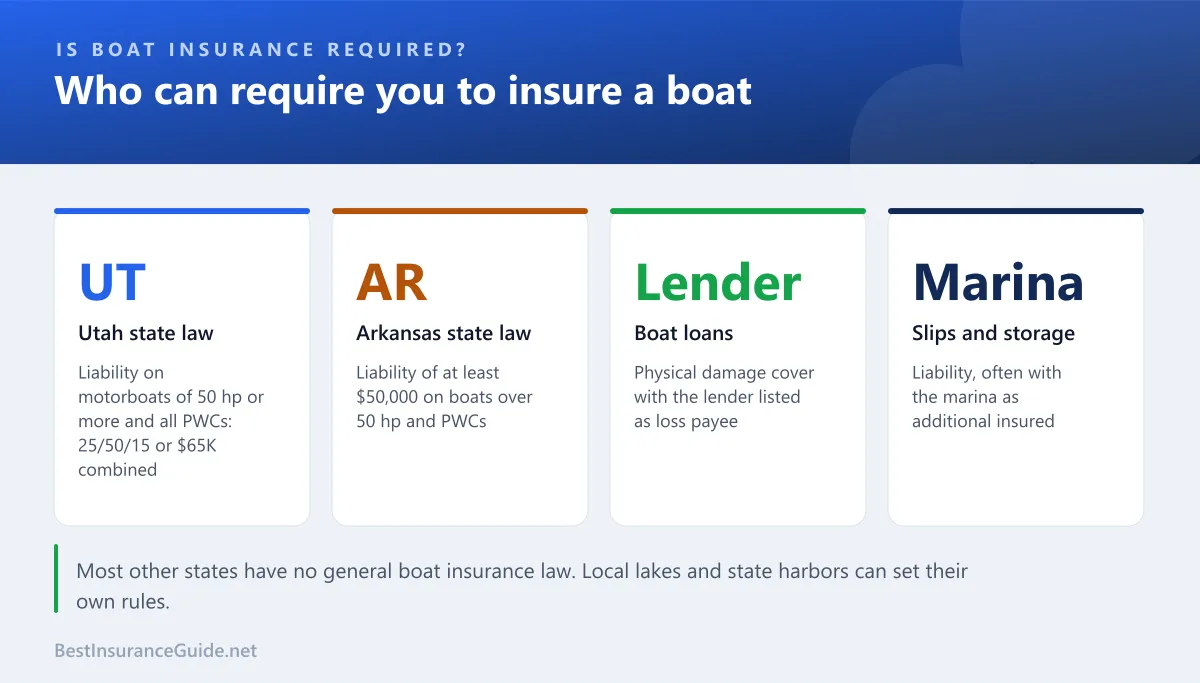
- State law: Most states don’t require boat insurance. Utah and Arkansas require liability coverage on many motorboats and on personal watercraft. Some sources also list Hawaii, where state harbor mooring permits require liability insurance.
- Lenders: If you finance a boat, the lender will almost always require physical damage coverage and list itself on the policy.
- Marinas and storage: Many marinas, yacht clubs and storage facilities require liability insurance before you can rent a slip or storage space.
- Common sense: Even when nobody requires it, liability insurance protects you from lawsuits if you injure someone or damage another boat or a dock.
Which states require boat insurance?
Utah
Utah requires owner’s or operator’s liability insurance for motorboats with engines of 50 horsepower or more and for all personal watercraft (PWCs such as jet skis) operated on Utah waters. The minimum limits are:
- $25,000 for bodily injury or death of one person
- $50,000 for bodily injury or death of two or more people in one accident
- $15,000 for property damage
A single combined limit of $65,000 per accident also meets the requirement. Motorboats under 50 horsepower and airboats are exempt, and you should carry proof of insurance on board.
Arkansas
Arkansas requires liability insurance on boats powered by more than 50 horsepower and on personal watercraft. A boat with exactly 50 horsepower doesn’t need it. The policy must provide at least $50,000 of liability coverage per occurrence, and proof of insurance must be carried on board and shown to an enforcement officer on request. Arkansas also asks for proof of insurance when you register a boat that falls under the rule.
Everywhere else
In most other states, there’s no general law requiring recreational boat owners to carry insurance. That doesn’t mean there are no rules. Local lakes, reservoirs and parks sometimes set their own conditions, and state-run harbors may require insurance for mooring or slip permits. Check with your state boating agency and the managers of the waters you use. Rules change, so confirm the current law before you launch.
When lenders and marinas require boat insurance
In practice, most boat owners are asked for insurance by a lender or a marina long before a state officer asks.
Boat loans
If you finance a boat, your loan agreement will almost certainly require:
- Physical damage coverage for the boat, usually for at least the loan balance.
- The lender listed as a loss payee, so any payment for a total loss goes to the lender first.
- Continuous coverage for the life of the loan. If your policy lapses, the lender may buy coverage for you and add it to your loan, usually at a much higher price and with less protection.
Marinas, yacht clubs and storage
Many marinas require slip holders to carry liability insurance, often at limits of several hundred thousand dollars or more. They commonly ask to be named as an additional insured and to receive a certificate of insurance. Our guides to additional insured status and certificates of liability insurance explain how those documents work.
Some marina contracts also include a waiver of subrogation, which stops your insurer from recovering its costs from the marina after a loss. That can affect how claims are handled, so read the slip agreement before you sign it. Our waiver of subrogation guide explains what that clause means.
Do you need boat insurance if nobody requires it?
For a paid-off boat in a state without a law, the decision is yours. Here are the reasons many owners still buy coverage.
- Liability exposure is the real risk. Hitting a swimmer, a water-skier, another boat or a dock can lead to a claim far larger than the boat is worth.
- Guest injuries happen. Slips on a wet deck, tubing accidents and falls while boarding are common, and your guests or their health insurers may look to you for payment.
- Fuel spills and wreck removal can be expensive. If your boat sinks, you may be responsible for removing the wreck and cleaning up fuel.
- Storms, theft and fire can destroy a boat on its trailer at home as easily as on the water.
- Uninsured boaters are common. Because insurance isn’t required in most states, the other boat in an accident may have no coverage at all.
Does homeowners insurance cover a boat?
This is the most common assumption, and it’s often wrong. Many homeowners policies do cover small boats, but only in a limited way.
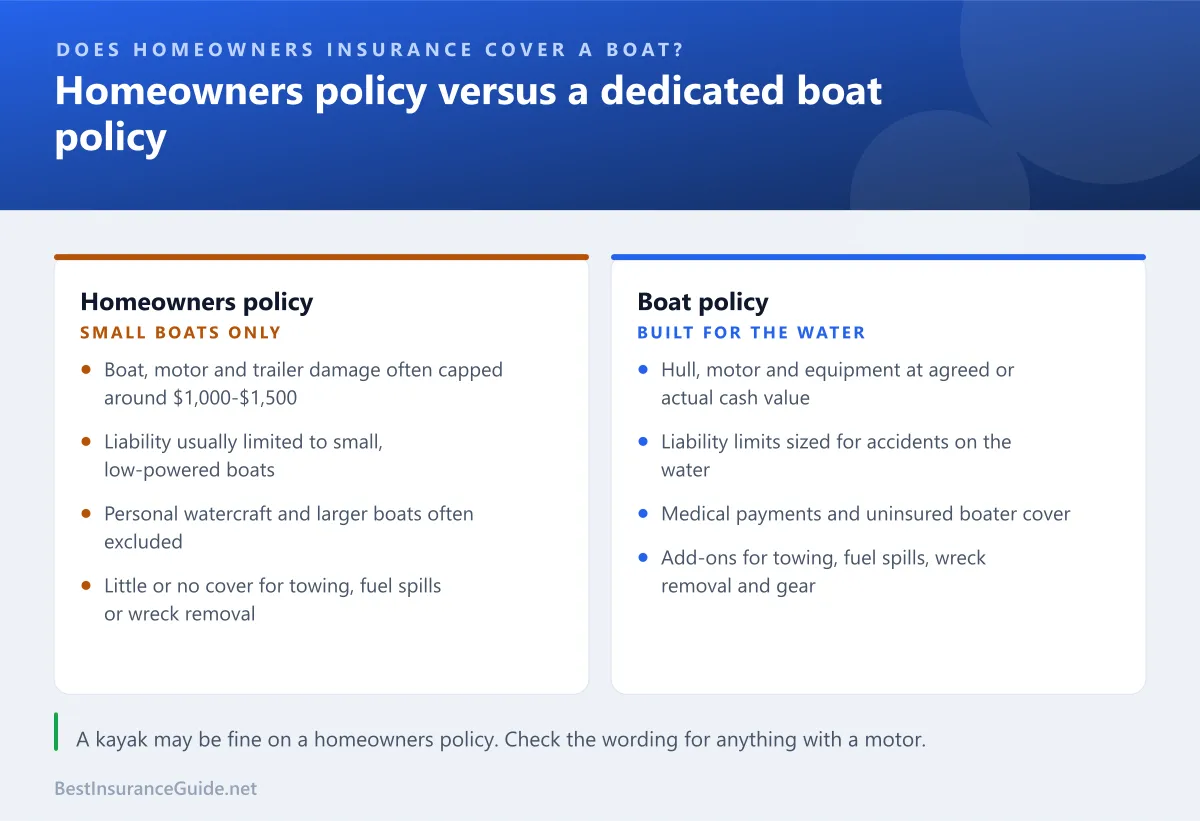
- Physical damage to a boat, its motor and trailer is often capped at a low figure, commonly around $1,000 to $1,500, and may only apply to certain perils.
- Liability usually applies only to small, low-powered boats, such as canoes, kayaks, small sailboats and boats with small outboard motors. Larger inboard boats, higher-horsepower outboards and personal watercraft are often excluded.
- Coverage away from home may be limited or excluded, including when the boat is on the water.
A kayak or a small rowboat may be adequately covered by your homeowners policy. For a powerboat, a sailboat of any size or a personal watercraft, check the policy wording, and assume you need a separate boat policy until your insurer tells you otherwise in writing. Our guide to what homeowners insurance covers explains the standard limits.
What boat insurance covers
A typical boat policy combines several coverages:
- Physical damage to the hull, motor and equipment from collisions, storms, fire, theft and vandalism.
- Liability for injuries and property damage you cause to others, including legal defense.
- Medical payments for injuries to you and your passengers.
- Uninsured boater coverage for your injuries when an uninsured boater is at fault.
- Trailer coverage, which is often included or available as an add-on.
Common add-ons include on-water towing and assistance, fuel spill liability, wreck removal, personal effects such as fishing gear and electronics, and hurricane haul-out coverage, which helps pay to remove a boat from the water ahead of a named storm.
The average cost of boat insurance
Boat insurance is generally cheaper than car insurance, but the range is wide. According to Boat Ed, premiums for smaller boats typically run about $25 to $75 a month, and annual premiums generally fall between 1% and 5% of the boat’s value. Larger or high-performance boats can cost $100 to $300 or more a month.
| Boat | Rough annual premium |
|---|---|
| Small fishing boat, jon boat or older runabout | A few hundred dollars |
| Mid-size runabout or pontoon boat | Several hundred dollars to over $1,000 |
| High-performance boats and yachts | Often 1%–5% of the boat’s value, or more |
These are broad ranges, not quotes. Your price depends on your boat, where you use it and how much coverage you buy.
What drives the price
- Value, size and type. Bigger, faster and more valuable boats cost more. High-performance boats and personal watercraft carry more risk.
- Where you use it. Coastal waters and hurricane-prone areas are generally more expensive than inland lakes.
- Navigation limits and lay-up period. Agreeing to keep the boat out of the water for part of the year, or within certain waters, can lower the premium.
- Coverage choices. Liability-only is the cheapest option. Agreed value coverage, high liability limits and add-ons all raise the cost.
- Your experience. Boating safety courses, years of experience and a clean record often earn discounts.
- Storage and security. Secure storage, anti-theft devices and GPS tracking can help.
Insuring an older boat
Many owners buy older boats because they’re affordable, and insurers will cover them, but the process is different.
Agreed value vs actual cash value
This is the most important choice for an older boat.
- Agreed value coverage pays the value you and the insurer agree on when you buy the policy, minus the deductible, if the boat is a total loss.
- Actual cash value (ACV) coverage pays the boat’s value at the time of the loss, after depreciation. On an older boat, that can be far less than you’d need to buy a similar boat.
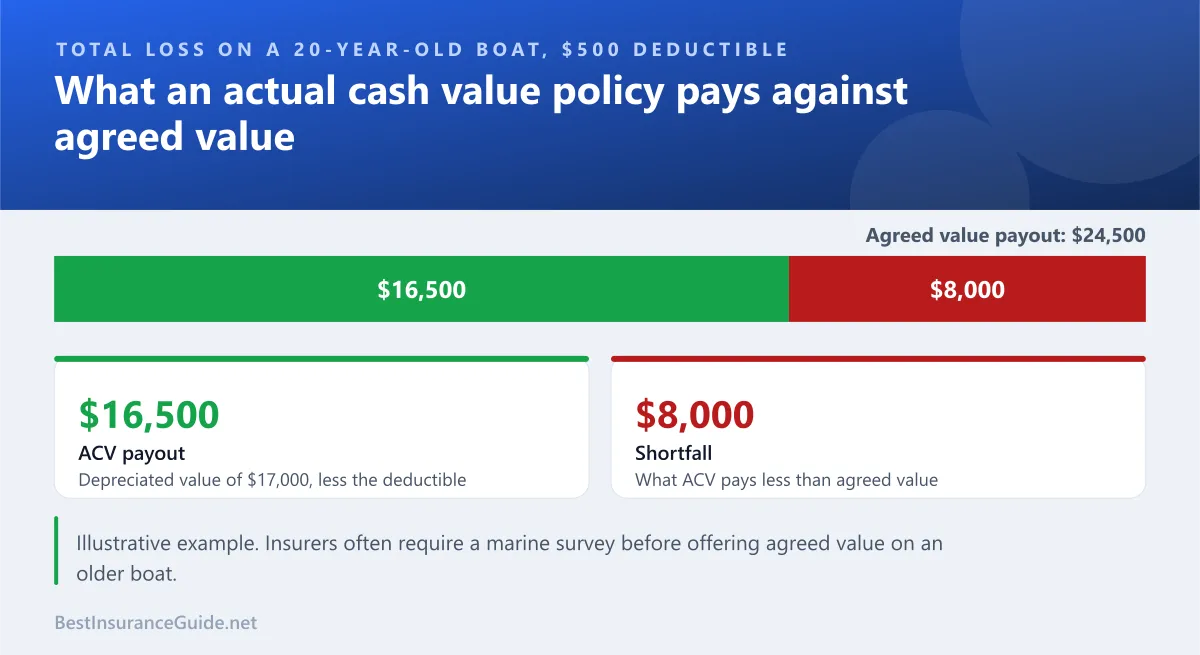
Example: You insure a 20-year-old boat for an agreed value of $25,000. It’s destroyed in a storm. With agreed value coverage and a $500 deductible, the insurer pays $24,500. If the policy were ACV, and the insurer valued the boat at $17,000 after depreciation, you’d receive $16,500 instead, leaving an $8,000 difference. These figures are illustrative. For more on the difference, see our guide to replacement cost vs actual cash value.
Many insurers limit agreed value coverage to boats under a certain age, or require a survey before they’ll offer it.
Marine surveys
For older or higher-value boats, insurers often ask for a marine survey, an inspection by a qualified surveyor that reports the boat’s condition and value. It can feel like an extra expense, but it has three benefits:
- It supports the agreed value, which can prevent disputes after a loss.
- It identifies problems, such as corrosion, soft decks, wiring faults and hull damage, before they cause a claim.
- It may be the only way to get coverage on a boat past an insurer’s age limit.
Some surveys come with recommendations that the insurer requires you to complete within a set period, such as replacing old fuel lines or adding a fire extinguisher. Complete those items and keep the receipts.
Tips for older boats
- Keep maintenance records, including engine service, bottom paint and electrical work.
- Upgrade safety equipment, such as bilge pumps, fire suppression and battery switches.
- Shop around. Standard insurers may decline an older boat that a specialty marine insurer is happy to write.
- Be honest about modifications. Repowering with a bigger engine or other changes can affect coverage if they aren’t disclosed.
How to buy boat insurance
- Check your state’s rules and any requirements for the waters you use.
- Read your loan and marina agreements for required coverages, limits, additional insured wording and waivers.
- Check your homeowners policy so you know what, if anything, it already covers.
- Decide on agreed value or ACV, liability limits and deductibles.
- Get quotes from several insurers, including marine specialists. An independent agent or broker can help; see our guide to insurance brokers vs agents.
- Ask about discounts for safety courses, lay-up periods and storage.
- Keep proof of insurance on board, especially in Utah and Arkansas.
If you also use a golf cart or other small vehicle around a lake community, our guide to golf cart insurance covers how those vehicles are insured.
Related reading
Boating on the coast up north? Boat insurance in Maine covers moorings, ledges and winter lay-up.
South Carolina has no boat insurance law yet, but a bill has been proposed. See boat insurance in South Carolina for marina, lender and hurricane rules.
The bottom line
Is boat insurance required? By state law, only in a few places, mainly Utah and Arkansas for many motorboats and personal watercraft. In practice, it’s required far more often: by lenders if you finance the boat, and by many marinas if you keep it in a slip.
Even when it isn’t required, liability coverage is the part most boat owners need, because an accident on the water can cost much more than the boat. Check your homeowners policy, decide how you want the boat valued, and compare quotes before the season starts.
BestInsuranceGuide.net is independent and not affiliated with any insurer, marina or state agency. State boating rules can change, so confirm current requirements with your state boating agency before you rely on them. Cost ranges are commonly quoted figures, not quotes.