Golf Cart Insurance in Florida: Not Required, But Rarely Optional
Is golf cart insurance required in Florida? Golf carts vs low-speed vehicles, what golf cart liability covers, what it costs and how to get it.

Table of contents
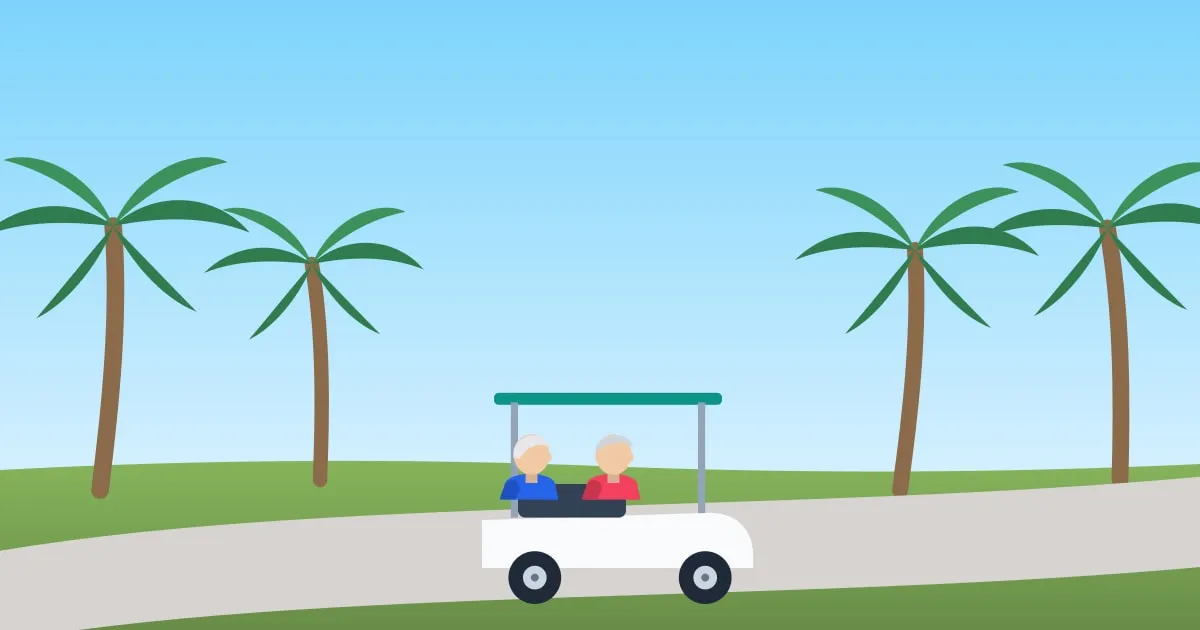
Florida has more golf carts on its streets than almost anywhere else in the country. In golf cart communities, beach towns and retirement developments across the state, they are a normal way to get to the shops, the pool and the neighbors’ house. That everyday use is exactly why golf cart insurance in Florida matters: a golf cart has no doors, little protection and a driver who may be 14 or 84, and it often shares the road with cars.
This guide explains when golf cart insurance is required in Florida, the crucial difference between a golf cart and a low-speed vehicle, what golf cart insurance covers, how much it costs, and why a homeowners policy is often not enough.
Is golf cart insurance required in Florida?
For a standard golf cart, no. Florida exempts golf carts from registration and titling when they are operated in line with the state’s golf cart rules, and it does not require insurance on them.
For a low-speed vehicle, yes. A low-speed vehicle (LSV) must be titled, registered and insured with at least:
- $10,000 of personal injury protection (PIP); and
- $10,000 of property damage liability (PDL).
These are the same minimums Florida requires for cars. Florida’s no-fault PIP law remains in effect; bills to repeal it were filed again in the 2026 legislative session but did not pass. Our guide to Florida automobile insurance explains how PIP and PDL work.
The fact that insurance is not required on a golf cart does not mean the owner is protected. If you injure someone or damage their property while driving a golf cart, you can be personally liable, and Florida’s golf cart rules do nothing to cap that.
Golf cart or low-speed vehicle?
The distinction decides your legal obligations, where you can drive and how you insure the vehicle.
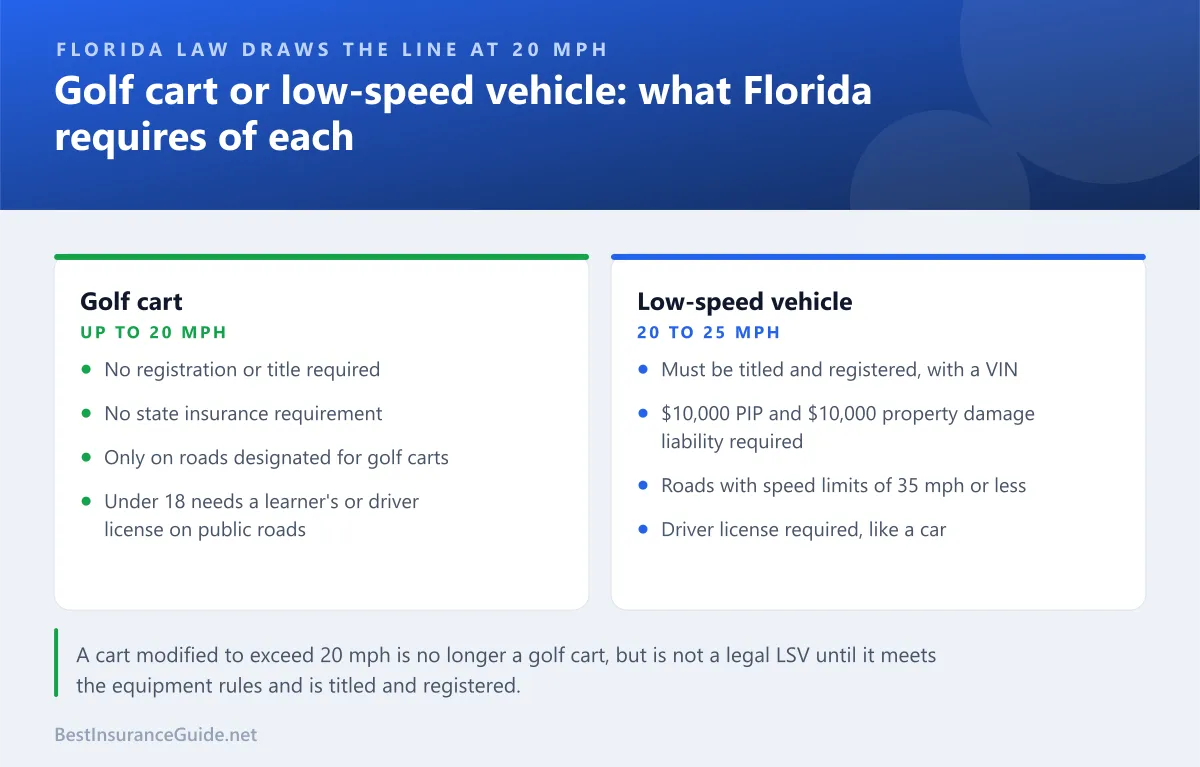
A golf cart is designed and manufactured for golf and cannot exceed 20 mph. In Florida it may be driven only on roads that the county or municipality has designated for golf cart use, and on certain other roads under specific conditions set out in the statute. Local governments may add equipment requirements, such as lights for driving after dark.
A low-speed vehicle has a top speed greater than 20 mph but not more than 25 mph, and must have safety equipment including headlights, stop lamps, turn signals, mirrors, a windshield, seat belts and a VIN. LSVs may use roads with a posted speed limit of 35 mph or less, and require a driver’s license.
Modified carts are the trap. A golf cart that has been modified to go faster than 20 mph is no longer a golf cart under the definition, but it is not automatically a legal LSV either. Converting a cart to an LSV requires meeting the equipment standards and going through Florida’s inspection and titling process. An unregistered, modified cart may leave you both illegal and uninsured.
Who can drive a golf cart in Florida?
Florida tightened the rules effective October 1, 2023:
- Under 18: must hold at least a learner’s license or driver license to drive a golf cart on public roads.
- 18 and older: must carry valid government-issued photo ID.
Before that change, 14-year-olds could drive golf carts on designated roads without any license. Families with teenagers should check both the law and their insurer’s rules on younger drivers. Our guide to car insurance for young drivers covers why insurers price inexperienced drivers so differently.
Does homeowners insurance cover a golf cart?
This is where many Florida owners are caught out.
Homeowners policies generally exclude motorized vehicles, with narrow exceptions. Depending on the insurer and the policy form, those exceptions may cover a golf cart:
- while used for golfing on a golf course;
- within certain private residential communities;
- while on your own property.
Coverage on public roads is commonly excluded, and coverage for damage to the cart itself may be limited or unavailable. Some Florida insurers offer a golf cart endorsement on the homeowners policy; many owners find a separate golf cart policy clearer. Our guide to what home insurance covers explains the liability section in more detail.
Car insurance usually does not cover golf carts either. An auto policy covers the vehicles listed on it. Some insurers let you add a golf cart or LSV to the same account, which can bring multi-policy discounts.
What golf cart insurance covers
A golf cart policy mirrors a car policy on a smaller scale.
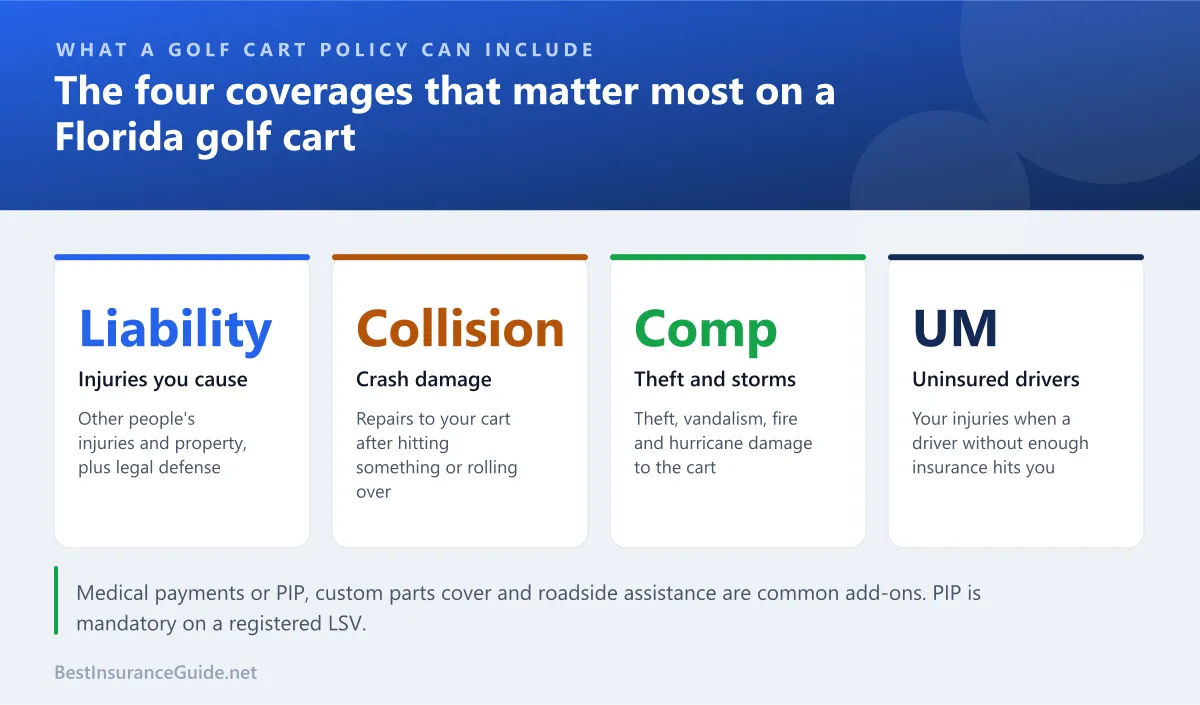
- Bodily injury and property damage liability. Pays for injuries to others and damage to their property you cause while driving the cart, plus legal costs. This is the core of golf cart liability insurance.
- Collision. Pays to repair your cart after it hits something or overturns, minus your deductible.
- Comprehensive. Covers theft, vandalism, fire, falling objects and weather, including hurricane damage. Golf cart theft is common in some Florida communities.
- Medical payments or PIP. Pays medical costs for you and your passengers regardless of fault. PIP is required on LSVs.
- Uninsured/underinsured motorist. Protects you if a driver without enough insurance hits you. In a state with a high share of uninsured drivers, this is worth considering even on a cart.
- Custom parts and equipment. Covers lift kits, upgraded seats, stereos and enclosures that a standard policy may cap.
- Roadside assistance and total loss replacement on some policies.
Our guides to the comprehensive deductible and collision deductible waiver explain how those deductibles work on cars; the same logic applies to carts.
How much is golf cart insurance?
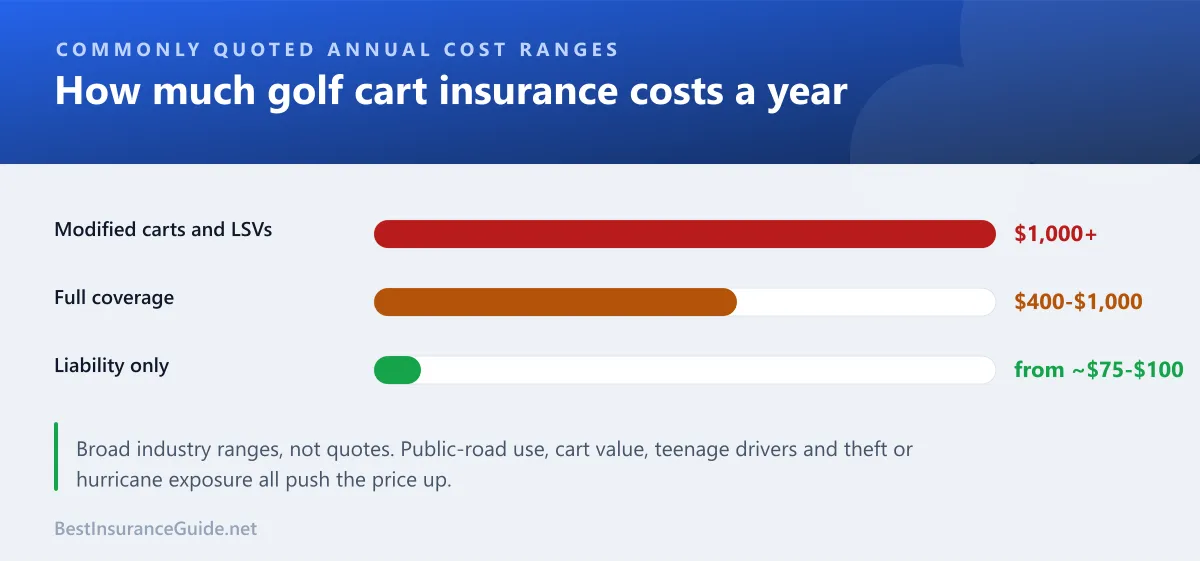
Golf cart insurance is typically inexpensive compared with car insurance. Commonly quoted industry ranges are:
| Coverage | Commonly quoted cost |
|---|---|
| Liability only | From around $75 to $100 a year |
| Full coverage (liability, collision, comprehensive) | Roughly $400 to $1,000 a year |
| Modified or high-value carts and LSVs | Can exceed $1,000 a year |
These are broad ranges, not quotes. What moves the price:
- Golf cart or LSV: LSVs are rated more like cars.
- Where you drive: a course-only cart is cheaper than one used on public roads.
- The cart’s value and modifications: lifted, customized or lithium-battery carts cost more to replace.
- Drivers: teenage and inexperienced drivers raise the price.
- Location: theft and hurricane exposure in your area.
- Limits and deductibles you choose.
- Discounts for bundling with auto or home, safety courses and paid-in-full premiums. Our guide to good driver discounts covers the ones that often carry over.
How much golf cart liability do you need?
Because Florida does not require insurance on a golf cart, there is no legal minimum to guide you. Think about the worst realistic accident instead: a cart turning onto a road and colliding with a car, or a passenger thrown out during a sharp turn. Golf cart injuries can be serious because occupants have so little protection.
Many owners choose liability limits similar to their car policy, and consider a personal umbrella policy if they have significant assets. A liability-only policy at the lowest limits is inexpensive, but it may not protect you in a serious accident.
Common golf cart accidents and how insurance responds
A cart pulls out in front of a car. The car’s driver is injured and the car is damaged. The golf cart owner’s liability coverage pays the other driver’s claim. Without it, the owner faces the claim personally, and injury claims can run far beyond the value of the cart.
A passenger falls out on a turn. Golf carts rarely have doors, and passengers, especially children, can be thrown out at surprisingly low speeds. Medical payments or PIP coverage pays the passenger’s medical bills regardless of fault; liability may also be involved if the passenger was not a household member.
A teenager drives the cart into a parked car. Property damage liability pays for the parked car. Collision coverage, if you have it, pays for the cart. Whether the teenager is covered depends on whether the policy lists them as a driver and whether they met Florida’s license requirement, which is why listing every driver matters.
The cart is stolen from a driveway. Comprehensive coverage pays the cart’s value, minus the deductible. Without comprehensive, theft is an uninsured loss. Owners with lifted or customized carts should check that the upgrades are covered too.
In every case, report the accident promptly, photograph the scene and exchange details as you would after a car accident. Our guide on what to do after an accident that wasn’t your fault covers the steps.
Rented carts and community carts
Renting a golf cart on vacation. Rental companies in Florida beach towns often offer damage waivers and may carry liability coverage on their fleet, but the terms vary widely and may leave you responsible for damage and for injuries you cause. Read the rental agreement, ask what insurance is included, and check whether your own auto or umbrella policy extends to a rented golf cart before you drive it on public roads.
Carts in homeowners associations. Many Florida communities set their own rules for golf carts, including registration with the association, safety equipment and proof of insurance. An association may require liability insurance even though the state does not. Check your community’s rules before you buy the cart.
Carts provided by a golf club. When you rent a cart at a course, the club’s own insurance generally covers the cart, but you may still be responsible for damage and liability arising from how you drive it, depending on the rental terms.
Hurricane season and your golf cart
Florida golf carts face storm risk every year. Comprehensive coverage is what pays if a cart is damaged by wind, falling trees or flooding, subject to your deductible and policy terms. A few practical steps help:
- Store the cart in a garage or secure structure during storms, and charge or disconnect batteries as the manufacturer recommends.
- Photograph the cart and any upgrades at the start of hurricane season for claim evidence.
- Check whether your policy has a named storm or hurricane deductible, which may differ from your standard deductible.
- Do not buy coverage at the last minute. Insurers commonly stop issuing new coverage in an area once a named storm is approaching.
How to get golf cart insurance in Florida
- Confirm whether your vehicle is a golf cart or an LSV, and whether it has been modified.
- Check your homeowners policy for any golf cart coverage and its limits on public roads.
- Ask your auto insurer whether it can add the cart or LSV, and compare with standalone golf cart policies.
- Choose liability limits based on your assets and how often you drive on public roads.
- Add comprehensive if theft or hurricanes are a concern, and collision if the cart is valuable.
- List every driver, including teenagers and visiting family.
- Keep proof of insurance with the cart, and for an LSV, keep registration and insurance documents as you would in a car.
The bottom line
Florida does not require insurance on a standard golf cart, but it does require PIP and property damage liability on a low-speed vehicle, and in both cases the owner is personally liable for accidents. Homeowners and auto policies rarely cover a golf cart on public roads. For most Florida owners who drive their cart beyond the course, a dedicated golf cart policy with meaningful liability limits is inexpensive protection against a very expensive accident.
BestInsuranceGuide.net is an independent publisher and is not affiliated with any insurer or golf cart manufacturer. Florida golf cart rules are set out in state statute and local ordinances; check your county or city for designated roads and equipment requirements. Cost ranges are commonly quoted figures, not quotes.