Boat Insurance in Arkansas: The 50-Horsepower Law and What Your Policy Should Cover
Is boat insurance required in Arkansas? Yes, for boats over 50 hp and all personal watercraft. The $50,000 minimum, proof rules and what to cover.

Table of contents
Arkansas has some of the best boating in the South, with Beaver Lake, Bull Shoals, Greers Ferry, Lake Ouachita, DeGray, the Arkansas River and hundreds of smaller lakes and rivers. It also has something most states don’t: a law requiring boat insurance.
If you own a bass boat, a ski boat, a pontoon with a large outboard or any jet ski, Arkansas law requires you to carry liability insurance. If you own a jon boat with a small motor, a kayak or a canoe, it doesn’t. This guide explains exactly where the line falls, what the $50,000 minimum does and doesn’t cover, and how to insure the kinds of boats Arkansas owners actually run.
Is boat insurance required in Arkansas?
Yes, for boats powered by more than 50 horsepower and for all personal watercraft. The Arkansas Game and Fish Commission (AGFC) puts it plainly: “Insurance is only required if your boat is powered by OVER 50 horsepower OR if you have a personal watercraft (Jet Ski, SeaDoo, Waverunner). ALL personal watercraft require insurance.”
The key rules are:
- Who must insure: motorboats with more than 50 horsepower, and every personal watercraft (PWC) regardless of engine size.
- Minimum coverage: a liability policy of at least $50,000 per occurrence.
- Who can issue it: an insurer authorized to do business in Arkansas.
- Proof on board: proof of insurance must be kept on the boat and shown to an enforcement officer on request.
- Proof at registration: if your boat falls under the rule, you’ll need to show proof of insurance when you register it.
- Operators: it’s illegal for the owner to operate the boat, or allow someone else to operate it, without the required insurance.
A boat with exactly 50 horsepower doesn’t fall under the requirement. The law only applies to boats over 50 horsepower.
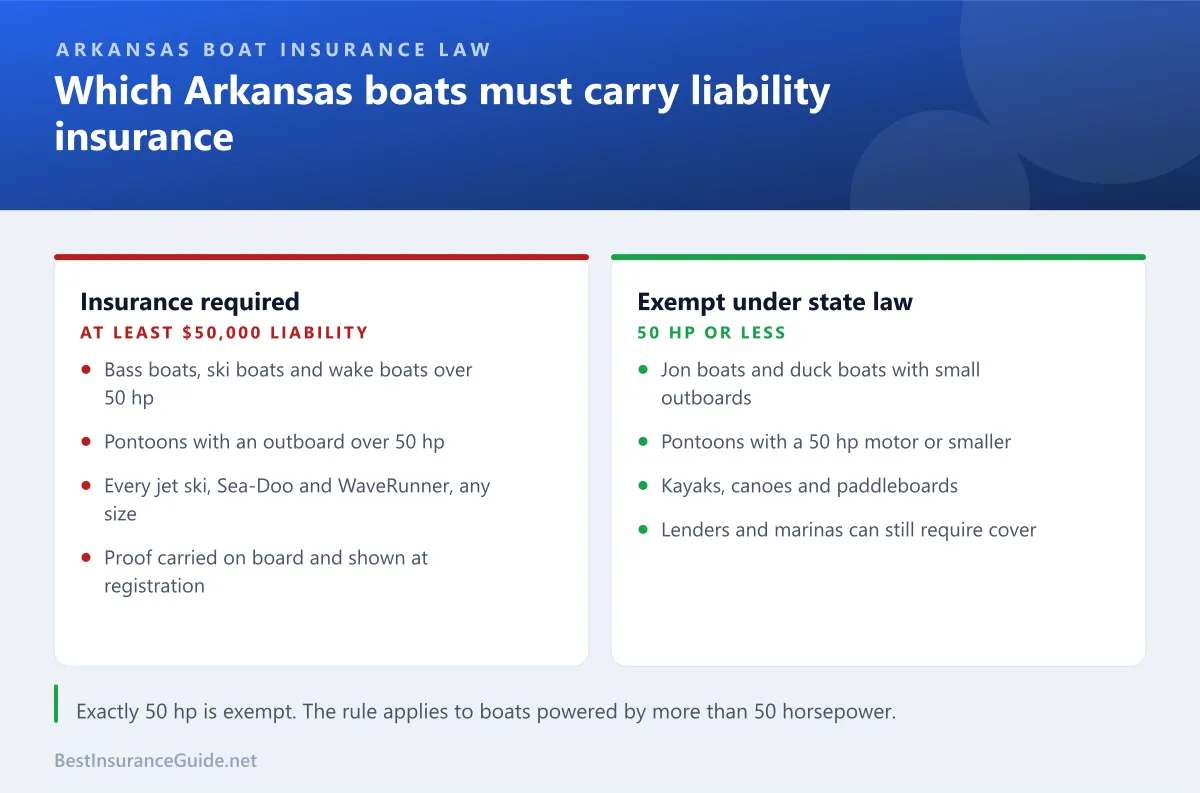
Which common Arkansas boats need insurance?
| Boat | Typical power | Arkansas insurance law applies? |
|---|---|---|
| Bass boat | Often 150–250 hp outboard | Yes |
| Ski or wake boat | Inboard, well over 50 hp | Yes |
| Pontoon with a 90–150 hp outboard | Over 50 hp | Yes |
| Pontoon with a 40–50 hp outboard | 50 hp or less | No |
| Jet ski, Sea-Doo or WaveRunner | Any | Yes, always |
| Jon boat or duck boat with a 25 hp outboard or small mud motor | Under 50 hp | No |
| Kayak, canoe, paddleboard | No motor | No |
If you’re unsure, check the horsepower rating on your motor, not the boat’s maximum rating plate. If you repower with a bigger engine, the requirement can start to apply, so tell your insurer when you change motors.
What the $50,000 minimum covers, and why it may not be enough
The Arkansas requirement is for liability insurance. That pays for injuries and property damage you cause to other people, such as:
- Hitting another boat, a swimmer, a water-skier or a tuber.
- Damaging a dock, a marina slip or another boat while docking.
- Injuring a guest on your boat, depending on the policy.
- Your legal defense if you’re sued after an accident.
It does not pay to repair or replace your own boat. That needs physical damage coverage, discussed below.
$50,000 is a legal minimum, not a recommendation. A serious injury on the water, such as a propeller strike or a collision at speed, can easily lead to medical bills and a lawsuit well above $50,000. Anything above your limit can come out of your own pocket. Many boat owners choose limits of $300,000 or more, and higher limits usually cost relatively little extra compared with the protection they add. If you have significant savings or a home, consider an umbrella policy that extends over your boat.
Coverage Arkansas boat owners should consider
A full boat policy typically combines:
- Physical damage coverage for the hull, motor and equipment against collision, storms, fire, theft and vandalism. If you have a boat loan, your lender will require it.
- Liability coverage, which meets the state requirement when your limit is at least $50,000.
- Medical payments for injuries to you and your passengers, regardless of fault.
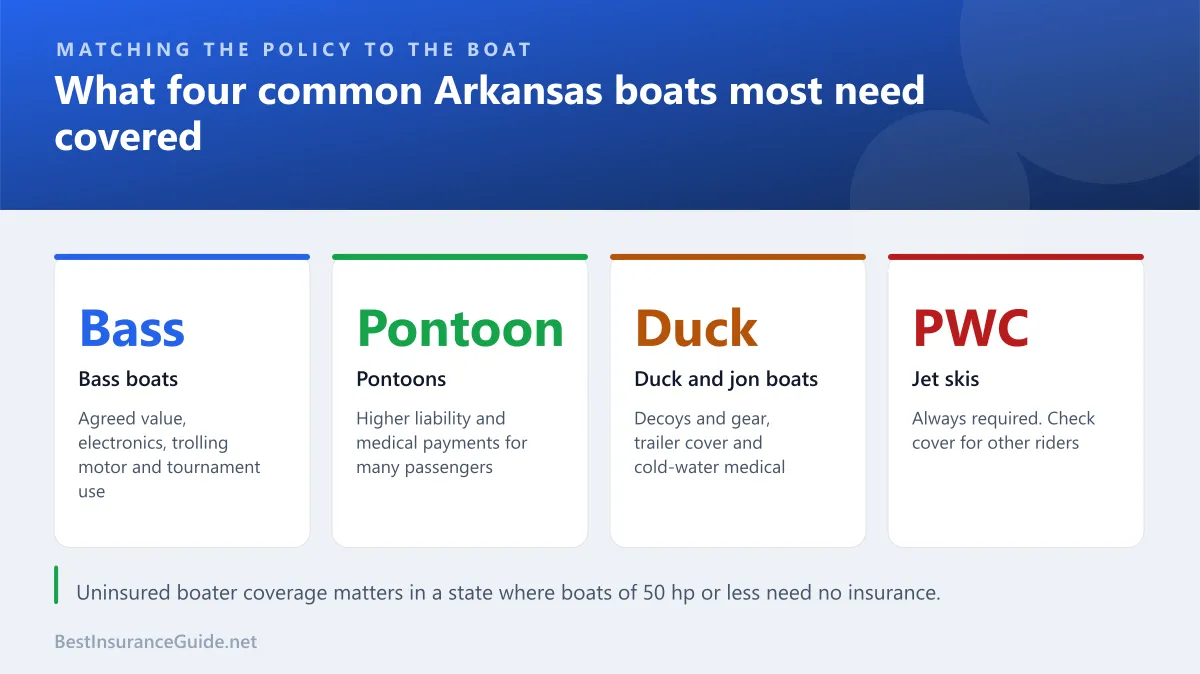
- Uninsured boater coverage, which is especially worth having because many boats in Arkansas, including every boat of 50 horsepower or less, don’t have to carry insurance at all.
- Trailer coverage, since most Arkansas boats spend more time on a trailer than in a slip.
- On-water towing and assistance for breakdowns on big lakes.
- Personal effects and fishing equipment for rods, reels, electronics, and hunting gear.
Agreed value vs actual cash value
On older boats, how the policy values a total loss matters a lot. Agreed value pays the amount you and the insurer agree on when you buy the policy. Actual cash value pays the boat’s depreciated value at the time of the loss, which can be much less. Our guide to replacement cost vs actual cash value explains the difference in more detail.
Insuring the boats Arkansas owners run
Bass boats
Arkansas is bass country, and a modern bass boat with a large outboard, trolling motor and electronics can be worth tens of thousands of dollars. Bass boats almost always exceed 50 horsepower, so liability insurance is required.
Beyond the minimum, consider:
- Agreed value coverage, so a total loss pays enough to replace the rig.
- Coverage for electronics and trolling motors, which are expensive and attractive to thieves.
- Tournament coverage. If you fish tournaments, confirm your policy covers tournament use, including any entry fees or prizes the policy defines.
Pontoon boats
Pontoons are a common sight on Beaver Lake, Lake Hamilton and other family lakes. Whether the law applies depends on the motor: a pontoon with more than 50 horsepower needs insurance, while one with a smaller outboard doesn’t. Because pontoons carry many passengers, liability and medical payments matter more than on a two-seat fishing boat, even when the law doesn’t require them.
Duck boats and jon boats
Arkansas is famous for duck hunting, and many duck boats and jon boats run small outboards or mud motors under 50 horsepower, so the state law often doesn’t apply. That doesn’t mean they’re covered by other insurance:
- A homeowners policy may cover a small boat and motor only up to a low limit, and may not cover it at all away from home.
- Decoys, blinds, and hunting equipment may need personal effects coverage.
- Hunting in cold water in winter carries real injury risk. Medical payments coverage is inexpensive and worth pricing.
If you’ve added a surface-drive mud motor over 50 horsepower, you are likely covered by the requirement.
Jet skis and other personal watercraft
Every personal watercraft in Arkansas needs liability insurance, regardless of horsepower. PWCs are fast and maneuverable, and they’re often operated by less experienced riders, so liability limits well above the $50,000 minimum make sense. If you let friends or family ride your PWC, check that the policy covers other operators, and review the age and education rules before handing over the key.
Arkansas risks that affect your policy
Arkansas boats are mostly used on inland lakes and rivers, which generally makes premiums lower than in coastal states. But inland boating has its own risks:
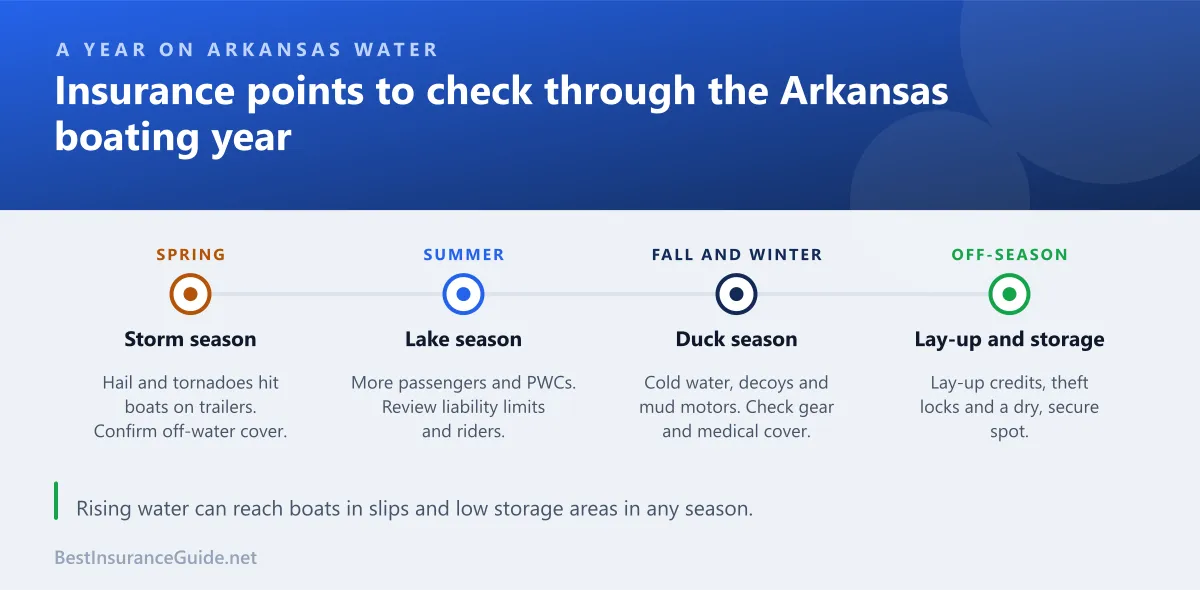
- Tornadoes, hail and severe storms. A boat stored on a trailer at home or at a dry-stack facility can be damaged or destroyed by spring storms. Make sure your policy covers the boat off the water.
- Flooding and rising water. Rivers and lakes can rise quickly. Boats in slips, on lifts or parked in low areas can be damaged.
- Theft. Trailered boats, outboards and electronics are common theft targets. Hitch locks, wheel locks and secure storage help.
- Hidden hazards. Stumps, submerged timber and shifting sandbars are common on some lakes and rivers and cause many hull and lower-unit claims.
- Cold water. Winter duck hunting and fishing carry a higher risk of serious injury from falls overboard.
What boat insurance costs in Arkansas
There’s no official average for Arkansas, and prices vary by insurer. Nationally, commonly quoted figures put boat insurance at about 1% to 5% of the boat’s value per year, and roughly $25 to $75 a month for smaller boats, according to Boat Ed. Because most Arkansas boating is inland, many owners find their premiums toward the lower end of that range compared with coastal states.
The factors that drive your price include:
- Boat value, type and horsepower. A fast bass boat or wake boat costs more than a pontoon with a small outboard.
- Coverage type. Liability-only coverage to meet the state minimum is the cheapest option; agreed value physical damage coverage costs more.
- Your experience and record. Boating experience, a clean record and a completed boater education course can earn discounts.
- Storage. Garaged or secured storage generally costs less to insure than a boat left on a trailer in the driveway.
- Lay-up period. Some policies offer a lower rate if the boat isn’t used during winter months.
These are broad national ranges, not quotes for Arkansas.
Boater education and registration
Two more state rules go hand in hand with insurance:
- Boater education. According to the AGFC, anyone born on or after January 1, 1986 must complete a boater education course before operating a motorboat. Insurers often offer a discount for completing a course, whatever your age.
- Registration. Any boat powered by machinery, including a trolling motor, must be registered, and boats covered by the insurance requirement need proof of insurance to register.
What to do after a boating accident
If you’re involved in an accident on the water, the steps you take in the first hours affect both your legal position and your claim:
- Make sure everyone is safe and get medical help for anyone who is hurt.
- Exchange information with the other operators, including names, contact details, registration numbers and insurance details.
- Report it if required. Federal boating rules require a written accident report to the state when someone dies, disappears or needs treatment beyond first aid, or when damage exceeds $2,000 or a boat is destroyed. In Arkansas, reports go to the AGFC. Check the current deadlines, which are short for serious accidents.
- Photograph the damage, the scene and any hazards such as submerged debris.
- Call your insurer promptly and keep receipts for any emergency repairs or towing.
How to buy boat insurance in Arkansas
- Check your horsepower. If it’s over 50, or if it’s a personal watercraft, you need at least $50,000 in liability coverage.
- Choose a liability limit above the minimum if you can. Your assets and the number of passengers you carry should guide the choice.
- Decide on physical damage coverage. If you have a loan, the lender will require it. If not, compare the premium with what it would cost to replace the boat yourself.
- Pick agreed value or actual cash value, especially for older boats.
- Add trailer, towing, electronics and personal effects coverage as needed.
- Compare quotes from several insurers, including marine specialists. An independent agent can help; see our guide to insurance brokers vs agents.
- Keep proof of insurance on board, either on paper in a waterproof bag or on your phone, and make sure other operators know where it is.
For the rules in other states, and for more on how lenders and marinas require insurance, see our guide to whether boat insurance is required. If you keep a boat at a marina that asks to be named on your policy, our guide to additional insured status explains how that works.
Related reading
Coastal boating raises different questions. Boat insurance in Maine looks at moorings and winter storage.
For a hurricane-exposed state, compare boat insurance in South Carolina.
The bottom line
Arkansas is one of the few states that requires boat insurance. If your boat is over 50 horsepower or it’s a personal watercraft, you need liability coverage of at least $50,000 per occurrence, with proof kept on board. Boats of 50 horsepower or less, including many jon boats and duck boats, are exempt under state law.
Meeting the minimum is the starting point. Choose a higher liability limit, protect the boat itself with physical damage coverage, and make sure your policy fits how you actually use the water, from spring bass fishing to winter duck hunting.
BestInsuranceGuide.net is independent and not affiliated with any insurer or with the Arkansas Game and Fish Commission. State rules can change, so confirm current requirements with the AGFC or the Arkansas Department of Finance and Administration. Cost ranges are national figures, not quotes.