Boat Insurance in Maine: Requirements, Moorings, Winter Storage and What It Costs
Is boat insurance required in Maine? No, but lenders and harbors ask. How Maine boat insurance handles moorings, winter storage, lay-up and cost.

Table of contents
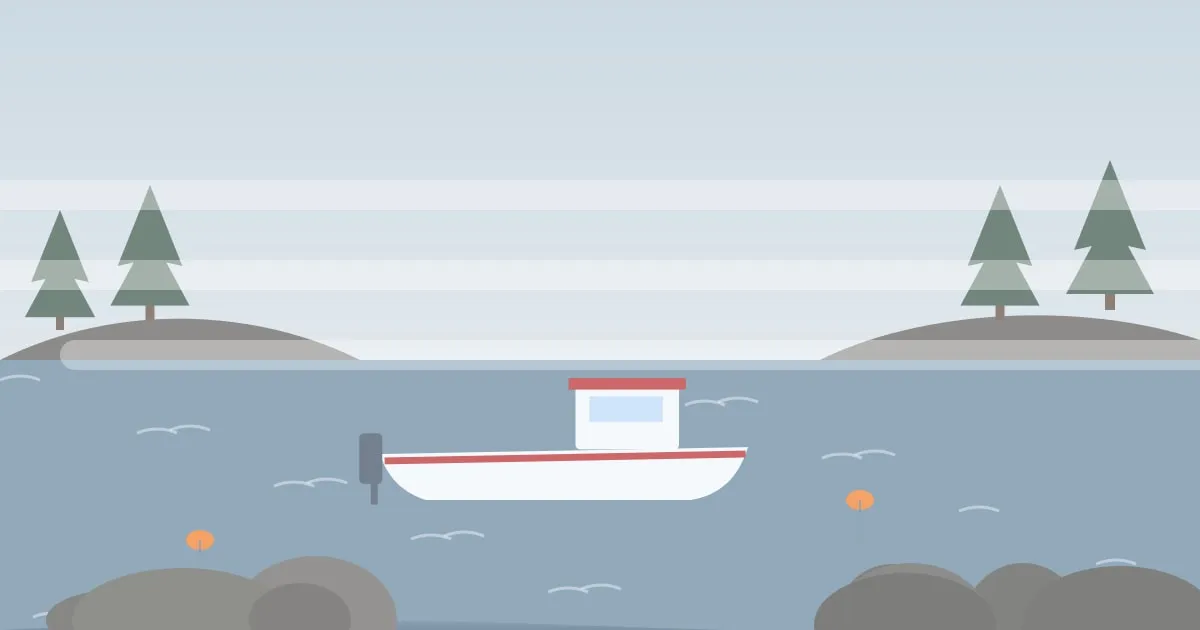
Boating in Maine means granite ledges and lobster buoys along the coast, fog that can roll in within minutes, water that stays cold even in August, and a season that is short enough that many boats spend more months on land than in the water. It also means thousands of lakes and ponds, from Sebago and Moosehead to the Rangeley Lakes, where family camp boats run all summer.
Those conditions shape boat insurance in Maine more than any state law does. This guide answers the basic question, is boat insurance required in Maine?, and then covers what matters most to Maine owners: moorings, ledges, lobster gear, cold water, winter storage and the cost of coverage.
Is boat insurance required in Maine?
No. Maine doesn’t require recreational boat owners to carry boat insurance. That’s true on the coast and on inland lakes, and it applies to personal watercraft as well.
Only a few states require boat insurance by law, mostly for boats above a certain horsepower. Our guide to boat insurance in Arkansas shows how one of those laws works, and our guide to whether boat insurance is required covers the national picture.
Even without a state law, most Maine owners will be asked for insurance by someone:
- Lenders require physical damage coverage on financed boats, with the lender listed as loss payee.
- Marinas and boatyards commonly require liability coverage for slips, moorings they manage and winter storage.
- Harbors and mooring programs in some towns ask for proof of insurance as part of a mooring permit. Check with your local harbor master.
- Yacht clubs often require members’ boats to be insured.
And even if nobody asks, liability coverage protects you if you injure someone, damage another boat, or cause damage to a dock or mooring field.
Maine boating rules that matter
Several state rules affect Maine boat owners, even though none of them require insurance:
- Boater education. Since January 1, 2024, anyone born on or after January 1, 1999 must complete a boater safety and education course before operating a recreational motorboat of more than 25 horsepower on Maine’s inland or territorial waters. There are exemptions, including registered Maine guides and daily renters who complete a temporary course. Many insurers also offer a discount for completing a course, whatever your age.
- Personal watercraft. No one under 16 may operate a PWC in Maine. Operators aged 16 and 17 need a completed safety course and proof on board, or must be accompanied by someone 18 or older.
- Registration. All motorboats, including personal watercraft, must be registered to use Maine waters. Motorized boats on inland waters must also display the lake and river protection sticker, which is included in the registration fee.
- Excise tax. Maine residents pay watercraft excise tax to their town when they register, based on the boat’s age, length and motor horsepower. Non-residents whose boats are in Maine for more than 75 days a year may owe it to the town where the boat is kept.
- Life jackets for children. According to Boat Ed’s summary of Maine law, from January 1, 2026 children aged 12 and under must wear a Coast Guard-approved life jacket on a recreational boat that’s underway.
What makes insuring a boat in Maine different
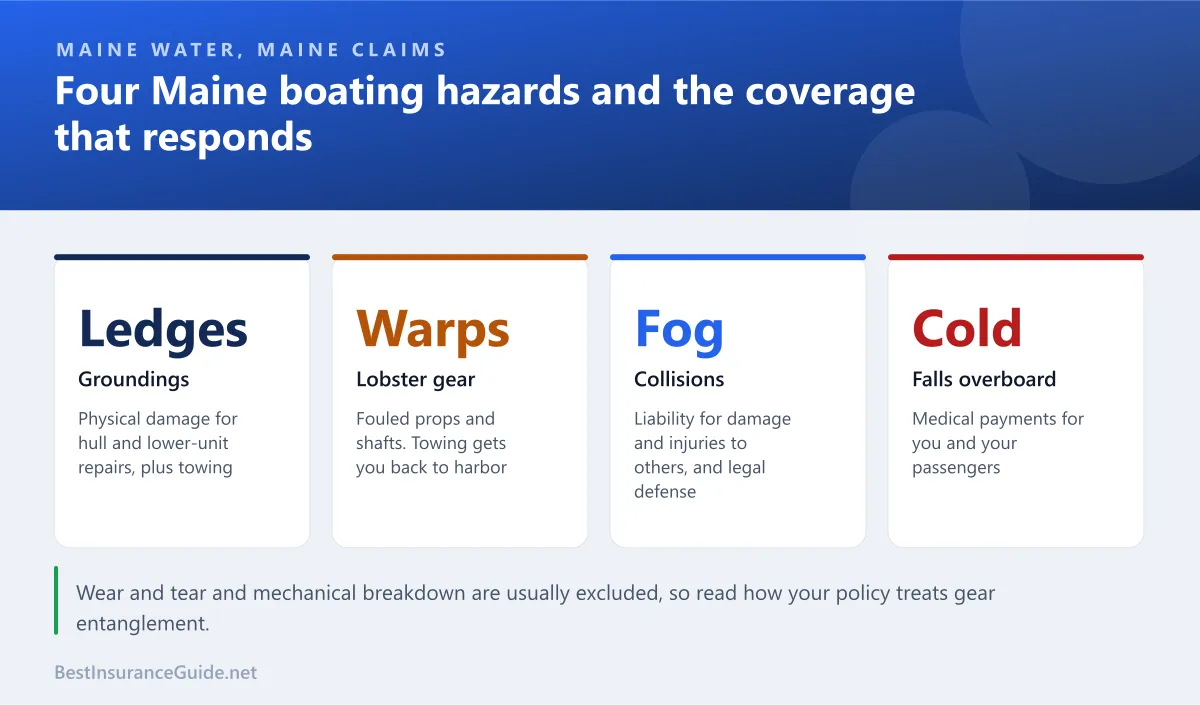
Ledges and rocks
The Maine coast is rocky and ledge-strewn, and many of its lakes have boulders and shallow shoals. Striking a ledge is one of the most common causes of serious hull and lower-unit damage. Physical damage coverage pays for the repairs after your deductible, and towing coverage helps if the boat can’t make it back under its own power. Keep your charts and electronics current. An insurer may look at whether you were operating reasonably, especially in fog or at night.
Lobster gear
Anyone who has boated in Maine knows the lobster buoys, often thousands of them in a single bay. Running over a pot warp can foul the propeller, damage the shaft or stall the engine. How a policy treats this depends on the wording: sudden, accidental entanglement damage may be covered, while gradual wear and mechanical breakdown usually aren’t. On-water towing coverage is especially useful here.
Fog and busy harbors
Fog can reduce visibility to almost nothing, and busy harbors mix recreational boats with commercial fishing traffic. Collisions in these conditions raise liability questions quickly. Liability coverage pays for damage and injuries you cause to others and your legal defense, which is why a limit well above the minimum you’d choose on a quiet lake makes sense on the coast.
Cold water
Maine’s water stays cold enough through most of the season to make a fall overboard dangerous. Medical payments coverage, which pays for injuries to you and your passengers regardless of fault, is inexpensive and worth including. Wearing life jackets matters more here than almost anywhere else in the country.
Moorings: a Maine insurance issue
Many Maine boats spend the season on a mooring rather than in a slip. Moorings raise their own insurance questions:
- Mooring failure. If a mooring chain, pennant or shackle fails in a storm and your boat washes ashore or hits another boat, physical damage and liability coverage generally respond, but insurers may look at whether the mooring was properly maintained and inspected.
- Damage to other boats. A boat that breaks free can damage others in the mooring field. That’s a liability claim.
- Nor’easters and tropical storms. Maine sees strong coastal storms, and hurricane remnants can reach the coast. Check whether your policy has a named storm deductible and whether it requires any storm preparation.
- Tender and dinghy. The dinghy you use to reach your mooring may need to be listed on your policy. Many boat policies include a tender up to a certain value, but check.
Keep records of mooring inspections and maintenance. They can help if a claim follows a mooring failure.
Camp boats on Maine lakes
Inland, many Maine boats belong to a seasonal camp: a runabout, pontoon or fishing boat that lives at the camp dock all summer and is used by whoever is visiting. That pattern raises questions a policy should answer:
- Who is allowed to drive it? Many policies cover other operators with your permission, but some exclude inexperienced or young drivers. Remember that operators born on or after January 1, 1999 need a boater safety course for motors over 25 horsepower.
- Is it covered while the camp is empty? Boats left at an unattended dock or in a camp boathouse can be stolen or damaged by storms. Tell your insurer where the boat is kept.
- What if you rent out the camp? If renters use your boat, most personal boat policies won’t cover that without an endorsement, and many exclude rental use entirely. Our guide to short-term rental insurance explains the wider issues with renting out a property.
- Does the dock or boathouse need cover? Docks and boathouses are usually insured under the camp’s property policy, not the boat policy. Check both.
The short season and lay-up periods
Most Maine boats are in the water for only part of the year, typically from late spring to mid-fall, and hauled out and stored for the rest.
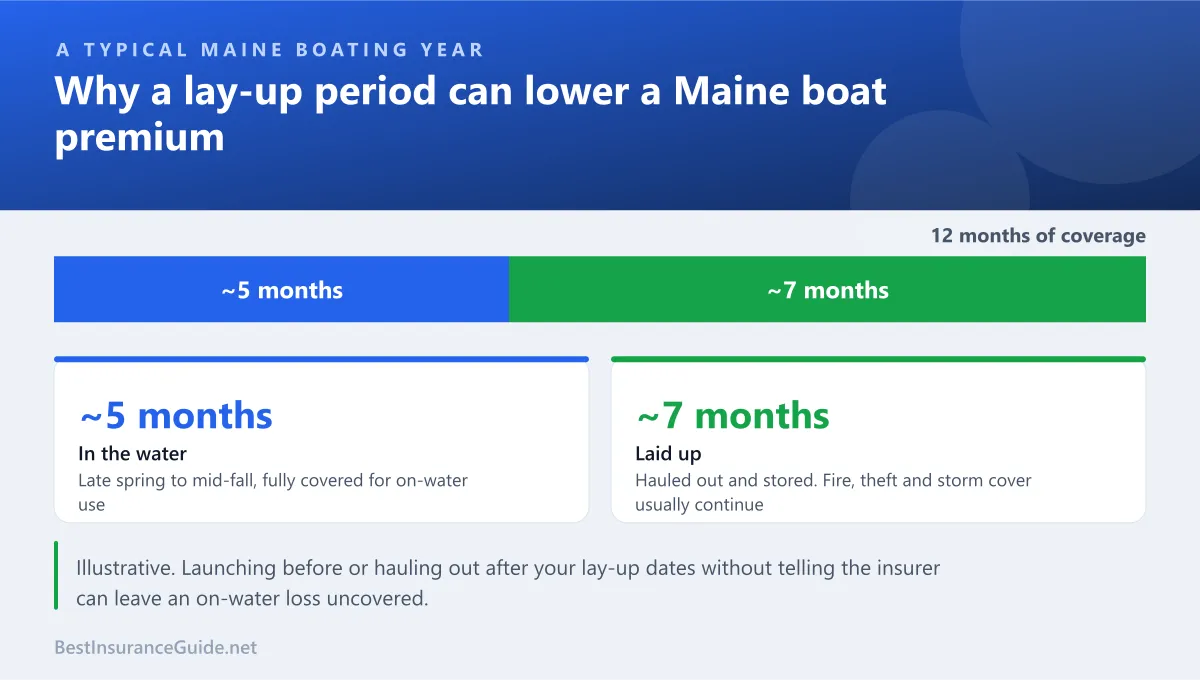
That pattern works in your favor on insurance. Many insurers offer a lay-up period, a set of months when you agree the boat will be out of commission. In exchange, the premium is reduced, because the boat isn’t exposed to on-water risks during that time.
A few things to know:
- Stick to the dates. If you launch early or haul out late without telling your insurer, an on-water loss during the lay-up period may not be covered.
- Coverage continues on land. Physical damage coverage for fire, theft, and storm damage usually continues while the boat is stored.
- Ask for a change if your season differs from the standard lay-up dates, such as if you fish late into the fall.
Winter storage and your boat insurance
Maine winters are long, and a lot can go wrong while a boat sits in storage. The main risks are:
- Freezing. Engines, plumbing and water systems that aren’t properly winterized can crack. Freeze damage is often excluded unless the policy specifically covers it or the damage resulted from a covered cause.
- Snow load. Heavy snow can collapse shrink-wrap, covers or storage shed roofs and damage the boat beneath.
- Fire. Fires in boatyards and storage buildings can damage many boats at once.
- Theft and vandalism. Boats and outboards stored at home or in unattended yards can be targets.
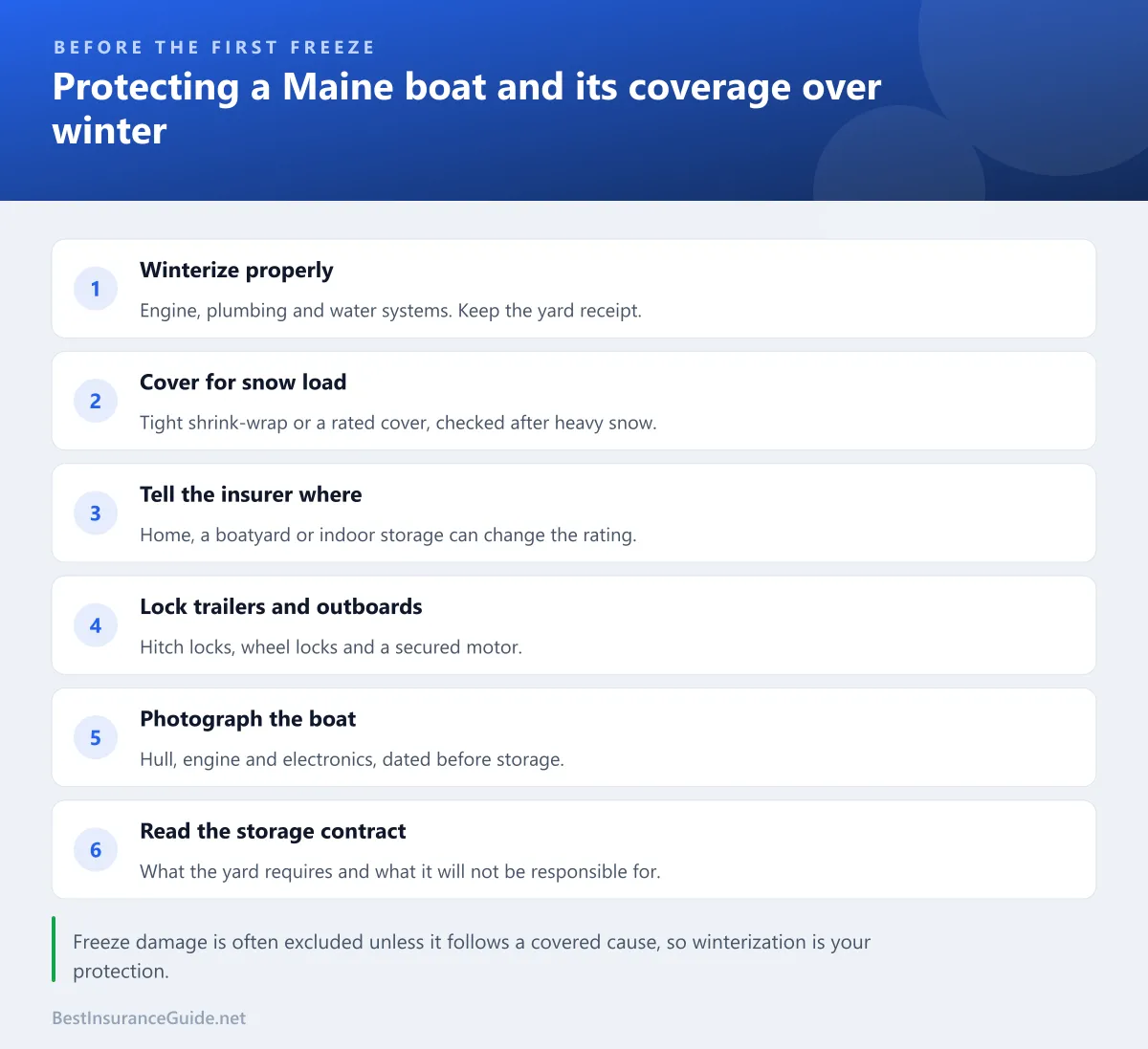
Before you store a boat for winter:
- Winterize properly, or have a yard do it and keep the receipt.
- Use a proper cover or shrink-wrap, and check it after heavy snow if the boat is at home.
- Tell your insurer where the boat is stored, whether at home, in a yard or indoors.
- Secure trailers and outboards with locks.
- Photograph the boat and equipment before storage.
- Check the storage facility’s contract for its insurance requirements and what it will and won’t be responsible for.
What boat insurance covers in Maine
A typical Maine boat policy combines:
- Physical damage to the hull, motor and equipment from collisions, groundings, storms, fire, theft and vandalism.
- Liability for injuries and property damage you cause, plus legal defense.
- Medical payments for injuries to you and your passengers.
- Uninsured boater coverage, since Maine doesn’t require other boaters to carry insurance.
- Trailer and tender coverage.
- Optional add-ons such as on-water towing, fuel spill liability, wreck removal and personal effects, including fishing gear and electronics.
For older boats, decide whether you want agreed value or actual cash value coverage. Agreed value pays the amount set when you buy the policy, while actual cash value pays a depreciated amount after a total loss. Our guide to replacement cost vs actual cash value explains the difference.
What boat insurance costs in Maine
There’s no official Maine average. Nationally, commonly quoted figures put boat insurance at about 1% to 5% of the boat’s value per year, and around $25 to $75 a month for smaller boats, according to Boat Ed.
Maine-specific factors that affect the price:
- Lay-up period. A long winter lay-up can reduce the premium.
- Coastal vs inland use. Lake boats usually cost less to insure than coastal boats, and offshore navigation limits cost more.
- Mooring vs slip vs trailer. How and where the boat is kept, in season and in winter, affects risk.
- Boat value and type. Larger cruisers and high-value boats cost more.
- Experience and education. A completed boater safety course and a clean record can earn discounts.
These are national ranges, not quotes for Maine.
How to buy boat insurance in Maine
- Decide on liability limits based on what you own and how you use the boat. Coastal boaters should consider higher limits.
- Check lender, marina, boatyard and harbor requirements, including any additional insured wording. Our guide to additional insured status explains how that works.
- Choose physical damage coverage and decide on agreed value or actual cash value.
- Set your lay-up period to match your actual season.
- List your tender, trailer and valuable equipment.
- Compare quotes from several insurers, including marine specialists. An independent agent can help; see our guide to insurance brokers vs agents.
- Keep proof of insurance with your registration, since marinas and harbors may ask for it.
The bottom line
Maine doesn’t require boat insurance by law, but lenders, marinas, boatyards and some harbors do, and the Maine coast gives every owner good reasons to carry it. Ledges, lobster gear, fog and cold water make liability, physical damage, towing and medical payments coverage worth having.
Use the short season to your advantage with a lay-up period, protect the boat during winter storage, and keep your mooring well maintained. A policy built around how Maine boating actually works will cost less and pay more reliably than a generic one.
BestInsuranceGuide.net is independent and not affiliated with any insurer or with the Maine Department of Inland Fisheries and Wildlife. State rules can change, so confirm current requirements with official sources. Cost ranges are national figures, not quotes.