Landlord Insurance Cost: What You Pay, and What Tenant Damage It Covers
How much landlord insurance costs vs homeowners insurance, what drives the premium, whether you need it, and whether it covers tenant damage.

Table of contents

The moment you move out of a home and rent it to a tenant, the insurance question changes. The homeowners policy you bought when you lived there was priced and written for you living there. Keep it in place after a tenant moves in and you may find, at claim time, that it does not cover the building, your liability or the rent you lose.
That is why rental homes are insured with landlord insurance, often written as a dwelling fire policy. This guide focuses on the practical questions: how much landlord insurance costs, why it costs more than homeowners insurance, whether you need it, and whether it covers damage tenants cause.
How much does landlord insurance cost?
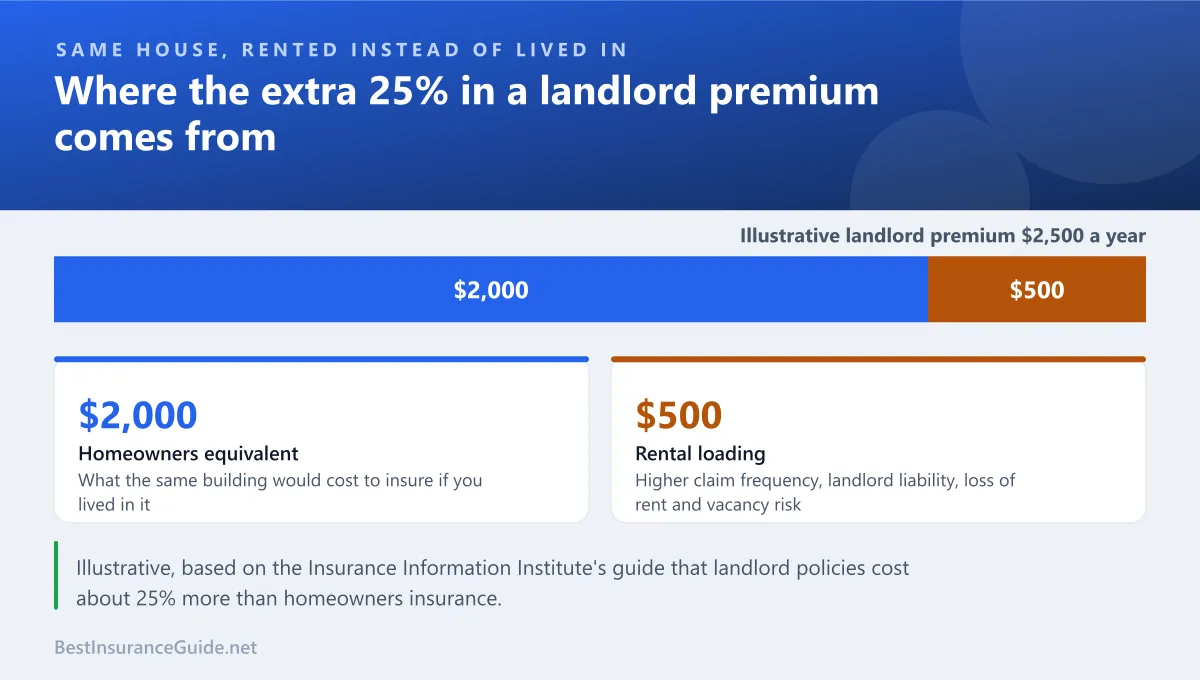
The most widely cited benchmark comes from the Insurance Information Institute: landlord policies generally cost about 25% more than a standard homeowners policy on the same property.
In practice, that means if an owner-occupied homeowners policy on a house would cost $2,000 a year, a comparable landlord policy on the same house would be expected to cost around $2,500, before optional extras. Your actual price can be well above or below that, depending on the property and your choices.
Why landlord insurance costs more
- Rented homes produce more claims. Tenants are less likely to notice small leaks early or to invest in maintenance, and problems can go unreported between inspections.
- Liability exposure is different. The landlord can be sued over conditions at a property they do not live in and see every day.
- Loss of rent is included or added. Most landlord policies can pay the rent you lose while a covered loss makes the home uninhabitable. Homeowners policies have no equivalent, because they assume you live there.
- Vacancy risk. Rental homes sit empty between tenants, when damage can go unnoticed for weeks.
What drives the price of landlord insurance
Landlord premiums respond to many of the same factors as homeowners insurance, plus a few specific to rentals.
- Location: exposure to wind, hail, wildfire, crime and the local cost of rebuilding.
- The building: age, construction, roof condition, electrical and plumbing systems.
- Number of units: a single-family rental is priced differently from a duplex or fourplex.
- Coverage form. Basic named-peril forms cost less than open-peril forms that settle at replacement cost. Our guide to dwelling insurance explains the DP-1, DP-2 and DP-3 forms.
- Dwelling limit and settlement basis. Insuring to full replacement cost costs more than actual cash value, but protects far better. See replacement cost vs actual cash value.
- Deductible. A higher deductible lowers the premium, for the reasons explained in why higher deductibles lower premiums.
- Liability limit and whether liability is included or added by endorsement.
- Loss of rent limit.
- Claims history on you and the property.
- Short-term versus long-term tenants. Nightly and weekly rentals usually need a different policy altogether, covered in our guide to short-term rental insurance.
Ways to lower the cost
- Choose a higher deductible you can comfortably fund.
- Bundle rental properties with one insurer, or with your own home and auto policies where the insurer allows it.
- Upgrade the roof, wiring, plumbing and heating, and document the dates.
- Install monitored smoke detectors and water leak sensors.
- Screen tenants carefully and inspect regularly.
- Require tenants to carry renters insurance, which reduces the chance of disputes over their belongings and their liability.
- Re-shop every two or three years. Landlord pricing varies widely between insurers.
Landlord insurance by type of property
The right policy, and therefore the cost, depends on what you are renting out.
A single-family house. The standard case: a landlord or dwelling fire policy on the house, with liability and loss of rent added.
A condo unit. The condo association’s master policy covers the building’s structure and common areas, depending on its terms. You insure the interior of your unit, your improvements and your liability, typically with a unit-owners policy endorsed for rental use or a policy designed for rented condos. Check the association’s bylaws for what the master policy leaves to you.
A duplex where you live in one unit. Many insurers will write an owner-occupied two-to-four-unit building on a homeowners policy, because you still live there. You will need to tell the insurer about the rented unit, and the tenant still needs their own renters insurance.
A duplex, triplex or fourplex you do not live in. Usually a dwelling policy, priced per building with the number of units as a rating factor.
An apartment building of five units or more. This usually moves into commercial insurance, often a business owner’s policy or a commercial package covering the building, liability, loss of rents and, sometimes, employees such as maintenance staff.
A home rented by the night or week. A different product entirely, because guest turnover changes the risk. See our guide to short-term rental insurance.
If you own several rentals, ask about a portfolio or scheduled policy that insures them together. It is often simpler to manage and can be cheaper than separate policies on each property.
What landlord insurance covers
Landlord policies are built from a few core coverages.
- Dwelling: the rental building itself.
- Other structures: detached garages, sheds and fences.
- Landlord’s contents: appliances, carpets and furnishings you own and provide for tenants.
- Loss of rent (fair rental value): the rent you lose while a covered loss makes the property uninhabitable.
- Landlord liability: injuries and property damage claims arising from the premises, for example a tenant’s guest injured by a broken stair. On many dwelling policies, liability is added by endorsement rather than included automatically.
Common optional additions include vandalism and malicious mischief coverage, ordinance or law coverage for code upgrades, water backup coverage and equipment breakdown.
Landlord insurance vs homeowners insurance
| Detail | Homeowners insurance | Landlord insurance |
|---|---|---|
| Designed for | A home the owner lives in | A home rented to tenants |
| Building | Covered | Covered |
| Owner’s personal belongings | Covered | Only contents the landlord provides in the rental |
| Tenant’s belongings | Not applicable | Not covered |
| Liability | Personal liability, anywhere | Liability arising from the rental property |
| Additional living expenses | Covered if you are displaced | Not applicable |
| Loss of rental income | Not included | Included or available |
| Typical cost | Baseline | About 25% more, per the Insurance Information Institute |
The most common mistake is keeping a homeowners policy on a property after moving out. Tell your insurer as soon as you plan to rent the home. Some insurers will convert the policy; others will require a new one.
Do I need landlord insurance?
If you rent out a home on a lease, almost certainly yes, for three reasons.
- Your homeowners policy may not respond. Homeowners policies assume owner occupancy. A claim on a property you no longer live in can be disputed or denied, and the policy may be cancelled once the insurer learns of the rental.
- Your mortgage requires it. Lenders require the property to be insured, and insuring it under the wrong kind of policy may not satisfy the loan terms.
- Your liability is real. As a landlord you can be sued over conditions at the property. Liability coverage defends you and pays covered claims.
There is no general law requiring landlords to carry insurance, but in practice the mortgage, the risk and many local rental licensing schemes make it close to essential.
Does landlord insurance cover tenant damage?
This is the question landlords search for most after cost, and the answer depends on how the damage happened.
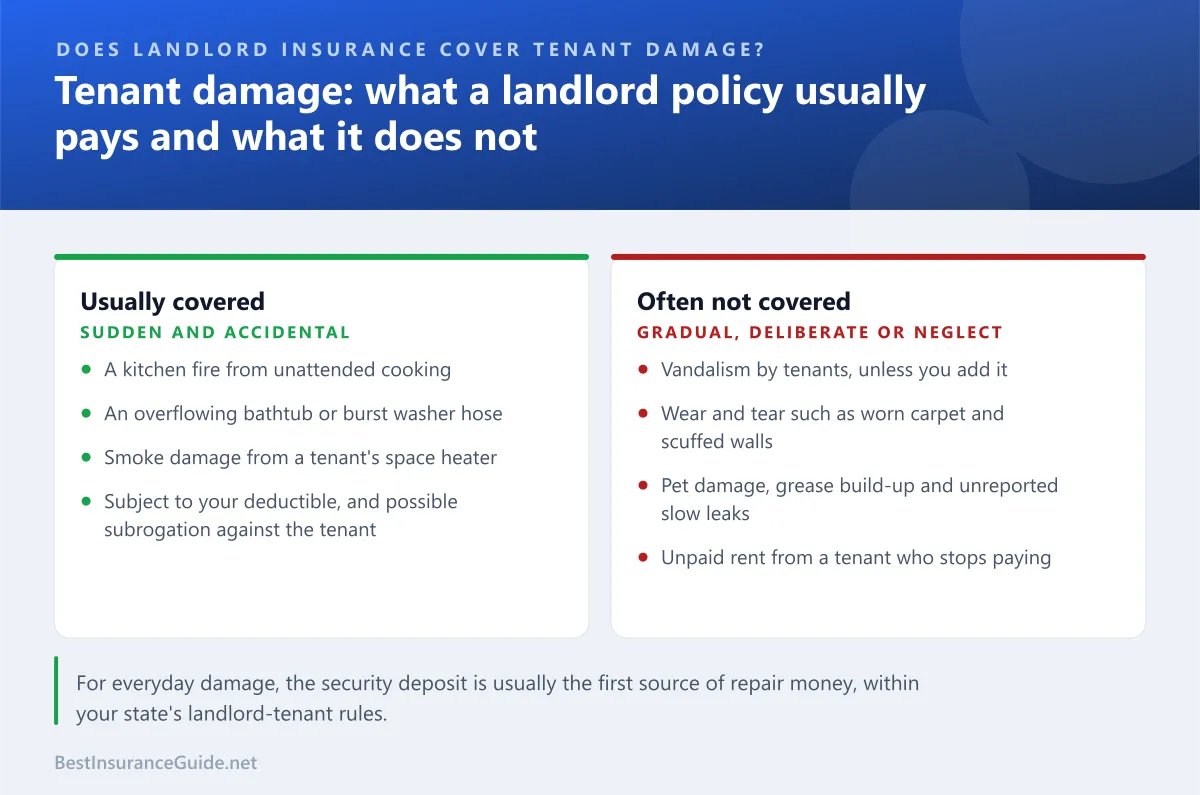
Usually covered, subject to your deductible:
- Accidental fire, such as a tenant leaving cooking unattended.
- Accidental water damage, such as a tenant’s overflowing bathtub or a washing machine hose bursting.
- Sudden damage from a covered peril, such as a tenant’s space heater causing smoke damage.
Often not covered, or only with an add-on:
- Intentional damage or vandalism by tenants. Many landlord policies exclude or limit damage by tenants unless you add malicious mischief or vandalism coverage. Check the wording carefully.
- Wear and tear, such as worn carpets, scuffed walls and faded paint.
- Neglect and poor housekeeping, such as damage from pets, grease build-up or a slow leak the tenant never reported.
- Theft by tenants of your appliances or fixtures, which many policies exclude.
- Unpaid rent from a tenant who simply stops paying. Loss of rent coverage applies after a covered physical loss, not to non-payment. Separate rent guarantee products exist for that.
Can your insurer go after the tenant?
Yes. If a tenant negligently causes a covered loss, your insurer pays you and may then pursue the tenant, or the tenant’s renters insurer, to recover what it paid. That process is called subrogation. Some leases contain mutual waivers that prevent it, which our guide to the waiver of subrogation explains.
The security deposit comes first
For everyday damage beyond normal wear, the security deposit is usually the first and quickest source of repair money, within the limits and procedures of your state’s landlord-tenant law. Insurance is for larger, sudden losses. Using it for small damage close to the deductible can raise your premium for little gain.
Require renters insurance from tenants
A landlord policy does not cover the tenant’s belongings, and the tenant’s own liability, for example a dog bite at the property, may otherwise end up pointed at you. Requiring tenants to carry renters insurance, which is permitted in most states, helps both of you:
- tenants’ belongings are protected after a fire or burst pipe;
- a tenant’s liability insurance can respond to damage they cause to your property or injuries they cause to others;
- disputes after a loss are shorter.
Ask for proof of coverage at move-in and at each renewal. Some insurers will list you as an interested party so you are notified if the policy lapses. Our renters insurance guide explains what tenants’ policies cover.
Converting your home into a rental: a checklist
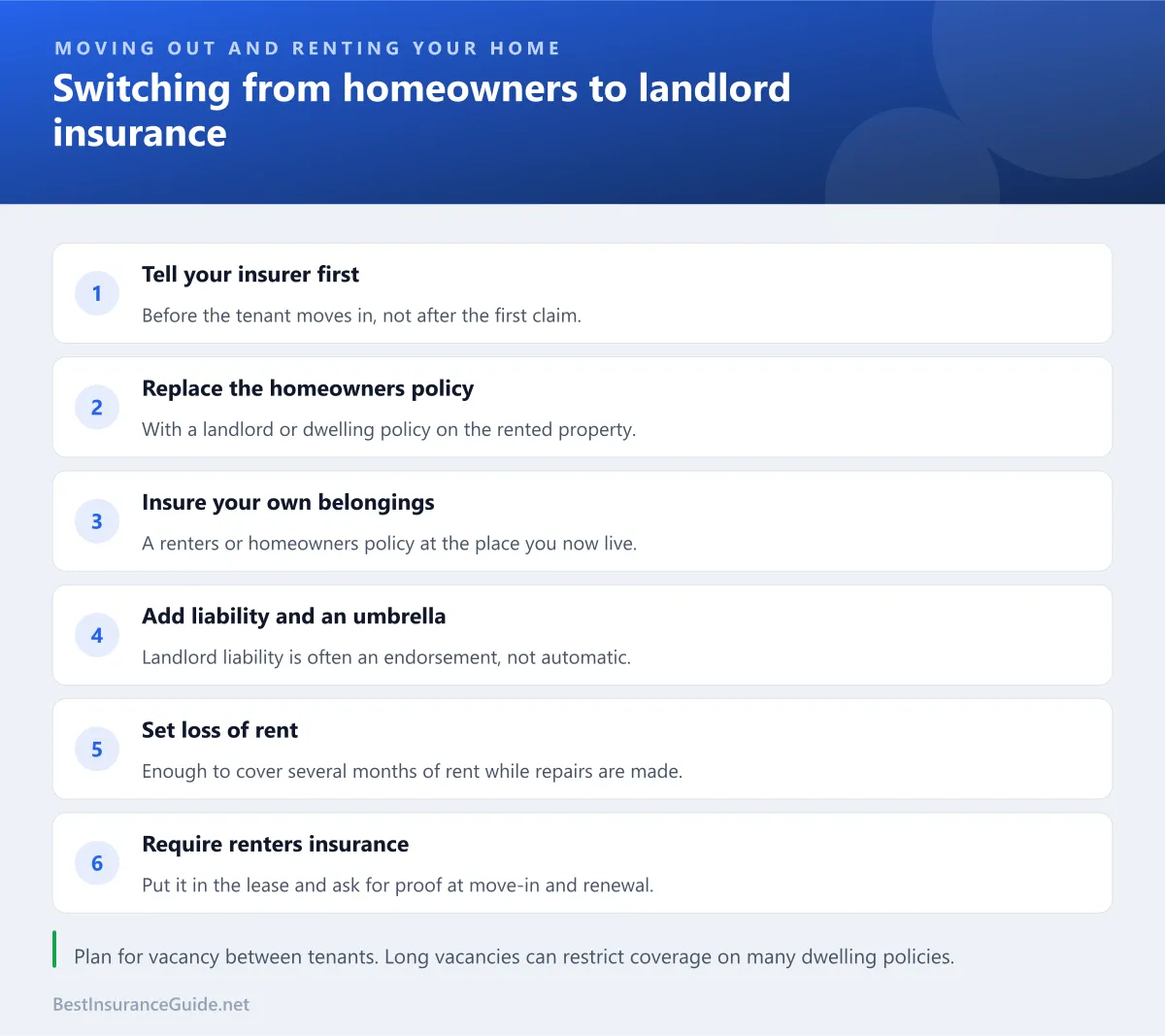
- Tell your insurer before the tenant moves in.
- Replace the homeowners policy with a landlord or dwelling policy on the property.
- Buy renters insurance for yourself at your new home, or a new homeowners policy if you are buying, to cover your belongings and personal liability.
- Add liability coverage to the landlord policy and consider an umbrella above it, especially with several properties. Our guide to business umbrella insurance explains how umbrella limits work.
- Set the loss of rent limit to cover several months of rent.
- Require renters insurance in the lease.
- Plan for vacancy between tenants, since long vacancies can restrict coverage.
The bottom line
Landlord insurance usually costs around 25% more than homeowners insurance on the same property, because rental homes have more claims, the policy adds loss of rent and the liability exposure is different. It covers the building, landlord liability and lost rent after a covered loss. It covers tenant damage only when it is sudden and accidental, not wear and tear, and often not intentional damage without an add-on. It never covers the tenant’s belongings.
If you rent out a home on a lease, a proper landlord policy is not optional in practice. Price it against the rent you collect, not against your old homeowners premium.
BestInsuranceGuide.net is an independent publisher and is not affiliated with any insurer. The 25% figure is the Insurance Information Institute’s general guide; your premium depends on your property, location and insurer. Landlord-tenant and security deposit rules vary by state.