Short-Term Rental Insurance: Why Your Homeowners Policy Stops at the Door
Short-term rental insurance: what it covers, why homeowners insurance may not, how it compares with Airbnb AirCover and landlord insurance.

Table of contents

Renting out a spare room, a vacation home or a whole house for a few nights at a time is now routine. What is less well understood is that the insurance on that home may not have caught up. A standard homeowners policy is written for a family living in their own house. Put paying guests in it and parts of that policy can stop working, often in exactly the situations hosts worry about most: a guest injury, serious damage or a fire during a booking.
Short-term rental insurance is designed for that gap. This guide explains when homeowners insurance does and does not cover short-term rentals, what dedicated short-term rental insurance covers, how it compares with Airbnb’s AirCover and landlord insurance, and what renters who host need to know.
Does homeowners insurance cover short-term rentals?
Often not, or only partly. Standard homeowners policies assume the home is your residence and is not being run as a business. They commonly include:
- Business activity exclusions, which can remove liability coverage for injuries connected to a rental.
- Limits on renting to others, sometimes allowing only occasional rental of part of the home, or excluding property rented to others.
- Occupancy conditions that matter if the home is rarely occupied by you.
The practical result varies by insurer and state, but the pattern is consistent: the more your home looks like a business, the less a standard homeowners policy will cover. A home you rent out every weekend is very unlikely to be fully covered by the homeowners policy you bought when you moved in.
Home-sharing endorsements
Some insurers offer a home-sharing endorsement that adds back limited coverage for occasional hosting on a homeowners policy. These usually:
- apply only when you rent part or all of your primary residence;
- cap the number of nights or the rental income per year;
- restore some property and liability coverage during rentals, often with sublimits.
If you host occasionally, this is the first thing to ask your insurer about. If you host often, you will probably outgrow it.
What short-term rental insurance covers
A dedicated short-term rental policy treats the home as a rental business. Coverage varies by insurer, but typically includes:
- Dwelling coverage for the structure, often on a replacement cost basis. Our guide to replacement cost and actual cash value explains why the settlement basis matters.
- Contents coverage for the furniture, linens, appliances and supplies you provide for guests.
- Liability coverage for guest injuries and damage to guests’ property, commonly $1 million or more.
- Loss of rental income when a covered loss makes the home uninhabitable and cancels bookings.
- Guest damage and theft, which some policies include and others exclude.
- Optional extras such as higher liability limits, equipment breakdown, pools and hot tubs, and bed bug remediation.
It does not usually cover wear and tear, damage you cannot prove happened during a stay, flood (which needs separate flood insurance) or earthquake (which usually needs its own policy or endorsement).
Is Airbnb AirCover enough?
Airbnb’s AirCover for Hosts is the protection hosts ask about most. According to Airbnb, it includes $3 million of host damage protection and $1 million of host liability insurance, alongside guest identity verification and reservation screening.
Airbnb itself says AirCover is not a substitute for personal insurance, and there are practical reasons why:
- It applies only to Airbnb bookings. Bookings through other platforms or directly with guests are not covered.
- Damage protection is a reimbursement program with conditions, including evidence requirements and exclusions such as wear and tear. It is not a property insurance policy on your building.
- It does not cover losses unrelated to guests, such as a fire from faulty wiring while the home is empty, storm damage or a burst pipe between bookings.
- It does not replace lost income in the way a rental income coverage would after a covered loss.
- The liability limit may be too low for a serious injury, particularly in homes with pools or stairs.
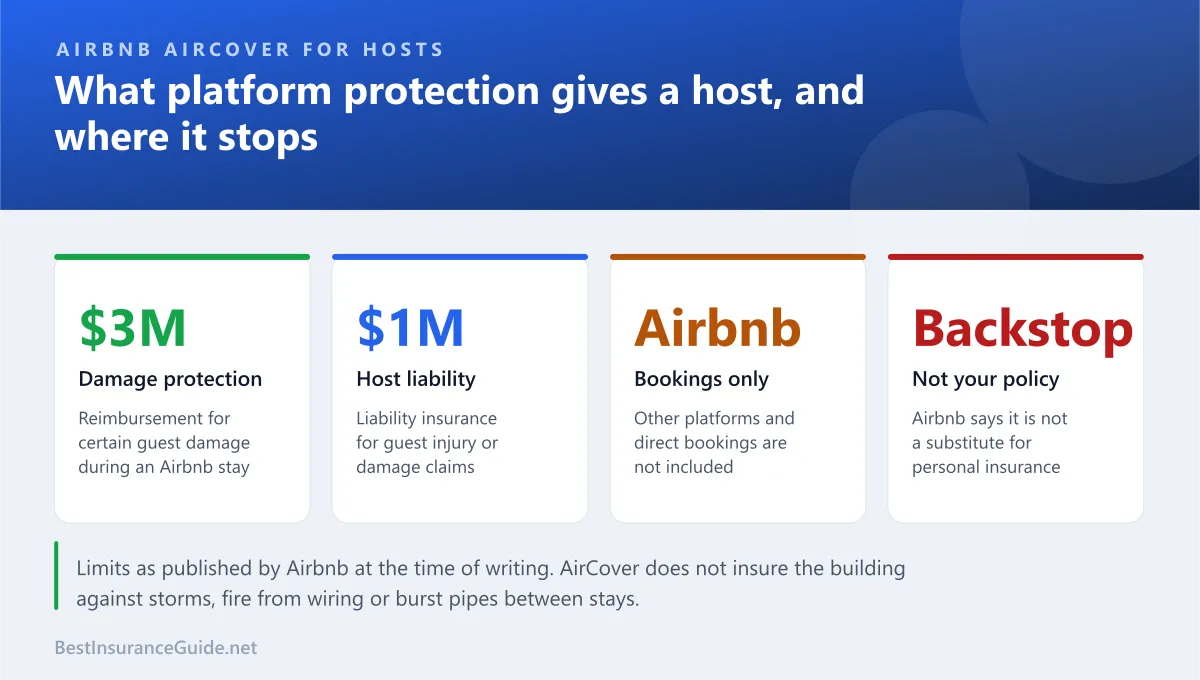
Other platforms have their own programs with their own terms. Treat any platform protection as a backstop, not as your insurance.
Short-term rental insurance vs landlord insurance
Landlord insurance, often written as a dwelling fire policy, is designed for long-term tenants on a lease. Our guide to dwelling insurance explains the DP-1, DP-2 and DP-3 forms.
Many landlord policies exclude or restrict short-term rentals, because guest turnover is much higher, guests are less familiar with the property, and the owner usually furnishes the home. Some landlord insurers offer a short-term rental endorsement; others require a specialist policy.
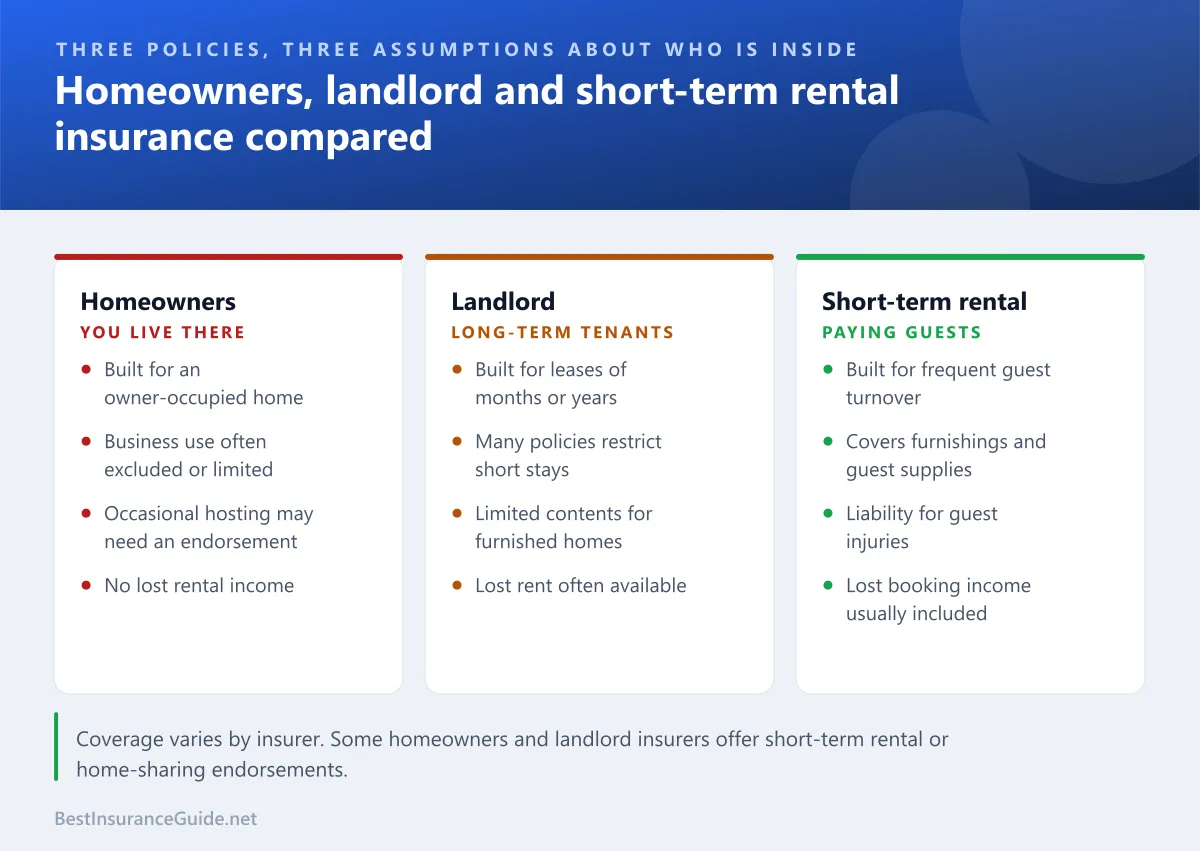
| Detail | Homeowners | Landlord (dwelling fire) | Short-term rental |
|---|---|---|---|
| Designed for | Owner living in the home | Long-term tenants on a lease | Paying guests for short stays |
| Rental use | Limited or excluded | Long-term leasing | The core purpose |
| Contents | Your belongings | Landlord’s appliances and furnishings, limited | Furnishings and supplies for guests |
| Liability | Personal liability; business use often excluded | Landlord liability for tenants | Liability for guest injuries |
| Lost rental income | No | Often available | Usually included |
Short-term rental insurance for renters
Renters who host on a platform face two separate problems.
First, the lease. Many leases prohibit subletting or short-term rentals, and some cities restrict short-term rentals by non-owners. Hosting without permission can breach your lease regardless of insurance.
Second, the renters policy. Renters insurance protects your belongings and personal liability, and typically excludes business activity. A guest injury during a paid stay may not be covered, and your belongings may not be covered if a guest steals or damages them.
If you have your landlord’s written permission, ask your renters insurer whether it offers a home-sharing endorsement, or look for a specialty policy for tenant hosts. Our renters insurance guide explains what a standard renters policy covers.
Which policy fits how often you rent?
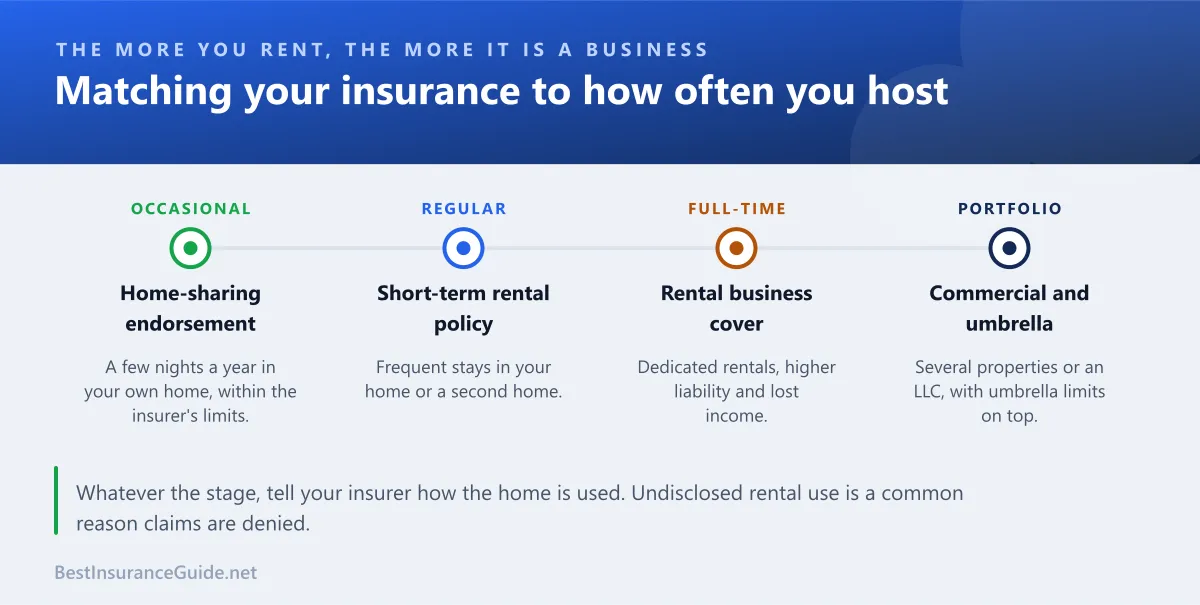
A few nights a year, in your own home. A home-sharing endorsement on your homeowners policy may be enough, combined with platform protection. Confirm the night or income limits.
Regular hosting of your own home or a second home. A dedicated short-term rental policy, or a homeowners or landlord policy with a proper short-term rental endorsement.
A full-time rental property, or several. A short-term rental policy written as a business, with higher liability limits and lost income coverage. If you own through an LLC or run several properties, a commercial policy and an umbrella are often appropriate. Our guide to business umbrella insurance explains how an umbrella sits on top.
Other requirements to check
- Local rules. Many cities and counties require registration or permits for short-term rentals, and some require hosts to carry a minimum amount of liability insurance. Check your local rules before you list.
- Your mortgage. Lenders require the property to be properly insured. A homeowners policy that does not cover your actual use may not satisfy your mortgage terms.
- HOA and condo rules. Condo associations may prohibit short-term rentals or impose their own insurance requirements.
- Taxes and income reporting, which are outside insurance but part of running a rental properly.
Common short-term rental claims
Seeing how claims play out makes the coverage choices clearer.
A guest slips on the deck stairs. The guest breaks an ankle and sues for medical costs and lost wages. On a homeowners policy with a business exclusion, the insurer may decline. On a short-term rental policy, liability coverage responds and pays for your defense. Platform liability protection may also apply to that booking, subject to its terms.
A kitchen fire during a stay. A guest leaves a pan on the stove. The kitchen needs rebuilding and the home is closed for two months. A short-term rental policy pays for the repairs and for the bookings you lose while the work is done. Without lost income coverage, those cancelled bookings come out of your pocket.
A party damages furniture and flooring. Guests break a table and stain carpets. Depending on the policy, guest damage may be covered, or you may need to claim through the platform’s damage program first. Photos taken before check-in are the difference between a paid claim and an argument.
A burst pipe between bookings. The house is empty in January and a pipe freezes. This has nothing to do with guests, so platform protection does not apply. Your own property policy must cover it, and some policies require minimum heating or regular inspections when the home is unoccupied.
Reducing risk: what insurers like to see
Insurers price short-term rentals partly on how well they are managed. Practical steps that lower claims and can improve terms:
- Written house rules covering parties, maximum occupancy, pets and smoking.
- Smoke and carbon monoxide detectors, fire extinguishers and clear exit instructions.
- Noise and occupancy monitoring that respects guest privacy, with no cameras inside the home.
- Pool fencing, stair lighting and non-slip surfaces where they apply.
- Smart locks that change codes for each guest.
- Regular inspections and a maintenance log, especially for vacant periods.
How much does short-term rental insurance cost?
Short-term rental insurance usually costs more than a standard homeowners policy on the same home, because the insurer is covering business use, guest liability and often lost income. The price depends on:
- the home’s location, age, construction and rebuild cost;
- how many nights a year it is rented;
- whether it is your primary residence, a second home or a dedicated rental;
- amenities such as pools, hot tubs and stairs;
- the liability limit, deductible and optional coverages.
Compare the premium against your rental income, not against your old homeowners premium. For most hosts, proper coverage is a modest fraction of annual booking revenue, and a single uninsured claim can wipe out several years of it. A broker who specializes in rentals can compare specialist insurers; our guide to insurance brokers and agents explains how to choose one.
How to set up short-term rental insurance
- Tell your current insurer how you use the home. Hiding rental use risks a denied claim or a cancelled policy.
- Ask about a home-sharing endorsement if you host occasionally in your primary home.
- Get quotes for a dedicated short-term rental policy if you host regularly or the home is a dedicated rental.
- Check liability limits, especially with pools, hot tubs, balconies or stairs. Many hosts choose at least $1 million.
- Confirm lost income coverage and how it is calculated.
- Check guest damage coverage and how it interacts with platform protection.
- Add flood or earthquake cover if the location needs it.
- Keep records: photos of the home before each stay, check-in and check-out records, and receipts for furnishings.
Related reading
Renting long-term instead? Landlord insurance cost explains the premium and what tenant damage it covers.
The bottom line
A standard homeowners or renters policy is built for people living in their own home, not for paying guests. Occasional hosts may be able to fill the gap with a home-sharing endorsement; regular hosts and dedicated rentals need a short-term rental policy that covers the building, guest liability and lost income. Platform protection such as AirCover helps, but by the platform’s own description, it is not a substitute for insurance.
If you are a guest rather than a host, see our guide to whether Airbnb travel insurance is worth it for the other side of the booking.
BestInsuranceGuide.net is an independent publisher and is not affiliated with Airbnb, Vrbo or any insurer. AirCover details are as published by Airbnb at the time of writing and may change. Coverage depends on your policy wording, insurer and state.