Horse Insurance Explained: Mortality, Major Medical, Liability and Trailer Cover
Horse insurance in plain English: equine mortality, major medical, loss of use, liability, horse trailer insurance and what horse insurance costs.

Table of contents

If you have a dog or cat, pet insurance mostly means one thing: a policy that helps pay the vet. Horse insurance is different. It isn’t one product but a set of coverages, each solving a different problem: a policy that pays if the horse dies, one that helps with vet bills, one that pays if the horse can no longer do its job, one that protects you if the horse hurts someone, and cover for the trailer that carries it.
This guide explains each type of horse insurance in plain English: equine mortality insurance, major medical and surgical coverage, loss of use, liability, and horse trailer insurance. It also covers how much horse insurance costs, and how to decide which pieces you actually need.
How horse insurance differs from pet insurance
Dog and cat insurance is built around reimbursing vet bills. Horse insurance developed from the livestock world, where a horse was a working asset with a market value, so it is built around the value of the horse.
- The core policy is life insurance. Equine mortality coverage pays an insured value if the horse dies from a covered cause.
- Vet bills are an add-on. Major medical and surgical coverage are usually bought on top of mortality, not on their own.
- You set a value. You insure the horse for an amount based on what you paid for it or what it’s worth now, and the premium is a percentage of that amount.
- Liability matters more. A 1,000-pound animal can cause serious injuries and property damage, and many homeowners policies exclude horse liability.
The five main types of horse insurance
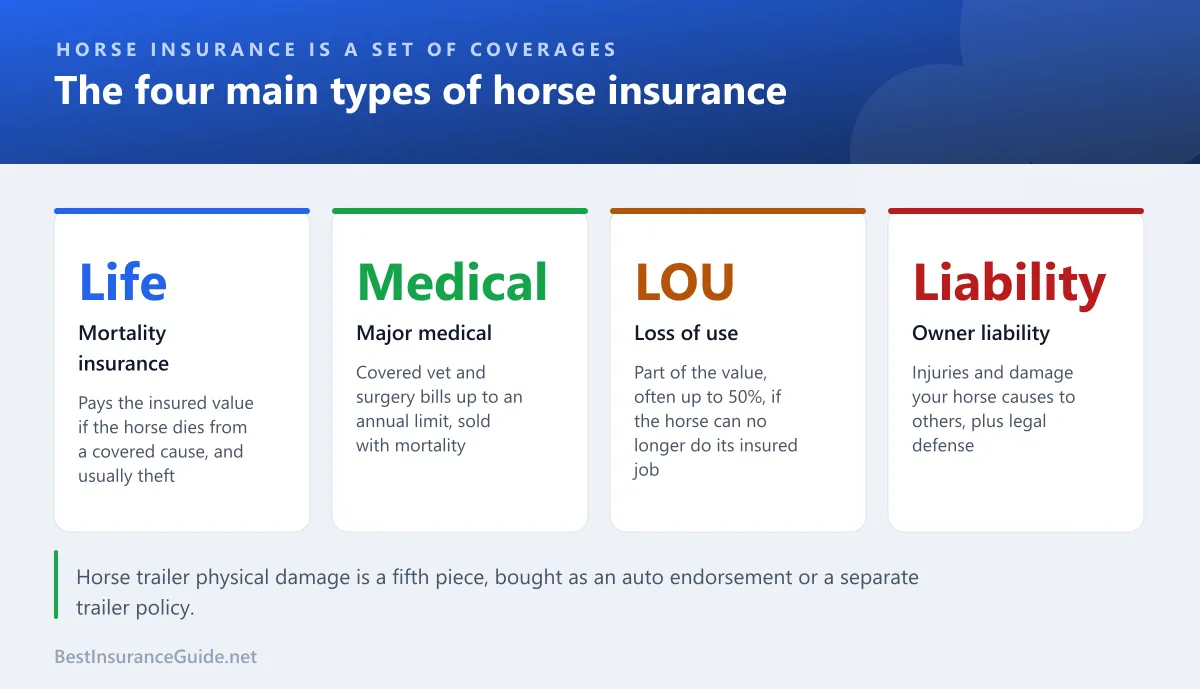
1. Equine mortality insurance
Equine mortality insurance is the foundation of most horse insurance. It pays if your horse dies or has to be humanely destroyed because of a covered accident, illness or injury. Most full mortality policies also cover theft.
Key features:
- Agreed or stated value. You insure the horse for a specific amount. On a claim, many policies pay the lower of the insured value and the horse’s actual market value at the time of death, so over-insuring a horse doesn’t pay more. Read how your policy values the loss.
- Vet exam at purchase. Insurers usually require a veterinary exam for higher values or older horses, and the exam findings can lead to exclusions.
- Humane destruction rules. Policies set strict conditions for euthanasia. Except in a genuine emergency where a vet certifies that immediate euthanasia is necessary to end suffering, you usually need the insurer’s approval first.
- Necropsy. Many insurers require a post-mortem exam to confirm the cause of death.
Mortality insurance is often called “horse life insurance.” A related, cheaper product, named perils coverage, pays only for death from specified events such as fire, lightning, flood or collision. It costs less but covers far less, because it doesn’t pay for death from illness, including colic.
2. Major medical and surgical coverage
Major medical helps pay for covered veterinary treatment from accidents and illnesses, such as diagnostics, hospital stays, medication and surgery, up to an annual limit after a deductible. Surgical-only coverage is a cheaper version that pays only for surgery and related care.
Most insurers only sell these coverages alongside mortality insurance. Many mortality policies also include a small amount of emergency colic surgery coverage automatically. Colic is one of the most common reasons for emergency equine surgery, and the bills can be large.
Important points:
- Limits are annual. Common limits run from about $5,000 to $15,000.
- Pre-existing conditions are excluded, and a condition treated under the policy may be excluded at renewal. Ask how each insurer handles renewals after a claim.
- Routine care isn’t covered. Vaccinations, farrier work, dental floating and wellness exams are costs you budget for yourself.
3. Loss of use
Loss of use coverage pays if your horse survives an injury or illness but can permanently no longer perform the use it was insured for, such as jumping, racing, breeding or showing. It typically pays a portion of the insured value, often up to 50%.
It’s mainly bought for high-value performance and breeding horses, where the horse’s value lies in what it can do. Insurers often require the horse to be kept, and some policies require it to be retired or transferred to the insurer. Read the conditions carefully before buying.
4. Horse owner’s liability
If your horse kicks a visitor, gets loose and causes a car accident, or damages a neighbor’s property, you could be held legally responsible. Horse owner’s liability insurance pays for those claims and your legal defense.
This is the piece many owners overlook. Many homeowners policies exclude or strictly limit liability for horses and other livestock. Some will add it by endorsement, but many owners need either:
- Private horse owner’s liability, for people who own horses for personal use, or
- Farm or equine business liability, if you board, train, give lessons or breed commercially.
Businesses that care for other people’s horses also need care, custody and control coverage, which protects them if a client’s horse is hurt or dies in their care.
Equine activity liability laws. Most states have laws that limit liability for injuries caused by the “inherent risks” of equine activities. According to legal compilations such as the Animal Legal & Historical Center, every state except California, Maryland, Nevada and New York has one. These laws usually require warning signs and specific contract language, and they don’t protect against negligence, such as faulty tack or a horse known to be dangerous. They reduce your risk, but they aren’t a substitute for insurance.
5. Horse trailer insurance
Horse trailer insurance covers the trailer you use to transport your horse. How it fits with your car insurance is often misunderstood:
| What’s damaged | Usually covered by your auto policy? | What to buy |
|---|---|---|
| Other cars or people you hit while towing | Often yes, through your liability coverage | Confirm with your auto insurer |
| The trailer itself, in a crash, theft or fire | Usually no | A trailer physical damage endorsement or separate trailer policy |
| Tack and equipment inside | Usually no | Contents or equine equipment coverage |
| The horse inside | No | Equine mortality insurance |
A living-quarters trailer may need different coverage from a standard stock or two-horse trailer. If the trailer is used for a business, such as hauling clients’ horses, you’ll need commercial auto coverage. See our guide to commercial auto insurance costs. When you lend or borrow a trailer, check whose insurance covers what before the trip, not after an accident.
How much does horse insurance cost?
Mortality insurance is priced as a rate, a percentage of the horse’s insured value. According to an article by an equine insurance specialist, published by the US Eventing Association, rates typically run from about 2.8% to 4.5% a year for horses aged 2 to 14. The main factors are age, breed and discipline.
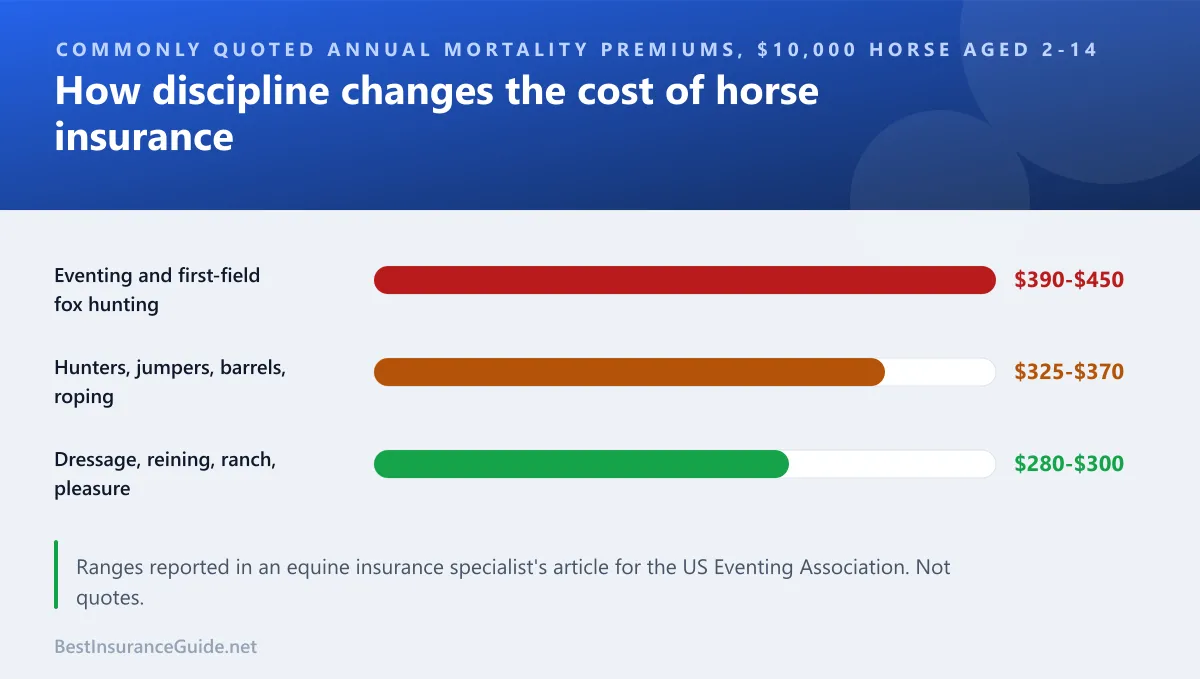
For a horse aged 2 to 14 insured at $10,000, the same source gives these annual mortality premiums:
| Discipline | Annual mortality premium on a $10,000 horse |
|---|---|
| Dressage, reining, cutting, ranch and pleasure | $280–$300 |
| Show hunters and jumpers, barrel racing and roping | $325–$370 |
| Eventing and first-field fox hunting | $390–$450 |
The same article gives these costs for other coverages:
- Major medical: about $250 a year for a $5,000 limit, rising to about $625–$850 for a $15,000 limit.
- Surgical-only: from about $100 for a $5,000 limit.
- Private horse owner’s liability: roughly $85–$275 a year for many owners, depending on the limit and whether it’s bought with a mortality policy.
These are commonly quoted ranges, not quotes. Your price depends on the insurer, your state, and your horse.
What drives the price
- Insured value. The premium is a percentage of the value, so a $50,000 horse costs about five times as much to insure as a $10,000 horse at the same rate.
- Age. Foals and yearlings, and horses older than about 15, carry higher rates. Many insurers stop offering full mortality coverage at about age 20.
- Discipline. Higher-risk activities such as eventing, racing and polo carry higher rates than pleasure riding.
- Breed. Some breeds are associated with higher claim rates.
- Health history. Past colic, lameness or surgery can lead to exclusions or higher premiums.
- Coverage choices. Major medical limits, deductibles and add-ons such as loss of use all affect the total.
A worked example
Consider a 9-year-old pleasure horse insured for $10,000, with a $5,000 major medical limit and personal liability coverage. Using the ranges above, the owner might pay about:
- $290 for mortality
- $250 for major medical
- $100–$200 for liability
That’s around $640–$740 a year in total, or roughly $55–$60 a month. Pricing a single emergency colic surgery is often enough to show why owners choose to carry medical coverage. This example is illustrative, not a quote.
Filing a claim: the rules that matter most
Horse insurance claims succeed or fail on process. Most disputes come from missed notification rules, not from coverage gaps.
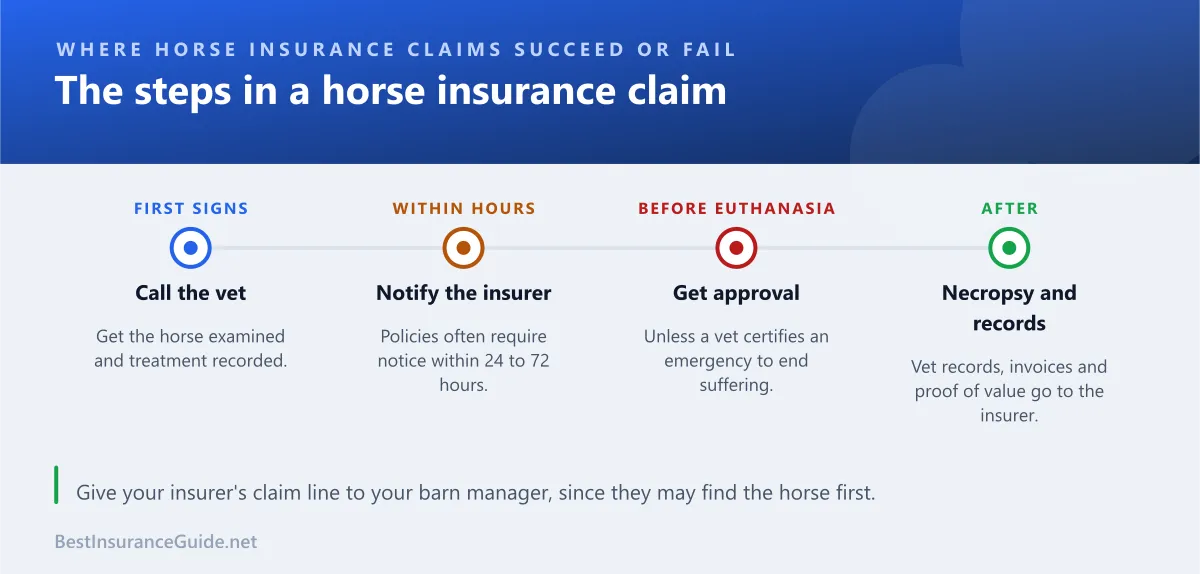
- Call your vet as soon as the horse is ill or injured.
- Notify the insurer promptly. Policies commonly require notice within a short window, often 24 to 72 hours, of any serious illness, injury or lameness. Many insurers have 24-hour claim lines.
- Get approval before euthanasia unless it’s a genuine emergency and your vet certifies that it’s necessary to end suffering.
- Arrange a necropsy if the insurer requires one.
- Submit records, including vet records, invoices, the necropsy report, and proof of value or purchase.
Save your insurer’s claim number in your phone and give it to your barn manager. If your horse is boarded, the person who finds it in trouble may not be you.
Which horse insurance do you actually need?
Not every owner needs every coverage. Here’s a practical way to decide:
- Liability: worth considering for almost every owner. A lawsuit can cost far more than the horse is worth, and your homeowners policy may not respond.
- Mortality: worth it if losing the horse’s value would hurt financially, if you’ve financed the purchase (lenders may require it), or if you’re insuring a competition, breeding or sale horse.
- Major medical or surgical: worth it if a $10,000 vet bill would force a hard decision. Many owners buy it mainly for colic surgery.
- Loss of use: mainly for high-value performance or breeding horses.
- Trailer coverage: worth it if you’d struggle to repair or replace the trailer, and essential if you haul horses for others.
If your horse is a family companion with little resale value, some owners skip mortality insurance and instead put money aside for vet emergencies, while still carrying liability coverage. That’s a reasonable choice, as long as it’s a deliberate one.
Tips for buying horse insurance
- Insure for a value you can document, such as the purchase price, a bill of sale, recent show results or a professional appraisal.
- Use an equine insurance specialist. Many general insurance agents don’t write horse insurance. Our guide to insurance brokers vs agents explains how different agents work.
- Read the exclusions from the vet exam before you pay the premium.
- Ask about renewal after a medical claim, since some insurers exclude conditions that were claimed in the prior year.
- Check your homeowners policy for animal and livestock exclusions. Our guide to dog bite liability insurance shows how animal liability exclusions work in practice.
- Update the value when the horse’s value changes, such as after a successful show season or as the horse ages.
If you have other animals, our pet insurance cost guide covers how dog and cat policies are priced, which is very different.
The bottom line
Horse insurance is a toolkit rather than a single policy. Mortality insurance protects the horse’s value, major medical protects you from large vet bills, loss of use protects a performance horse’s earning value, liability protects you from lawsuits, and trailer coverage protects the equipment you haul with.
For most owners, liability is the priority, followed by mortality and medical coverage according to what the horse is worth and what you could afford to pay yourself. Get quotes from an equine specialist, read the notification rules carefully, and keep the claim line handy.
BestInsuranceGuide.net is independent and not affiliated with any insurer, agency or equestrian organization. Cost ranges are commonly quoted industry figures, not quotes, and policy terms vary by insurer and state. Confirm details with a licensed insurance professional before you buy.