Drone Insurance: What It Covers, What It Costs and When You Need It
Drone insurance explained: liability and hull cover, what it costs, Part 107 commercial requirements, and whether homeowners insurance covers a drone.

Table of contents
Drones have gone from toys to working tools. Real estate photographers, roof inspectors, surveyors, farmers, filmmakers and wedding videographers all fly them for money, and millions more people fly them for fun. Every one of those flights carries two risks: damaging something that belongs to someone else, and destroying an expensive piece of equipment you own.
Drone insurance covers those two risks through two separate coverages, liability and hull. This guide explains what each one covers, when drone insurance is required, what commercial drone pilots need, what drone insurance costs, and why a homeowners or general liability policy is usually not enough.
What drone insurance covers
Most drone insurance policies are built from two main parts, which you can usually buy separately.
Drone liability insurance
Liability insurance pays for damage your drone causes to other people and their property, including legal defense costs, up to the policy limit. It is the part clients and property owners care about.
Typical claims include:
- a drone losing signal and crashing through a car windshield;
- a drone striking a person at an outdoor event;
- a drone damaging a roof, solar panels or a skylight during an inspection;
- a crash starting a fire or damaging landscaping.
Common liability limits are $500,000, $1 million and $2 million or more. Commercial clients often require at least $1 million.
Some policies also include or offer privacy and invasion-of-privacy liability, sometimes called personal and advertising injury. Because drones carry cameras, claims alleging that footage invaded someone’s privacy are a real exposure, and many general liability policies exclude them for aircraft.
Drone hull insurance
Hull insurance covers physical damage to the drone itself, and often the camera, gimbal and other payload. Depending on the policy, it may pay for:
- crash damage, whether from pilot error, a gust of wind or a collision;
- flyaways, where the drone loses connection and is never recovered;
- theft;
- damage in transit.
Hull cover is optional. For a $400 hobby drone it rarely makes sense. For a $15,000 mapping drone with a thermal camera, it usually does.
Other coverages you may see
- Ground equipment: controllers, tablets, batteries and chargers.
- Payload: cameras and sensors, sometimes insured separately from the airframe.
- Non-owned drone liability: for flying a drone you rent or borrow.
- Worldwide or territory extensions for flying outside the US.
Is drone insurance required?
There is no federal requirement. The FAA does not require insurance for recreational flyers or for commercial pilots operating under its Part 107 small drone rules.
That does not mean insurance is optional in practice:
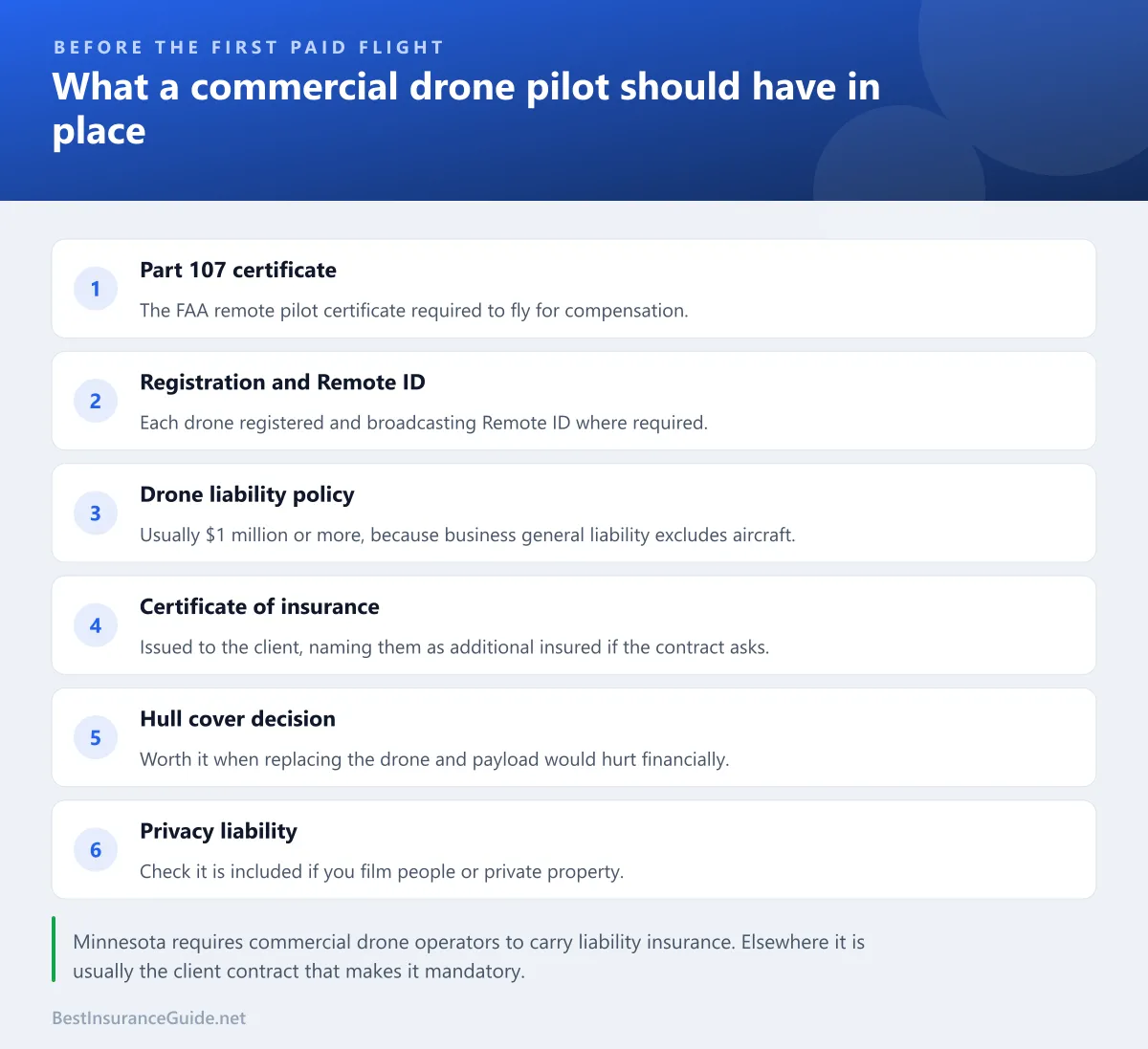
- Minnesota requires commercial drone operators to carry liability insurance.
- Clients in construction, real estate, film, energy and infrastructure commonly require proof of insurance before you fly.
- Venues, event organizers and property managers often require it, and may ask to be named on your policy.
- Local governments and parks may require insurance for permits to fly on public land.
- Employers that use drones in their business will need it, because their general liability policy almost certainly excludes aircraft.
What the FAA does require is separate from insurance. Recreational drones over 250 grams (0.55 lb), and every drone flown commercially regardless of weight, must be registered, at $5 per aircraft for three years; commercial pilots need a Part 107 remote pilot certificate; recreational pilots need to pass the free TRUST safety test; and most drones must comply with the Remote ID rule, which requires them to broadcast identification and location during flight.
Recreational drone insurance: do hobby pilots need it?
For a hobby pilot, the big risk is liability. A crash that injures someone or damages a car can cost far more than the drone.
Your homeowners or renters policy may help, partially.
- The drone as property. A drone is usually personal property. It may be covered for named perils such as fire and theft, but crash damage from your own flying is often not a covered peril.
- Liability. Homeowners policies exclude aircraft liability, but some standard forms make an exception for model or hobby aircraft not designed to carry people or cargo, which can include small recreational drones. Not every insurer uses that wording, and some add drone-specific exclusions.
- Any business use is typically excluded. Selling a single photo from your drone can turn a hobby flight into a business activity in your insurer’s eyes.
Recreational pilots have a few other options:
- Membership organizations for model aircraft, such as the Academy of Model Aeronautics, include liability coverage for members flying within their safety programs.
- Standalone recreational drone policies, often inexpensive, for liability and sometimes hull.
- Manufacturer protection plans, which cover accidental damage to the drone but not liability.
Ask your home insurer directly whether your policy covers drone liability. Our guide to what home insurance covers explains the liability section in more detail.
Commercial drone insurance
If you fly for money, even occasionally, you are a commercial operator, and your needs change.
Why your business insurance does not cover the drone
Most commercial general liability policies contain an aircraft exclusion, which applies to drones. A photographer, roofer or surveyor who adds a drone to their business may find their existing general liability policy does not respond to a drone accident at all. A separate drone liability policy, or a specific endorsement from your insurer, fills that gap. Our business insurance checklist covers the other policies a small business usually needs.
What clients will ask for
Commercial clients typically ask for:
- $1 million or more of drone liability, sometimes $2 million or $5 million for larger sites.
- A certificate of insurance showing that coverage. Our guide to the certificate of liability insurance explains how to request and read one.
- Additional insured status for the client or property owner, so your policy defends them if they are sued over your flight. See what additional insured means.
- Your Part 107 certificate number and drone registration.
Annual vs on-demand drone insurance
Annual policies cover all flights during the policy year. They suit pilots who fly regularly and need a certificate on file with clients.
On-demand policies are bought through an app for a single flight, day or job. They suit pilots who fly commercially only occasionally, or who need a higher limit for one specific job. Most on-demand products cover liability only; hull is usually annual.
How much does drone insurance cost?
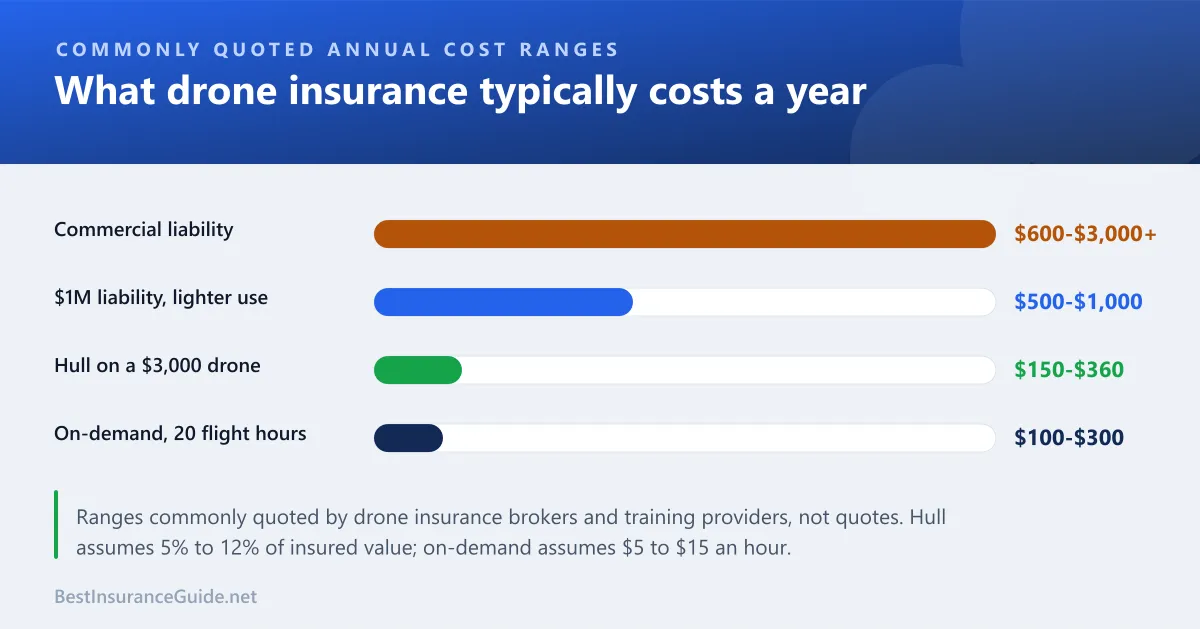
Prices depend on the liability limit, the drone’s value, how and where you fly, your experience and the type of work. Industry brokers and drone training providers commonly quote ranges like these:
| Coverage | Commonly quoted cost |
|---|---|
| $1 million liability, lighter-risk use | About $500 to $1,000 a year |
| Commercial liability, depending on work and limits | About $600 to $3,000+ a year |
| Hull cover | Roughly 5% to 12% of the drone’s insured value a year |
| On-demand liability | Roughly $5 to $15 an hour |
For example, hull cover on a $3,000 drone at those rates would cost roughly $150 to $360 a year, before any deductible.
What drives the price
- Liability limit. $2 million costs more than $1 million, but not twice as much.
- Type of work. Real estate photography over empty lots is priced very differently from inspections near power lines or filming over crowds.
- Drone value, for hull cover.
- Flight hours and experience. Logged hours and a clean claims record help.
- Deductible on hull cover.
- Territory, such as flying abroad.
Hull: agreed value or actual cash value?
Check how a hull claim will be settled. Agreed value pays the amount agreed when the policy started; actual cash value deducts depreciation, which can be steep for electronics that lose value quickly. Our guide to replacement cost and actual cash value explains the difference.
Drone insurance by type of work
The same drone can carry very different risks depending on the job.
Real estate photography. Flights are short and usually over the client’s own property, but they happen near neighbors’ homes, cars and people. A $1 million liability limit is the usual requirement, and privacy liability matters because neighboring homes appear in the footage.
Roof and building inspections. Flying close to structures raises the chance of a collision with the building itself. Contractors and property managers often require additional insured status and may ask for higher limits. Hull cover is common because inspection drones fly in tight spaces.
Weddings and events. Flying near crowds is one of the highest-risk activities for liability. Venues frequently require a certificate naming them, and FAA rules on flying over people apply. Our guide to certificates of insurance covers what venues ask for.
Agriculture and mapping. Larger, more expensive aircraft and long flights make hull cover more important. Spray drones carrying chemicals raise separate liability and regulatory questions, and not every drone insurer will cover them.
Film and media production. Productions typically require high liability limits, specific additional insured wording and proof of FAA waivers for any operations outside standard Part 107 rules.
Common drone claims and how they are handled
A flyaway over a lake. A drone loses GPS lock and flies into the water. The drone is lost; nothing else is damaged. Only hull cover pays, and some policies require the pilot to show flight logs demonstrating the loss was not caused by flying outside the rules.
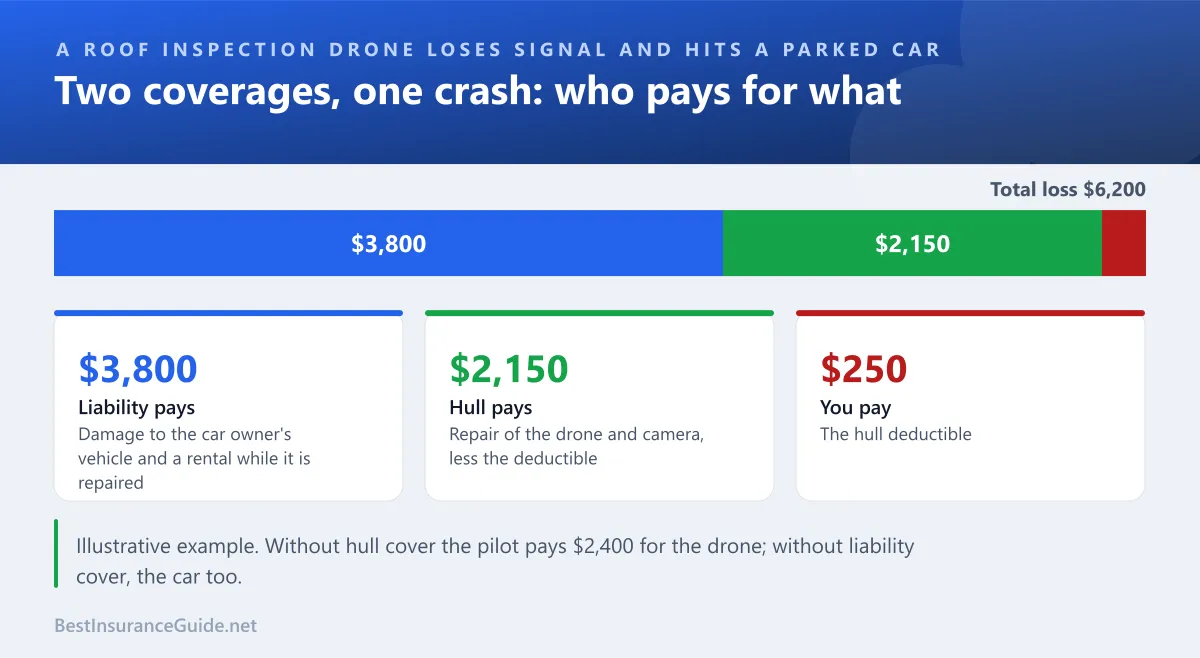
A collision with a vehicle. As in the example above, liability pays for the vehicle and hull pays for the drone. The pilot’s flight logs and any footage are important evidence.
An injury at an event. A drone clips a guest’s head during a descent. Liability covers medical costs and any claim, and defends the pilot and, if they are additional insureds, the venue and organizer. This is the scenario that makes a $1 million limit feel modest.
A privacy complaint. A neighbor alleges that footage captured their backyard and sues. Whether the policy responds depends on whether privacy or personal injury liability is included, which is why it is worth checking before you need it.
In every case, report the incident promptly, preserve the drone’s flight logs and footage, and do not admit fault at the scene.
How to choose a drone insurance policy
- Start with liability. It protects against the losses that can genuinely hurt you financially.
- Match the limit to your clients’ contracts, not just your own comfort level.
- Decide whether hull is worth it by comparing the premium to the cost of replacing the drone yourself.
- Check privacy liability, especially if you film people or private property.
- Check how drones are scheduled. Some policies cover named drones only, so a new drone needs to be added.
- Read the exclusions: flights that break FAA rules, flying beyond visual line of sight without a waiver, or flying under the influence are common exclusions.
- Compare annual and on-demand based on how often you actually fly commercially.
The bottom line
Drone insurance is two coverages: liability for the damage your drone does to others, and hull for the drone itself. It is not required by federal law, but commercial clients, Minnesota’s rules and ordinary common sense make liability coverage close to essential for anyone flying for money. Hobby pilots may have some protection through a homeowners policy or a model aircraft organization, but it is worth confirming rather than assuming.
If a drone is one part of a wider small business, see our guide to business insurance for sole proprietors for the other coverages you are likely to need.
BestInsuranceGuide.net is an independent publisher and is not affiliated with the FAA, any drone manufacturer or any insurer. Cost ranges are commonly quoted industry figures, not quotes; your premium depends on your operations and insurer. FAA rules change; check faa.gov for current requirements.