Boat Insurance in South Carolina: Is It Required, and What Coastal and Lake Boaters Need
Is boat insurance required in South Carolina? Not yet. The proposed watercraft bill, marina and lender rules, hurricane cover and what it costs.

Table of contents

South Carolina has two very different kinds of boating. On the coast, boaters run the Intracoastal Waterway, the harbors around Charleston, the sounds around Beaufort and Hilton Head, and the waters off Myrtle Beach. Inland, they head to Lake Murray, Lake Marion, Lake Moultrie, Lake Hartwell, Lake Keowee and Lake Wateree. The insurance questions are similar in both places, but the risks, especially hurricanes, are not.
This guide answers the question most SC boat owners start with, is boat insurance required in South Carolina?, explains a proposed law that could change the answer, and covers what coastal and lake boaters should actually buy.
Is boat insurance required in South Carolina?
Not by state law, as of this writing. South Carolina doesn’t require recreational boat owners to carry liability or any other boat insurance, and registering a boat doesn’t generally require proof of insurance.
That puts South Carolina with most other states. Only a few states, such as Utah and Arkansas, require boat insurance by law. Our guide to boat insurance in Arkansas shows how one of those laws works.
But “not required by law” doesn’t mean nobody will ask for it. In practice, most South Carolina boat owners carry insurance because:
- Lenders require it. If you finance a boat, the loan will require physical damage coverage, with the lender listed as loss payee.
- Marinas require it. Most marinas and many dry-stack facilities along the coast and on the big lakes require liability insurance, often naming the marina as an additional insured.
- Liability is the real risk. A collision, a propeller injury or damage to a dock can cost far more than the boat is worth.
The proposed South Carolina boat insurance law
South Carolina has debated requiring boat insurance. Senate Bill 26 in the 2025–2026 legislative session would require liability insurance for certain watercraft. According to the bill text on the South Carolina Legislature’s website, it would:
- Apply to watercraft with more than 70 horsepower, personal watercraft such as jet skis, and specialty propcraft, when titled in South Carolina or documented by the U.S. Coast Guard with a South Carolina hailing port.
- Require at least $50,000 of combined liability coverage for bodily injury and damage to other people’s property.
- Set fines starting at $50 to $250 for a first offense and rising for repeat offenses, with fines directed to boater training and safety programs.
The bill passed second reading in the Senate on February 3, 2026, by a 24–19 vote, but was recommitted to the Senate Committee on Fish, Game and Forestry on May 7, 2026. That means it isn’t law. It could return in a future session, possibly in a different form.
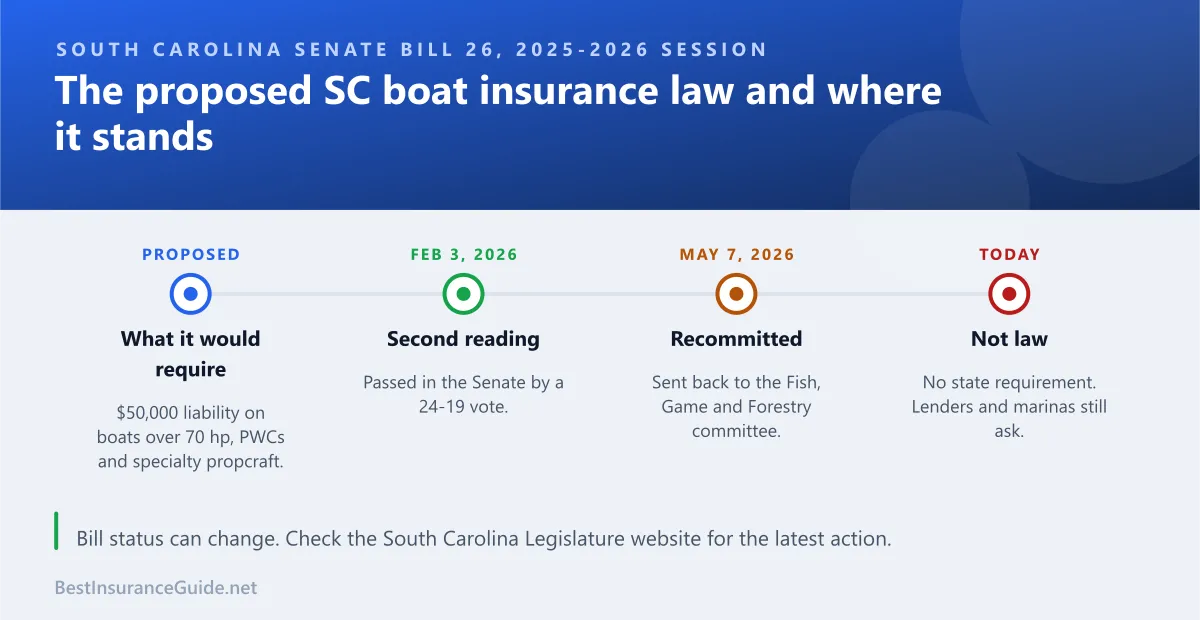
What this means for you: If you own a boat over 70 horsepower or a personal watercraft, carrying at least $50,000 of liability coverage now puts you ahead of any future requirement. Most owners should carry far more than that anyway. Check the South Carolina Legislature’s website before relying on any summary, including this one, because bill status can change.
Boating rules that affect SC boat owners
Several state rules aren’t about insurance but still matter:
- Boater education. According to the South Carolina Department of Natural Resources (SCDNR), anyone born after July 1, 2007 must pass an approved boater education course before operating a boat, personal watercraft or specialty propcraft with a motor of 10 horsepower or more. SCDNR notes that completing a course may also qualify you for insurance discounts.
- Titling. South Carolina titles boats and outboard motors, including many smaller outboards. Keep titles and registration current, because insurers and lenders rely on them.
- Property tax. South Carolina counties generally tax boats and motors as personal property. That isn’t an insurance issue, but it’s part of the true annual cost of owning a boat in the state.
- Rentals. Rental operators may require a rental safety certificate and their own insurance. Confirm what the rental company’s policy covers before you leave the dock.
Coastal vs lake boating: different risks, different coverage
Where you keep and use your boat has the biggest effect on what you need and what you’ll pay.
Coastal boats
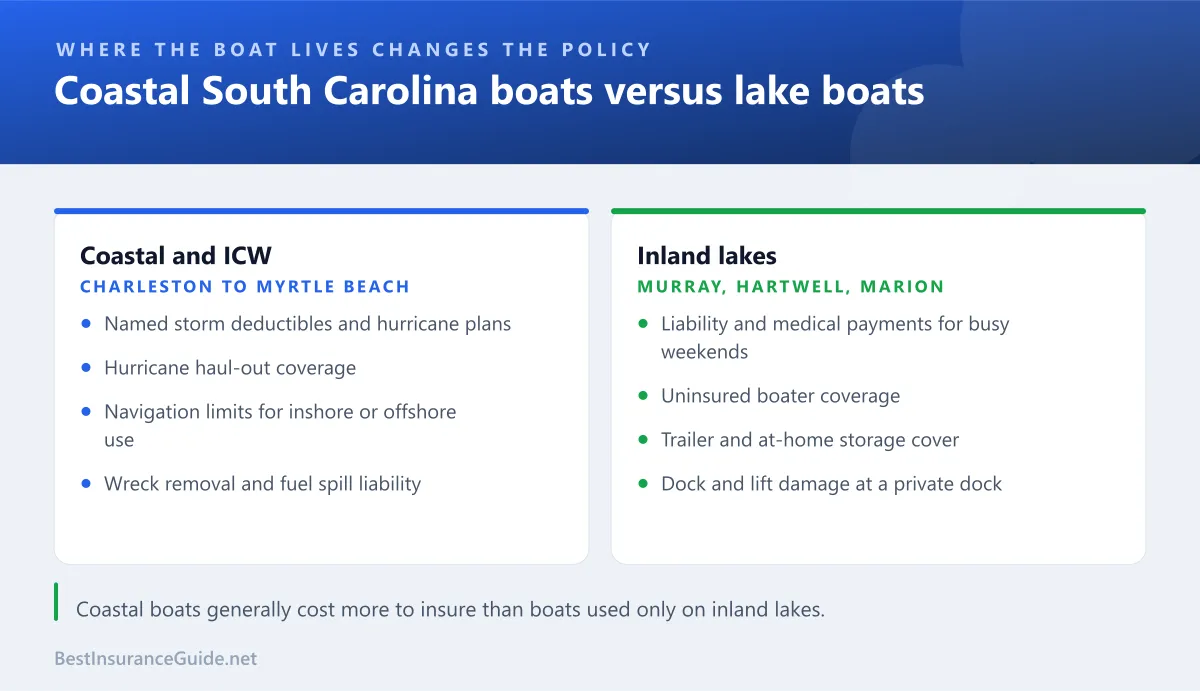
Coastal boats face salt water, tides, strong currents, shoaling, heavy traffic in harbors and on the Intracoastal Waterway, and most importantly, hurricanes and tropical storms. Coastal policies are generally more expensive, and they often come with:
- Navigation limits that set where the boat can be used, such as inland and coastal waters within a set distance of shore.
- Named storm deductibles, a separate and often higher deductible that applies to damage from a named storm.
- Hurricane plan requirements, where the insurer wants to know in writing how you’ll protect the boat when a storm threatens.
- Wreck removal and fuel spill liability, which matter more when a sunk boat is in a busy harbor or marina.
Lake boats
Boats on Lake Murray, Lake Hartwell and other inland lakes face different risks: heavy weekend traffic, water sports, submerged hazards, crowded coves, and thunderstorms. Lake boats generally cost less to insure than coastal boats, but pay attention to:
- Liability and medical payments, especially for pontoons and wake boats carrying many guests and towing skiers or tubers.
- Uninsured boater coverage, because state law doesn’t require other boaters to carry insurance.
- Coverage on the trailer and at home, since many lake boats spend most of the year in a driveway or garage.
- Dock and lift damage, for boats kept at a private dock on the lake.
Hurricanes and your boat insurance
For coastal owners, and for lake owners in the path of a strong storm, hurricane season from June through November is the most important insurance consideration.
Named storm deductibles
Many coastal boat policies use a separate deductible for damage from a named storm, often expressed as a percentage of the boat’s insured value. On a $60,000 boat, a 5% named storm deductible would be $3,000, compared with perhaps $500 or $1,000 for other claims. The figures here are illustrative. Check your policy’s actual deductible before the season starts.
Hurricane haul-out coverage
Many insurers offer hurricane haul-out coverage, which helps pay the cost of hauling your boat out of the water, or moving it to a safer location, when a named storm threatens. Some policies pay a share of the cost, and some reduce your deductible if you follow your hurricane plan. It’s usually inexpensive and worth adding on the coast.
A hurricane plan
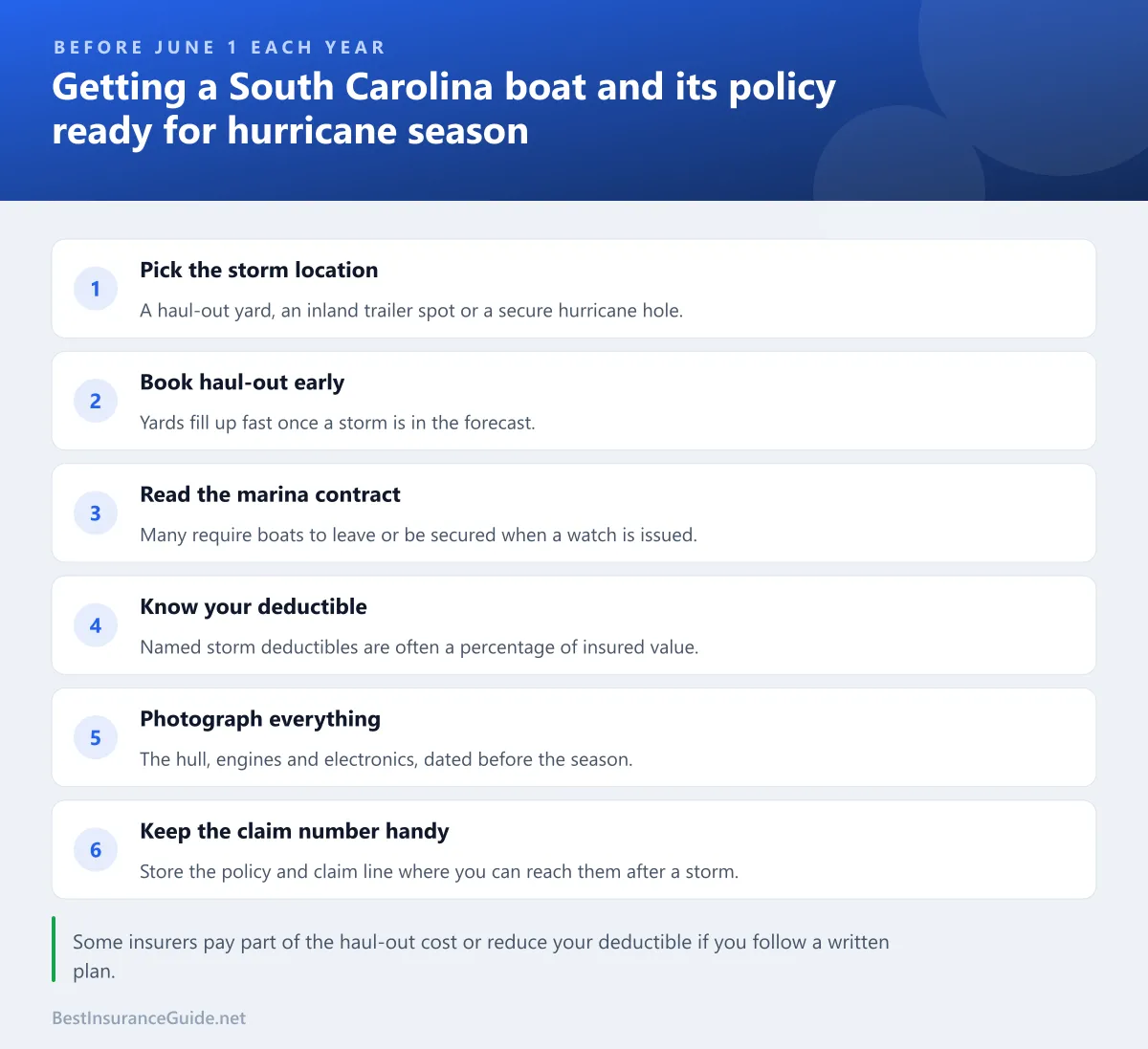
If your insurer requires a hurricane plan, or even if it doesn’t, write one down before the season:
- Decide where the boat goes when a storm threatens, such as a haul-out yard, a trailer inland, or a secure hurricane hole.
- Book haul-out early. Yards fill quickly when a storm is forecast.
- Check your marina contract. Many marinas require boats to leave, or to be secured to specific standards, when a hurricane watch is issued.
- Know your named storm deductible and what haul-out coverage pays.
- Photograph the boat and its equipment before the season.
- Remove valuables and electronics that aren’t secured.
- Keep policy documents and your insurer’s claim number somewhere you can reach them after the storm.
What boat insurance covers
A South Carolina boat policy typically includes:
- Physical damage to the hull, motor and equipment from collisions, storms, fire, theft and vandalism.
- Liability for injuries and property damage you cause, including legal defense.
- Medical payments for injuries to you and your passengers.
- Uninsured boater coverage for injuries caused by boaters without insurance.
- Trailer coverage, often included or available as an add-on.
- Optional coverages such as on-water towing, hurricane haul-out, fuel spill liability, wreck removal, and personal effects including fishing gear.
For older boats, choose between agreed value and actual cash value carefully. Agreed value pays the amount you and the insurer agree on for a total loss, while actual cash value pays the depreciated value, which can be much lower. Our guide to replacement cost vs actual cash value explains why this matters. If you keep a boat at a marina that includes a waiver in its slip agreement, see our guide to waivers of subrogation.
Four common South Carolina boat claims
These scenarios show how the pieces of a policy work together. They’re illustrative, and the outcome of any real claim depends on your policy wording.
- Grounding on a sandbar in the ICW. Shoaling is common on parts of the Intracoastal Waterway. Physical damage coverage typically pays for hull and lower-unit repairs after your deductible, and on-water towing coverage helps with the cost of getting pulled free.
- A tuber injured on Lake Murray. A guest being towed collides with a dock. Medical payments coverage can pay the guest’s medical bills regardless of fault, and liability coverage responds if the guest or their health insurer makes a claim against you.
- A storm surge sinks a boat in its slip. Physical damage coverage generally pays for the boat, subject to the named storm deductible. Wreck removal and fuel spill coverage can pay to raise the boat and clean up fuel, costs that can be significant in a crowded marina.
- An uninsured jet ski hits your boat. Because state law doesn’t require insurance, the rider may have no coverage. Uninsured boater coverage can pay for injuries to you and your passengers, and your own physical damage coverage can pay to repair the boat.
After any accident, federal boating rules require a written report to the state when someone dies, disappears or needs treatment beyond first aid, or when damage exceeds $2,000 or a boat is destroyed. In South Carolina, reports go to SCDNR.
What boat insurance costs in South Carolina
There’s no official average cost of boat insurance for South Carolina. Nationally, commonly quoted figures put annual premiums at about 1% to 5% of the boat’s value, with smaller boats often costing around $25 to $75 a month, according to Boat Ed.
Where your boat sits within that range depends on:
- Location. Coastal and hurricane-exposed areas generally cost more than inland lakes.
- Boat value, type and speed. Offshore fishing boats, high-performance boats and personal watercraft cost more to insure than a small lake pontoon.
- Navigation area. Offshore use costs more than inshore or lake use.
- Storage. A boat stored in a dry-stack or garage generally costs less to insure than one kept in the water through hurricane season.
- Deductibles. Choosing higher standard and named storm deductibles lowers the premium.
- Experience and education. A clean record and a completed boater education course can earn discounts.
These are national ranges, not quotes for South Carolina.
How to buy boat insurance in South Carolina
- Decide how much liability you need. State law doesn’t set a minimum, so base it on what you own and how many passengers you carry. Many owners choose $300,000 or more.
- Check lender and marina requirements, including liability limits, additional insured wording and any hurricane rules.
- Choose physical damage coverage and decide on agreed value or actual cash value.
- Review the navigation limits so they match where you actually boat.
- On the coast, compare named storm deductibles and haul-out coverage between insurers, not just the premium.
- Get several quotes, including from marine specialists. An independent agent can compare options for you; see our guide to insurance brokers vs agents.
- Keep proof of insurance on board, since marinas and rental operators may ask for it.
For how boat insurance requirements work across the country, see our guide to whether boat insurance is required.
The bottom line
South Carolina doesn’t require boat insurance by law today, but a proposed bill would require $50,000 of liability coverage on boats over 70 horsepower and on personal watercraft. Lenders and marinas already require insurance in most cases.
The biggest decisions for South Carolina boat owners come down to where the boat lives. Coastal owners need to understand named storm deductibles, haul-out coverage and hurricane plans. Lake owners should focus on liability, medical payments and uninsured boater coverage for busy summer weekends. Whichever you are, carry more liability than any proposed minimum, and review your policy before hurricane season starts.
BestInsuranceGuide.net is independent and not affiliated with any insurer, the South Carolina Department of Natural Resources or the South Carolina Legislature. Legislation and state rules can change, so confirm current requirements with official sources. Cost ranges are national figures, not quotes.