Life Insurance for Seniors: Options in Your 60s, 70s and Over 80
Life insurance for seniors explained: do retirees need it, options over 60, 70, 80 and 85, senior term vs final expense, and no-waiting-period policies.

Table of contents

If you’re past 60 and wondering about life insurance, you’re probably asking two questions at once: do I still need it, and can I even get it at my age? The short answers are “maybe” and “usually, yes”. Life insurance for seniors is widely available, but the options change a lot between your 60s, your 70s and your 80s, and the wrong product can cost you thousands for very little coverage.
This guide walks through whether retirees need life insurance, what’s realistically available at each age, how senior term life compares with final expense insurance, what “no waiting period” really means, and how to get the best rate. This site is independent and doesn’t sell insurance or take commissions from insurers.
Do retirees need life insurance?
Plenty of retirees don’t. Life insurance exists to cover a financial gap your death would leave behind. When the kids are grown, the mortgage is paid and your savings would cover a funeral, that gap may be small or gone.
But retirement doesn’t automatically end the need. Here are the most common reasons seniors still buy or keep coverage:
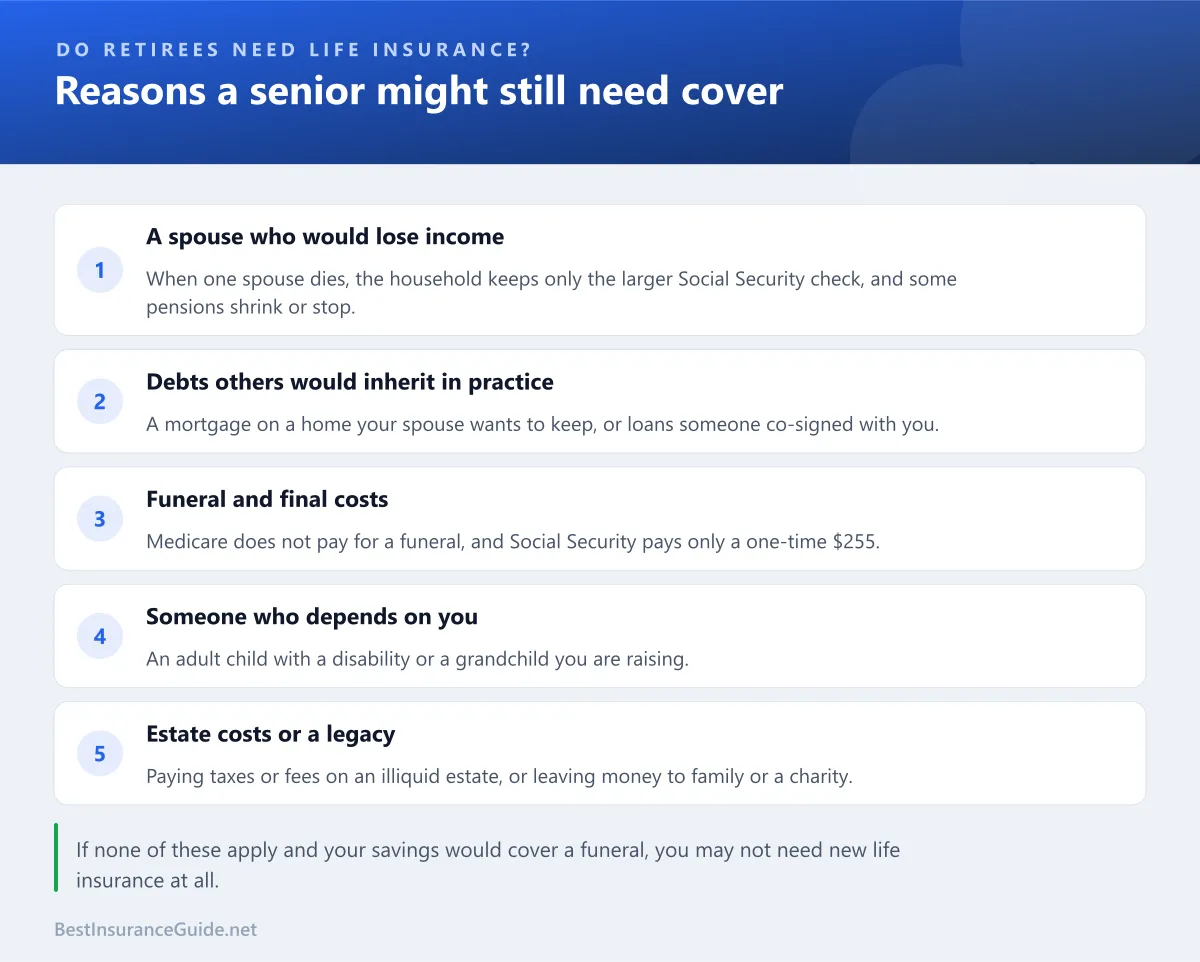
- A spouse would lose income. This is the one people miss. When one spouse dies, the household keeps only the larger of the two Social Security benefits, not both. Some pensions also shrink or stop at death, depending on the payout option chosen.
- Debts that would fall on family in practice, such as a mortgage on a home your spouse wants to keep, or a loan someone co-signed.
- Funeral and final costs. Medicare doesn’t pay for a funeral, and Social Security’s one-time death payment is $255. The NFDA’s 2023 median for a funeral with viewing and burial was $8,300. Our guide to how much cremation costs breaks down the lower-cost options.
- Someone depends on you, like an adult child with a disability or a grandchild you’re raising.
- Estate costs or a legacy, including leaving money to children or a charity, or paying costs on an estate that’s mostly property.
If none of these apply, you may be better off putting the premium money into savings. Our guide to whether life insurance is worth it goes deeper.
Life insurance options for seniors by age
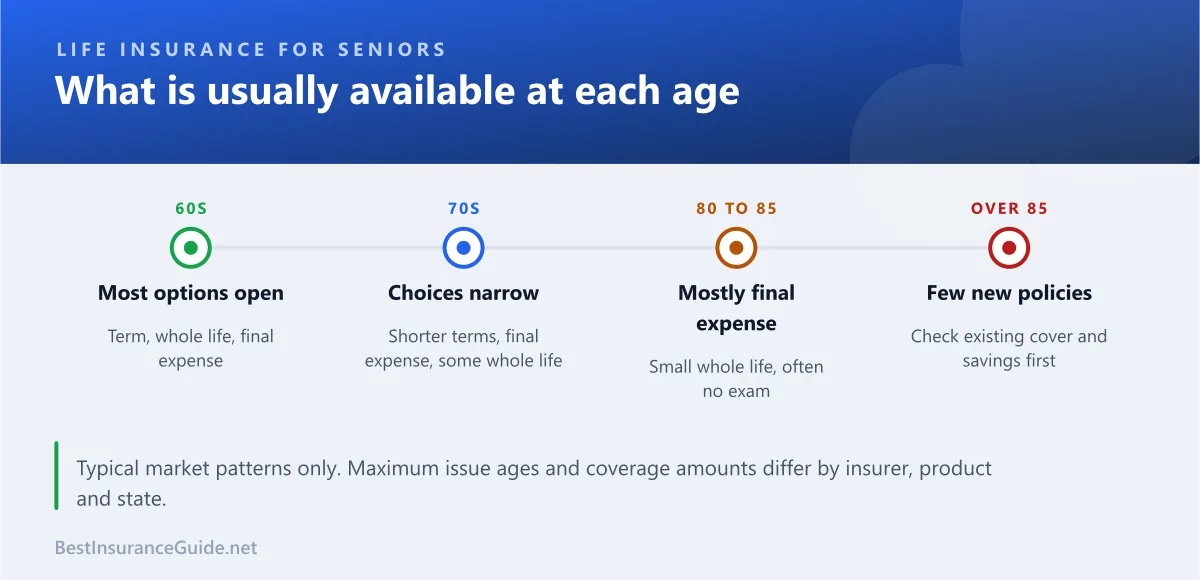
What you can buy depends heavily on your age and health. These are typical market patterns. Each insurer sets its own maximum issue ages and coverage limits.
Life insurance for seniors over 60
Your 60s are the best window to buy, because most options are still open:
- Senior term life insurance, often in 10-, 15- or 20-year terms
- Fully underwritten whole life or guaranteed universal life for lifelong needs
- Final expense insurance, a small whole life policy for funeral costs
If you’re reasonably healthy, a fully underwritten policy almost always beats final expense on price per dollar of coverage. It’s worth going through the medical questions, and sometimes an exam, to get the better rate.
Life insurance for seniors over 70
Options narrow in your 70s, but you still have real choices:
- Term life from some insurers, usually for shorter terms like 10 years, and at a much higher price than in your 60s.
- Whole life and guaranteed universal life, if you’re in good health and need permanent coverage.
- Final expense insurance, which becomes the most common choice.
Life insurance for seniors over 80
Past 80, most new coverage is final expense whole life. Death benefits are small, often in the range of a few thousand dollars up to around $25,000, and premiums are high relative to the coverage. Many final expense products accept applicants up to age 80 or 85, and some guaranteed issue products have similar limits.
At this age, it’s especially important to compare the total premiums you might pay against the death benefit. If you could live another 10 years, you may pay in more than the policy pays out.
Life insurance for seniors over 85
New policies are scarce over 85. A few insurers offer small whole life policies, but you’ll have few quotes to compare. Before shopping, check:
- whether you already have an old whole life policy, a burial policy or retiree group coverage
- whether a payable-on-death bank account or savings would cover final costs more cheaply
- whether a prepaid funeral plan would better match your goal
Senior term life vs final expense insurance
These are the two products most seniors end up choosing between.
| Detail | Senior term life | Final expense (whole life) |
|---|---|---|
| How long it lasts | A set term, often 10 to 20 years | For life, as long as premiums are paid |
| Typical coverage | Can be large, depending on age and health | Small, often a few thousand to around $25,000 |
| Underwriting | Health questions and often an exam | Simplified or guaranteed issue, usually no exam |
| Price per dollar of coverage | Lowest, if you’re healthy | Higher |
| Best for | Needs with an end date, like a mortgage or replacing income for a spouse | Funeral and final costs |
| Main risk | Can expire before you die | You may pay in more than the benefit if you live a long time |
A common approach is to use both: a term policy sized to a mortgage or a spouse’s income gap, plus a small final expense policy that will always be there for the funeral. Our guide to term vs whole life insurance explains the differences in more depth, and multiple life insurance policies covers how combining them works.
Senior life insurance with no waiting period
You’ll see “no waiting period” in a lot of senior life insurance ads. It comes down to the type of underwriting:
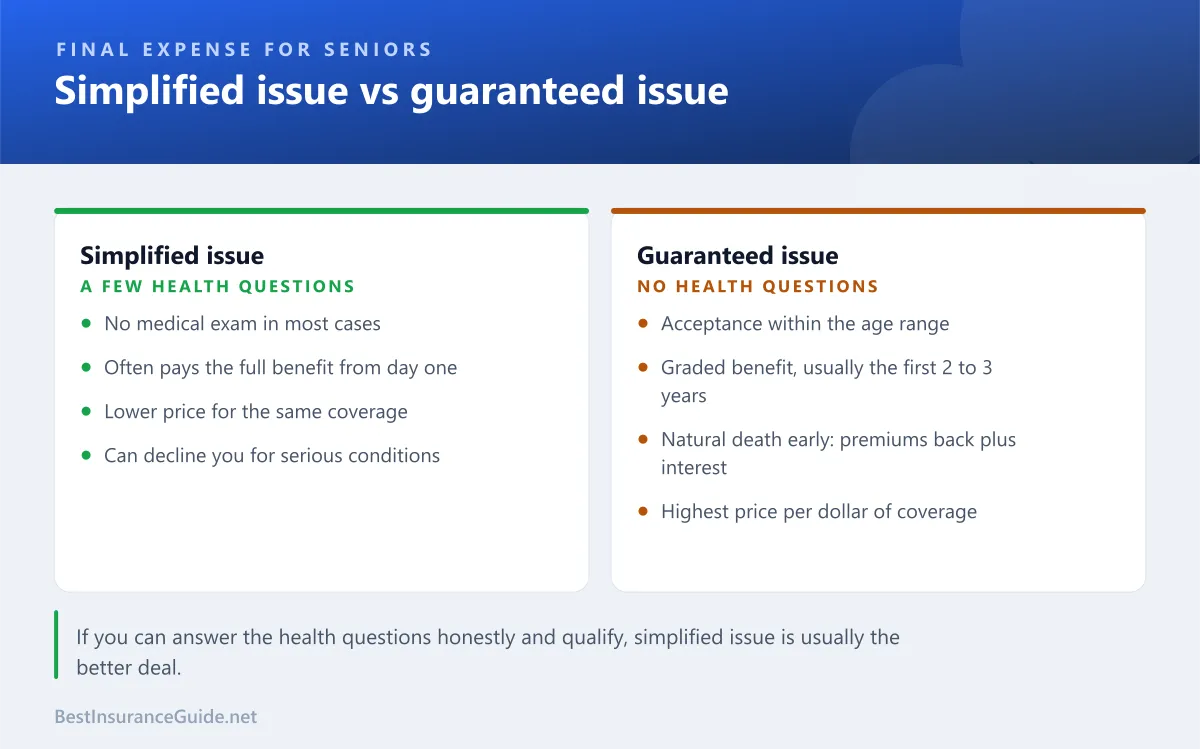
- Simplified issue policies ask a short list of health questions. If you’re approved, they usually pay the full death benefit from day one. This is what most “no waiting period” policies are.
- Guaranteed issue policies ask no health questions, so anyone in the age range is accepted. In exchange, they usually have a graded death benefit for the first two or three years. If you die of natural causes during that period, your beneficiary typically gets your premiums back plus interest rather than the full benefit. Accidental deaths are usually covered in full from the start.
If you can answer the health questions honestly and qualify, simplified issue is almost always the better deal. Our burial insurance guide explains level, graded and modified benefits in detail. Guaranteed issue is the fallback for people with serious health conditions. Never shade the truth on health questions to qualify. A misstatement found during the contestability period can lead to a denied claim.
What those senior life insurance TV ads really offer
“Senior life insurance as seen on TV” gets thousands of searches a month, and for good reason: the ads run constantly. Most of them advertise guaranteed acceptance whole life for people roughly 50 to 85. The usual features:
- No health questions and no exam, so you can’t be turned down for health reasons
- A low-sounding monthly price, often because it buys a small amount of coverage, sometimes sold in “units”
- A graded benefit period, often two years, during which a natural death returns premiums plus interest
- Premiums that are locked in, while the coverage amount for a given price can be lower the older you are when you apply
These policies are real and can be useful for people who can’t qualify elsewhere. But because they skip underwriting entirely, they usually cost more per dollar of coverage than a simplified issue policy. Before calling the number on the screen, get a simplified issue quote too and compare the death benefit you’d get for the same monthly payment.
Senior life insurance rates: what drives the price
We don’t publish a “senior life insurance rates by age” chart with named insurers’ prices, because rates for older applicants vary so much by health and insurer that a chart can be badly misleading. Here’s what actually sets your price:
- Age. Premiums rise every year you wait, and the increases get steeper in your 70s and 80s.
- Health and medications. Conditions like heart disease, COPD, diabetes with complications or recent cancer treatment can move you to a higher rate class or to guaranteed issue.
- Tobacco use, which can roughly double the price.
- Gender. Women generally pay less because they live longer on average.
- Type of policy. Term is cheapest, then simplified issue final expense, then guaranteed issue.
- Coverage amount. Smaller policies often carry a higher price per $1,000 because of fixed policy fees.
How to get the cheapest life insurance as a senior
- Buy sooner rather than later. Every birthday raises the price.
- Try for full underwriting first if you’re in decent health, then simplified issue, and use guaranteed issue only if you need to.
- Compare several insurers. Underwriting for older applicants varies a lot, and an independent agent who works with seniors can shop multiple companies at once.
- Buy only the coverage you need. Sizing it to an actual funeral or debt keeps premiums manageable.
- Pay annually if you can. Monthly payments often cost a little more in total.
- Check existing coverage before buying more. An old policy or retiree group coverage may already cover part of the need.
What about the policy you already have?
Many seniors already hold life insurance, and it can be worth more than they think.
- Keep it if you still need it. Replacing an old policy at your current age is usually much more expensive.
- Check for cash value in an old whole life policy. You may be able to borrow against it or reduce the coverage to a “paid-up” policy with no more premiums.
- Ask about accelerated death benefits. Many policies let you access part of the death benefit early if you’re diagnosed with a terminal illness.
- Consider a life settlement only after careful comparison. Some seniors sell a policy they no longer need to a third party for more than its cash surrender value, but fees and tax consequences apply. Get independent advice.
- Update your beneficiaries. Name a primary and a contingent beneficiary so the money doesn’t end up in probate.
Watch out for these common mistakes
- Paying for a guaranteed issue policy when you’d qualify for simplified issue. It’s the most expensive way to buy a small amount of coverage.
- Letting a policy lapse. Set up automatic payments and add a trusted family member as a third-party contact for lapse notices.
- Buying more coverage than you can afford long term. Final expense premiums are for life. If you stop paying at 85, you may lose everything you paid in.
- Not telling your family the policy exists. A policy nobody knows about doesn’t help anyone.
- Being rushed by a high-pressure sales call. Take time to compare, and get every promise in writing.
If your children are asking
Sometimes it’s not the senior who starts this conversation but an adult child worried about funeral costs. If that’s you, our guide to life insurance for parents explains insurable interest, consent, and how to set up the policy so it pays out smoothly.
Sources and notes
- Social Security survivor benefits and the $255 lump-sum death payment: Social Security Administration, survivors benefits.
- NFDA 2023 General Price List Study median funeral costs, as reported by the Arizona Funeral, Cemetery & Cremation Association.
- Typical issue ages, coverage limits and graded benefit periods reflect common market practice and vary by insurer, product and state. Your quote and policy contract are authoritative.
This article is general information, not financial or insurance advice. A licensed independent agent can compare policies for your age, health and state.