Term vs Whole Life Insurance: Which Is Right for You?
Whole life costs roughly twelve times term for the same benefit. Where the money goes, when permanent cover genuinely fits, and how to decide between them.

Table of contents

Ask ten financial advisers whether to buy term or whole life and you’ll get a fairly clean split, which tells you the answer depends on circumstances rather than on one being right.
What it doesn’t depend on is the sales pitch. Whole life carries substantially higher commissions than term, so the enthusiasm you encounter isn’t always calibrated to your situation. That’s not an accusation of bad faith. It’s just worth knowing which way the incentive points before you sit down.
Here’s the honest comparison.
The two products
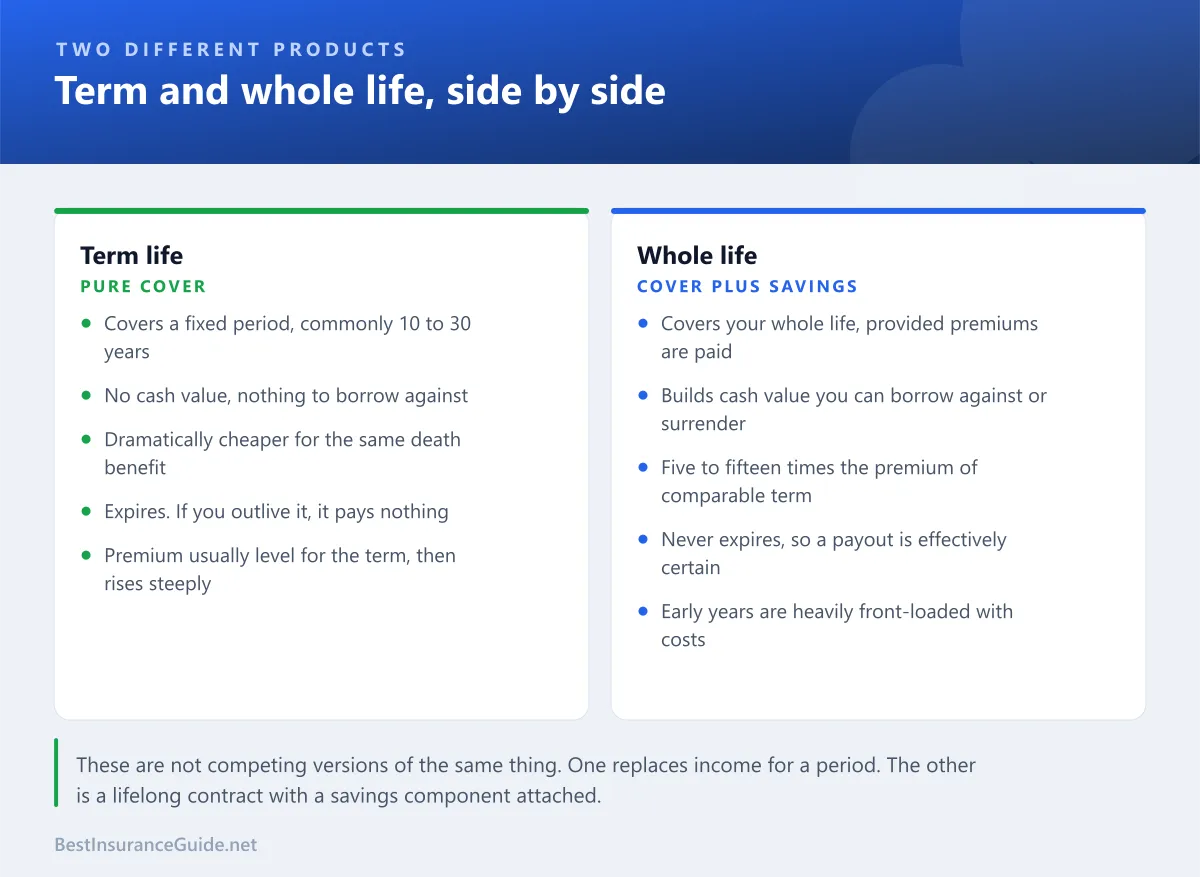
These aren’t competing versions of the same thing, which is the framing that causes most confusion.
Term life is pure insurance. You buy cover for a defined period. If you die during it, it pays. If you don’t, it expires and you’ve bought protection you happily didn’t need, exactly like car insurance in a year you didn’t crash.
Whole life is a lifelong contract with a savings component attached. It pays whenever you die, which means the insurer is certain to pay eventually. That certainty is most of why it costs what it does.
The cost gap
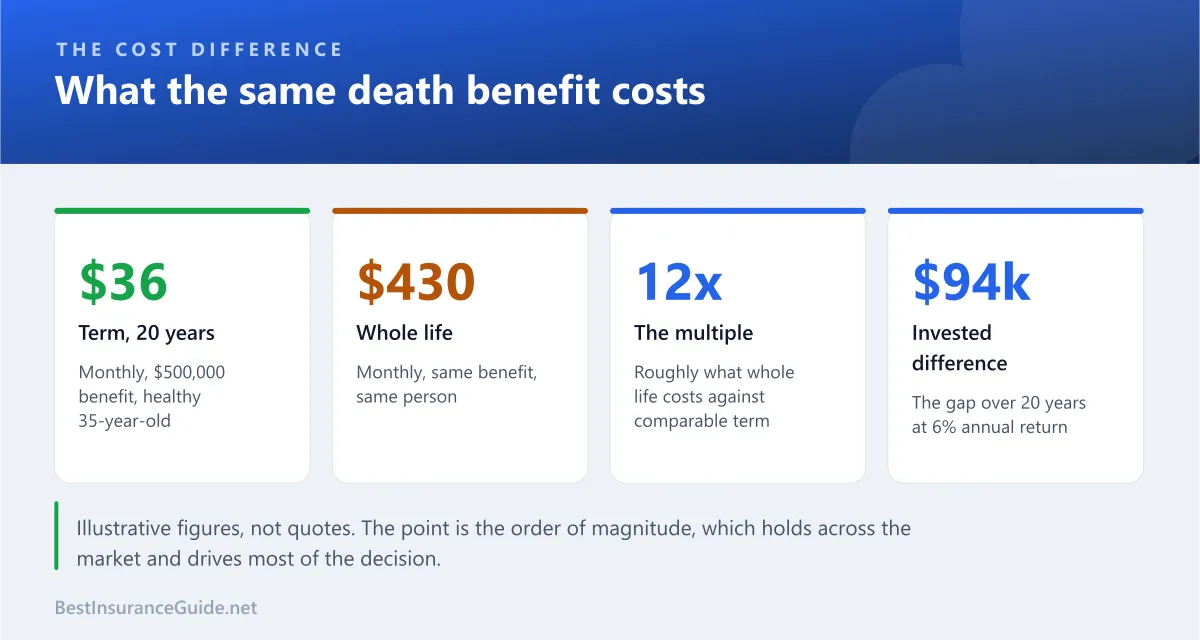
The multiple is the thing to internalise. Roughly twelve times, for identical death benefit, for a healthy buyer in their thirties.
Worked example: the same family, two structures
A 35-year-old, healthy, non-smoker, needing $500,000 of cover.
| Detail | Term, 20 years | Whole life |
|---|---|---|
| Monthly premium | $36 | $430 |
| Annual | $432 | $5,160 |
| Paid over 20 years | $8,640 | $103,200 |
| Cash value at year 20 | $0 | ~$78,000 |
| Death benefit throughout | $500,000 | $500,000 |
Whole life returns roughly $78,000 of cash value against $103,200 paid in. Term returns nothing against $8,640 paid in.
Framed that way whole life looks better, which is exactly how it’s usually presented. The comparison is incomplete though, because it ignores what happens to the $4,728 a year the term buyer didn’t spend.
Worked example: buy term and invest the difference
Same person, same 20 years. The term buyer invests the annual difference in a low-cost index fund.
| Detail | Whole life | Term + invest the difference |
|---|---|---|
| Annual outlay | $5,160 | $432 premium + $4,728 invested |
| Value at year 20, whole life cash value | $78,000 | — |
| Value at year 20, invested at 6% | — | $183,700 |
| Value at year 20, invested at 4% | — | $146,300 |
| Death benefit during the 20 years | $500,000 | $500,000 |
| Cover after year 20 | Continues | Ends |
Even at a conservative 4% return the invested difference roughly doubles the whole life cash value. At 6% it’s more than double.
Two honest caveats, because this comparison gets oversold in the other direction.
The first is that cover ends at year 20 for the term buyer. If they die at 58, the family gets the invested pot but no death benefit. Whether that matters depends on whether the pot is by then large enough to make cover unnecessary, which for most people following this plan it is.
The second, and the real one: the strategy fails on discipline, not arithmetic. The whole life buyer is forced to save $5,160 a year because it’s a bill. The term buyer has to choose to invest $4,728 every year for twenty years, through job changes and car repairs and school fees. A great many people don’t. If you know you won’t, the forced-savings feature of whole life has genuine value that the spreadsheet doesn’t capture.
Where the money goes in early years
This is the part that surprises whole life buyers most, and it’s worth seeing plainly.
Worked example: cash value in the first decade
$5,160 a year paid into a whole life policy.
| End of year | Total paid in | Cash value | Difference |
|---|---|---|---|
| 1 | $5,160 | $0 | −$5,160 |
| 3 | $15,480 | $4,200 | −$11,280 |
| 5 | $25,800 | $12,900 | −$12,900 |
| 10 | $51,600 | $41,500 | −$10,100 |
| 15 | $77,400 | $73,800 | −$3,600 |
| 20 | $103,200 | $78,000 | −$25,200 |
Cash value in year one is typically zero or close to it, because the first year’s premium largely covers commission and policy setup. It takes over a decade before the policy is worth anything like what’s been put in.
Which has a practical consequence: whole life is a poor product to cancel. Surrendering in the first ten years locks in a substantial loss. If you’re not confident you’ll hold it for decades, that alone is a reason not to start.
When whole life genuinely fits
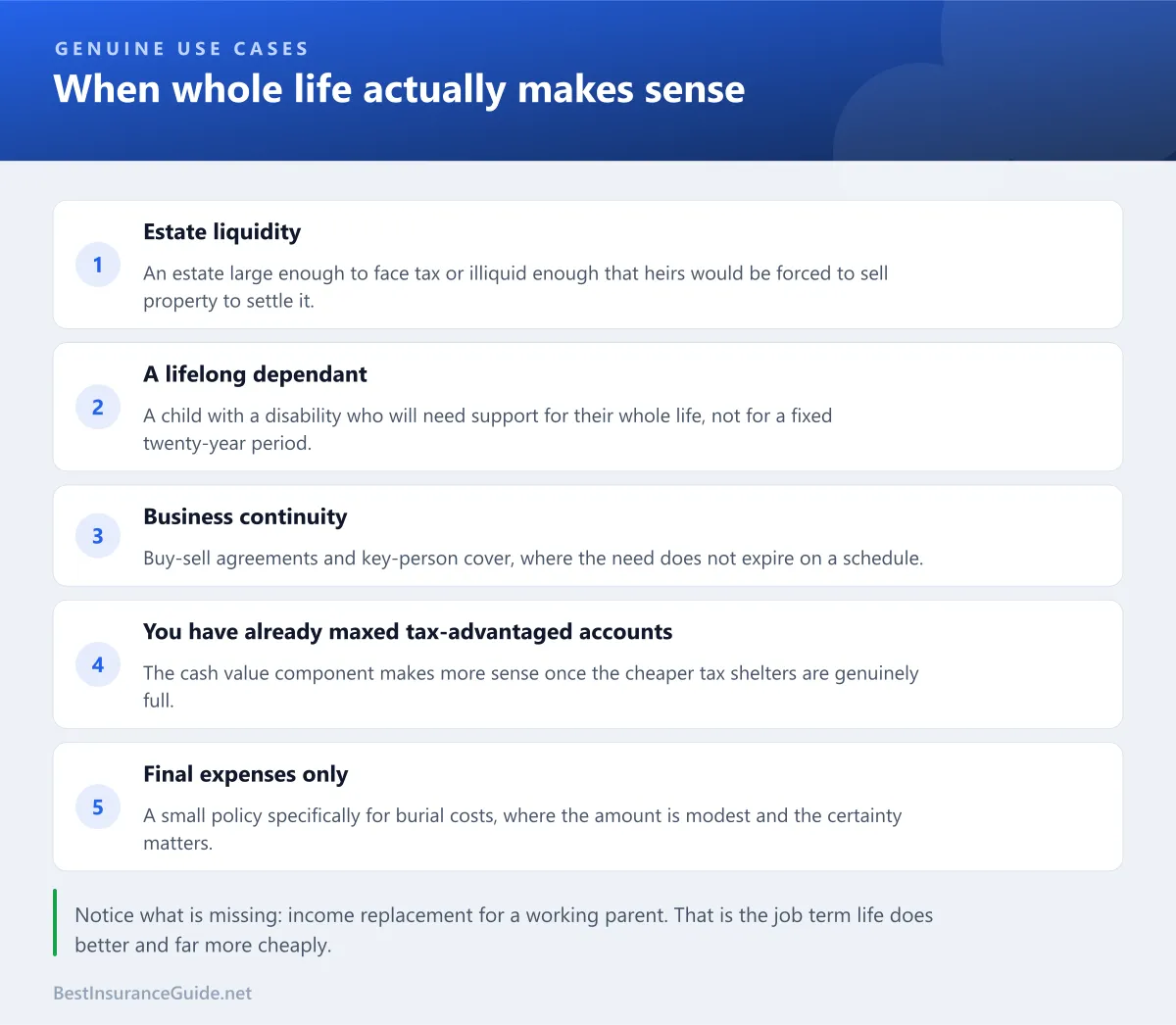
Notice what isn’t on that list: income replacement for a working parent. That’s the job term does better and far more cheaply.
The strongest case is a lifelong dependant. A child with a disability who’ll need support for their whole life doesn’t have a twenty-year need. Cover that expires at 65 doesn’t solve that problem at any price, and this is the scenario where permanent cover is straightforwardly the right instrument.
Estate liquidity is the next clearest. An estate that’s large or illiquid, a farm, a family business, property that heirs would be forced to sell quickly to settle obligations. A permanent policy provides cash at exactly the moment it’s needed.
Business continuity covers buy-sell agreements and key-person cover, where the need doesn’t expire on a schedule.
Term, in more detail
Term lengths are typically 10, 15, 20 or 30 years. Choose based on when the need ends: usually the youngest child finishing education, or the mortgage ending, whichever is later. Round up. A 20-year policy expiring two years before your youngest graduates is a bad twenty dollars saved.
Level term keeps the premium fixed for the whole term. This is what most people mean by term life and what you should default to.
Decreasing term has a benefit that falls over time, usually tracking a mortgage. It’s cheaper, and it’s frequently worse value than level term at the full amount, because it only ever covers the mortgage rather than the mortgage plus everything else.
Renewable term lets you continue past expiry without new underwriting, at sharply higher rates.
Return of premium term refunds your premiums if you outlive the policy, at commonly two to three times the price of level term. Our guide to return of premium life insurance works through whether the refund beats investing the difference.
Convertible term lets you switch to permanent cover without new medical underwriting. This is the feature to look for. It costs little and preserves an option you may want if your health changes.
Worked example: laddering, for the whole picture
Needs decline over time, and cover can be structured to match, which is cheaper than one large policy.
A 35-year-old with two young children needing $1.2 million now, falling as the mortgage amortises and children grow up.
| Policy | Benefit | Term | Monthly |
|---|---|---|---|
| A | $500,000 | 30 years | $52 |
| B | $400,000 | 20 years | $29 |
| C | $300,000 | 10 years | $14 |
| Total now | $1,200,000 | $95 |
Against a single $1.2 million 30-year policy at roughly $124 a month.
Cover steps down as policies expire: $1.2m for ten years, then $900k for another ten, then $500k for the final decade. That’s a closer match to how the actual need behaves, and it saves about $350 a year in the meantime.
Universal life, briefly
Between term and whole sits universal life, which offers flexible premiums and an adjustable death benefit. Indexed and variable versions tie cash value growth to market performance.
The flexibility is real. So is the complexity, and so is the risk that underperformance leaves the policy needing much larger premiums later to stay in force. Several generations of policyholders have been caught by exactly that. If you’re considering universal life, request an in-force illustration at a conservative rather than an illustrated rate, and read what happens if returns disappoint.
What to do with a permanent policy you already have
Plenty of people arrive at this comparison holding a whole life policy they were sold years ago and now doubt. Cancelling is rarely the automatic answer.
Get an in-force illustration first. It shows current cash value, surrender value, and what the policy does going forward on current assumptions. That document, not the original sales illustration, is what you should be deciding against.
Understand the surrender charge. In the early years it can consume most of the cash value, and it usually declines to zero over a set period. Surrendering a year before it expires can be an expensive way to be right.
Remember the sunk cost is sunk. The correct question is not whether buying it was a mistake. It is whether, given the current cash value and the current premium, keeping it beats the alternatives from here.
Consider the alternatives to outright surrender. A reduced paid-up option keeps a smaller death benefit with no further premiums. A 1035 exchange moves the cash value into another policy or an annuity without triggering tax on the gain. Both preserve something that simply cancelling would not.
Never cancel before replacement cover is in force, and be aware that your health may have changed since the original underwriting. Our guide to holding multiple life insurance policies covers why the older policy’s pricing is often worth keeping even when the product is imperfect.
Converting term to permanent
Most term policies include a conversion privilege, and it is the most valuable feature almost nobody uses.
Conversion lets you exchange a term policy for a permanent one from the same insurer without new medical underwriting. Your health at conversion is irrelevant; the permanent policy is priced on your age at conversion using your original health class.
That matters enormously for anyone whose health has deteriorated. A person who becomes uninsurable during a term still holds the right to permanent cover, which can be the difference between having lifelong protection and having none.
Three limits to check on your own policy.
The conversion deadline. Commonly the earlier of a set number of years or a specific age, often somewhere between 65 and 70.
Which products you may convert into. Some insurers restrict conversion to a narrow, expensive permanent product.
Whether partial conversion is allowed. Converting part of a large term policy is often the sensible move, keeping a small permanent policy for final expenses while letting the rest expire.
Check the conversion terms when you buy the term policy, not when you need them. It is a feature worth paying slightly more for.
The third product, and why it is the most complex
Term and whole life are the two ends of the market. A third product sits between them and is the most complicated thing commonly sold to retail buyers.
Indexed universal life is permanent cover with a flexible premium, whose cash value is credited with interest linked to a market index, subject to a floor that protects you and a cap that limits you. You are not invested in the index; the policy credits interest by formula, and you receive no dividends.
The floor is contractually guaranteed. The caps, the participation rates and the cost of insurance largely are not, which is where outcomes diverge from illustrations. The failure mode that matters is lapse: rising insurance costs against cash value that underperformed the projection, decades in, after substantial premiums have been paid.
Our guide to what indexed universal life insurance is works through the crediting mechanics, what is guaranteed against what is not, and the questions to ask before buying one.
How to decide
The question that resolves most of it: does your need for cover expire?
If it does, when children are independent and the mortgage is gone, term matches the shape of the need and costs a fraction as much.
If it genuinely doesn’t, because of a lifelong dependant, an estate problem, or a business obligation, permanent cover is doing something term can’t do at any price.
And if you’re being sold whole life as an investment, compare it honestly against investing the difference, then ask yourself truthfully whether you’d actually make those investments every year for two decades. That answer is yours alone, and it’s the one the spreadsheets can’t give you.
Our life insurance basics guide covers sizing the policy with the DIME method, and the life insurance need calculator runs the arithmetic. For checking any insurer before you buy, particularly on a contract that may run forty years, our comparison guide covers the free tools worth using.