How Much Does Cremation Cost? Prices, Fees and How to Pay for It
Cremation costs from direct cremation without services to a $6,280 median funeral with cremation. See the fee breakdown, your rights and how to pay.

Table of contents

Most people never ask what a funeral costs until they have to, usually in the worst week of their lives, often with a funeral director waiting for an answer. If you’re reading this ahead of time, for yourself or for a parent, you’re already doing it the better way.
So here’s the short answer: how much cremation costs depends far more on what you do around the cremation than on the cremation itself. The cremation fee is only a few hundred dollars. The big numbers come from embalming, a viewing, staff time, a service and the funeral home’s basic fee.
The National Funeral Directors Association (NFDA) found that the median cost of a funeral with a viewing followed by cremation was $6,280 in its 2023 General Price List study, the most recent it has published. Direct cremation, with no viewing and no service at the funeral home, costs much less. Many families pay a few thousand dollars or under, depending on where they live.
Below you’ll find a line-by-line cost breakdown, the cheapest legitimate options, the rights federal law gives you when you shop, and how families actually pay for it, including final expense insurance. This site is independent and not affiliated with any funeral home, cremation provider or insurer.
How much does cremation cost? The three price levels
Cremation isn’t one product. It’s a decision about how much ceremony you want, and the price follows that decision. Roughly, there are three levels.
| Type of cremation | What’s included | Typical cost |
|---|---|---|
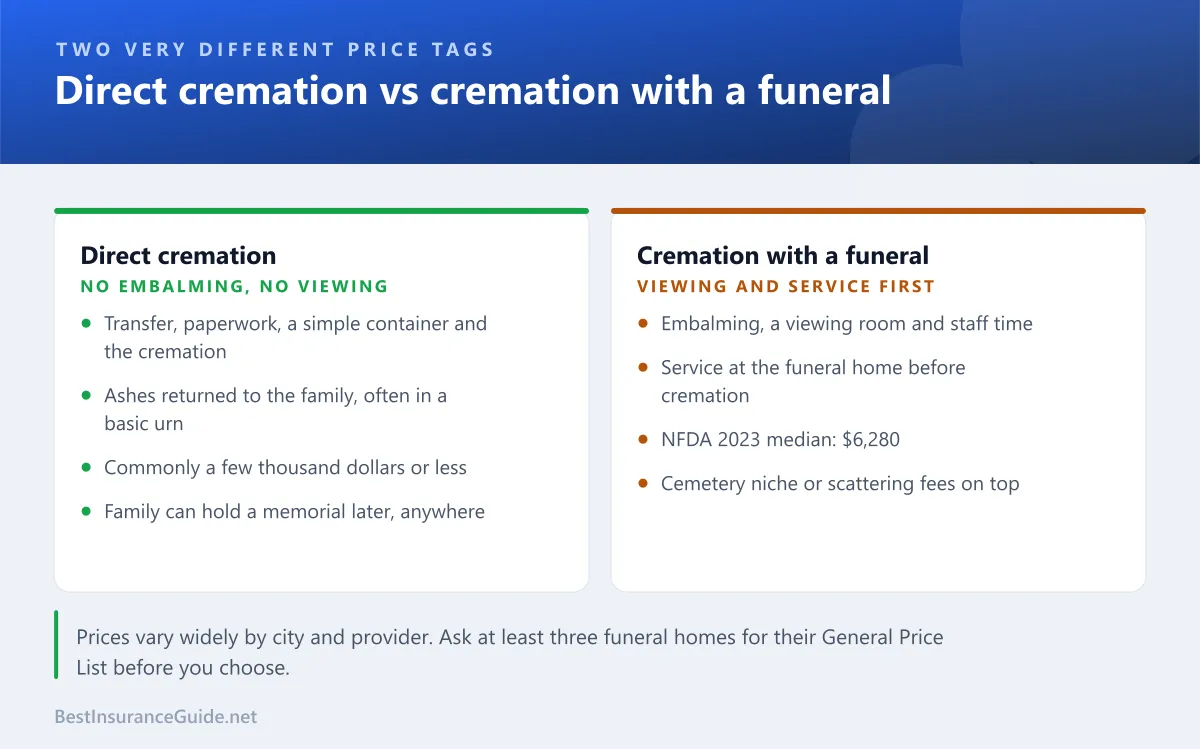
| Direct cremation | Transfer of the body, paperwork and permits, a basic container, cremation, ashes returned | Lowest. Often a few thousand dollars or less, varies widely by city |
| Cremation with a memorial service | Direct cremation, then a gathering later with the ashes present (no embalming or viewing) | Direct cremation plus venue, staff and printing costs |
| Funeral with viewing, then cremation | Embalming, viewing, a service at the funeral home, then cremation | NFDA 2023 median: $6,280 |
The difference between the first and last row is mostly embalming, the viewing and staff time. If an open-casket viewing isn’t important to your family, choosing direct cremation and holding your own memorial later is the single biggest way to cut the cost.
For comparison, the same NFDA study put a funeral with viewing and burial at $8,300, rising to $9,995 with a burial vault. Those numbers don’t include a cemetery plot, opening and closing the grave, or a headstone, which can add several thousand dollars more. It’s no surprise that cremation is now the most common choice. NFDA projects the U.S. cremation rate at 63.4% for 2025, against 31.6% for burial.
Cremation cost breakdown: where the money goes
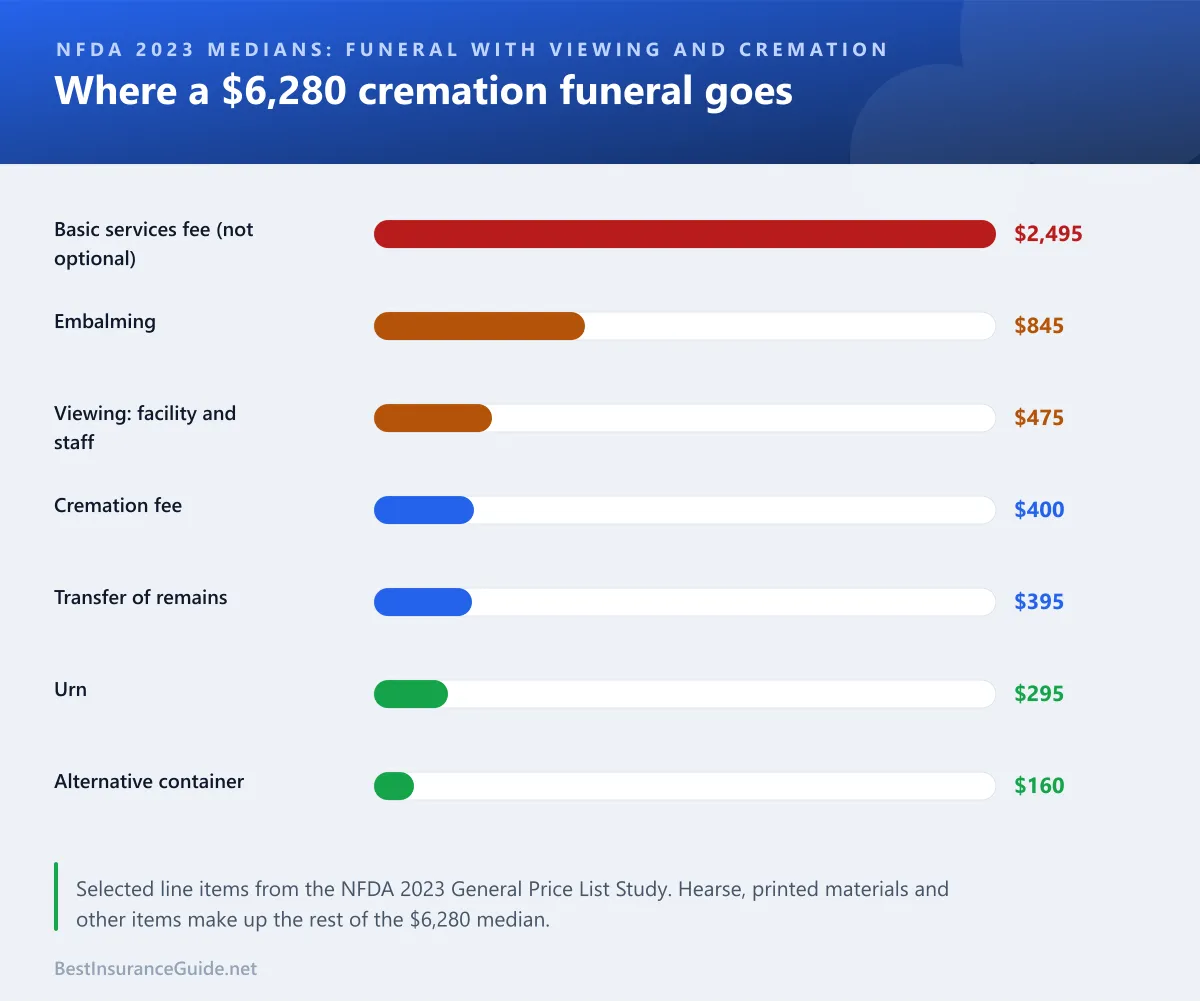
The NFDA publishes median prices for individual items. For a funeral with a viewing followed by cremation, the 2023 medians were:
| Item | NFDA 2023 median | Can you decline it? |
|---|---|---|
| Basic services fee | $2,495 | No. This is the one fee every funeral home may charge |
| Transfer of remains to the funeral home | $395 | Only if someone else transports |
| Embalming | $845 | Yes, for direct cremation |
| Use of facilities and staff for viewing | $475 | Yes |
| Cremation fee | $400 | Only if you use a crematory directly |
| Alternative cremation container | $160 | Required in some form, but no casket needed |
| Urn | $295 | Yes. You can buy one elsewhere |
Add a hearse or service van, printed memorial packages and a few smaller items, and you reach the $6,280 median. Between the 2021 and 2023 studies, the median for a cremation funeral rose from $5,810 to $6,280, an increase of about 8%.
A few things stand out once you see the numbers laid out like this:
- The basic services fee is the biggest single item. It covers the funeral home’s overhead, planning time and permits. You can’t negotiate it away, but it varies a lot between homes, which is a good reason to compare.
- Embalming plus viewing is about $1,300 together. It’s the main thing that separates a “funeral with cremation” from direct cremation.
- The cremation itself is one of the cheapest lines. When a family is quoted $7,000 for “a cremation”, most of that money is for everything around it.
Keep in mind that a median is the middle of a range. Half of funeral homes charge more and half charge less, and prices in big coastal cities usually sit above the national figures.
How much does cremation cost without services?
This is one of the most-searched questions about cremation, and the answer is good news. Cremation without services is called direct cremation, and it’s the lowest-cost option from a funeral home or cremation provider.
A direct cremation package normally includes:
- Collecting the body from the place of death, within a set distance
- Refrigeration or holding until the cremation
- Filing the death certificate and getting the cremation permit
- A basic container, such as cardboard or unfinished wood
- The cremation
- Returning the ashes in a simple container
Ask carefully about what is not included, because these are the common extras:
- Certified copies of the death certificate. You’ll need several for banks, insurers and Social Security, and states charge per copy.
- Medical examiner or coroner fees, which some counties charge before a cremation can be authorized.
- A mileage charge if the death happened outside the provider’s service area.
- An urn. The basic container is fine for storage or scattering, but many families want something nicer.
- Shipping or delivery of the ashes.
Online cremation companies and local cremation-only providers often advertise lower prices than traditional funeral homes. Many charge from around $1,000 to $3,000 in lower-cost areas, and more in expensive metros. Those ads are real, but always ask for the itemized price in writing so you can compare like for like.
Direct cremation doesn’t mean no goodbye
A lot of families worry that choosing direct cremation means skipping the funeral. It doesn’t. It means separating the cremation from the gathering. You can hold a memorial a few weeks later at a church, a park, a family home or a restaurant’s back room, with the ashes present or not. That gives people time to travel, and it usually costs far less than the funeral home’s chapel and staff.
Cremation prices: why quotes vary so much
If you call three funeral homes in the same town, you might get three very different prices for what sounds like the same thing. That’s normal, and there are a few reasons for it:
- Business model. Traditional funeral homes carry the cost of chapels, viewing rooms and full-time staff. Cremation-only providers don’t, so their direct cremation prices are often lower.
- Who owns the crematory. A funeral home that owns its own crematory may price differently from one that sends bodies to a third party.
- Local costs and competition. Labor, property and regulation all cost more in some states, and a town with one provider has less price pressure.
- Packaging. Some providers bundle things like a death certificate copy or a basic urn. Others list them separately, which makes the headline price look lower.
The fix for all of this is simple: compare General Price Lists. Federal law makes that easy.
Your rights: the FTC Funeral Rule
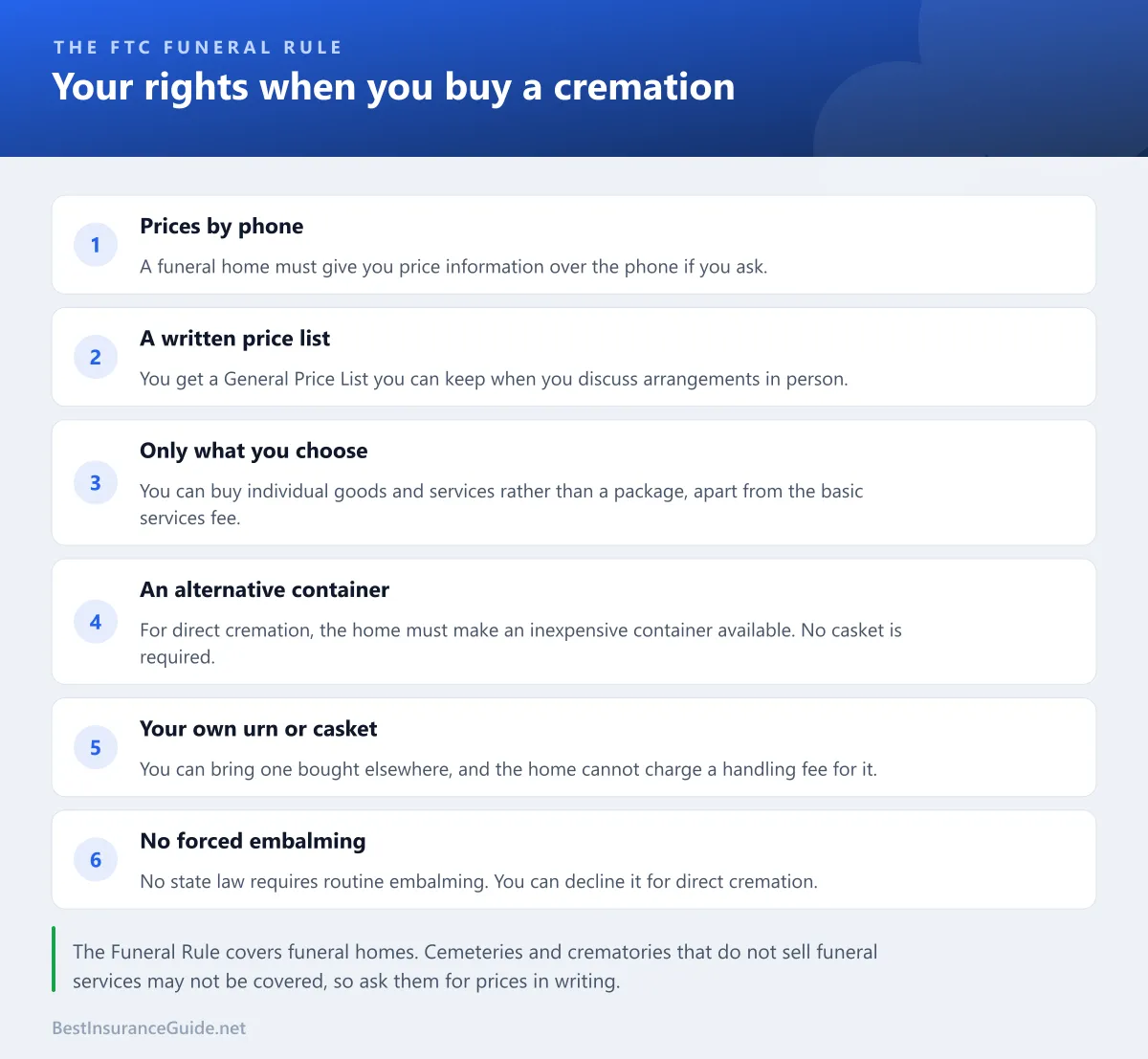
The Federal Trade Commission’s Funeral Rule applies to funeral homes across the U.S. It’s one of the most useful consumer protections few people have heard of. Under the rule, you have the right to:
- Get prices over the phone. You don’t have to visit in person to find out what things cost.
- Get a written General Price List that you can keep when you discuss arrangements in person.
- Buy only the goods and services you want. Apart from the basic services fee, you don’t have to accept a package.
- Use an alternative container for direct cremation. The funeral home must make one available, and you don’t need a casket.
- Provide your own urn or casket bought somewhere else, without paying a handling fee.
- Get an itemized statement of what you’ve chosen before you pay.
The FTC also points out that no state law requires routine embalming. A funeral home can require embalming for certain choices, such as a public viewing, but it can’t tell you that the law requires it for direct cremation.
One gap to know about: the Funeral Rule covers funeral homes. Cemeteries, and crematories that don’t sell funeral services, may not be covered, so ask them for prices in writing too.
How to pay for cremation
Very few families have $6,000 or more sitting in a checking account they can use the day after a death. Funeral homes usually want payment before or at the time of the service, and life insurance can take a couple of weeks to pay out. Here are the usual ways families cover the cost.
Final expense and burial insurance
Final expense insurance, also sold as burial insurance or funeral insurance, is a small whole life policy, often with a death benefit somewhere between a few thousand and about $25,000. It’s aimed at people in their 50s to 80s who want to make sure their funeral or cremation doesn’t land on their children.
How it works in practice:
- Simplified issue policies ask a handful of health questions but don’t need a medical exam.
- Guaranteed issue policies ask no health questions, but usually have a graded death benefit. If you die of natural causes in the first two years or so, your beneficiary gets your premiums back, often plus interest, rather than the full benefit. Accidental deaths are normally covered in full from day one.
- The premium stays level for life, and the coverage doesn’t expire as long as you keep paying.
Our guide to burial insurance explains no-waiting-period policies and whether it’s worth the cost.
The trade-off is price per dollar of coverage. Final expense insurance costs more for each $1,000 of benefit than a term policy bought when you’re younger and healthy. If you’re already healthy enough to qualify for term life, compare both before you decide. Our guide to term vs whole life insurance explains the difference.
Regular life insurance
Any life insurance payout can pay for a cremation, because the beneficiary can spend it however they want. If a parent already has a policy, find it now, check who the beneficiary is, and make sure someone knows where the paperwork is. If you’re thinking about buying a policy to cover a parent’s costs, our guide to life insurance on your parents explains consent, insurable interest and what’s realistic at older ages.
One timing tip: insurers usually pay claims within a few weeks once they have the certified death certificate. Some funeral homes will accept an assignment of benefits, where part of the payout goes straight to them, so the family doesn’t have to pay upfront. See how long life insurance takes to pay out for what affects the timeline.
Workplace coverage
If the person who died was still working, check for group life insurance through their employer, including any supplemental life insurance they bought. Many employer plans also include dependent life coverage, a small benefit that’s designed for exactly this situation.
Payable-on-death accounts and savings
A payable-on-death (POD) bank account passes directly to the named person without going through probate, so the money is available quickly. Some people set one up specifically for funeral costs. It’s a simple, low-cost option if you can put money aside.
Preneed funeral plans
Many funeral homes sell preneed plans, where you choose and pay for your arrangements ahead of time, often funded by a trust or a special insurance policy. They can lock in some prices and spare your family decisions. They also tie the money to one provider. Before you sign, ask what happens if you move, if the funeral home closes or changes owners, or if you want to cancel and how much you’d get back. State rules on preneed contracts differ.
Government and other help
- Social Security pays a one-time $255 lump-sum death payment to an eligible surviving spouse or child. It’s a small amount, but claim it.
- Veterans may be eligible for VA burial benefits, including burial in a national cemetery and, in some cases, an allowance toward costs.
- States and counties often have indigent burial or cremation programs for families who can’t afford one.
- Whole-body donation programs at medical schools often cover cremation after the study is complete, at little or no cost to the family.
Medicare doesn’t pay for funeral or cremation costs, which surprises a lot of people.
Worked example: two families, two very different bills
Here’s an illustrative example of how choices change the total. These are not quotes. Real prices depend on your provider and area.
The Garcias choose a traditional approach: embalming, a viewing at the funeral home the evening before, a short service, then cremation. They buy the urn from the funeral home and order several death certificate copies. Their total lands close to the national median, a little over $6,000, plus a cemetery niche later.
The Turners choose direct cremation from a local cremation-only provider. They buy an urn online, hold a memorial at their church three weeks later and ask friends to bring food. Their provider’s bill is a fraction of the Garcias’. Even after the church donation and printed programs, they spend several thousand dollars less.
Neither family made the wrong choice. The point is that the decision about a viewing is a decision about money, and it’s easier to make calmly before a death than in the 48 hours after one.
How to keep cremation costs down without cutting corners
- Call at least three providers and ask for their direct cremation price and General Price List. You’re entitled to prices by phone.
- Decide whether a viewing matters to you. If it doesn’t, skipping embalming and viewing saves about $1,300 at median prices.
- Buy the urn elsewhere if the funeral home’s choices are expensive. The home can’t charge you to use it.
- Hold the memorial somewhere free or cheap, like a place of worship, a park or a family home.
- Ask what’s excluded from any package: death certificates, medical examiner fees, mileage and delivery.
- Write your wishes down and tell your family. A short note that says “direct cremation, memorial later” removes a lot of guesswork and guilt.
- Make sure the money is reachable. A life insurance policy, a POD account or final expense cover only helps if someone knows it exists.
Plan ahead: a short checklist for you or a parent
- Decide on direct cremation, cremation with a memorial, or a full funeral first.
- Get one or two price lists now, while there’s no deadline.
- Check existing life insurance, including employer coverage, and update the beneficiaries.
- If there’s no coverage, compare final expense insurance with a small term policy.
- Keep the paperwork together and tell one trusted person where it is.
If you’re still deciding whether coverage makes sense at all, is life insurance worth it? walks through who needs it, and life insurance basics explains how much coverage to buy.
Sources and notes
- National Funeral Directors Association, 2023 General Price List Study, median costs for a funeral with viewing and burial ($8,300; $9,995 with vault) and with viewing and cremation ($6,280), with line-item medians, as reported by the Arizona Funeral, Cemetery & Cremation Association. NFDA cremation rate projections from nfda.org.
- Federal Trade Commission, The FTC Funeral Rule: price lists, itemized purchases, alternative containers, third-party caskets and urns, and embalming.
- Social Security Administration, lump-sum death payment.
- Direct cremation price ranges are typical advertised prices and vary widely by location. They are not quotes. Always get a written General Price List.
This article is general information, not financial, legal or insurance advice. Funeral prices, state rules and insurance terms vary. Check written price lists and policy documents before you commit.