Return of Premium Life Insurance: How It Works and Whether It's Worth the Cost
Return of premium life insurance refunds your premiums if you outlive the term. How ROP term works, what it costs, taxes, and whether it beats investing.

Table of contents

The biggest complaint about term life insurance is simple: you pay for 20 or 30 years and, if you’re lucky enough to live, you get nothing back. Return of premium life insurance is the insurance industry’s answer to that complaint.
Return of premium (ROP) term life insurance refunds the premiums you paid if you outlive the policy. If you die during the term, your beneficiaries get the death benefit, just like regular term. If you live, you get your money back. It sounds like a no-lose deal. The catch is the price, and whether a refund in 20 or 30 years is worth paying two or three times as much today.
This guide explains how return of premium term life insurance works, what it costs, how the refund is taxed, and the actual math on whether it beats buying regular term and investing the difference. This site is independent and doesn’t sell insurance or take commissions from insurers.
What is return of premium life insurance?
Return of premium life insurance is term life insurance with a refund feature. You choose a coverage amount and a term, usually 15, 20 or 30 years, and pay a level premium for the whole term. Then one of two things happens:
- You die during the term: your beneficiaries receive the death benefit. The premiums aren’t refunded on top of it.
- You’re alive at the end of the term: the insurer refunds your eligible premiums as a lump sum, and the coverage ends.
If you’ve seen the quiz question “a return of premium life insurance policy is…”, that’s the answer: a term policy that pays a death benefit if you die within the term and returns your premiums if you don’t.
ROP rider vs standalone ROP term policy
You’ll see return of premium sold in two ways:
- A standalone ROP term policy, where the refund is built into the policy design.
- An ROP rider added to a regular term policy for an extra premium. The rider’s terms, including which premiums it refunds and the early cancellation schedule, can differ from a standalone policy.
Both work the same way in broad terms. The details are in the contract, so compare the actual refund terms, not just the price.
Return of premium vs regular term life insurance
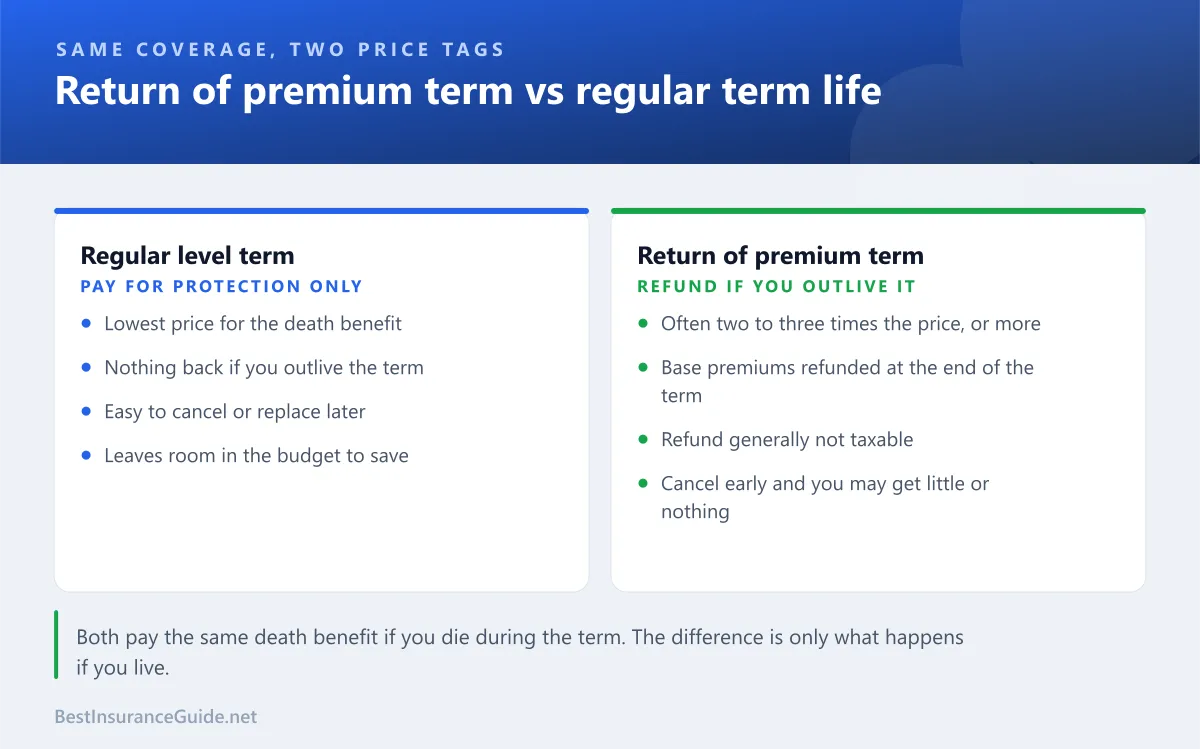
The death benefit is identical. The difference is what you pay and what happens if you outlive the policy.
| Detail | Regular level term | Return of premium term |
|---|---|---|
| Death benefit during the term | Yes | Yes |
| Money back if you outlive it | No | Yes, eligible premiums refunded |
| Price | Lowest | Commonly 2 to 3 times as much, sometimes more |
| Cancel early | Coverage ends, nothing lost beyond past premiums | Refund usually forfeited or reduced |
| Number of insurers offering it | Many | Fewer |
| Refund taxed? | Not applicable | Generally no |
The reason ROP costs so much more is that the insurer has to fund the refund. It does that by investing your extra premiums for decades and keeping the earnings, plus the money from people who cancel before the end and lose their refund. In effect, you’re lending the insurer money at a 0% interest rate, and you only get it back if you stay to the end.
How much does return of premium life insurance cost?
There’s no single price, because life insurance is priced on your age, health, term length, coverage amount and the insurer. In consumer comparisons, return of premium term commonly costs two to three times as much as the same amount of level term, and sometimes considerably more. The gap tends to be widest for older applicants, where the base term premium is already high.
We don’t publish sample premiums for named insurers. The only reliable number is a quote for your own age and health. When you get one, ask for both an ROP quote and a regular term quote for the same coverage and term, so you can do the math below with your own figures.
The real question: ROP refund vs investing the difference
This is where most return of premium decisions are made or lost. The fair comparison isn’t “ROP vs nothing back”. It’s “ROP vs buying regular term and investing the money you save”.
Here’s a worked example with hypothetical prices, chosen to reflect a typical three-to-one price gap. They are not quotes.
- Regular 20-year term: $35 a month
- ROP 20-year term: $105 a month
- Difference: $70 a month
If you buy the ROP policy and keep it for all 20 years, you pay $25,200 and get $25,200 back.
If you buy regular term and invest the $70 difference every month for 20 years, here’s what you’d have:
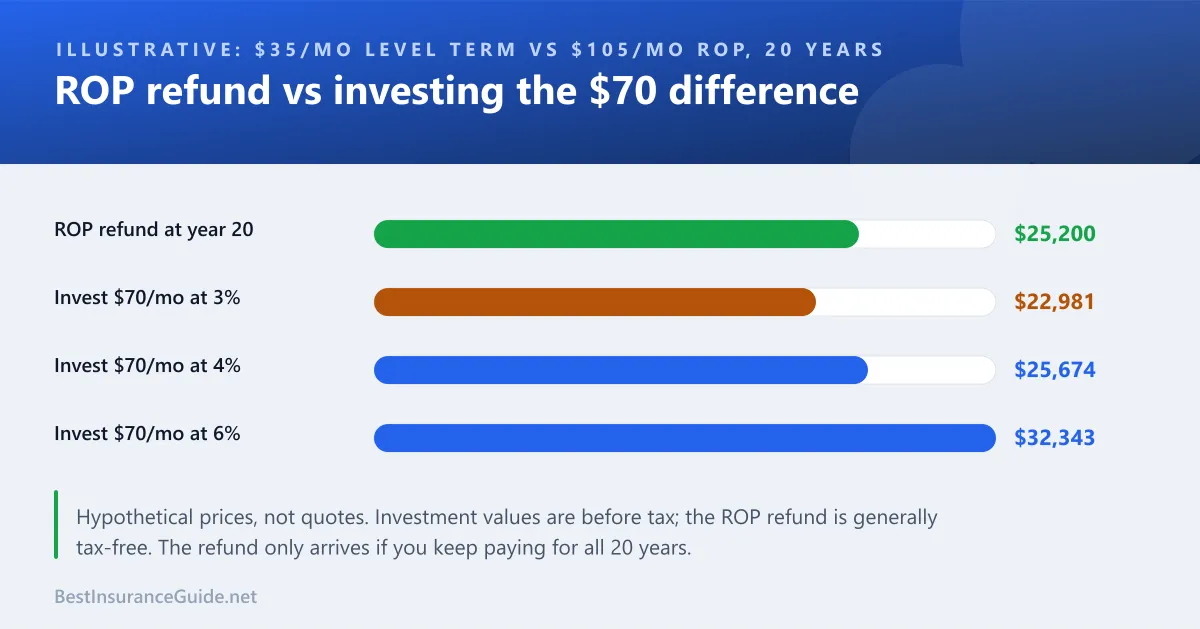
| Scenario | Value after 20 years |
|---|---|
| ROP refund | $25,200, generally tax-free |
| Invest $70/month at 3% | About $22,981 before tax |
| Invest $70/month at 4% | About $25,674 before tax |
| Invest $70/month at 6% | About $32,343 before tax |
A few honest takeaways:
- At a three-to-one price gap, the break-even return is roughly 4% a year. Below that, ROP wins. Above it, investing wins.
- Taxes narrow the gap. The ROP refund is generally tax-free, while investment gains in a taxable account are taxed. Investing through a tax-advantaged account like a Roth IRA changes that.
- A bigger price gap tilts things toward investing. If ROP costs four times as much, you’d be investing a larger difference, and investing comes out ahead at much lower returns.
- Inflation erodes the refund. $25,200 in 20 years buys less than $25,200 today. At 2.5% annual inflation, it’s worth roughly $15,400 in today’s dollars. That applies to any savings, but it’s worth remembering that the refund is “your money back”, not a gain.
- The investing plan only works if you actually invest. This is the strongest argument for ROP. A refund you’re forced to save beats an investment plan you never start.
How the return of premium refund is taxed
The refund is generally not taxable. You paid the premiums with after-tax money, and getting back what you paid doesn’t exceed your cost basis, so it isn’t treated as income. The IRS rule for life insurance is that amounts received up to your total premiums aren’t taxable. It’s the gain above them that would be.
Two things to check:
- If a policy pays anything above your premiums, that extra amount could be taxable.
- If you cancel early and receive a partial refund, that’s also generally a return of basis rather than income.
Our full guide to life insurance and taxes covers the death benefit, cash value and the exceptions.
What happens if you cancel early
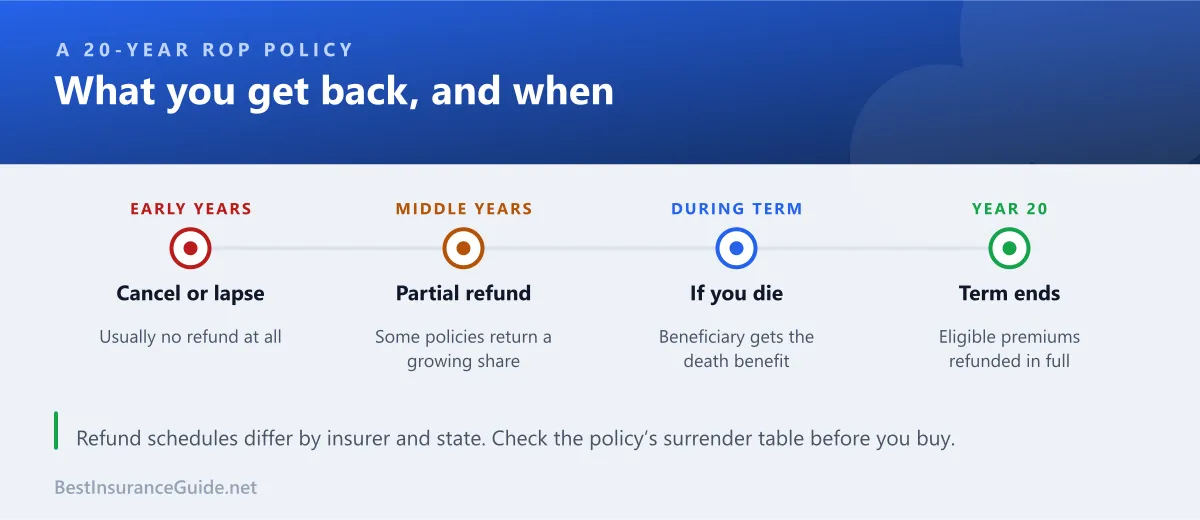
This is the most important fine print in any ROP policy, and it’s where many buyers lose out.
- In the early years, cancelling usually returns nothing. You’ve paid the higher ROP premium and get no refund.
- In the middle years, many policies return a partial refund that grows over time, following a schedule in the contract.
- At the end of the term, you get the full refund of eligible premiums.
Plenty of people don’t keep a term policy for the full term. Their needs change, they divorce, they find cheaper coverage, or money gets tight. If there’s a real chance you’ll drop the policy, ROP is usually a poor fit, because you’ll have paid much more for coverage and walked away with little or nothing.
Missing payments has the same effect. If the policy lapses, the refund is generally lost. Set up automatic payments from an account you check.
Which premiums are refunded?
Read the definition of “refundable premiums” in the contract. Some policies exclude:
- annual policy fees
- extra premiums for health ratings, called flat extras or table ratings
- the cost of other riders, such as a waiver of premium or child term rider
The refund you’re promised may be slightly less than the total you paid.
Who return of premium life insurance makes sense for
ROP term can be a reasonable choice if:
- You’re certain you’ll keep the policy for the full term. You have stable income and the coverage need lasts the whole period.
- You know you won’t invest the difference. The refund works as forced savings.
- You want to avoid feeling you’ve “wasted” money on insurance, and that peace of mind keeps you insured.
- You’re comparing it with whole life insurance. If you’re being pushed toward whole life for its “money back” feature, ROP term is usually cheaper and simpler. Our guide to term vs whole life insurance explains the trade-offs.
Who should usually skip it
- Disciplined savers and investors, who’ve historically done better with regular term plus investing.
- Anyone on a tight budget. The most important thing is having enough coverage. If ROP’s price forces you to buy less coverage than your family needs, that’s a bad trade.
- People who might cancel or replace the policy within the term.
- Older applicants, for whom ROP’s premium can be very high relative to the coverage.
Remember the main job of life insurance is replacing your income if you die. How much life insurance you need should come first, and the ROP decision second.
Questions to ask before you buy ROP term
- How much is the regular term quote for the same coverage and term? You need both prices to do the math.
- What’s the refund schedule if I cancel in year 5, 10 or 15?
- Which premiums are refundable, and which are excluded?
- Is it a rider or a standalone policy, and does that change anything?
- Can I convert the policy to permanent coverage, and what happens to the refund if I do?
- What happens to the refund if I reduce the coverage amount partway through?
If an agent can’t answer these clearly, get the answers in writing or look elsewhere.
A middle path some people take
Some people split the difference: they buy enough regular term to cover their family’s full need, and put the money they would have spent on ROP into a retirement account or a high-yield savings account set up for that purpose. That gets them the coverage, the savings and the flexibility to cancel without losing anything.
Others with stable finances and no investing habit buy ROP for a portion of their coverage and regular term for the rest. It’s also possible to own more than one life insurance policy, which makes blended approaches easy.
The bottom line
Return of premium life insurance gives you a refund of your premiums if you outlive the term, in exchange for paying commonly two to three times as much as regular term. At a typical price gap, the refund roughly matches what you’d get investing the difference at about 4% a year, before tax. It’s a reasonable fit for people who’ll definitely keep the policy and wouldn’t invest the savings. For most others, cheaper level term plus a separate savings plan is more flexible and often ahead in the end.
Still deciding whether you need coverage at all? Start with is life insurance worth it?
Sources and notes
- Price ranges reflect common market comparisons of ROP and level term, such as NerdWallet’s ROP guide. Actual prices depend on your age, health, term and insurer.
- Tax treatment: IRS Publication 525 on life insurance proceeds and cost basis.
- Investment comparison: hypothetical $70 a month invested for 240 months, compounded monthly at the rates shown, before tax and fees. Inflation adjustment uses a hypothetical 2.5% a year. These are illustrations, not predictions.
- Refund schedules, excluded premiums and term lengths differ by insurer and state. The policy contract is authoritative.
This article is general information, not financial, tax or insurance advice. Compare quotes and read the refund provisions in the policy before you buy.