Joint Life Insurance for Couples: First-to-Die vs Survivorship Policies
How joint life insurance works for couples: first-to-die vs survivorship (second-to-die) policies, estate planning uses, and when two policies are better.

Table of contents

When couples shop for life insurance together, the idea of one policy for both of you sounds tidy: one application, one premium, one set of paperwork. That’s what joint life insurance offers. But a joint policy pays only once, and when it pays changes everything about who it helps.
There are two very different kinds. First-to-die pays when the first partner dies. Survivorship, also called second-to-die, pays only after both partners have died. The first is about protecting the survivor. The second is mostly about estate planning and leaving money to the next generation.
This guide explains how each one works, how survivorship life insurance helps in estate planning, what happens in a divorce, and why many married couples are better off with two individual policies. This site is independent and doesn’t sell insurance or take commissions from insurers.
What is joint life insurance?
Joint life insurance is one policy that covers two lives and pays one death benefit. Couples are the most common buyers, but business partners sometimes use it too.
The two types:
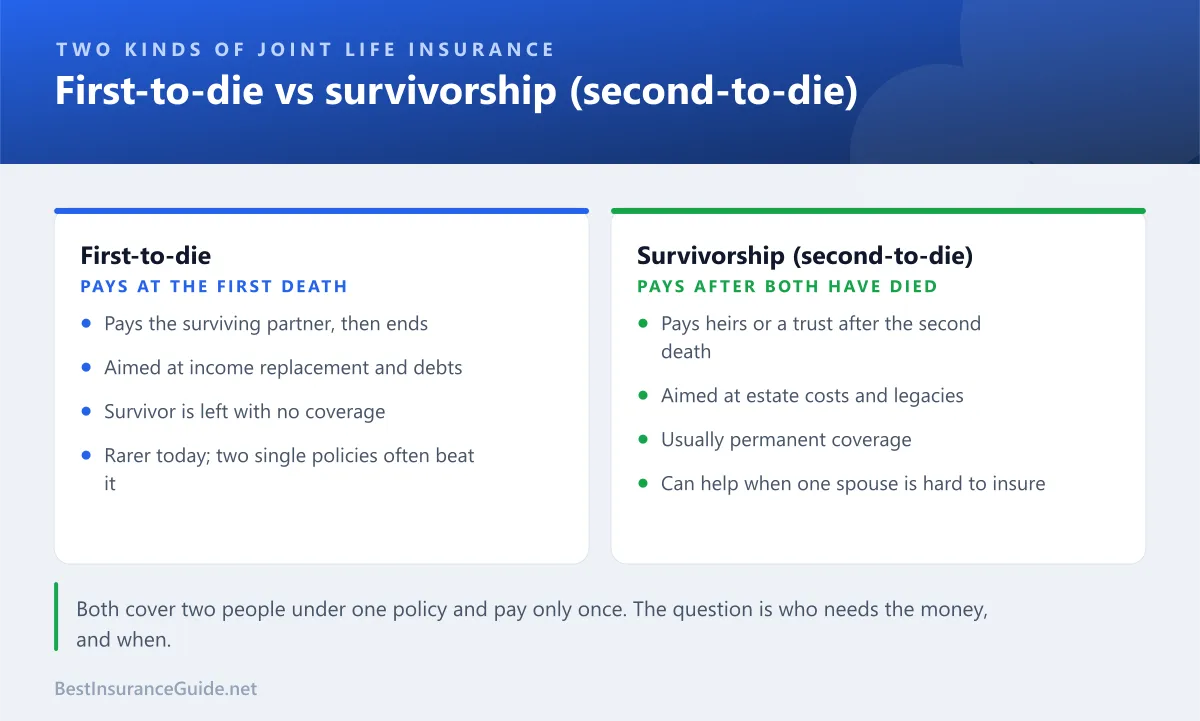
| Detail | First-to-die | Survivorship (second-to-die) |
|---|---|---|
| When it pays | At the first death | After both deaths |
| Who usually gets the money | The surviving partner | Children, other heirs or a trust |
| Main purpose | Replacing income, paying off a mortgage | Estate taxes, legacy, special needs trusts, business succession |
| Policy type | Term or permanent | Almost always permanent |
| What’s left after the payout | Survivor has no coverage, unless they buy a new policy | Nothing, the job is done |
| Relative cost | Can be less than two single policies | Usually less than two single permanent policies |
First-to-die life insurance
A first-to-die policy covers both partners and pays the death benefit when either one dies. The survivor gets the money, and the policy ends.
That makes it look like a substitute for two individual policies, and some couples buy it that way. The appeal is a single, sometimes lower, premium. The drawbacks are real, though:
- It only pays once. If both partners die in the same accident, there’s just one payout. Two individual policies would have paid twice.
- The survivor is left uninsured. After the first death, the surviving partner has no coverage and may be older or in poorer health when they try to buy more. Some policies include a survivor purchase option that lets the survivor buy a new policy without health questions. Check whether yours does.
- Divorce is messy. Splitting one policy between two people isn’t always possible.
First-to-die policies are less common than they once were, and joint term life insurance is offered by relatively few insurers. For most couples protecting an income, mortgage or young children, two individual term policies do the same job with more flexibility. Each partner can choose their own coverage amount and term, and each policy stands on its own.
Survivorship life insurance (second-to-die)
Survivorship life insurance covers two people and pays only after both have died. Because the insurer pays later on average, and only once, a survivorship policy usually costs less than two separate permanent policies for the same death benefit.
It’s almost always a form of permanent life insurance, such as whole life or guaranteed universal life, because the point is to be in force whenever the second death happens, which may be decades away. Our guide to term vs whole life insurance explains how permanent policies work.
Who survivorship life insurance is for
- Couples with larger estates who expect estate taxes or need cash to settle the estate
- Parents of a child with special needs who want to fund a special needs trust after both parents are gone
- Owners of a family business, farm or real estate who want heirs to keep it rather than sell it to pay costs
- Couples who want to leave a legacy to children, grandchildren or a charity
- Couples where one spouse is hard to insure. Because the insurer looks at both lives together, a survivorship policy can sometimes be approved when one spouse would be declined on their own.
How survivorship life insurance helps in estate planning
This is the main use for second-to-die coverage, and the timing is the reason.
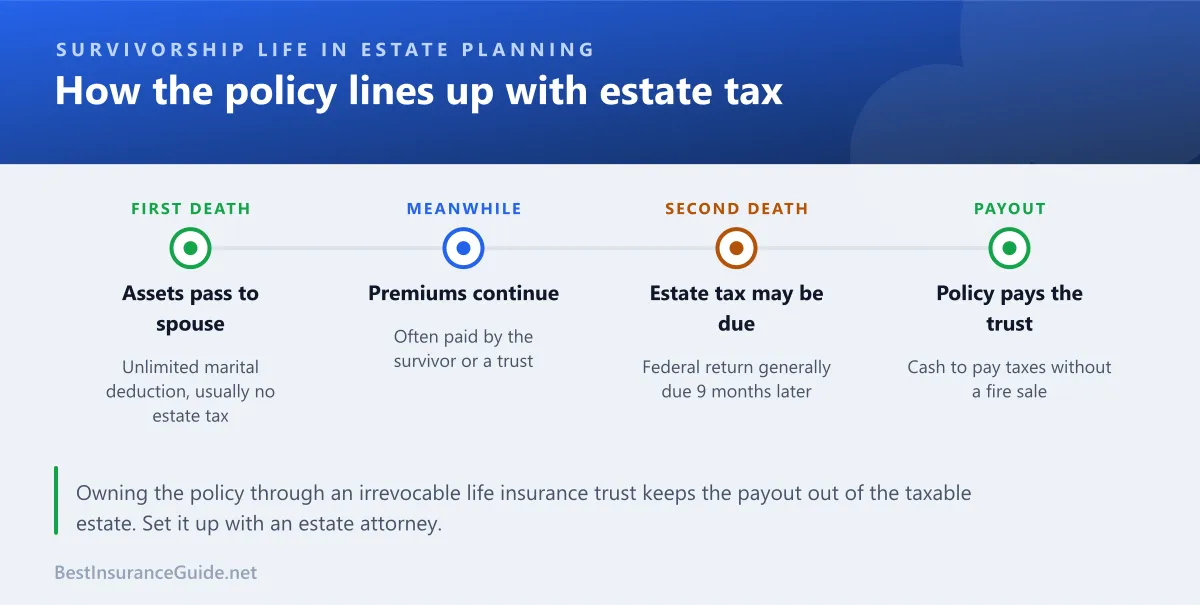
Under federal law, a married person can generally leave any amount to a U.S. citizen spouse free of estate tax, using what’s called the unlimited marital deduction. So for most married couples, the estate tax question doesn’t come up at the first death. It comes up at the second death, when assets pass to children or other heirs.
That’s exactly when a survivorship policy pays. The proceeds give heirs cash to cover:
- federal estate tax, where the estate is large enough. The basic exclusion is $15 million per person for 2026, and a surviving spouse can often use the unused exclusion of the first spouse to die.
- state estate or inheritance taxes, which can apply at much lower thresholds in some states
- legal, probate and administration costs
- equalizing an inheritance, for example when one child inherits the family business and the others receive the insurance money
Without that cash, heirs may have to sell a home, a business or investments quickly, sometimes at a bad time, just to pay the bills.
Why survivorship policies are often owned by a trust
If either spouse owns the policy, the death benefit can be counted in the taxable estate. That can increase the very estate tax the policy is meant to pay. To avoid this, survivorship policies are often owned by an irrevocable life insurance trust (ILIT). The trust buys and owns the policy, the couple funds the premiums through gifts to the trust, and the payout goes to the trust outside the estate.
ILITs have strict rules, including a three-year lookback when an existing policy is transferred into the trust. This is firmly territory for an estate attorney. Our guide to life insurance and taxes covers the basics of how estate tax applies to life insurance.
A worked example
This is an illustrative example, not tax advice.
A couple in their 60s owns a family farm and other assets. Their children want to keep the farm. After both parents die, the estate could owe state estate tax and significant settlement costs. The farm is most of the value and can’t easily be split.
The couple set up an ILIT, which buys a survivorship policy sized to the expected costs. When the second parent dies, the trust receives the death benefit outside the estate, and the trustee uses it to buy assets from the estate or lend it money. That puts cash in the estate to pay the bills, and the children keep the farm.
Life insurance for married couples: joint or two individual policies?
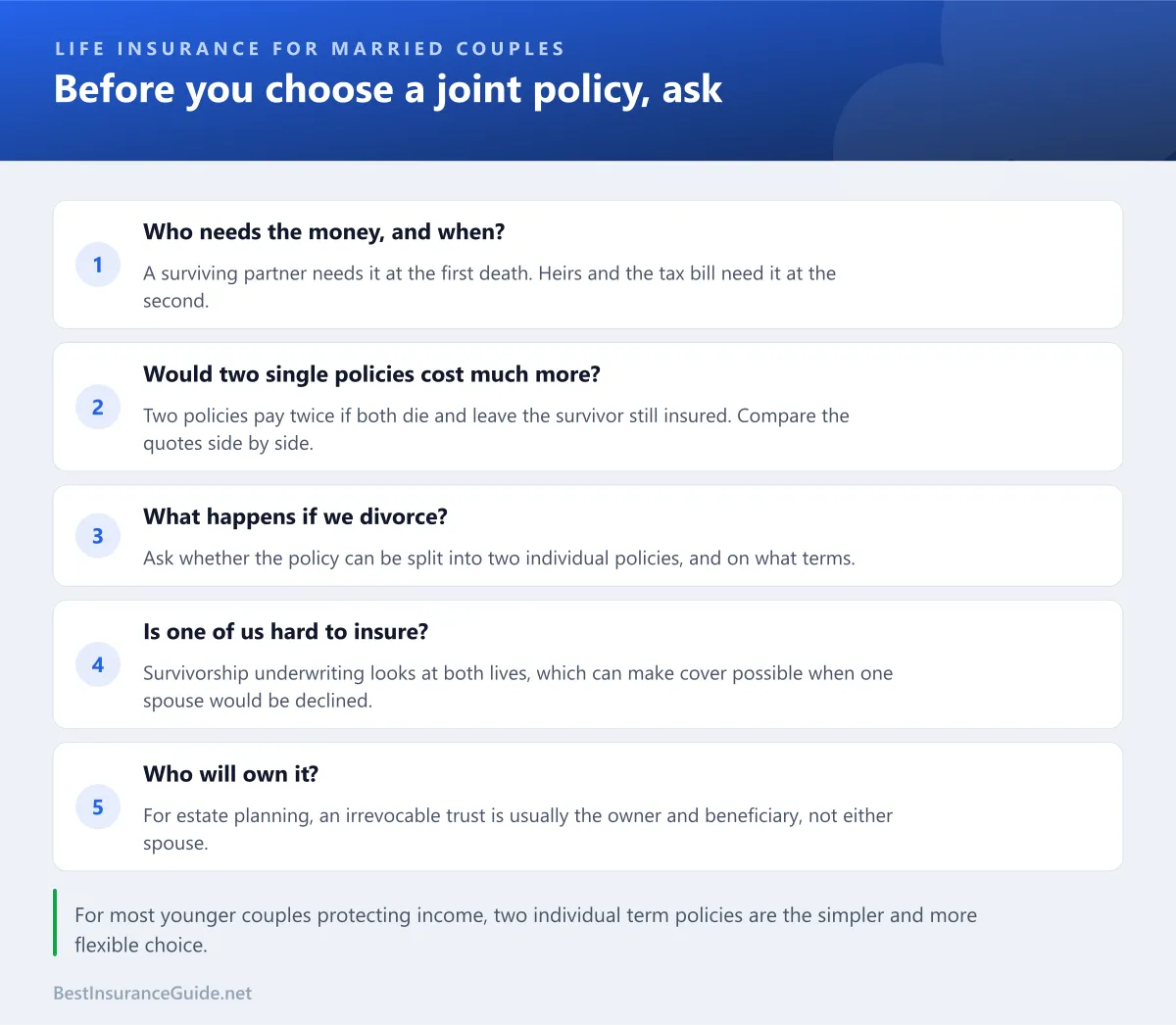
For most married couples buying life insurance to protect each other and their kids, the answer is two individual policies. Here’s why:
- Each of you is covered separately. If one partner dies, the other still has their own policy.
- Two payouts if both die. That can make a big difference for children who lose both parents.
- Different coverage amounts. One partner may earn more or carry more of the mortgage, and needs more coverage.
- Different term lengths, matched to each person’s situation.
- Divorce is simple. Each person keeps their own policy.
A joint policy is worth a look when:
- you want survivorship coverage for estate planning, where a joint policy is the right tool
- one partner can’t get coverage alone, and a survivorship policy may be possible
- you’re comparing a first-to-die policy to two singles and the price difference is large enough to matter
Ask about adding a spouse rider to your own policy too. Some insurers offer a small amount of term coverage on a spouse as an add-on, though it’s usually limited and best for modest needs.
If you already have life insurance through work, our guide to supplemental life insurance explains spouse coverage options at open enrollment, and can you have multiple life insurance policies? covers combining coverage.
How much does joint life insurance cost?
There’s no standard price, because a joint policy is priced on both people. Insurers look at each partner’s age, sex, health and tobacco use, then combine them into what’s sometimes called a “joint equal age”. The main things that move the price:
- The type of policy. First-to-die costs more than survivorship for the same death benefit, because the first of two deaths comes sooner, on average, than the second.
- Term or permanent. Joint term, where available, is cheaper than permanent coverage. Survivorship is almost always permanent, so expect permanent-policy prices.
- Both partners’ health. With survivorship, one partner’s health problems have less effect on the price than they would on a single policy, because the insurer is waiting for both deaths. With first-to-die, the less healthy partner tends to drive the cost.
- Premium guarantees. Guaranteed universal life survivorship policies often cost less than whole life survivorship, but build little cash value.
- Riders, such as a policy split option or survivor purchase option, which may add to the premium.
We don’t publish sample premiums for named insurers. Ask for quotes on a joint policy and on two individual policies for the same total coverage, so you can see exactly what the joint discount buys you and what it gives up.
Joint life insurance and divorce
Divorce is the most common way a joint policy goes wrong. Before buying, check:
- Is there a policy split option? Some joint policies let the couple divide the coverage into two individual policies after a divorce, sometimes without new health questions, and usually within a set time.
- Who owns the policy? The owner controls beneficiary changes and can cancel. In a divorce, ownership has to be agreed on or decided by the court.
- Is the policy part of a divorce agreement? Courts sometimes require a parent to keep life insurance for the children’s benefit.
With individual policies, divorce is much simpler. Update your beneficiaries, and include a contingent beneficiary so the money goes where you intend.
Questions to ask before buying a joint policy
- Is it first-to-die or second-to-die, and does that match who needs the money?
- How does the price compare with two individual policies for the same coverage?
- Is there a survivor purchase option (first-to-die) or a policy split option (both types)?
- Is the premium guaranteed, or can it change?
- Who should own the policy? For estate planning, should a trust own it?
- What happens if premiums stop? Permanent policies can lapse and lose value if underfunded.
The bottom line
Joint life insurance covers two people under one policy and pays once. First-to-die pays the surviving partner but leaves them uninsured, and for most couples two individual term policies do the job better. Survivorship, or second-to-die, pays after both partners die. It’s a useful estate planning tool for larger estates, family businesses, special needs planning and legacies, especially when owned by an irrevocable trust.
If you’re not sure how much coverage you need in the first place, start with life insurance basics.
Sources and notes
- IRS, Estate tax: filing threshold and basic exclusion amount ($15,000,000 for 2026), and the marital deduction.
- IRS, Instructions for Form 706: estate tax return due date (generally nine months after death) and portability of the deceased spousal unused exclusion.
- Policy features such as split options, survivor purchase options and underwriting for survivorship policies vary by insurer and state. Your policy contract is authoritative.
This article is general information, not financial, tax or legal advice. Estate planning with life insurance and trusts should be done with an estate attorney and a tax professional.