Pet Insurance in Kentucky: Lone Star Ticks, No Pet Insurance Law, and What to Check Yourself
Pet insurance in Kentucky: lone star ticks, ehrlichiosis, heartworm and fungal disease, no state pet insurance law, and policy terms to check.

Table of contents

Kentucky’s pet risks are mostly invisible until they are expensive. A tick no bigger than a sesame seed. A mosquito on a warm evening. Fungal spores in river-bottom soil. Most of what drives serious pet insurance claims here is chronic disease that starts quietly, and once diagnosed, stays excluded by any new insurer for life.
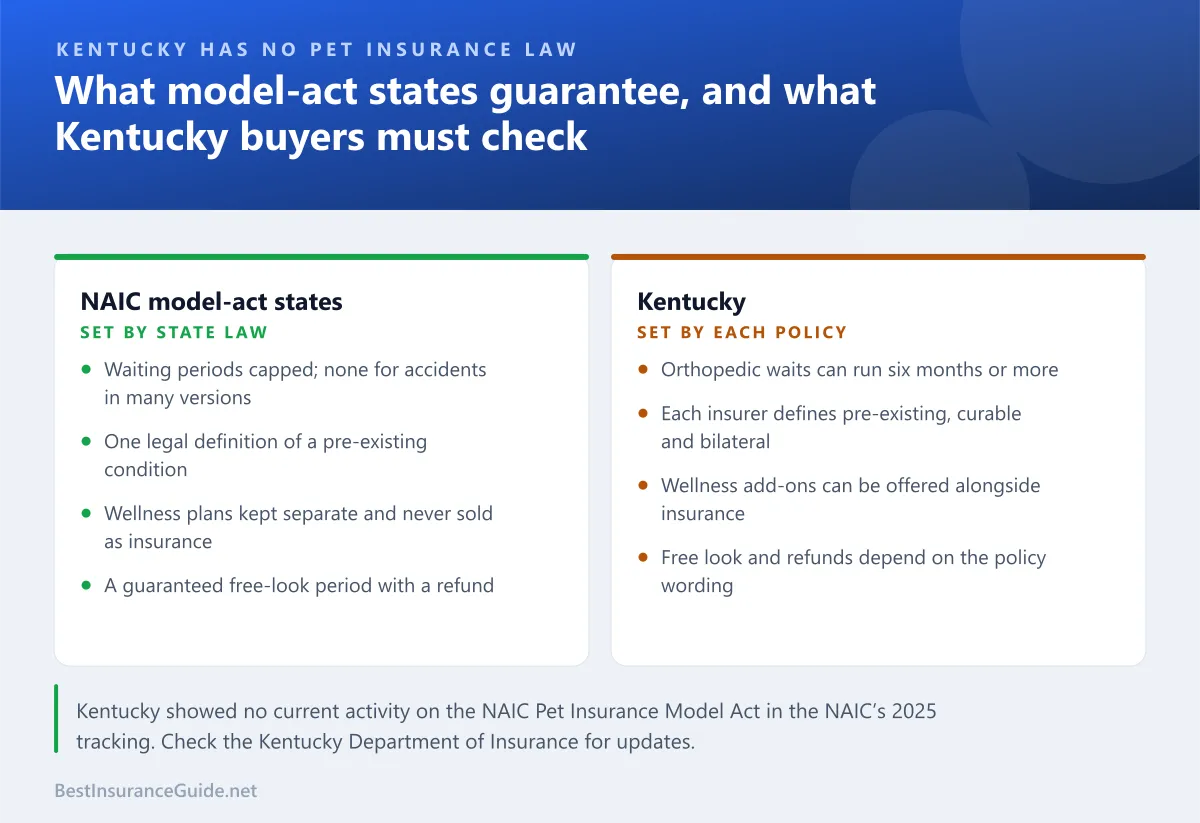
Kentucky also differs from a growing list of states in one important way. It has no pet-insurance-specific law. Several states now cap waiting periods, standardise the definition of a pre-existing condition and require plain-English disclosures. In Kentucky, those terms are whatever each insurer’s policy says. That puts more of the checking on you.
This guide covers Kentucky’s disease profile, what sets the price, the policy terms that matter most without state standards, and how to buy well. This site is independent and not affiliated with any insurer. Policy terms vary, and your own documents and the Kentucky Department of Insurance are the final word.
Kentucky and pet insurance regulation
Pet insurance in Kentucky is sold under the state’s general insurance laws and overseen by the Kentucky Department of Insurance.
In 2022 the National Association of Insurance Commissioners adopted a Pet Insurance Model Act, a template that states can turn into law. It standardises definitions, limits waiting periods, requires disclosures and separates wellness plans from insurance. A growing group of states has passed laws based on it. Montana did so in 2025, as our Montana pet insurance guide explains.
As of the NAIC’s Summer 2025 tracking, Kentucky showed no current activity on the model act. Unless that has changed by the time you read this, here is what it means in practice:
- Waiting periods are set by the insurer, not capped by state law.
- “Pre-existing condition” is defined by each policy, and definitions differ.
- Wellness plans may be bundled or marketed alongside insurance without the specific separation rules some states require.
- Your free-look period, if any, is whatever the policy provides.
None of this makes Kentucky policies bad. Most major insurers sell similar products nationwide. But it means the comparison work the law does for buyers in other states falls to you.
Kentucky’s disease profile
Lone star ticks and ehrlichiosis
The lone star tick is common across Kentucky. It is the main carrier of Ehrlichia chaffeensis, and Kentucky has some of the highest human ehrlichiosis incidence rates in the country. That is a reliable signal of how much infected tick activity there is. University of Kentucky researchers have tracked the tick and the pathogen county by county.
For dogs, ehrlichiosis can range from mild illness to a chronic form affecting blood cell counts, needing extended treatment and monitoring. Once diagnosed, it is a pre-existing condition for any new policy.
Other tick diseases, and Lyme moving in
Rocky Mountain spotted fever and anaplasmosis also occur in Kentucky. And the Companion Animal Parasite Council’s 2026 forecast projects continued spread of the black-legged tick, which carries Lyme disease, into Kentucky and neighbouring states. Kentucky’s tick picture is getting more complicated, not less.
Heartworm
Heartworm is transmitted by mosquitoes, and Kentucky’s warm, humid summers support them. CAPC describes heartworm as entrenched in the Southeast and continuing to spread north along the Mississippi River corridor, which borders western Kentucky.
Heartworm treatment is long, involves several injections and strict rest, and is costly. Insurers do not treat it the same way. Some cover it as an illness, and some of those require the dog to have been on prevention for the claim to be paid. Others exclude it outright. Fetch’s published sample policy, for example, excludes treatment of parasite-related illness, including heartworm, whenever a preventive medication exists. Check this before you rely on it, and keep your dog on prevention either way.
Fungal disease in the river valleys
The Ohio and Mississippi River valleys are known endemic areas for histoplasmosis, and blastomycosis also occurs in the region. Both are fungal infections picked up from spores in soil. They are especially linked to river bottoms, decaying wood and bird or bat droppings. Both can need months of antifungal medication, and blastomycosis in particular can be serious.
These are illnesses, covered subject to waiting periods and pre-existing exclusions. They are a strong reason to insure a dog that hunts, hikes or digs in river country before symptoms appear.
The everyday claims
Beyond the regional diseases, Kentucky dogs make the claims dogs everywhere make: swallowed objects, cruciate ligament tears, lacerations, allergies and skin disease in the humid summers, heatstroke, and snakebites from copperheads and timber rattlesnakes in wooded and rocky areas. Hunting breeds, including the coonhounds and bird dogs common in rural Kentucky, see more field injuries.
Worked example: the same tick bite, two timelines
Picture a four-year-old beagle in Bullitt County who spends weekends in the woods. In July she becomes lethargic and stops eating, and bloodwork confirms ehrlichiosis. Diagnosis, medication and follow-up blood tests add up, and in this illustration the first round of care comes to $3,000.
Timeline A: insured since she was a puppy. Her policy has a $500 deductible and 80% reimbursement. The insurer pays 80% of the $2,500 above the deductible, which is $2,000, and the owner pays $1,000. If the disease turns chronic, later flare-ups are still covered, subject to the annual limit.
Timeline B: insured the month after diagnosis. The new policy excludes ehrlichiosis as pre-existing. The owner pays the full $3,000, and every future flare-up, blood test and medication for that condition is also excluded for as long as she lives.
Illustrative figures only. Your costs depend on your vet, your dog and your policy.
The two owners might pay similar premiums. What separates them is timing. In a state where tick disease is this common, buying before the first diagnosis is most of the value.
Cats in Kentucky
Cats are not exempt. Outdoor and indoor-outdoor cats pick up ticks, and cytauxzoonosis, a severe tick-borne disease of cats carried by the lone star tick and associated with bobcats, has been reported across the south-central US, including Kentucky. Cats also get heartworm, though there is no approved treatment for cats, which makes prevention the real protection. And like dogs, cats in the humid summers see skin, ear and dental problems. Our cat insurance guide covers what cat policies typically include and exclude.
What sets the price in Kentucky
Pet insurance reimburses a share of your actual vet bill, so premiums follow local veterinary costs.
Louisville and Lexington have the state’s largest concentrations of emergency and specialty hospitals. Clinic costs are higher there, and so are premiums. Northern Kentucky prices partly against the Cincinnati market across the river.
Rural Kentucky, especially the Appalachian east, has lower routine costs but longer distances to emergency and specialist care. A serious case can mean a long drive and a referral bill priced like the city, not like home. Choose an annual limit that could cover a specialist surgery and several nights of hospitalisation.
Your premium also depends on your pet’s species, breed and age, and on the deductible, reimbursement percentage and annual limit you choose. Our pet insurance cost guide explains how those trade off.
Kentucky’s vet workforce
Kentucky has never had its own veterinary college. For decades it has instead bought reserved seats for Kentucky students at other universities. According to Kentucky’s Council on Postsecondary Education, that has meant 38 seats per class at Auburn University and a smaller allocation at Tuskegee University.
Not all of those graduates come home. A 2018 analysis for the Council found that Kentucky residents who earned Auburn veterinary degrees had returned to practise in Kentucky at a rate of about 56%.
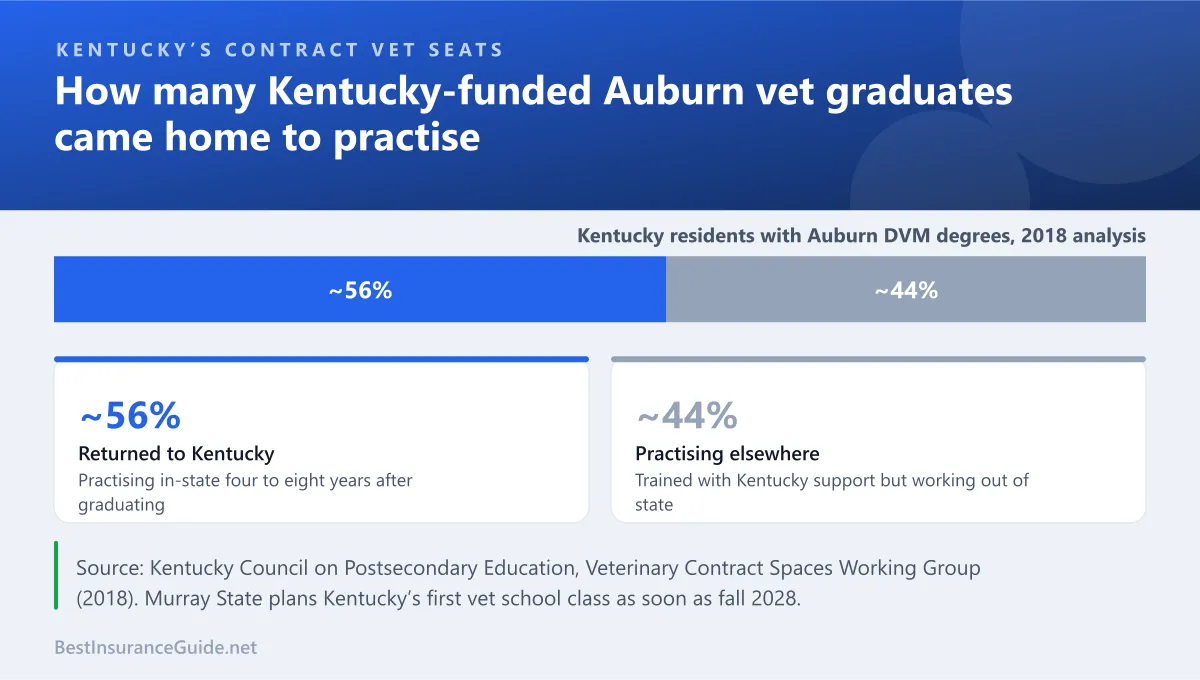
That is changing. In early 2026 the Council approved Murray State University’s Doctor of Veterinary Medicine program, and Murray State’s regents voted to create a College of Veterinary Medicine. It is now working through accreditation, and it has said a first class could enrol as soon as fall 2028.
For pet owners today, the practical point is that emergency and specialty capacity is concentrated in a few places. When planning for the bill you most need insurance for, assume it will come from a referral hospital.
The policy terms Kentucky buyers must check themselves
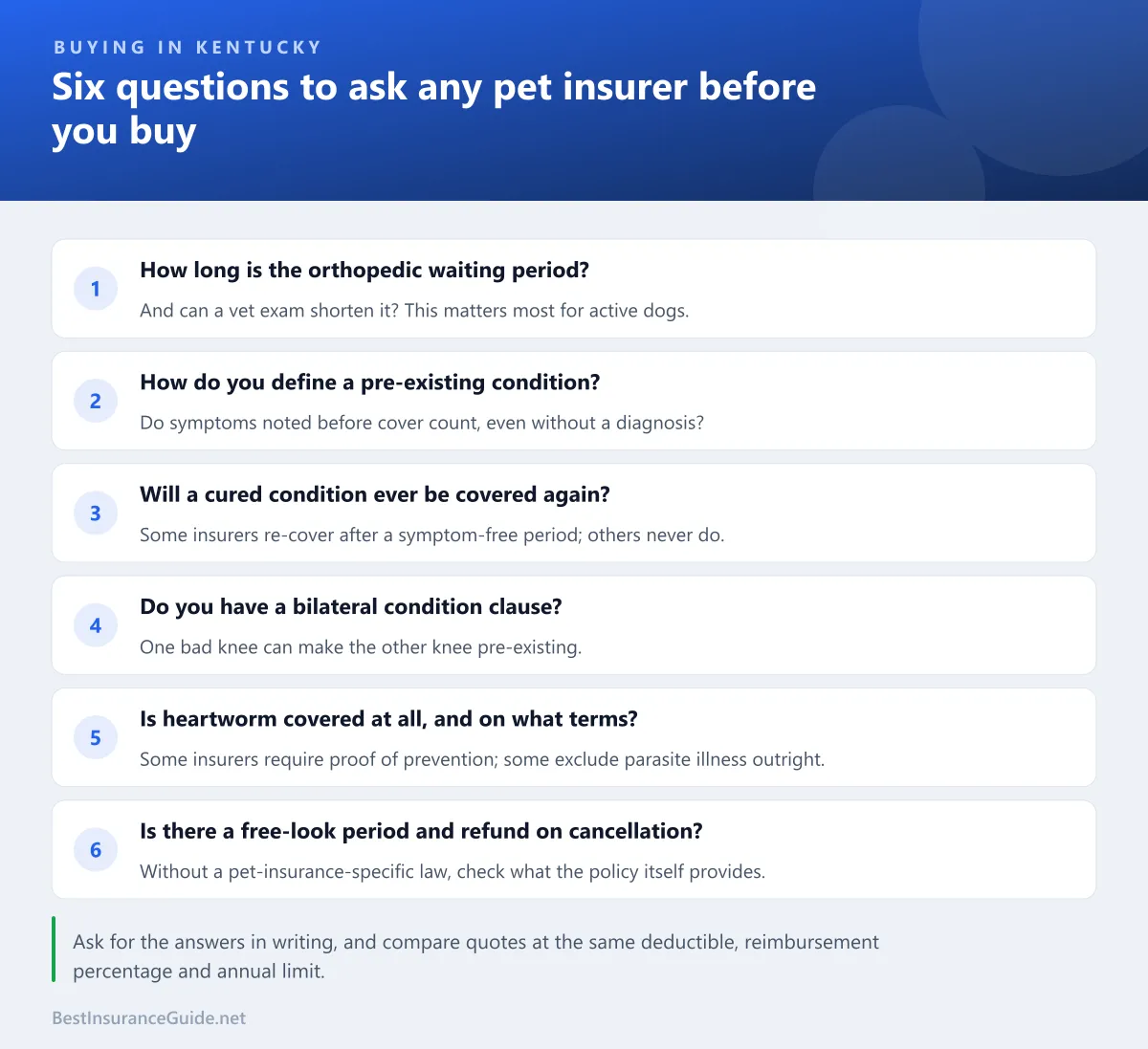
Without state standards, these are the terms most worth reading in every quote.
Waiting periods
Expect three kinds, and compare all of them:
- Accidents: often a few days. Some insurers have none.
- Illnesses: often around 14 days.
- Orthopedic conditions such as cruciate ligament tears and hip dysplasia: some insurers apply six months or longer, others match the illness period, and some let you shorten it with a vet exam.
For an active dog, the orthopedic waiting period can matter more than the premium. Our guide to pet insurance waiting periods explains the differences.
The pre-existing condition definition
Look for how the policy treats:
- Signs or symptoms noted before cover, even without a diagnosis
- “Curable” conditions, which some insurers will cover again after a symptom-free period, often 12 months, and others never will
- Bilateral conditions, where a problem in one knee or hip makes the other side pre-existing too
Tick and heartworm conditions
Ask in writing whether heartworm cover requires proof of prevention, and whether there are any exclusions or sub-limits for vector-borne disease.
Wellness add-ons
A wellness add-on reimburses routine care such as vaccines, heartworm testing and prevention, up to fixed allowances. Decide whether it is worth its separate price. Do not buy it thinking it improves your accident and illness cover, because it does not. See does pet insurance cover vaccines?
Cancellation and refund terms
Check whether there is a free-look period, how long it lasts, and how refunds work if you cancel. Our guide on how to cancel Spot pet insurance shows what those terms look like in a real policy.
How to buy pet insurance in Kentucky
- Insure before tick season and before the first diagnosis. Ehrlichiosis, heartworm and fungal disease all become permanent exclusions once recorded.
- Get at least three quotes with the same deductible, reimbursement percentage and annual limit.
- Line up the waiting periods side by side, especially the orthopedic period.
- Read the pre-existing definition and any bilateral clause.
- Keep prevention records. Heartworm and tick prevention receipts can matter at claim time.
- Choose a limit for the referral hospital, not your local clinic.
- Read your documents in the first weeks, and use any free-look period the policy gives you.
If the bill arrives before the reimbursement, vet payment plans and vet credit cards can bridge the gap.
Horse country, briefly
Kentucky is horse country, and many households have both dogs and horses. Pet insurance does not cover horses. Equine mortality and major medical cover is a separate, specialist market. Our guide to horse insurance explains how it works.
Where to complain
Start with your insurer’s complaints process. If it is not resolved, contact the Kentucky Department of Insurance, which handles consumer complaints about insurers licensed in the state.
Comparable states
Pet insurance in Missouri shares Kentucky’s heavy tick-borne disease burden. Pet insurance in Virginia has a similar Appalachian-versus-metro pricing split. Pet insurance in Illinois borders Kentucky across the Ohio River and shares much of its parasite and fungal disease picture.
A note on scope
This guide describes Kentucky’s regulatory position based on NAIC tracking from 2025 and disease risks based on public research and CAPC forecasts. Laws change, and Kentucky could adopt pet-insurance-specific rules in a future legislative session, so check the Kentucky Department of Insurance for the current position. Waiting periods and definitions described here are typical ranges, not any particular insurer’s terms.
Clinical questions, including which tick and heartworm prevention suits your dog, are for your veterinarian. This site is independent and not affiliated with any insurer.
Related reading
Pet insurance by state links to every state guide on this site. Dog walking insurance covers the cover professionals need if you look after other people’s dogs.