Dog Walking Insurance: What You Need, What It Costs, and the Gap Most Walkers Miss
Dog walking insurance: general liability, care custody and control, bonding and commercial auto. What each covers, 2026 costs and what to skip.

Table of contents
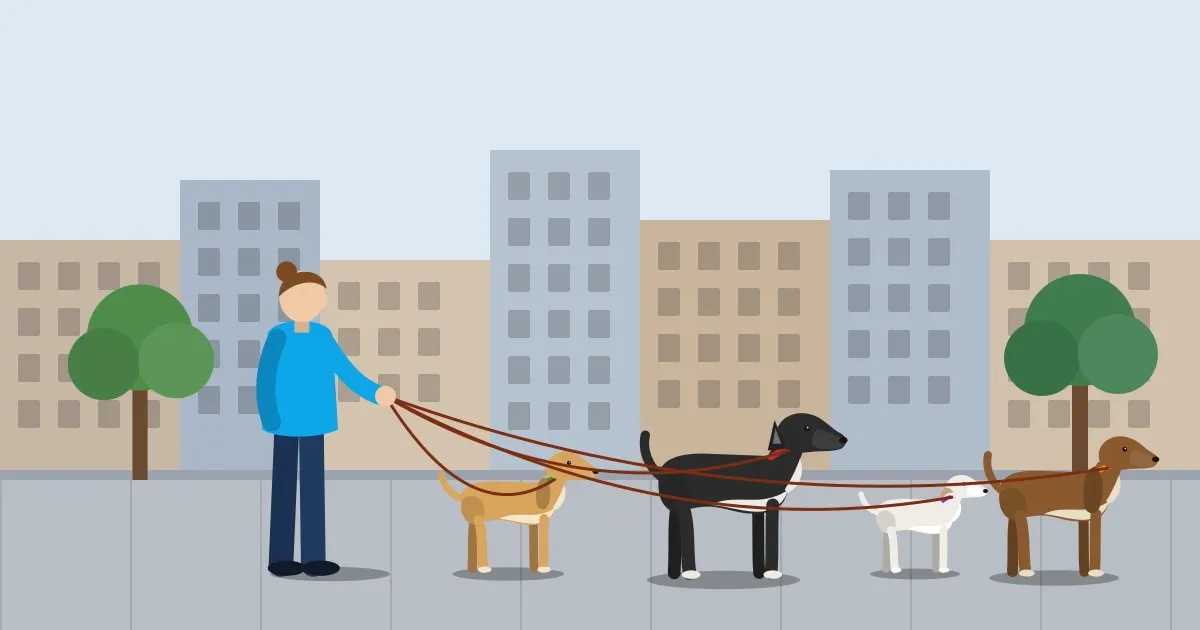
Here is the problem in one sentence: the policy most dog walkers buy first does not cover the dogs.
General liability insurance is the foundation of any dog walking business, and you should have it. But in its standard form it excludes damage to property in your care, and the law treats a client’s dog as property. So when a dog slips its harness and is hit by a car, or tears a ligament chasing a squirrel on your watch, the policy you were sure would cover you can decline the claim.
This guide is for anyone walking dogs for money. That includes the student doing three walks a day through an app, the full-time solo walker with a regular client list, and the small business with a van and two employees. It covers what each type of insurance does, which ones you actually need, what they cost in 2026, and how to buy without overpaying.
This site is independent and does not sell insurance. Cost figures are attributed to their source, and coverage descriptions are general. Your own policy wording is what counts.
What dog walking insurance actually is
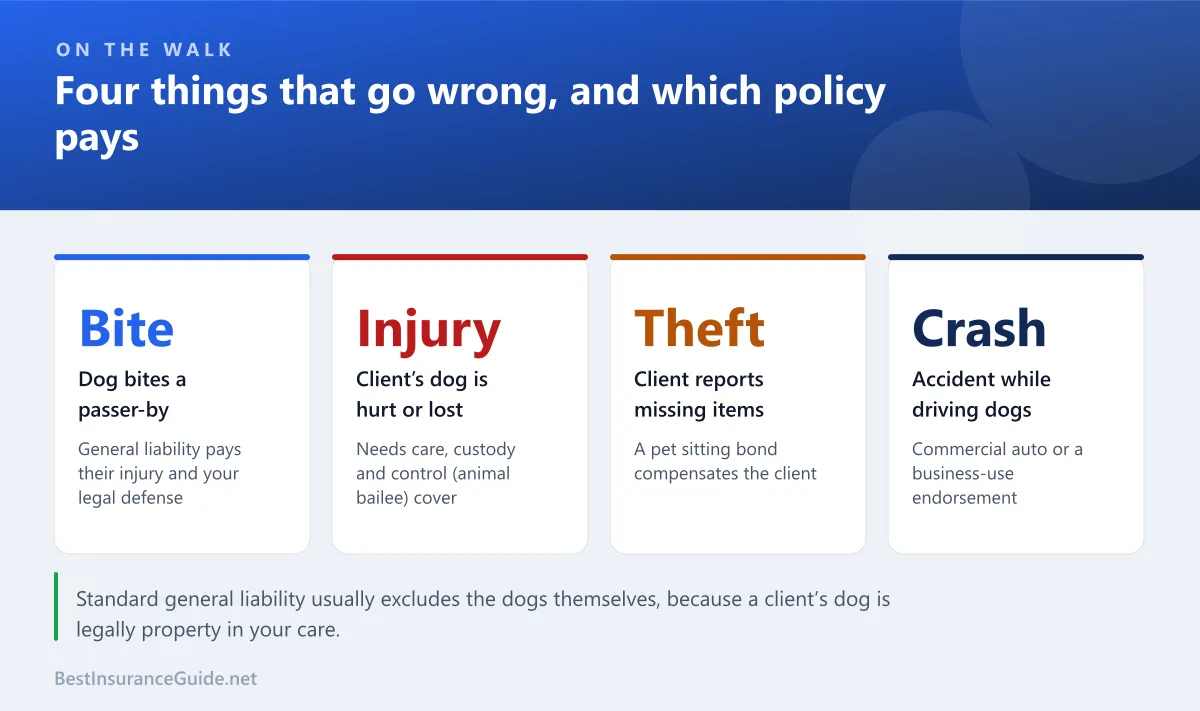
There is no single product called “dog walking insurance.” The phrase covers a bundle of policies, each answering a different question:
- Who pays if a dog I am walking injures someone, or damages their property? General liability.
- Who pays if the dog I am walking is injured, gets lost or dies? Care, custody and control coverage, also called animal bailee coverage.
- Who pays a client who says something went missing from their home? A fidelity or pet sitting bond.
- Who pays if I crash while driving dogs for work? Commercial auto, or a business-use endorsement on your personal policy.
- Who pays if my employee is hurt on the job? Workers’ compensation.
Most specialist pet care insurers package the first two, and often the bond, into one policy aimed at walkers and sitters. That is usually the simplest place to start.
The care, custody and control gap, explained properly
This is the single most important thing to understand before you buy.
A general liability policy pays for bodily injury and property damage you cause to other people. If a dog you are walking knocks over a cyclist, or bites a neighbour, or chews through someone’s garden hose, that is the territory GL is built for.
But almost every GL policy contains a care, custody or control exclusion. It says the policy will not pay for damage to property that you are looking after at the time. The reasoning is that you have a duty to look after things entrusted to you, and the insurer does not want to underwrite your own handling of them.
For most businesses, that exclusion barely matters. For a dog walker, it is your entire job, because legally the dog on the end of your lead is your client’s property, in your care.
So unless your policy adds care, custody and control coverage (animal bailee coverage), the following are typically not covered:
- A dog injured while you are walking it, such as a cut pad, a torn ligament or a fight with another dog.
- A dog that escapes and is lost or killed.
- A dog that becomes ill in your care, where the illness is linked to something on your watch.
- Emergency vet bills you run up on the client’s behalf.
Specialist insurers add animal bailee cover as an endorsement, with limits commonly offered from around $10,000 up to $200,000. When you compare quotes, check that this line actually appears on the quote, and check its limit, rather than assuming a “pet care” policy includes it.
The five coverages, one by one
1. General liability
What it covers: injury to other people and damage to their property caused by your business operations, plus your legal defence costs. For a walker, that means bites to passers-by, a dog tripping a pedestrian, damage inside a client’s home, and similar.
Do you need it? Yes. It is the coverage clients, buildings and HOAs ask to see on a certificate of insurance, and it protects your personal assets from a lawsuit.
Dog-related injuries are not small claims. According to the Insurance Information Institute and State Farm, dog bite and dog-related injury claims cost homeowners insurers about $1.86 billion in 2025 across 28,450 claims, an average of roughly $65,450 per claim. A walker who causes one of those, without cover, is the one paying it.
Typical limits: $1 million per occurrence and $2 million aggregate is the standard starting point.
2. Care, custody and control (animal bailee)
What it covers: injury, illness, loss or death of the animals in your care, usually including vet bills up to the limit.
Do you need it? If you walk other people’s dogs, effectively yes. It covers the risk you face every single day.
What to check: the per-animal limit, whether vet bills count in full, whether lost or stolen dogs are covered, and any exclusions for specific breeds or for dogs off lead.
3. Pet sitting or fidelity bond
What it covers: compensates a client if you or someone working for you is accused of theft from their home.
Do you need it? If you hold client keys or door codes, a bond is cheap reassurance and is often expected. Be clear about what it is, though. A bond protects the client, not you. If the bonding company pays out, it can come back to you for the money.
4. Commercial auto
What it covers: accidents while driving for business, including injury to others, damage to their vehicles and, depending on your options, your own vehicle.
Do you need it? Only if you drive as part of the work. Walking dogs on foot around your neighbourhood does not need it. Collecting dogs and driving them to a park or trail does.
Personal auto policies frequently exclude or restrict business use. If you drive dogs for money and have not told your insurer, ask now. Sometimes a business-use endorsement on your existing policy is enough, and sometimes a commercial policy is required. Our guide to commercial auto insurance costs covers how that is priced.
5. Workers’ compensation
What it covers: medical bills and lost wages for employees injured on the job. Bites, sprains from a lunging dog and slips on ice are all common in this work.
Do you need it? Once you hire employees, most states require it, though thresholds and exemptions vary by state. Solo walkers without employees generally do not need it, though some choose a policy for themselves.
What dog walking insurance costs in 2026
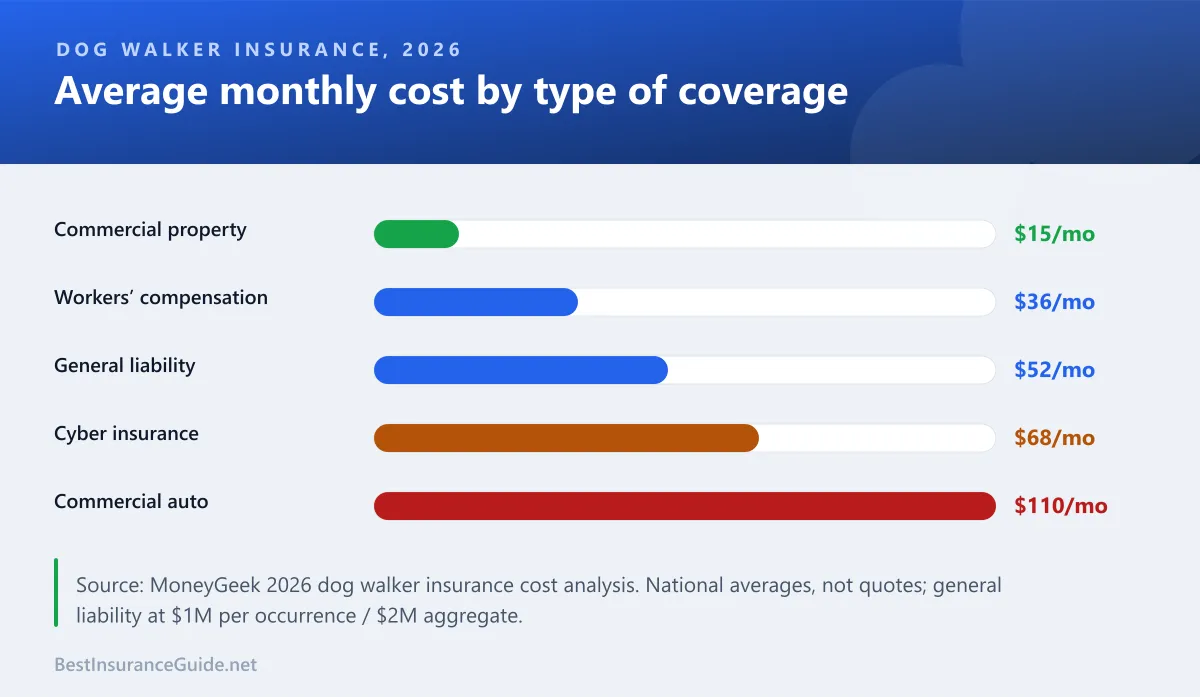
The most recent large dataset we have found is MoneyGeek’s 2026 analysis of dog walker insurance pricing, updated in September 2026. It is based on just over six million pricing estimates from ten providers across all 50 states and Washington, D.C., with general liability priced at $1 million per occurrence and $2 million aggregate.
| Coverage | Average monthly | Average annual |
|---|---|---|
| Commercial property | $15 | $174 |
| Workers’ compensation | $36 | $432 |
| General liability | $52 | $626 |
| Cyber insurance | $68 | $817 |
| Commercial auto | $110 | $1,318 |
| Overall average | $56 | $673 |
Source: MoneyGeek, dog walker insurance cost report, 2026. Averages, not quotes.
Three things stand out from that data.
General liability is affordable. At around $52 a month on average, it costs less than the fee for two or three walks.
Driving changes everything. Commercial auto is the most expensive line by a distance. A walker who works on foot avoids that cost entirely.
Location matters a lot. The same analysis found general liability ranging from about $24 a month in South Dakota to about $103 a month in Michigan. A national average is a starting point, not a quote.
Animal bailee cover and bonds are not broken out in that dataset because they are often sold as add-ons or packaged into specialist pet care policies. Get them quoted explicitly so you can see what they add.
What pushes your premium up or down
Insurers price dog walking on how likely a claim is and how large it could be. The factors that move the price most are:
- How many dogs you walk at once. Pack walks raise the chance of a fight, an escape or a tangle that trips someone.
- Breeds and sizes. Some insurers restrict or surcharge certain breeds, and a large, strong dog can do more damage.
- Whether you drive. Transporting dogs adds auto risk and, often, a separate policy.
- Other services. Overnight sitting, boarding, training or grooming each add exposure and may need different cover.
- Employees. Staff bring workers’ comp and wider liability exposure.
- Claims history. As with any insurance, past claims raise future prices.
- Limits and deductibles. Higher limits cost more. A higher deductible lowers the premium but raises what you pay on each claim.
App walkers: are you covered by Rover or Wag?
Many walkers start on an app, and it is reasonable to assume the platform has you covered. Be careful with that assumption.
Walking platforms run their own protection or guarantee programs, and these can be genuinely useful. But they are not the same as owning a policy:
- They apply to bookings made through that platform. A private client you met at the park is not covered by an app’s program.
- They have their own conditions, limits and exclusions, which can change.
- They may act as reimbursement programs rather than insurance, with a different claims process and less certainty.
If you walk only through one app and take no private clients, read that platform’s terms carefully and decide whether the gaps matter to you. If you have any private clients at all, your own general liability and animal bailee policy is what protects you.
How to get insured before your first client
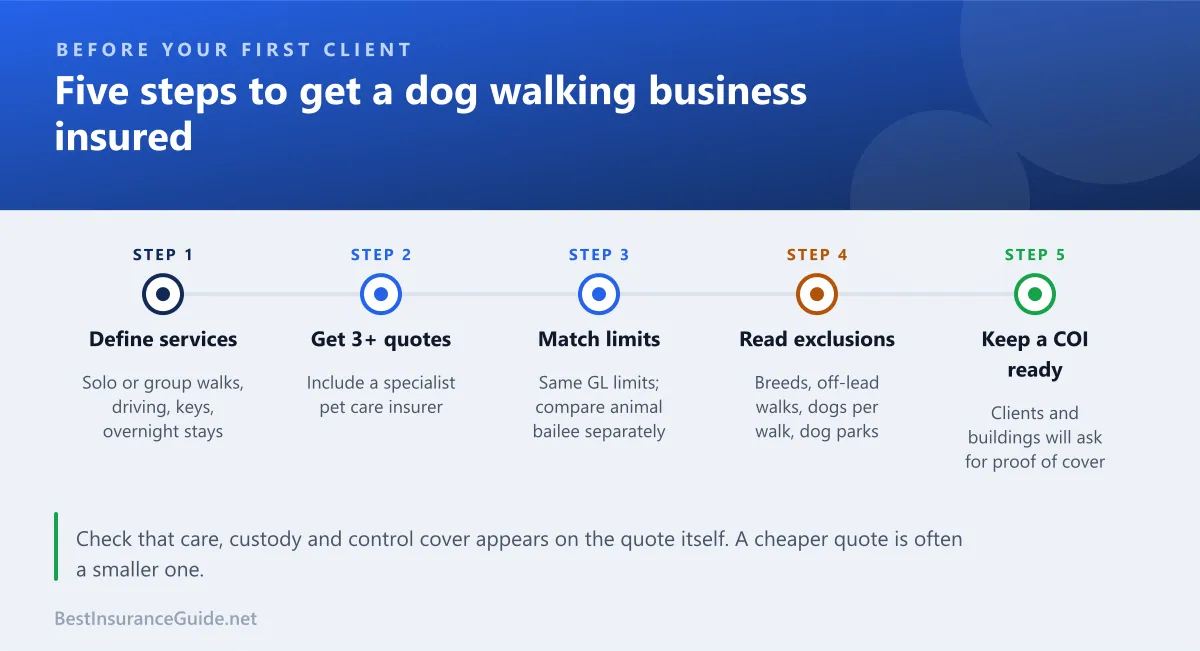
- Write down exactly what you do. Walks only? Group walks? Driving? Home visits with keys? Overnight stays? The answer decides which coverages you need, and an honest description protects you at claim time.
- Get at least three quotes. Include at least one specialist pet care insurer, since they are more likely to bundle animal bailee cover and bonding in a single policy.
- Compare the same limits. Line up general liability at the same occurrence and aggregate limits, and compare the animal bailee limit and the deductible separately. A cheaper quote is often a smaller one.
- Check the exclusions. Look for breed restrictions, off-lead exclusions, limits on the number of dogs at once and anything about dog parks.
- Keep a certificate of insurance ready. Clients, apartment buildings and property managers will ask for it. Most insurers let you download one, or add a client as an additional insured, online.
If you are setting up as a sole trader, our guide to business insurance for sole proprietors covers the wider picture, and the business insurance checklist is a useful final pass.
Habits that prevent claims, and help when one happens
Insurance pays after something goes wrong. These habits make it less likely, and make claims smoother when they happen:
- Use a meet-and-greet and a written service agreement that records the dog’s health, behaviour, vet details and emergency permissions.
- Check harnesses, collars and leads at every pick-up. Equipment failure is one of the most common causes of escapes.
- Keep group sizes manageable, and do not mix dogs that have not been introduced.
- Respect local leash laws. Walking a client’s dog off lead where it is not allowed can complicate a claim.
- Write things down when something happens. Take photos, get witness names, keep the vet invoice and notify your insurer promptly.
When you might need more cover
As a business grows, a few situations call for more than the basics:
- Many client contracts or a large building portfolio may require higher limits than $1 million. An umbrella policy can raise limits across your liability cover. See business umbrella insurance.
- Boarding or daycare at your premises brings property, premises liability and much larger animal bailee exposures.
- Expensive equipment, such as a fitted-out dog van, may need its own property or inland marine cover.
A note on scope
This guide explains dog walking insurance in general terms. Coverage names, endorsements, limits and prices vary by insurer and by state, and the cost figures above are averages from a third-party dataset rather than quotes. Workers’ compensation requirements in particular depend on your state’s law.
Nothing here is legal or tax advice. For your own business, confirm details with a licensed agent or your state insurance department. This site is independent and is not affiliated with any insurer or walking platform.
Related reading
Dog bite liability insurance covers how bites are handled under homeowners and renters policies, which is the other side of the claims a walker may face. Business insurance by trade compares the core coverages across other small service businesses, and accident-only pet insurance is worth sharing with clients whose own dogs are uninsured.