Pet Insurance in Montana: A New State Law, Porcupines and Long Drives to the ER
Pet insurance in Montana: the 2025 Montana Pet Insurance Act caps waiting periods at 30 days and bans them for accidents. Local risks, costs and how to buy.

Table of contents
Montana is a big state with a lot of dogs, a lot of wildlife and not many emergency vets per square mile. That combination shapes which pet insurance coverage actually earns its money here.
It also has something most states do not: its own pet insurance law. In 2025 the Legislature passed the Montana Pet Insurance Act, and it changes several things buyers in other states have to watch out for. Waiting periods are the biggest one.
This guide covers the law in plain English, the Montana-specific risks that drive claims, what affects your premium, and how to buy well. This site is independent and not affiliated with any insurer. Legal provisions are taken from the text of House Bill 78 as enrolled. Your own policy and the Commissioner of Securities and Insurance are the final word.
The Montana Pet Insurance Act in plain English
Montana’s law was introduced at the request of the State Auditor, who serves as Montana’s insurance commissioner, and signed in April 2025. It is based on the National Association of Insurance Commissioners’ Pet Insurance Model Act, the template a growing number of states have used to standardise pet insurance. Montana did not adopt the model word for word, and it added its own training requirement for agents.
Here is what it means for you as a buyer.
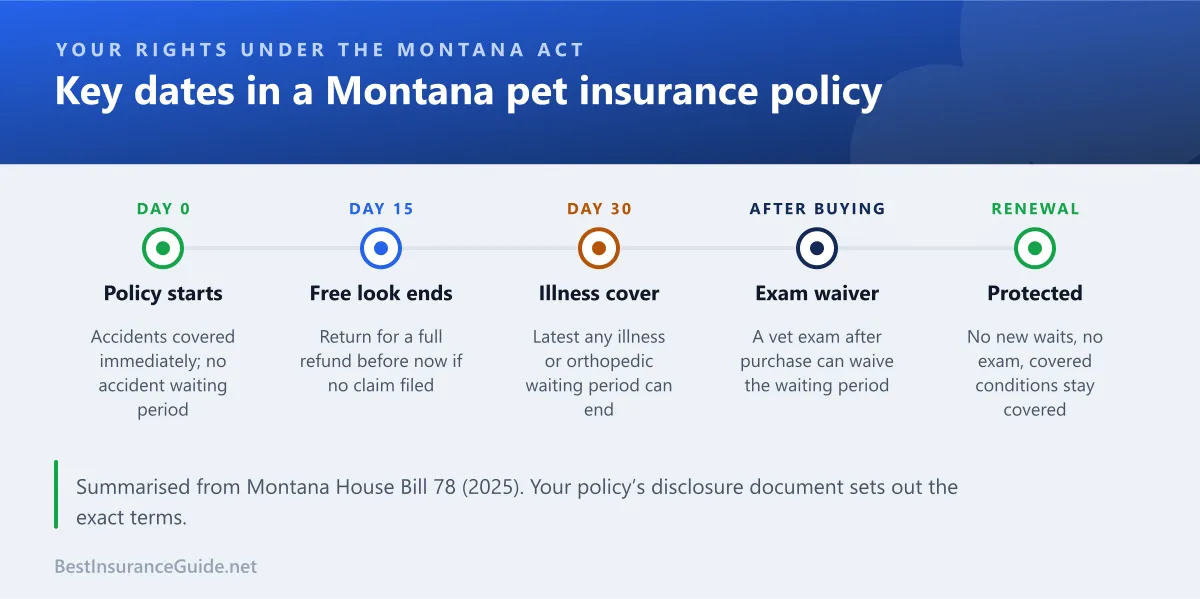
Waiting periods are short, and accidents have none
This is the headline. Under the Act:
- Waiting periods for accidents are prohibited. If your dog is hit by a car or swallows a sock on day two, an accident policy cannot refuse because you are “still in the waiting period.”
- Waiting periods for illnesses and orthopedic conditions not caused by an accident cannot exceed 30 days.
- Any insurer that uses a waiting period must let you waive it by having a veterinary examination after you buy. You pay for that exam unless the policy says the insurer will.
- Waiting periods must be clearly disclosed before you buy, and they cannot be applied to renewals.
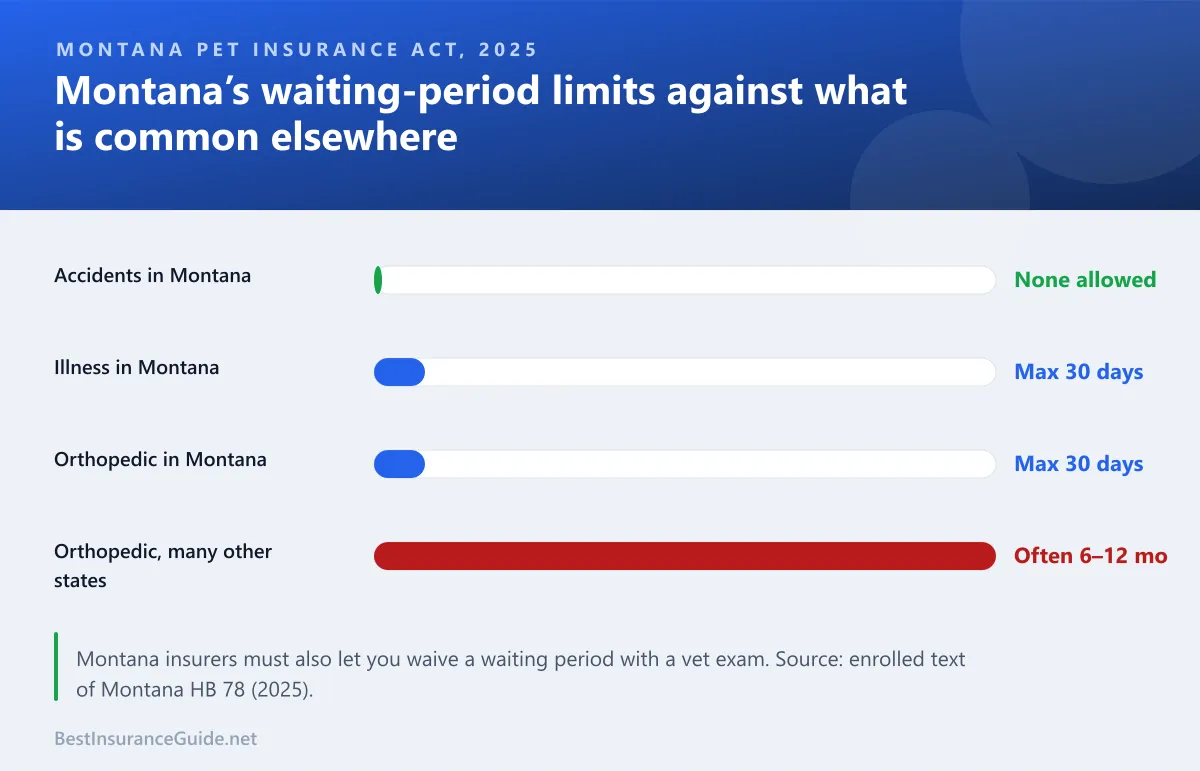
Why this matters so much: in many states, insurers apply six or twelve months to orthopedic conditions like cruciate ligament tears and hip dysplasia. For an active Montana dog that hikes, hunts and runs, those are exactly the injuries most likely to happen. Montana’s 30-day cap closes a gap that catches a lot of owners elsewhere. Our guide to pet insurance waiting periods explains how they work in other states.
A 15-day free look
You have 15 days from receiving your policy to return it for a full premium refund, provided you have not filed a claim. You do not need to give a reason. The insurer must send the refund within 30 days of receiving the returned policy.
Use those 15 days. Read the declarations page, the exclusions and the “Insurer Disclosure of Important Policy Provisions” document the Act requires insurers to provide.
A clear definition of “pre-existing”
The Act defines a pre-existing condition as one where, before the policy started or during a waiting period:
- a veterinarian gave medical advice about it,
- the pet received treatment for it, or
- verifiable sources show the pet had signs or symptoms directly related to it.
Two protections follow. The insurer carries the burden of proving that a pre-existing exclusion applies to a claim. And a condition that was covered under your policy cannot become pre-existing at renewal. Once your dog’s allergies are covered, the insurer cannot reclassify them next year.
Renewal without a vet exam
Insurers cannot require a veterinary examination to renew your policy.
Wellness plans must be kept separate
Routine-care plans covering vaccines, dental cleanings and check-ups are called wellness programs, and the Act says they are not insurance. They cannot be marketed as insurance, they cannot be required to buy a policy, and their cost and terms must be shown separately. If you are offered both, you should be able to see exactly what each costs. Our guide to whether pet insurance covers vaccines explains why routine care sits outside core cover.
Trained agents
Agents selling pet insurance in Montana must complete two hours of training covering pre-existing conditions, waiting periods, the difference between insurance and wellness programs, and related topics.
The Montana risks that drive claims
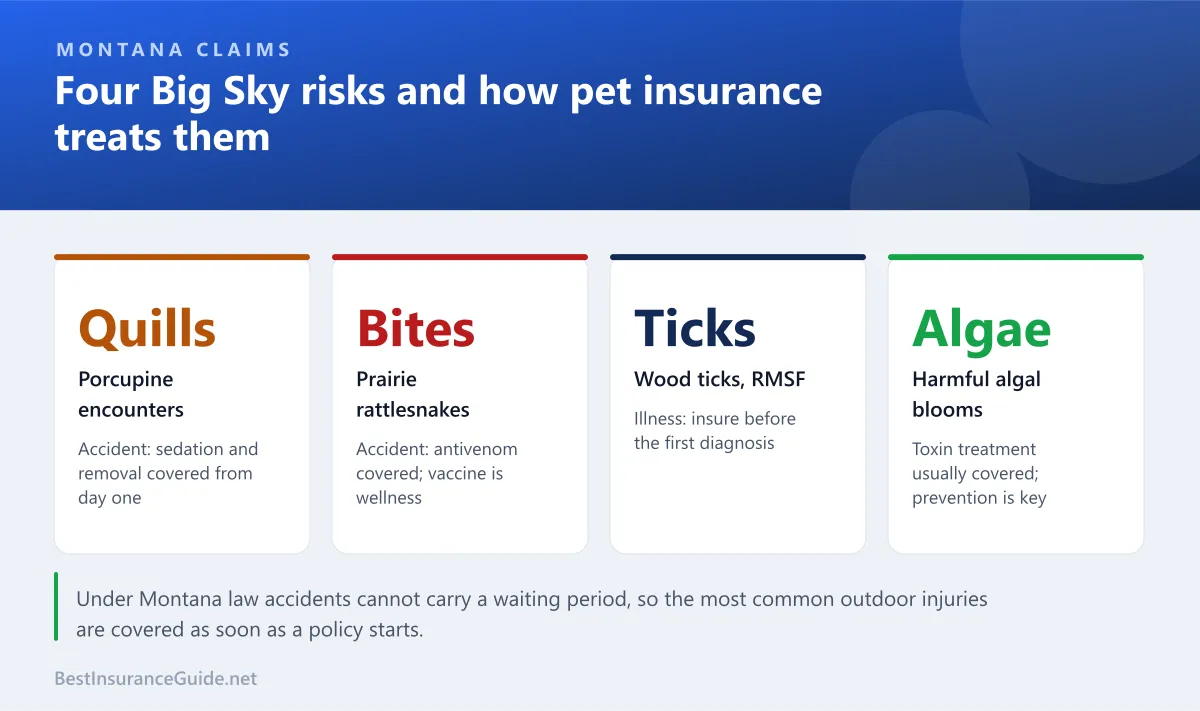
Porcupines
Ask any Montana vet about the most predictable summer and fall visit, and porcupine quills will be near the top. Dogs rarely learn from the first encounter. A face full of quills usually means sedation or general anaesthesia, and quills that break off can migrate and need further procedures.
Quill removal is an accident, covered by both accident and illness and accident-only policies. Under Montana law there is no accident waiting period, so a dog insured last week is covered.
Rattlesnakes
Prairie rattlesnakes are found across much of eastern and central Montana, particularly in lower, drier country. A bite can mean emergency treatment, antivenom and hospitalisation, and antivenom alone is expensive.
Bite treatment is an accident and covered. The rattlesnake vaccine is preventive care and would only be reimbursed through a wellness program.
Ticks
Montana has a direct connection to tick-borne disease: Rocky Mountain spotted fever was first studied in the Bitterroot Valley. The Rocky Mountain wood tick is common in spring, and dogs can also develop tick paralysis, which usually resolves once the tick is removed but can need hospital support.
Tick-borne disease is an illness. Montana caps the illness waiting period at 30 days, but the bigger point is timing. Once a tick disease is diagnosed, any new insurer will treat it as pre-existing. Insure before the first diagnosis, not after.
Harmful algal blooms
Montana DEQ regularly issues warnings for harmful algal blooms on lakes and reservoirs, including Canyon Ferry Reservoir. Blooms caused by cyanobacteria can look like pea soup, spilled paint or grass clippings, and can sicken or kill dogs that swim in or drink the water.
Treatment for toxin exposure is generally covered as an accident or illness. Prevention is far better: if water looks wrong, keep your dog out, and rinse them with clean water immediately if they get in.
Winter, wildlife and hunting season
The rest of the Montana claim profile reads like a list of outdoor hazards. It includes frostbite and hypothermia, antifreeze poisoning, cheatgrass awns in ears, paws and noses, encounters with skunks, moose, coyotes and wolves, and injuries to hunting dogs in rough country. Almost all of these are accidents, covered from day one under Montana law.
What sets the price in Montana
Pet insurance reimburses a share of your actual vet bill, so premiums follow local veterinary costs. That gives Montana two pricing realities:
- The growth towns, including Bozeman, Missoula, Billings, Kalispell and Helena, have more specialist and emergency capacity and higher clinic costs. Premiums tend to be higher.
- Rural Montana has lower routine clinic costs but long distances to emergency and specialty care. A serious case may mean a long drive and a referral hospital bill that looks nothing like your local vet’s prices.
That second point is the one to plan for. If your dog needs surgery at a referral hospital, the bill reflects that hospital’s prices, not your hometown’s. Choose an annual limit that could absorb a specialist surgery plus hospitalisation, not just a routine illness.
Montana also does not have its own veterinary college. Montana State University in Bozeman hosts the first year of a regional program with Washington State University, through which a limited number of Montana students train each year. Like many rural states, Montana has felt the effects of a tight veterinary workforce, which is one more reason to treat emergency costs, not routine ones, as the risk worth insuring.
Your premium also depends on your pet’s species, breed and age, and on the deductible, reimbursement percentage and annual limit you choose. Our pet insurance cost guide explains how those trade against each other.
Worked example: a torn cruciate on day 45
Take a three-year-old Labrador that hunts upland birds every fall. The owner buys an accident and illness policy in August. In late September, 45 days later, the dog pulls up lame after a long day in the field and is diagnosed with a torn cranial cruciate ligament. It is not the result of a single identifiable accident, so the insurer treats it as an orthopedic condition. The recommended surgery at a referral hospital is quoted in the thousands of dollars.
In a state without a cap, a policy with a six- or twelve-month orthopedic waiting period would refuse the claim outright. Worse, the knee would now be pre-existing for any other insurer too. If the policy has a bilateral clause, the other knee could be excluded as well.
In Montana, the orthopedic waiting period could not have been longer than 30 days. By day 45 it has run, so the claim is assessed like any other covered illness. The insurer pays its reimbursement percentage after the deductible, up to the annual limit, and subject to the policy’s other terms.
The difference is not the price of the policy. It is whether the policy pays for the single most expensive orthopedic surgery a sporting dog is likely to need.
How to buy pet insurance in Montana
- Insure early. Every condition diagnosed before you buy is excluded. A young, healthy pet has the cleanest record.
- Get at least three quotes using the same deductible, reimbursement and limit, so you are comparing price for the same cover.
- Read the disclosure document. Montana requires insurers to give you a summary of important policy provisions. Check the waiting periods, the definition of pre-existing, and any bilateral condition clauses. Bilateral clauses treat a problem in one knee as pre-existing for the other.
- Ask about waiving the waiting period. Montana insurers must offer a vet-exam waiver. If you are booking a check-up anyway, it may cost little to use.
- Use your 15-day free look to read everything before it matters.
- Keep wellness separate in your head. Decide on insurance first, then decide whether a wellness program is worth its separate price.
- Keep records. Vet invoices and medical notes make claims faster.
If cash flow is the immediate problem rather than insurance, see our guide to vets that take payment plans.
Common mistakes Montana owners make
- Waiting until after the first tick-borne illness or limp. It becomes pre-existing, and the Act’s protections do not change that.
- Choosing a low annual limit in a rural area. The bill that matters is the referral hospital bill, not the local one.
- Assuming the wellness add-on is insurance. Under Montana law it is explicitly not.
- Skipping the disclosure document. It is there to show you the terms that cause claim denials.
- Not checking a hunting dog’s activities. Most policies cover working and hunting activity for pets, but confirm there is no exclusion for your dog’s use.
Where to complain
If you have a problem with a pet insurer, start with the insurer’s complaints process. If that does not resolve it, contact the Montana Commissioner of Securities and Insurance. The Act requires insurers to give you the Commissioner’s mailing address, toll-free number and website when the policy is delivered.
Comparable states
Pet insurance in Utah shares Montana’s active dogs, cheatgrass and orthopedic injury profile. Pet insurance in Washington State is another NAIC-model state, plus salmon poisoning disease. Pet insurance in Colorado covers a similar mountain lifestyle with a much larger metro market.
A note on scope
This guide summarises the Montana Pet Insurance Act from the enrolled text of House Bill 78 and describes typical policy treatment of common claims. It is not legal advice, and individual policies vary. Rules may be supplemented by regulations from the Commissioner of Securities and Insurance, so check the Commissioner’s website for the current position.
Clinical questions, such as whether your dog needs the rattlesnake vaccine or tick prevention, are for your veterinarian. This site is independent and not affiliated with any insurer.
Related reading
Pet insurance by state links to every state guide on this site. Dog life insurance covers mortality insurance for valuable working and hunting dogs, which is common in ranch country.