Pet Insurance for Senior Cats: Is It Still Worth It After 10?
Pet insurance for senior cats: age limits, why chronic conditions decide everything, the curable pre-existing rule, costs and alternatives.

Table of contents
Most cats reach ten looking much as they did at five. That is what makes the senior years deceptive. The diseases that become common after ten, including kidney disease, an overactive thyroid and arthritis, tend to arrive quietly, and they are often found on a routine blood test or X-ray before the owner has noticed anything wrong.
For pet insurance, that quiet arrival is the whole story. Whether senior cat insurance is worth it depends far less on your cat’s age than on what is already in its medical record.
This guide explains how insurers treat older cats, why chronic conditions decide almost everything, what the policy small print says about “curable” conditions, what to expect on price, and the alternatives if full cover no longer makes sense.
This site is independent and not affiliated with any insurer. Clinical figures are drawn from veterinary guidelines and research, and policy terms are quoted from insurers’ published sample policies. Clinical questions about your own cat belong with your veterinarian.
When is a cat a “senior”?
The 2021 AAHA/AAFP Feline Life Stage Guidelines, written by the American Animal Hospital Association and the American Association of Feline Practitioners, define four stages:
- Kitten: birth to 1 year
- Young adult: 1 to 6 years
- Mature adult: 7 to 10 years
- Senior: 10 years and older
The guidelines recommend vet visits at least every six months for senior cats, and every four months for healthy cats over 15. They also note that some cats are better treated as senior from around eight, depending on breed and health.
Those extra visits are good medicine. They also mean more blood tests, and more chance that something gets written in the record. That has a direct effect on insurance, as the next sections explain.
The four conditions that shape senior cat insurance
Chronic kidney disease
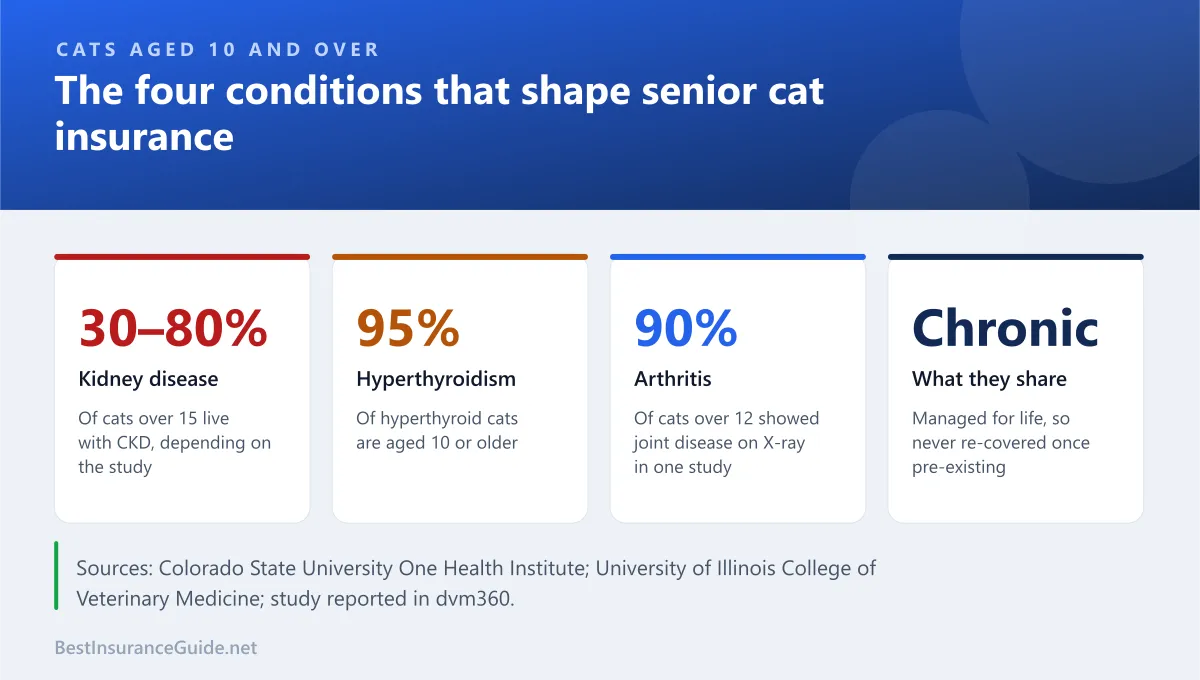
According to Colorado State University’s One Health Institute, an estimated one-third of cats develop chronic kidney disease (CKD) in their lifetime, and 30% to 80% of cats over 15 live with it, depending on the study. It is described as the leading cause of death in geriatric cats.
CKD is managed rather than cured. Treatment typically includes prescription kidney diets, fluid therapy, medications for blood pressure, nausea or phosphate, and regular monitoring bloods, often for years. It is an expensive condition precisely because it goes on for so long.
Hyperthyroidism
According to the University of Illinois College of Veterinary Medicine, 95% of cats with hyperthyroidism are 10 or older. Classic signs are weight loss despite a big appetite, a fast heart rate and restlessness. Treatment options include daily medication, surgery, a prescription low-iodine diet, or radioactive iodine therapy at a specialty clinic. Radioactive iodine is often curative, but it carries a significant upfront cost.
Arthritis (degenerative joint disease)
Arthritis in cats is common and badly under-recognised. One study reviewed in dvm360 found radiographic evidence of degenerative joint disease in 90% of cats over 12, yet the condition was rarely mentioned in their medical records. Cats hide pain. They stop jumping onto the counter, groom less and sleep more, and owners put it down to age.
Arthritis management can include pain medication, joint injections, weight management and environmental changes, often for the rest of a cat’s life.
Dental disease
Dental disease affects cats of all ages and becomes more advanced with time. In older cats, extractions under anaesthesia are common, and anaesthesia itself needs more pre-operative testing. Our guide to dog dental insurance explains the line insurers draw between dental disease, which can be covered, and routine cleaning, which is not, and the same logic applies to cats.
Diabetes, high blood pressure and cancer, particularly lymphoma, are also more common in older cats.
Why the same procedure costs more in an older cat
Even a straightforward procedure tends to cost more for a senior cat, and that matters when you choose an annual limit.
More testing before anaesthesia. Vets usually want up-to-date bloodwork, and often blood pressure and urine tests, before anaesthetising an older cat, so they can spot kidney, thyroid or heart problems that change how anaesthesia is managed.
More support during and after. Intravenous fluids, closer monitoring and longer recovery times are common for seniors, especially those with reduced kidney function.
More things found at once. A dental procedure in a 13-year-old may turn up several teeth needing extraction, and a work-up for weight loss may uncover two conditions rather than one.
None of this means senior care is poor value. It means the bill for an older cat is often a combination of diagnostics, procedure and aftercare rather than a single line item. A policy’s annual limit and any per-condition limits should be set with that in mind.
Why “chronic” is the most important word in your policy
Every pet insurer excludes pre-existing conditions, meaning anything that showed signs, was noted or was treated before cover began or during a waiting period. That is true at any age.
Some insurers soften that rule for curable conditions. Spot’s published sample policy, for example, says that if a pre-existing condition is curable, has been cured, and your pet has been free from treatment and symptoms for 180 days, it is treated as a new occurrence. But the same policy is explicit that this does not apply to chronic conditions, which it defines as conditions that can be treated or managed, but not cured.
Now look back at the four conditions above. Kidney disease, arthritis and, for many cats, hyperthyroidism managed with medication are chronic. Once any of them is in your cat’s record, it is excluded, and the curable-condition rule will not bring it back.
This is why timing matters so much more for senior cats than for young ones. A young cat’s pre-existing conditions are often one-off events, like a broken toe or a stomach upset, that a curable-condition rule can eventually forgive. A senior cat’s are usually lifelong.
The senior bloodwork paradox
Here is the uncomfortable trade-off. Your vet will rightly recommend senior screening: blood tests, urine tests and blood pressure checks, ideally from around ten. Early detection of kidney disease or hyperthyroidism genuinely improves outcomes.
But a borderline kidney value or a slightly raised thyroid level, once written in the record, becomes the start of a pre-existing condition.
The answer is not to skip the screening. It is to put insurance in place first, and wait out the illness waiting period, before the first senior panel. Do not put off a vet visit for a cat that seems unwell because of insurance. A sick cat needs a vet, whatever the policy implications.
Worked example: two 11-year-old cats
Two indoor cats, Biscuit and Pepper, are both 11.
Biscuit is enrolled at 11 with a clean record. A year later, a routine senior panel picks up hyperthyroidism. Her owner chooses radioactive iodine therapy. In this illustration the bill is $2,000. Her policy has a $250 deductible and 80% reimbursement. The insurer pays 80% of the $1,750 above the deductible, which is $1,400, and her owner pays $600.
Pepper’s owner waits. At her 11-year check, a raised thyroid level is noted, and only then does her owner buy a policy. The hyperthyroidism is pre-existing. The same $2,000 treatment is entirely her owner’s cost, as is any related care in future.
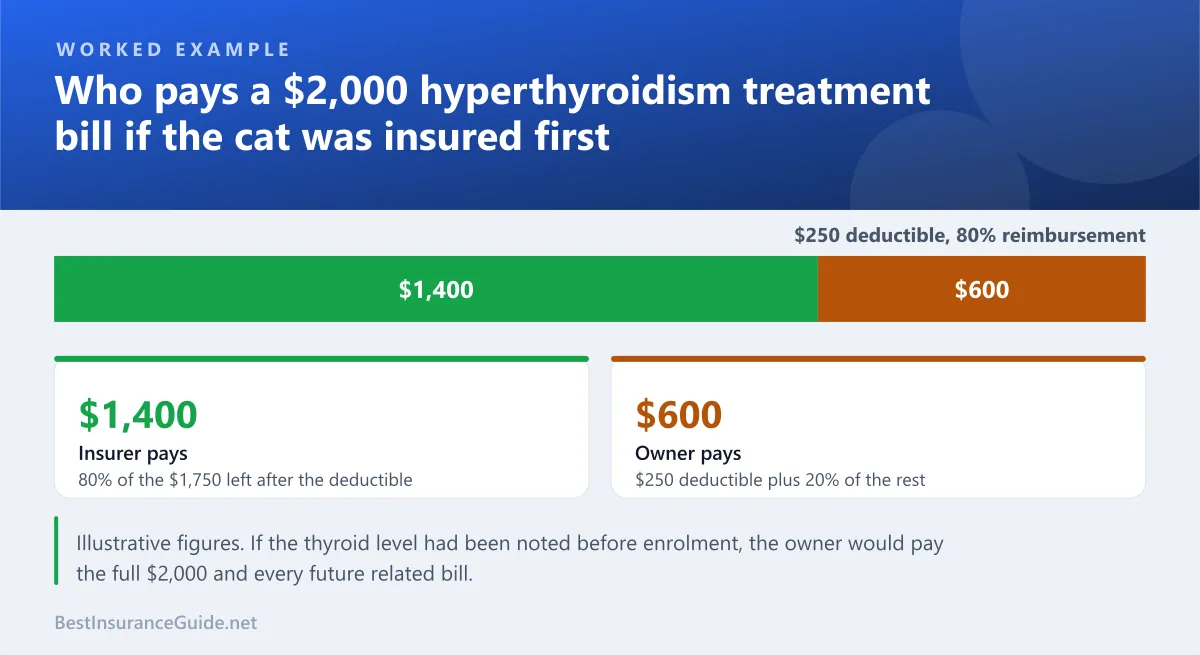
Illustrative figures only. Real costs vary widely by clinic, region and treatment.
The two policies might cost the same. The difference is one appointment’s worth of timing.
Age limits: can you still enrol an older cat?
Practices vary.
- Some insurers have no upper age limit. CNBC’s 2026 review of Spot, for example, notes that pets must be at least eight weeks old but there is no upper age limit for enrolment.
- Others stop accepting new cats at a set age, or accept older cats only for some plan types, such as accident-only.
- Once enrolled, most insurers renew regardless of age, but premiums usually rise at each renewal.
Check each insurer’s current enrolment rules directly, because they change.
What senior cat insurance costs
Premiums rise with age because claims rise with age. Expect a senior cat to cost noticeably more to insure than a young adult, and expect the premium to reprice upward at most renewals.
You control the price mainly through three levers:
- Deductible. A higher deductible lowers the premium. For a senior cat, think about whether you would rather pay more upfront each year or more at claim time.
- Reimbursement percentage. Dropping from 90% to 70% lowers the premium but raises your share of every bill.
- Annual limit. A lower limit is cheaper, but a chronic condition can use up a low limit quickly.
Our pet insurance cost guide explains how these trade off, and cat insurance explained covers how cat premiums behave across a whole life.
Read the small print on death and end-of-life cover
Some policies include a death benefit or end-of-life cover, and the terms for older pets can be restrictive. Fetch’s published sample policy, for example, includes a benefit for death from an accident, injury or illness, but excludes death resulting from illness for any pet aged six or older. Spot’s sample policy defines end-of-life expenses as euthanasia, burial and cremation. Do not assume an end-of-life benefit will apply to a senior cat until you have read the wording.
Is it worth it? A decision guide
It is likely worth it if:
- Your cat’s record is clean, or close to it.
- A sudden $2,000 to $5,000 bill would be hard to pay.
- You would choose treatments like radioactive iodine, specialist referral or hospitalisation if your vet recommended them.
It is less likely to be worth it if:
- Your cat already has kidney disease, hyperthyroidism or arthritis on record. Those are the conditions most likely to cost you, and they will be excluded.
- You have savings set aside that could absorb a large bill.
- You would choose palliative or conservative care in most scenarios.
Alternatives to full cover for an older cat
Accident-only insurance. Cheaper than accident and illness cover, and still pays for falls, swallowed objects, injuries and poisonings. It will not cover kidney disease or hyperthyroidism, but it protects against the emergencies that arrive with no warning. See accident-only pet insurance.
A dedicated vet fund. Put the premium you would have paid into a separate savings account each month. It works best if you start early and do not dip into it.
Wellness plans. These budget for routine senior screening and dental care. They are not insurance and will not cover a serious illness.
Payment plans and vet credit. If a large bill arrives, vets that take payment plans and vet credit cards can spread the cost.
How to buy senior cat insurance well
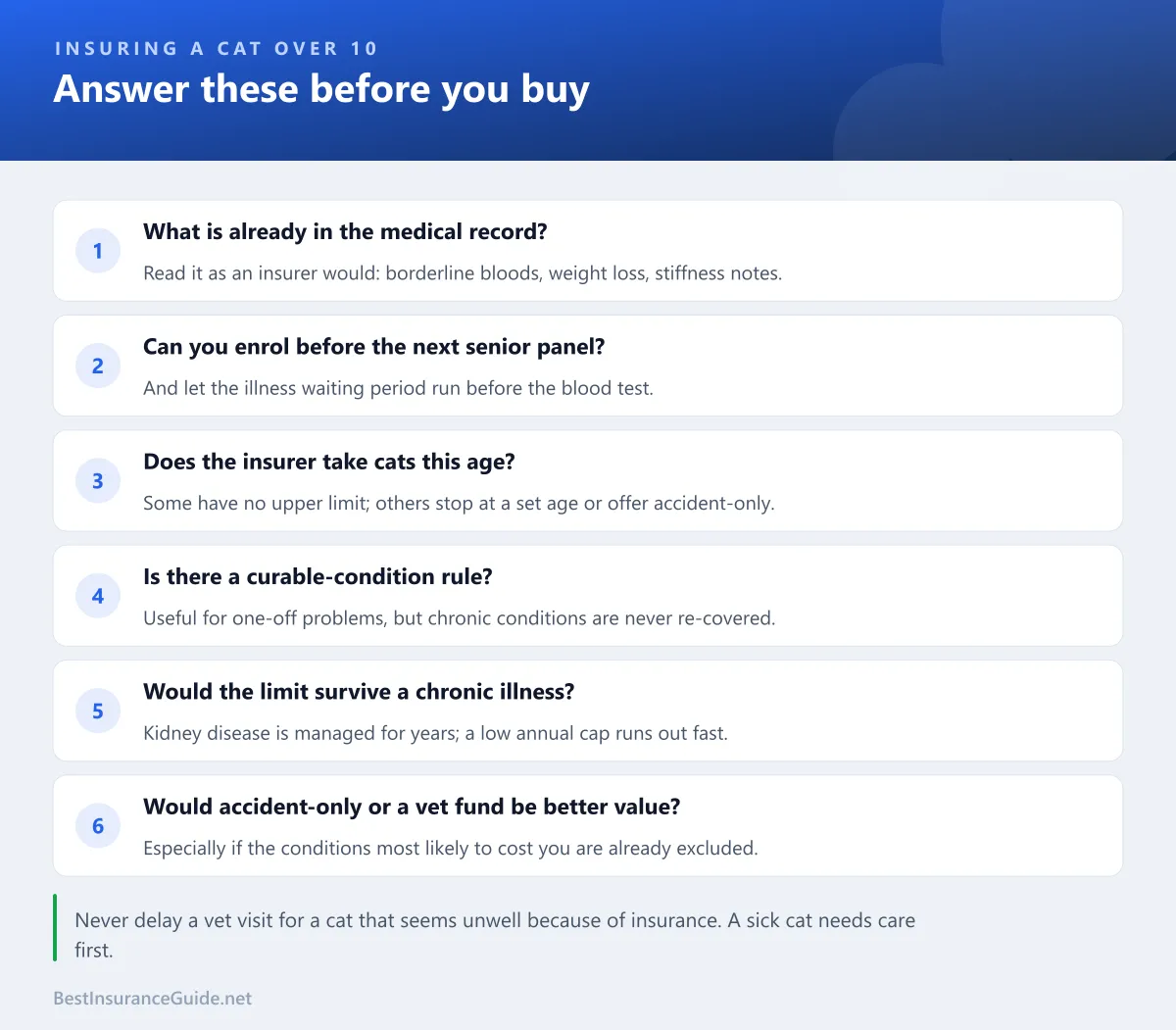
- Get your cat’s full medical records and read them as an insurer would. Note anything that could be treated as a sign of a condition.
- Enrol before the next senior panel if you can, and wait out the illness waiting period.
- Get at least three quotes at the same deductible, reimbursement and limit.
- Ask each insurer in writing how they would treat anything in the record, and whether they have a curable-condition rule.
- Check enrolment age limits and any limits on plan types for older cats.
- Read the end-of-life and death benefit wording, if any.
- Set your annual limit for a chronic condition, not a one-off illness.
A note on scope
Prevalence figures in this guide come from published veterinary sources and vary by study. Policy terms are quoted from published sample policies and may differ in your state and over time. The worked example uses illustrative costs, not quotes. Nothing here is veterinary, legal or financial advice.
This site is independent and is not affiliated with any insurer.
Related reading
Dog life insurance explains end-of-life cover and mortality insurance in more detail. Pet insurance that starts immediately covers waiting periods, which matter most when you are racing the next senior blood test.