Pet Insurance Cost Guide: What You'll Pay and What It Covers
Pet insurance runs $15-$80 a month and rises every year your pet ages. Lifetime cost worked through, what's excluded, and whether it's worth it.

Table of contents
Pet insurance is genuinely useful and genuinely oversold, often in the same conversation.
It’s useful because veterinary medicine can now do things it couldn’t twenty years ago: chemotherapy, orthopaedic surgery, MRI diagnostics. It’s oversold because the marketing implies it covers everything, and it doesn’t come close.
Here’s what it actually costs across a pet’s life, what’s excluded, and how to work out whether it’s the right call for you specifically.
What it costs
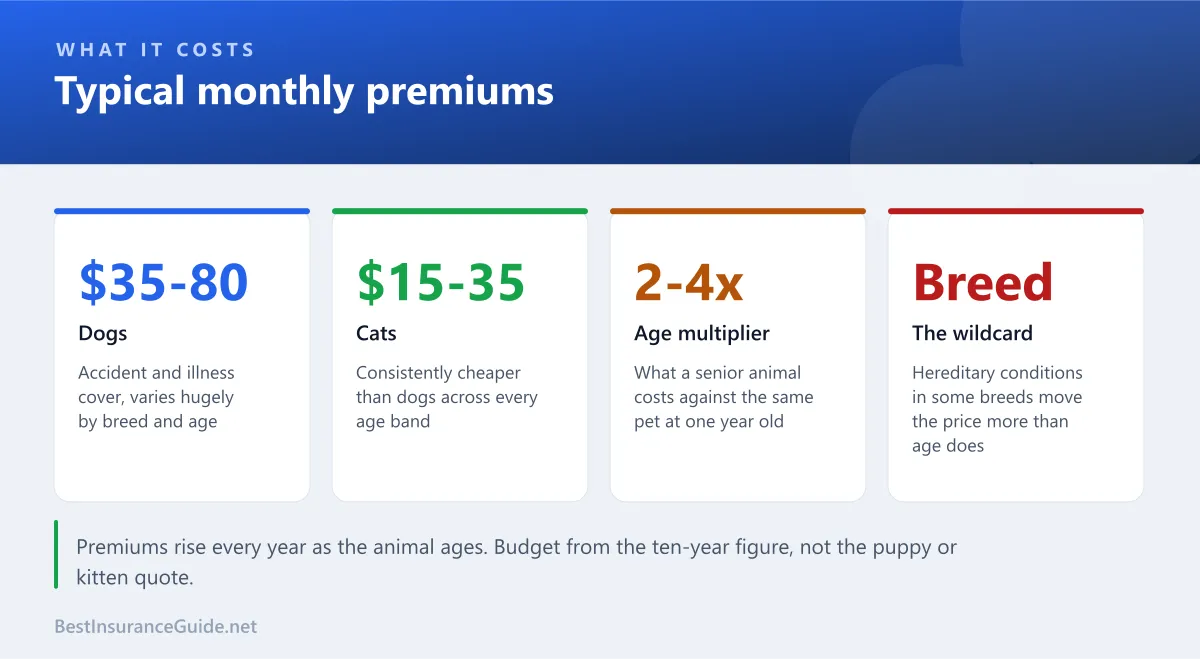
Those are starting figures, and the starting figure is the number people budget from. It’s also the least useful one, because pet insurance has a characteristic almost no other consumer insurance has: the premium rises every single year, automatically, because the risk genuinely rises every year.
Worked example: a dog’s whole life
A medium-breed dog insured at 12 weeks. $5,000 annual limit, $250 deductible, 80% reimbursement.
| Age | Monthly premium | Annual cost |
|---|---|---|
| 1 | $34 | $408 |
| 3 | $42 | $504 |
| 5 | $56 | $672 |
| 7 | $78 | $936 |
| 9 | $104 | $1,248 |
| 11 | $142 | $1,704 |
| 13 | $186 | $2,232 |
| Lifetime total | ~$13,400 |
Someone budgeting from the $34 figure is planning around $5,300 across thirteen years. The real number is closer to $13,400, and more than half of it falls in the last four years.
That back-loading is the crux of the whole product. Premiums climb fastest exactly when the pet becomes most likely to need care, which is precisely when people start looking at the bill and considering cancelling. Cancelling at nine, after paying in for nine years, means walking away right before the cover would have earned its keep, and no insurer will write fresh cover on a nine-year-old dog without excluding everything that’s developed.
If you buy pet insurance, budget from the year-ten figure and commit to holding it. A policy you’ll cancel at the first expensive renewal is worse than no policy, because you’ve paid the premiums and kept none of the protection.
What the levels of cover do
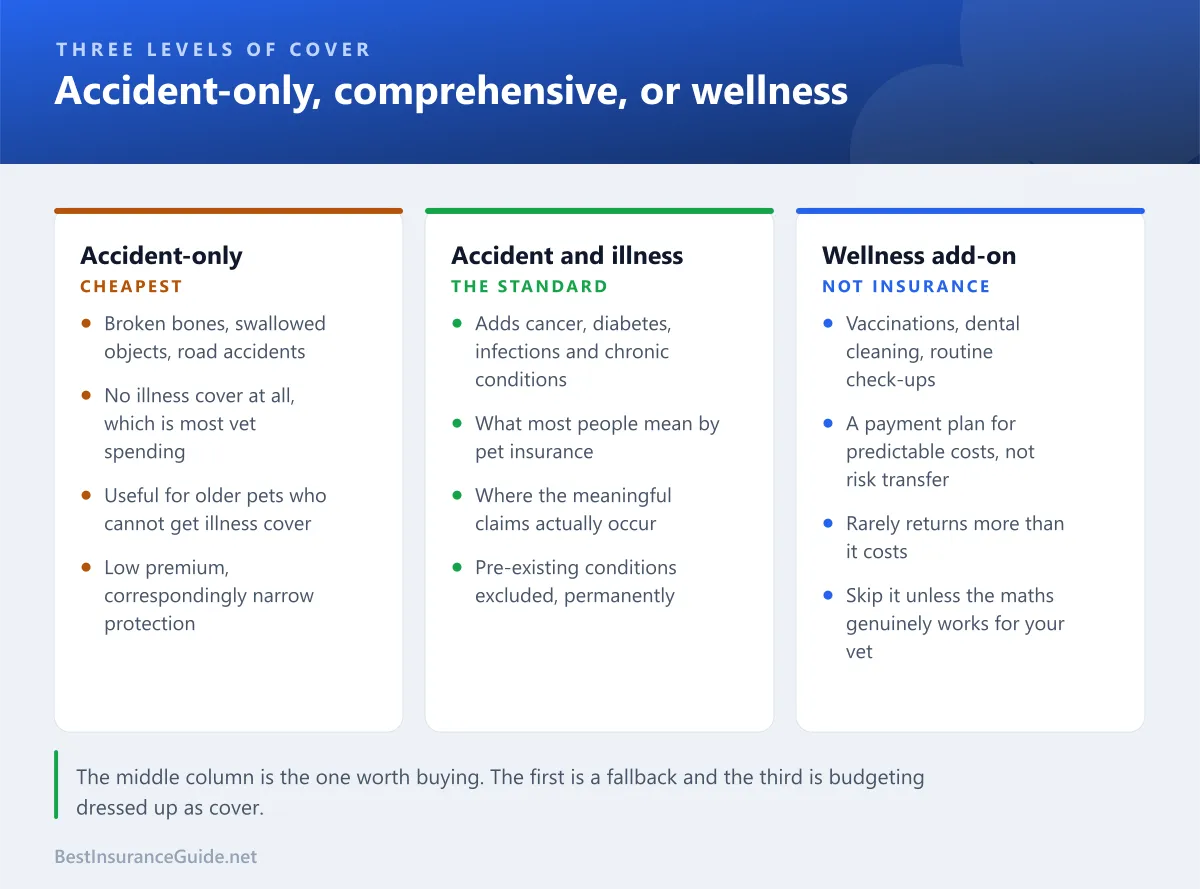
The middle column is the one worth buying. Accident-only sounds like a sensible economy until you look at where vet spending actually goes, which is overwhelmingly illness rather than injury.
Wellness add-ons deserve blunter treatment. They cover vaccinations, dental cleaning and routine check-ups, which are predictable costs you already know are coming. Paying an insurer to smooth a predictable cost means paying their margin for the privilege.
Worked example: does a wellness plan pay?
| Detail | Annual cost |
|---|---|
| Wellness add-on premium | $312 |
| Vaccinations, actual cost | $95 |
| Annual exam | $70 |
| Dental clean, every other year, averaged | $190 |
| Flea and worm treatment | $140 |
| Total covered value | $495 |
| Reimbursed at plan limits | $340 |
Marginally positive here, and that assumes you use every benefit. Many plans cap individual items below actual cost, which is where the arithmetic usually turns negative. Check the per-item caps against your own vet’s prices before buying.
The reimbursement mechanics
Three settings determine what a claim actually pays, and people frequently misjudge how they interact.
Deductible can be annual (once per policy year) or per-condition (once per condition, for its lifetime). Per-condition sounds worse and is often better for a pet with one chronic problem, because you satisfy it once and never again for that condition.
Reimbursement percentage is typically 70%, 80% or 90% of the covered amount after the deductible.
Annual limit caps total payouts per year. Options usually run from $5,000 to unlimited.
Worked example: the same surgery on three policies
A cruciate ligament repair, $6,400 including diagnostics, surgery and rehab.
| Detail | Policy A | Policy B | Policy C |
|---|---|---|---|
| Monthly premium | $38 | $52 | $71 |
| Annual deductible | $500 | $250 | $100 |
| Reimbursement | 70% | 80% | 90% |
| Annual limit | $5,000 | $10,000 | Unlimited |
| Bill | $6,400 | $6,400 | $6,400 |
| Less deductible | $5,900 | $6,150 | $6,300 |
| Reimbursed at % | $4,130 | $4,920 | $5,670 |
| Capped by annual limit | $4,130 | $4,920 | $5,670 |
| You pay | $2,270 | $1,480 | $730 |
Policy A costs $396 a year less than Policy C and left the owner $1,540 worse off on this single claim.
And cruciate repairs frequently affect both legs within a couple of years. Under Policy A’s $5,000 annual limit, a second repair in the same policy year would be almost entirely uncovered.
The annual limit is the setting people economise on and shouldn’t. It’s the one that fails at exactly the wrong moment.
What isn’t covered
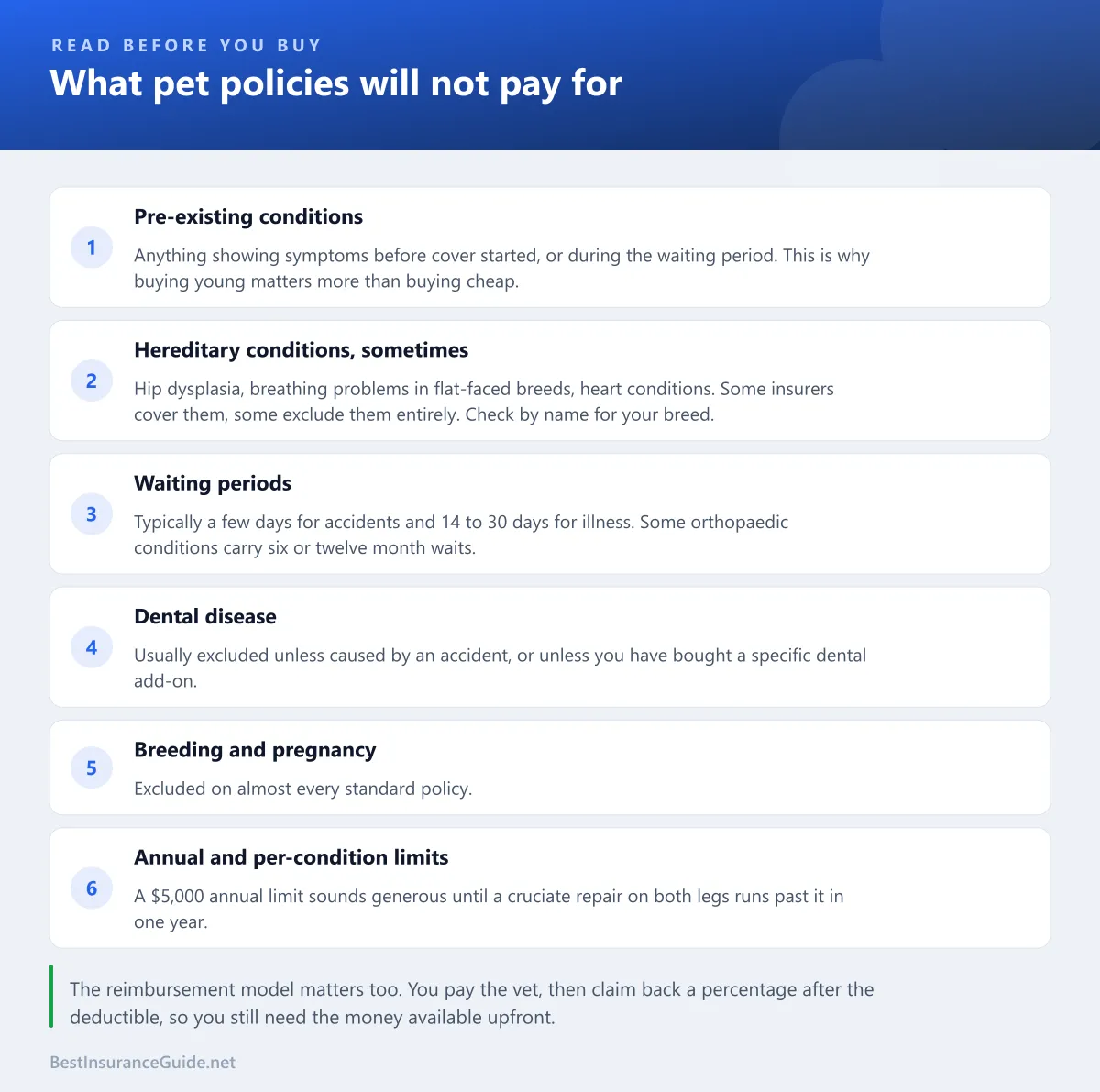
Pre-existing conditions is the exclusion that matters most, and it’s broader than people expect. It isn’t just diagnosed conditions. Symptoms noted in a vet record before cover started can be enough, even without a diagnosis. A limp at eighteen months can exclude joint problems at six years.
This is the whole argument for insuring early. Not because premiums are cheaper, though they are, but because nothing has happened yet that can be excluded.
Hereditary and congenital conditions vary enormously between insurers. Hip dysplasia in larger breeds, breathing problems in flat-faced breeds, heart conditions in certain lines. Some insurers cover these, some exclude them entirely, and for many breeds these are the most likely expensive claims you’ll ever make. Check by name for your specific breed before buying, because a policy excluding your breed’s characteristic problem is close to worthless.
Waiting periods run a few days for accidents and typically 14 to 30 days for illness. Orthopaedic conditions often carry six or twelve month waits, which catches out people who buy after noticing a limp.
Is it worth it?
The honest test is the same as for any insurance: could you absorb the bad outcome from savings?
Worked example: insuring versus self-insuring
Two owners, identical dog, thirteen years.
Owner A buys insurance from twelve weeks. Owner B pays the same amount into a savings account instead.
| Detail | Owner A, insured | Owner B, self-insured |
|---|---|---|
| Total premiums / contributions | $13,400 | $13,400 |
| Growth at 4% | — | ~$17,900 |
| Year 6: foreign body surgery, $3,800 | Pays $610 | Pays $3,800 |
| Year 9: cancer treatment, $11,200 | Pays $1,340 | Pays $11,200 |
| Year 12: chronic medication, $2,400 | Pays $730 | Pays $2,400 |
| Total vet spend from own pocket | $2,680 | $17,400 |
| Total outlay | $16,080 | $17,400 |
| Remaining fund | $0 | ~$500 |
On this claims history insurance wins, modestly. On a healthy dog with $2,000 of lifetime vet costs, Owner B ends with roughly $15,900 in the bank and Owner A has $13,400 of premiums and nothing to show.
Which is exactly what insurance is: you’re not buying an investment, you’re buying the removal of a worst case. The question isn’t which comes out ahead on average. It’s whether you could write an $11,200 cheque in year nine without insurance, because that’s the moment the decision actually gets made.
Self-insuring only works if you genuinely do it. Setting up a dedicated account and funding it monthly is a real strategy. Intending to and not doing it is how people end up choosing between debt and euthanasia in a consulting room, which is the situation this product exists to prevent.
Practical advice
Insure early or not at all. The value is heavily concentrated in buying before anything develops.
Don’t economise on the annual limit. Take a higher deductible or a lower reimbursement percentage before you cut the limit.
Check hereditary cover for your breed by name. For many breeds this determines whether the policy is worth anything.
Read the per-condition versus annual deductible structure. For a pet likely to develop one chronic condition, per-condition is often better.
Expect to hold it for life. Budget from the year-ten premium, not the puppy quote.
Our pet insurance cost calculator estimates premiums by species, breed and age. Run it at your pet’s current age and again at ten years, because the second number is the one that determines whether you’ll still be holding the policy when it matters. Our guide to using insurance calculators covers that technique in more detail.
When to stop paying, and when not to
The hardest decision in pet insurance is not buying it. It is whether to keep it at nine or ten, when the premium has doubled and nothing has been claimed.
The case for keeping it is that claim probability rises exactly as the premium does. Cancelling at ten means paying for a decade of protection and dropping it immediately before the years when it pays. You also cannot go back: everything on the record by then is pre-existing, so a new policy would exclude most of what is likely to happen.
The case for stopping is real where exclusions have accumulated to the point that the policy covers little of what the animal is actually likely to need.
The middle path is the one most people miss. Before cancelling, ask the insurer to re-quote at a higher deductible, a lower reimbursement percentage, or a lower annual limit. A policy at 70% with a $1,000 deductible costs far less than one at 90% with $250, and it still covers the catastrophic year. Crucially it keeps your enrolment date.
Worked example: adjusting rather than cancelling
| Detail | Current policy | Adjusted policy |
|---|---|---|
| Reimbursement | 90% | 70% |
| Annual deductible | $250 | $1,000 |
| Annual limit | Unlimited | $10,000 |
| Monthly premium | $138 | $71 |
| Cover for a $9,000 year | $8,750 | $5,600 |
The adjusted policy costs roughly half and still absorbs most of a bad year. Cancelling saves $71 more a month and absorbs nothing.
Set a reminder to review the policy at ages seven and ten rather than reacting to a renewal notice. Reacting is how good policies get cancelled at the worst moment.
A note on the figures
Premiums and treatment costs in this article are illustrative, drawn from typical ranges rather than from any single insurer’s rates. Actual pricing depends on species, breed, age, your ZIP code and the limits you choose, and veterinary charges differ substantially between practices even within one city.
Breed matters more than most owners expect. Large and giant breeds, brachycephalic breeds and several purebred lines with known hereditary conditions all price well above a mixed-breed animal of the same age, and some insurers exclude specific hereditary conditions for particular breeds outright.
Quote your own animal and postcode, and read the policy wording rather than the summary before relying on any figure here.
Three situations the averages do not describe
The figures above describe a typical dog. Three common situations sit outside them.
Cats cost meaningfully less and get ill differently. Urinary blockage, kidney disease and hyperthyroidism dominate the claim profile rather than the orthopaedic and foreign body claims that drive dog costs, and an indoor cat is not the low-risk animal owners assume. Our guide to cat insurance sets out what the claims actually look like.
Rabbits and other exotics are a thin market for an expensive animal. Few US insurers cover them, while rabbits produce emergencies including gastrointestinal stasis and dental disease that rival dogs for cost and urgency. Our guide to pet insurance for rabbits covers what exotic cover costs and who writes it.
Wellness plans are two different products with one name. An insurer’s wellness rider and a veterinary practice’s wellness plan are not the same thing: one is a cancellable add-on to a policy, the other is a contract with a practice. Our guide to puppy wellness plans explains how to tell them apart and which is worth buying.
The one thing that matters most
If you’re going to insure a pet, do it now rather than later, and pick a policy you can still afford at year ten.
Everything else on this page is optimisation. That one decision is most of the outcome.
Related reading
Switching insurers to save money? Cancel carefully. How to cancel Fetch pet insurance shows the steps for one major insurer.
Ongoing prescriptions are one of the biggest long-term pet costs. See does pet insurance cover medication?.