How to Cancel Fetch Pet Insurance: The Phone Call, the End Date and Your Refund
How to cancel Fetch pet insurance: the number to call, when cancellation takes effect, the 30-day full refund rule and what to check first.

Table of contents
Cancelling Fetch pet insurance comes down to one phone call. What surprises people is the timing. Fetch does not end your policy the moment you hang up. The end date follows a rule written into the policy, and knowing it in advance decides whether you pay for an extra month, and whether you get money back.
This guide covers the call itself, the end-date rule with worked examples, how refunds are calculated, the special case when a pet has died, and what to check before cancelling at all.
This site is independent and not affiliated with Fetch, its administrator Fetch Insurance Services, LLC, or its underwriter, AXIS Insurance Company. Policy terms below are quoted from a Fetch sample policy form, GPTM 050 1125 A, published on Fetch’s website. Contact details come from Fetch’s own help pages. Policies vary by state and over time, so your own policy and declarations page take priority over anything here.
The quick answer
- Call Fetch. Its cancellation help page lists 866-509-0163, Monday to Friday, 9am to 6pm Eastern. Fetch’s sample policy lists 1-866-467-3875 for questions about your policy. Massachusetts residents can also cancel by email, according to Fetch’s help page.
- State the future date you want the cancellation to take effect.
- Expect the end date to be set by the billing-cycle rule, explained below. It may be earlier than the date you asked for.
- Ask for written confirmation of the end date and any refund.
- Check your next statement to make sure no further premium was taken.
What Fetch’s policy says about cancelling
Here is the core of the cancellation section in Fetch’s sample policy, in plain English.
- How: you may cancel at any time by calling and stating the future date you want the cancellation to be effective.
- When it takes effect: on the last day of your billing cycle at the time of the request, or 30 days after it, whichever is sooner.
- No backdating, unless you give written proof that your pet has passed away or is no longer in your possession.
- Refund in the first 30 days: if you notify Fetch within 30 days of the original inception date on your declarations page and have not submitted any claim, Fetch refunds the entire premium.
- Refund after 30 days: Fetch returns the pro rata premium based on the date the policy ends.
- Claims: cancellation is without prejudice to any claim occurring before it takes effect, except in specific situations the policy lists, such as fraud or failing to comply with policy terms.
Fetch’s help page adds a practical note. Expect the call to include an offer to customise your plan, discounts or other options before you cancel. You are free to decline.
What to say on the call
Have your policy number, the policyholder’s name and your pet’s name ready, plus a pen. A short script keeps the call on track:
“Hi, I’d like to cancel my Fetch policy, number [number], for [pet’s name]. I’d like it to end on [date]. Can you tell me the actual effective date under the billing-cycle rule, and whether I’ll receive any refund? Please email me written confirmation of both.”
If you insure more than one pet, say which pets you are cancelling. If you are cancelling because your pet has died, say so at the start, because it changes the date Fetch can use (see below).
If the representative offers a cheaper plan, a discount or a different deductible, it is reasonable to listen. If you have already decided, a polite “Thanks, but I’d like to go ahead with the cancellation” is all you need. Write down the representative’s name and the time of the call.
The end-date rule, explained with examples
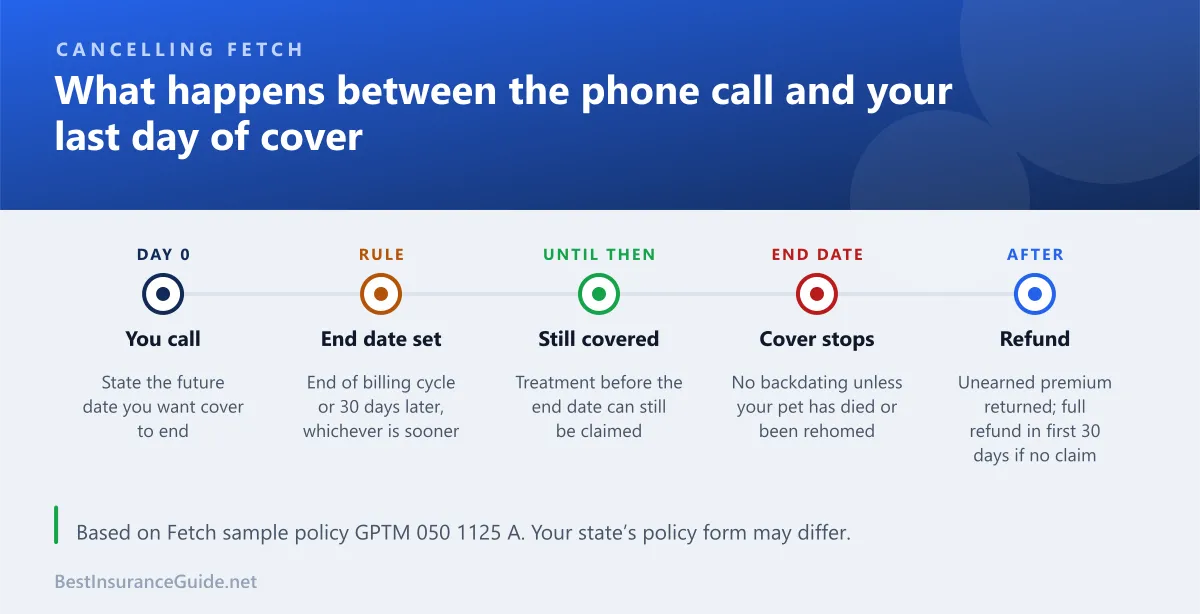
This is the part most cancellation guides skip, and it is the one that affects your money.
Your cancellation takes effect at whichever comes first:
- A: the last day of the billing cycle you are in when you call, or
- B: 30 days after you call.
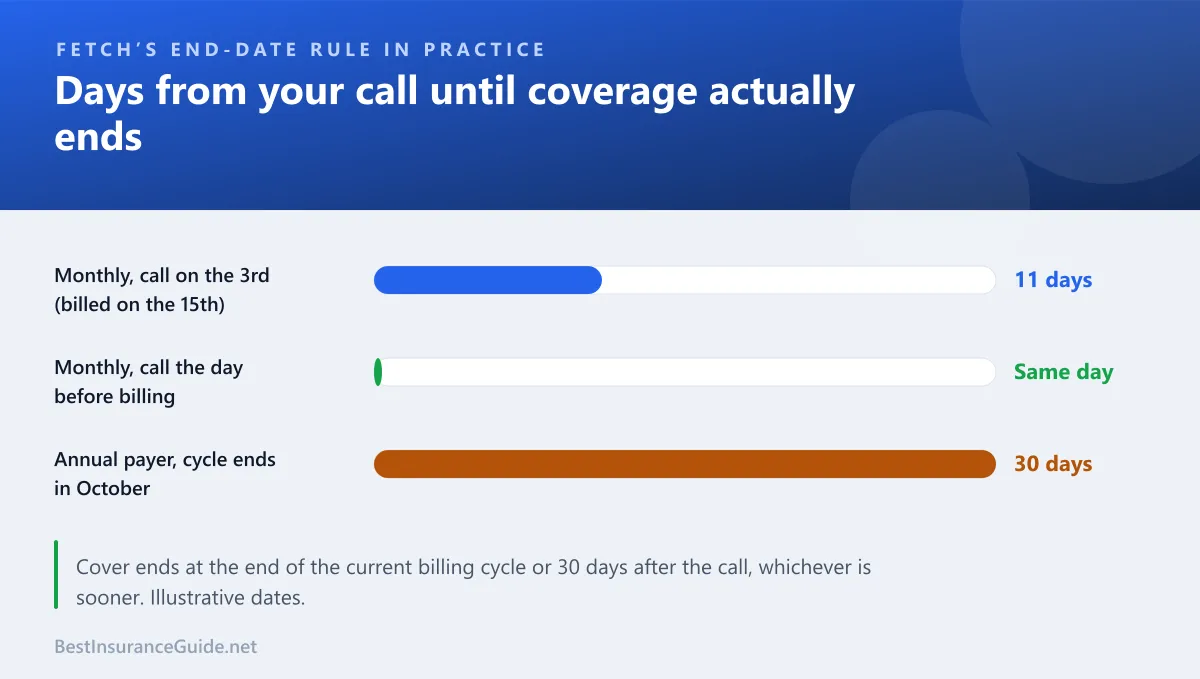
Example 1: monthly payer, calling early in the cycle
Your premium is taken on the 15th of each month. You call on March 3.
- A, end of the current billing cycle: March 14
- B, 30 days after the call: April 2
The sooner date is March 14. Coverage ends then, and you are not billed on March 15.
Example 2: monthly payer, calling the day before billing
Same billing date. You call on March 14.
- A: March 14
- B: April 13
Coverage ends March 14, so you avoid the next payment. Timing your call just before your billing date means the end date lines up with the premium you have already paid.
Example 3: annual payer
You paid for the year in full, and your billing cycle runs to October 31. You call on March 3.
- A: October 31
- B: April 2
The sooner date is April 2. Coverage ends then, and because you are past your first 30 days, Fetch returns the pro rata premium for the rest of the year.
Why it matters
You may still be covered for a few days or weeks after the call. That is useful if you are switching insurers, because the new policy’s waiting periods can run while the old policy is still in force. If your pet needs treatment before the end date, that treatment can still be claimed.
You cannot end coverage retroactively to avoid a payment that has already been taken, unless your pet has died or is no longer with you.
How your refund is worked out
Within 30 days, no claims submitted
The entire premium is refunded. Note the exact condition in Fetch’s wording: you have not submitted any claim. A claim that was submitted and denied still counts as submitted, so the full refund no longer applies.
Within 30 days, after submitting a claim
The full refund is off the table, and the standard pro rata rule applies.
After 30 days
Fetch returns the unearned portion of any premium paid. That is premium covering the period after your policy ends.
- Monthly payers usually get little or nothing back, because the end-date rule tends to line up with the premium already paid.
- Annual payers can get a meaningful refund. If you paid $720 for the year and the policy ends after exactly five months, the pro rata refund would be about $420, for the seven unused months. That figure is illustrative. Your actual refund depends on your premium, your dates and your state’s rules.
If your pet has died
This is the one situation where Fetch’s policy allows backdating: when you provide written proof that your pet has passed away or is no longer in your possession.
- Ask your vet for written confirmation of the date, such as a euthanasia invoice or a note in the medical record.
- Call Fetch, explain what happened, and ask for the cancellation to be backdated to that date.
- Ask for any premium paid after that date to be refunded.
- Submit any final claims for treatment before your pet’s death. Euthanasia may be covered where it relates to a covered condition. Our guide to dog life insurance explains how end-of-life costs are usually treated.
There is no rush. If it takes you a few weeks to face the paperwork, the backdating provision is there for exactly this.
The same backdating applies if your pet is rehomed or otherwise no longer in your possession, as long as you can provide written proof.
Before you cancel: five checks
1. Will a new insurer exclude your pet’s conditions?
Every condition in your pet’s medical history becomes pre-existing with a new insurer. If your pet has allergies, a heart murmur, joint problems or anything ongoing, get quotes and read what would be excluded before cancelling.
2. Has your new policy started, and have its waiting periods run?
The billing-cycle rule may give you some overlap, but do not count on it. Start the new policy first and let its waiting periods finish. Our guide to pet insurance waiting periods explains how long they last. In states with pet insurance laws, such as Montana, those periods are capped by statute.
3. Have you submitted every claim?
Claims for treatment before the end date are protected by the policy wording, but it is easier to resolve questions while you are still a customer. Submit everything and keep copies.
4. Would changing the plan solve the problem?
If cost is the reason, ask about a higher deductible, a lower reimbursement percentage or a lower annual limit. Fetch’s help page says its team will work with customers to customise a plan. Changes may only apply at renewal, so ask when they would start.
5. Was it a denied claim?
Fetch’s sample policy includes conditions some owners miss. For example, it requires a first veterinary exam within 12 months before or 30 days after the policy starts, and keeping your pet vaccinated as recommended for certain diseases to be covered. If a claim was denied, ask for the reason in writing and appeal with supporting veterinary records before deciding to leave. If you still disagree, your state insurance department handles complaints.
Fetch vs Spot: how cancellation rules differ
We have also written a guide on how to cancel Spot pet insurance. Comparing the two shows why reading your own policy matters.
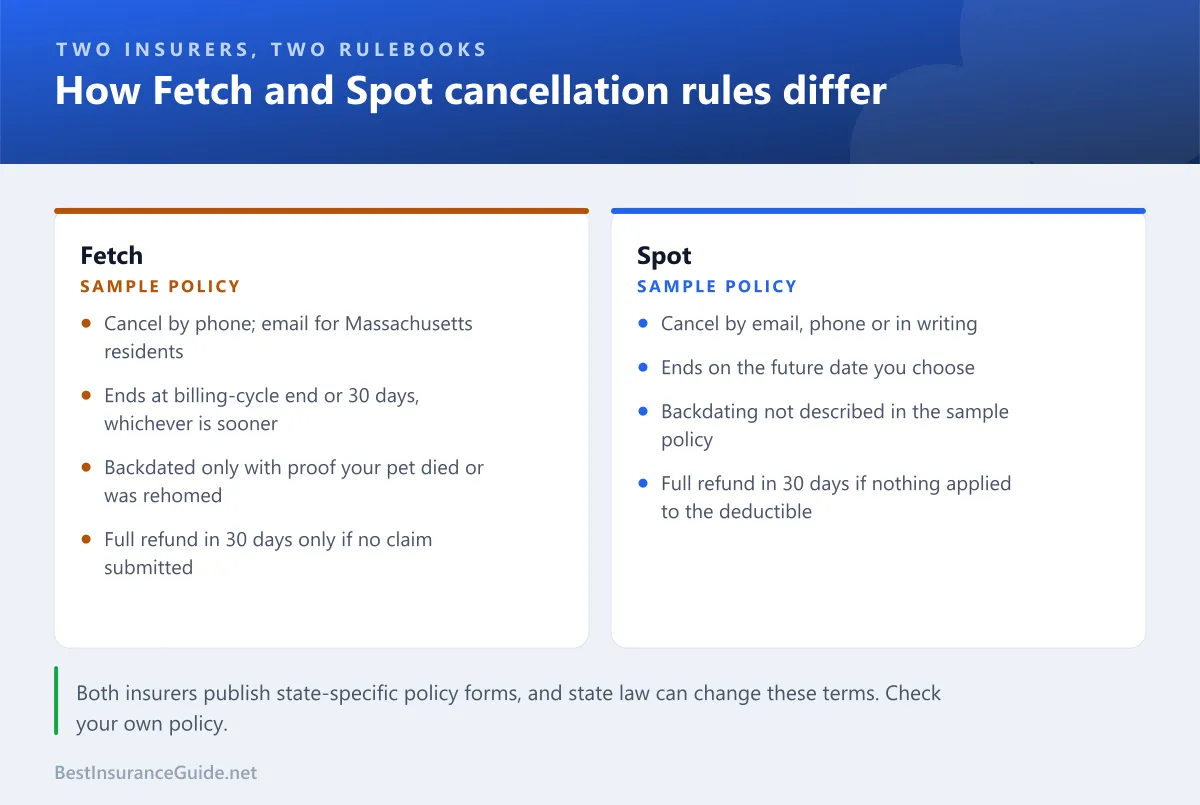
| Detail | Fetch (sample policy) | Spot (sample policy) |
|---|---|---|
| How to cancel | By phone (email for Massachusetts residents, per Fetch’s help page) | Email, phone, or in writing |
| When it takes effect | End of billing cycle or 30 days after request, whichever is sooner | The future date you give |
| Backdating | Only with written proof the pet died or is no longer with you | Not described |
| Full refund condition | Within 30 days and no claim submitted | Within 30 days and no covered expenses applied to deductible or reimbursed |
| After 30 days | Pro rata refund | Refund of premium for the period after coverage ends |
Based on each insurer’s published sample policy. State versions can differ.
The biggest practical difference is the end date. With Spot, you choose it. With Fetch, the policy sets it, and it may come sooner than you asked for.
If you are switching to another insurer
- Request your pet’s full medical records.
- Get quotes and read the pre-existing condition and waiting period sections.
- Buy the new policy and note its start date and every waiting period.
- Call Fetch and work out your end date under the billing-cycle rule.
- Make sure the new waiting periods finish before the Fetch end date if possible, or accept the risk of a short gap knowingly.
- Get written confirmation from Fetch and keep it with your new policy documents.
If a full policy is out of reach for an older pet, an accident-only policy keeps protection against the biggest, most sudden bills. And if the real problem is paying vets upfront, vet payment plans may help more than switching insurers.
A note on scope
This guide is based on Fetch’s sample policy form GPTM 050 1125 A and Fetch’s online help pages as of October 2026. Fetch publishes different policy forms for different states, and state law overrides policy wording where they conflict. Your own policy, declarations page and any state amendments take priority. Nothing here is legal or financial advice.
This site is independent and is not affiliated with Fetch Insurance Services, LLC, AXIS Insurance Company or any other insurer.
Related reading
VPI pet insurance covers what to check when an insurer changes or withdraws a plan. Pet insurance cost guide explains how deductibles, reimbursement and limits affect your premium if you are adjusting rather than cancelling.