VPI Pet Insurance: What Happened to It, and What It Means for You Now
Is VPI pet insurance still around? VPI became Nationwide pet insurance. The history, the old login, the 2024 non-renewals and what to do now.

Table of contents
If you have typed “VPI pet insurance” into a search bar, you are probably in one of three situations.
You found an old policy document in a drawer and want to know whether it still means anything. You have had a pet insured for a decade, the paperwork now says Nationwide, and you are not sure when or why that happened. Or a long-time customer just received a letter they did not expect, and you are trying to work out what it means.
This guide covers all three. It explains what VPI was, why it matters in the history of pet insurance, what happened to the brand, where the old login went, and what you should check if you still hold a policy that began life as VPI.
One thing first: this site is independent and is not affiliated with Nationwide or any other insurer. The facts below are drawn from Nationwide’s own published material, trade press coverage of the company, and independent reviews, and they are attributed where it matters.
The short answer: VPI is now Nationwide
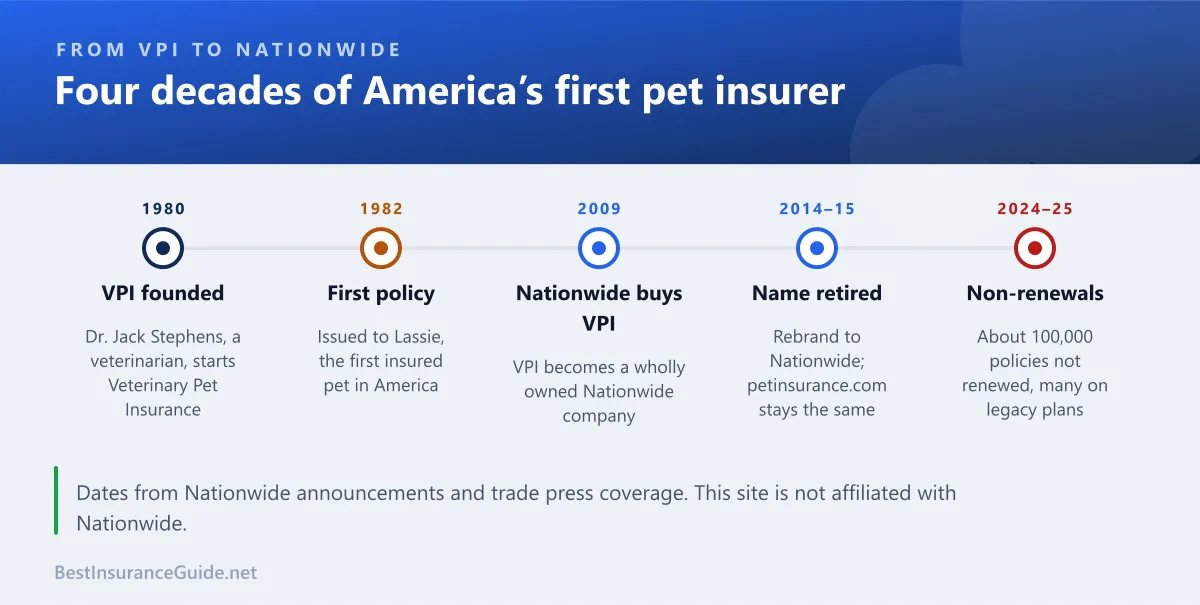
VPI pet insurance still exists as a business, but not as a brand. Veterinary Pet Insurance was bought by Nationwide in 2009. In September 2014, Nationwide announced that VPI would adopt the Nationwide name over roughly eighteen months, and by 2015 the VPI brand had been retired.
The policies, the claims operation and the website carried on. Nationwide’s pet insurance site is still petinsurance.com, the same address VPI used, which is why so many owners still call it VPI years after the logo changed.
So if your question is simply “is VPI still around,” the answer is yes, under a different name. The more useful question, especially for long-standing customers, is whether the policy you bought as VPI is still the policy you have. In many cases it is not, and the reasons are covered below.
Where VPI came from, and why it is in the history books
VPI was the first company to sell pet health insurance in the United States, and the story of how it started explains a lot about how pet insurance still works today.
A veterinarian’s idea
Dr. Jack Stephens, a veterinarian, founded Veterinary Pet Insurance in 1980. The motivation he described in interviews was a familiar one to anyone who has worked in a clinic: owners who loved their animals were turning down treatment because they could not cover a sudden bill. Insurance was his answer to the gap between what medicine could do and what families could pay for on the day.
That origin matters because it set the template the whole industry still follows. You pay the vet, you claim afterwards, and the insurer reimburses you. Pet insurance in the US is built around reimbursing the owner rather than paying the clinic directly, and VPI is the reason.
The first insured pet in America: Lassie
VPI issued its first policy in 1982, and it went to Lassie, the collie from the television series. It was a publicity move, and a clever one. Most Americans had never heard of health insurance for animals, and attaching the idea to the most famous dog in the country made it something people talked about.
If you have ever seen the trivia question “who was the first pet in America to be insured,” the answer is Lassie, and the insurer was VPI.
Growth, then acquisition
Through the 1990s and 2000s VPI grew into the largest pet insurer in the country. Trade press coverage around the 2014 rebrand described it as covering more than half a million US pets, and based in Brea, California.
Nationwide bought VPI outright in 2009. Dr. Stephens had left VPI before the acquisition, and he went on to found another pet insurer, Pets Best, before retiring in 2014. So the founder of the first US pet insurer was also responsible for one of its later competitors.
The rebrand: what changed and what did not
In September 2014 Nationwide announced that VPI and several other subsidiaries would move to the Nationwide name and logo, with the change rolled out over around eighteen months. The VPI name largely disappeared from policies, marketing and the website during 2015.
For a policyholder at the time, the practical effect was small:
- The policy stayed in force. A rebrand does not cancel or rewrite a contract.
- Premiums and terms were not changed by the rebrand itself. They continued to change at renewal in the usual way.
- The website address stayed the same. Members kept logging in at petinsurance.com.
- The claims process carried on. You still paid the vet, submitted the invoice, and were reimbursed.
What changed was the name on the paperwork and the logo on the card. That is why people with policies dating back to the early 2010s often describe themselves as VPI customers who “somehow ended up with Nationwide.”
VPI pet insurance login: where the old account went
Searches for “VPI pet insurance login” usually come from someone holding an old card or email.
There is no separate VPI login any more. Member accounts moved to Nationwide’s pet insurance site. To get in:
- Go to petinsurance.com and choose the member login.
- Try your existing username and password. Accounts were migrated, not recreated, so older credentials often still work.
- If they do not, use the password or username reset on that page.
- If the reset fails, call the number printed on your policy documents or your most recent renewal letter. Have your policy number and your pet’s details ready.
A word of caution. Because “VPI login” is an old phrase that still gets searched, you will find sites that are not Nationwide’s offering to help. Only enter your details on the insurer’s own site, and type the address yourself rather than clicking a link in an unexpected email.
The 2024 non-renewals, and why long-time VPI customers were hit
This is the part that matters most if you have held a policy for many years.
In June 2024, Nationwide said it would not renew roughly 100,000 pet insurance policies, with the non-renewals taking effect between spring and summer of 2025. The company pointed to rising veterinary costs and wider economic pressure, and said affected customers would be notified in writing in advance, in line with state law.
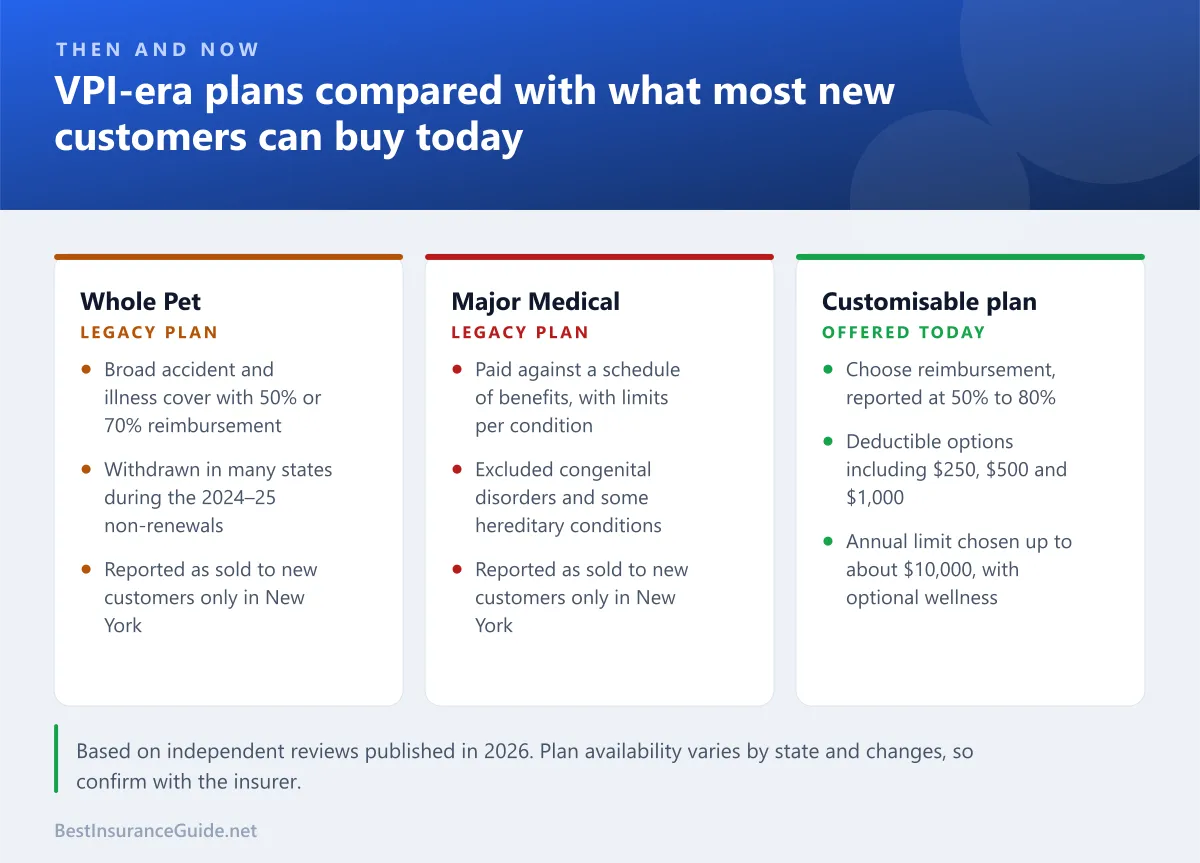
Reporting at the time said the non-renewals were concentrated in older plan types, including Whole Pet and Major Medical, which were withdrawn in a number of states. These were the plans most closely associated with the VPI era, and the people holding them were, almost by definition, long-standing customers with older pets.
That combination is what made the decision so painful for the people affected. An older pet is more likely to have a medical history, and any condition on that history counts as pre-existing with a new insurer. A family moving from a policy that covered a dog’s arthritis to a new policy would usually find the arthritis excluded.
A class action lawsuit was later reported over the cancellations. Its outcome is a legal matter beyond the scope of this guide, and if you believe you were affected, the right people to ask are your state insurance department or a lawyer, not a blog.
Was your policy affected?
Not every legacy policy was non-renewed, and the decision varied by plan and by state. The reliable way to know is your own paperwork:
- A non-renewal notice will say so plainly and give an end date.
- A renewal offer for the same plan means your policy continued.
- A renewal offer for a different plan means your old plan was replaced. Read what you were moved to, because the reimbursement, deductible and limits may all be different.
If you have none of these and are unsure, log in or call. It is a two-minute question, and the answer decides whether you need to start shopping.
What Nationwide pet insurance looks like today
Because VPI customers are now Nationwide customers, the current product is the relevant one. Based on independent reviews published in 2026, and with the warning that plan details change and vary by state:
A customisable accident and illness plan is offered to most new customers. Reviews describe reimbursement options ranging from 50% to 80%, deductible choices including $250, $500 and $1,000, and annual limits that can be set at different levels up to around $10,000.
Whole Pet and Major Medical are reported as available to new customers only in New York.
Wellness cover is available as an optional add-on, covering routine items such as check-ups, vaccinations and dental cleaning allowances. Our guide to whether pet insurance covers vaccines explains why routine care sits in an add-on rather than the main policy.
Avian and exotic pets are still a genuine point of difference. Nationwide is one of very few US insurers that will cover birds, rabbits, reptiles and other exotics, and exotic pets generally have to be enrolled by phone rather than online. If you keep a rabbit, our pet insurance for rabbits guide covers that market in detail.
What we will not do is quote you a price. Premiums depend on species, breed, age, location and the options you choose, and any figure printed in an article is out of date by the time you read it. The only reliable price is a quote for your own pet.
Should you stay, switch, or start fresh?
Your next step depends on where you are.
You still have an active legacy policy
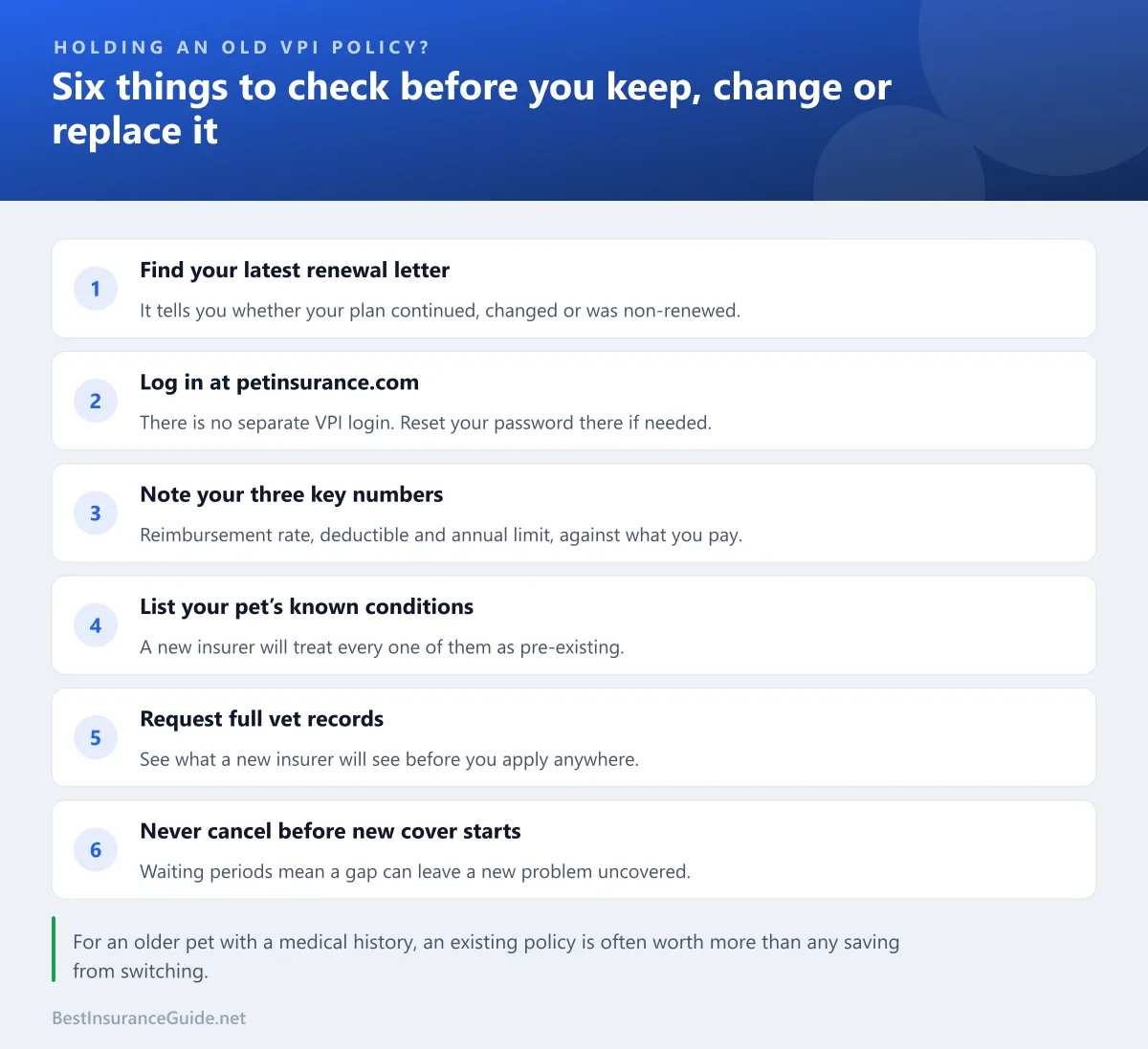
Think very carefully before cancelling. An old policy often covers conditions that would be excluded as pre-existing with any new insurer. Even if the premium has risen, the coverage you would lose may be worth more than the saving.
Read your latest renewal, note the reimbursement level, deductible and annual limit, and compare those against the premium. If the policy is still doing its job, there is usually no reason to move.
You were non-renewed, or moved to a different plan
Start by asking for your pet’s full medical records from your vet. Any new insurer will review them, and you want to know what they will see before they see it.
Then compare quotes from several insurers. Expect existing conditions to be excluded, and look for:
- How each insurer defines “curable” pre-existing conditions. Some will cover a condition again after a symptom-free period. Others never will.
- Waiting periods. A new policy will not cover anything that starts in its first days. Our guide to pet insurance waiting periods explains how long they run and which conditions carry longer ones.
- Age limits on enrolment. Some insurers will not take a new pet above a certain age, which can narrow the field for a senior dog or cat.
If full accident and illness cover is out of reach or poor value for an older pet, an accident-only policy can still protect against the large, sudden bills that cause the most financial damage.
You have never had VPI and are just comparing
The VPI name is history, so compare Nationwide as you would any other insurer: on reimbursement rate, deductible, annual limit, exclusions, waiting periods and price for your specific pet. Our pet insurance cost guide walks through how those levers trade off against each other.
Why the VPI story is worth knowing even if you never had it
VPI’s history is a useful lesson in how pet insurance works, and three parts of it apply to any policy you buy.
First, the reimbursement model. Because VPI started the American market, you pay the vet and claim afterwards. Budget for paying the full bill upfront, even with a good policy. If cash flow is the problem, vets that take payment plans cover the gap that insurance does not.
Second, renewal is not guaranteed for life. The 2024 non-renewals showed that a long relationship with an insurer does not protect a policy from being withdrawn. When you compare insurers, look at how a policy is described at renewal, not only at sign-up.
Third, pre-existing conditions make switching expensive. The longer a pet is insured, the more valuable continuous cover becomes, and the harder it is to replace. That is a reason to choose carefully the first time rather than plan to switch later.
Quick reference: VPI facts at a glance
| Question | Answer |
|---|---|
| What did VPI stand for? | Veterinary Pet Insurance |
| When was it founded? | 1980, by Dr. Jack Stephens, DVM |
| First policy | 1982, issued to Lassie |
| Where was it based? | Brea, California |
| Who owns it now? | Nationwide, which bought it in 2009 |
| When did the name change? | Rebrand announced September 2014, completed around 2015 |
| Where is the login now? | petinsurance.com, Nationwide’s pet insurance site |
| Major recent change | Around 100,000 policies non-renewed in 2025, announced June 2024 |
A note on scope
This article describes the history of VPI and the general position of its former policyholders. It is not legal or financial advice, and it is not a review or endorsement of any insurer. Plan names, terms, availability and pricing change over time and vary by state, so confirm current details directly with Nationwide or your state insurance department before you make a decision.
This site is independent and not affiliated with Nationwide, VPI or any other insurer.
Related reading
Pet insurance by state links to our state-by-state guides, including how each state’s insurance department handles pet insurance complaints. Cat insurance explained covers the same questions for cat owners, and vet credit cards and payment plans covers what to do when a bill arrives before a claim pays out.