Cat Dental Insurance: What It Covers, What It Excludes, and the Cat-Specific Catches
Cat dental insurance: tooth resorption, stomatitis and extractions, why cleaning is not covered, and how to keep dental cover valid.

Table of contents
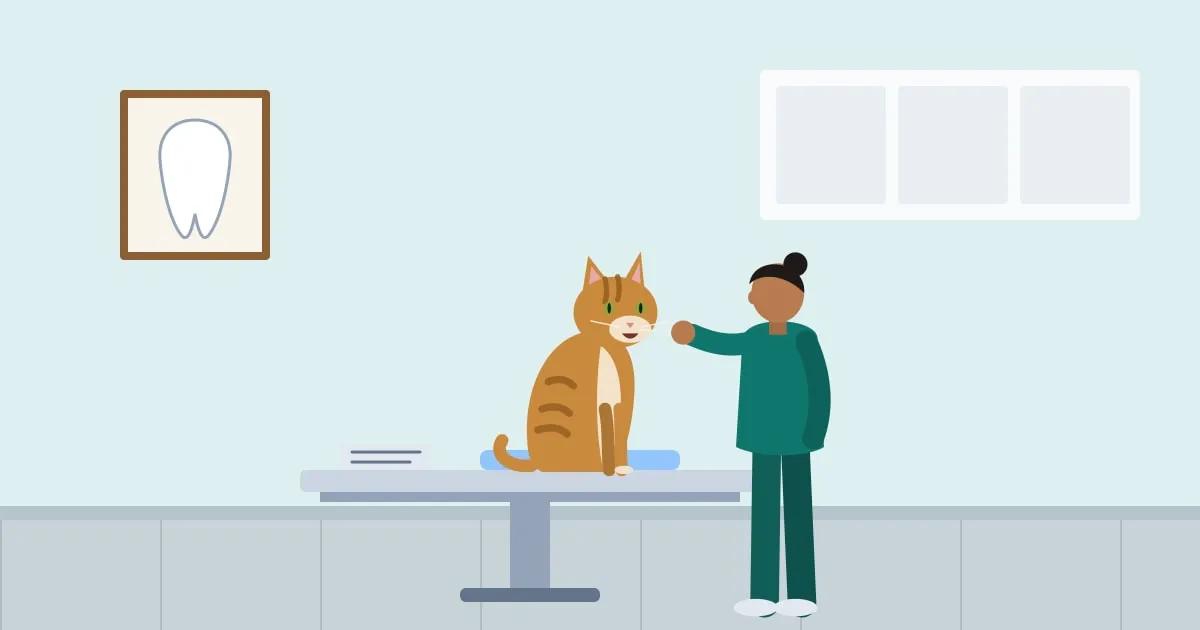
Cats are experts at hiding mouth pain. A cat with a painful tooth will often keep eating, chewing on one side or swallowing kibble whole, and the problem is only found when a vet looks under anaesthesia and takes dental X-rays. By then it usually means extractions.
That makes dental care one of the most common reasons cat owners end up at the vet, and one of the most misunderstood parts of pet insurance. Cat dental insurance covers dental disease and injury, not routine cleaning. Cats also get dental diseases that dogs rarely do, and the way some policies are worded can leave a common feline treatment uncovered.
This guide explains the cat-specific dental conditions, what two real policies say about dental cover, the catches to look for, a worked claim example, and how to keep dental cover valid. This site is independent and not affiliated with any insurer. Clinical facts come from veterinary literature, and policy terms are quoted from published sample policies. Questions about your own cat’s mouth belong with your veterinarian.
The short answer
- Usually covered: treatment of dental disease and dental injury that began after cover started, including extractions, dental X-rays, anaesthesia and related medication.
- Usually not covered: routine cleaning with no disease present, cosmetic dental work, and anything pre-existing.
- Check carefully: how the policy treats crown amputation, stomatitis, and any annual dental exam requirement.
There is generally no stand-alone “cat dental insurance” product. Dental cover comes as part of an accident and illness policy, sometimes with a wellness add-on that contributes toward cleanings.
Three dental diseases cats get
Tooth resorption
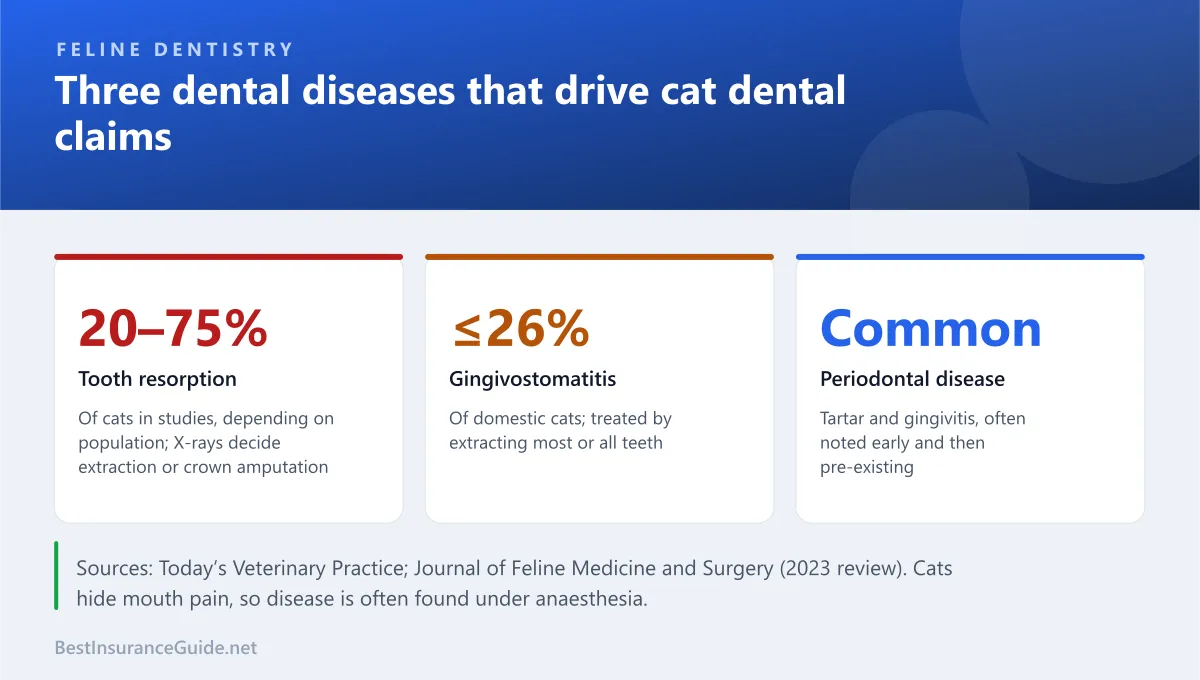
Tooth resorption is a condition in which the body breaks down a tooth’s structure, often starting at the gumline. It is painful and progressive. Studies report it in 20% to 75% of cats, depending on the population and how they were examined, and it is more common in older cats.
The American Veterinary Dental College (AVDC) classifies resorption into stages and types. Treatment depends on the type, which can only be determined with dental X-rays:
- Types 1 and 3: extraction is the treatment of choice.
- Type 2, where the root is being replaced by bone-like tissue: crown amputation with intentional root retention is the treatment of choice, according to Today’s Veterinary Practice. The vet removes the crown and leaves the resorbing root to be absorbed, rather than trying to extract it.
Fillings are not recommended, because they do not stop the disease.
Feline chronic gingivostomatitis (FCGS)
FCGS is severe, painful inflammation of the gums and the back of the mouth. A 2023 review in the Journal of Feline Medicine and Surgery reports that it affects up to 26% of domestic cats, and that extracting all, or nearly all, teeth remains the mainstay of treatment.
Outcomes vary. In one study of 95 cats, 28% had complete resolution and 39% substantial improvement after extraction, while about a third did not respond. Many cats also need ongoing medical management afterwards. FCGS is one of the most expensive dental problems a cat can have, because it combines extensive surgery with long-term medication.
Periodontal disease
As in dogs, plaque and tartar lead to gum inflammation, bone loss and loose teeth. It is the most familiar form of dental disease, and the one most often noted early in a cat’s life as “tartar” or “gingivitis” on a health check. That detail matters for insurance, as the next sections show.
Dental injuries
Not every dental claim is disease. Cats break teeth, most often the long canine teeth, in falls, fights, collisions with cars or by biting something hard. A fractured canine with the pulp exposed is painful and prone to infection, and it is usually treated by extraction or, at a specialist, root canal therapy.
Dental injuries are generally treated as accidents, so they can be covered by accident and illness policies and, depending on the wording, by some accident-only policies. Watch the restorative-work exclusions, though. A policy that excludes root canals, as Spot’s sample policy does, may pay for an extraction but not for saving the tooth.
Dental cover across a cat’s life
Kittens. The best time to enrol, because the mouth is usually clean and nothing is on record. Watch for retained baby teeth, which some policies treat differently. Fetch’s sample policy, for example, refers to deciduous teeth in its exclusion for oral health problems that showed signs before cover began.
Adults. Periodontal disease and tooth resorption become increasingly common. This is when annual dental exams and dental X-rays earn their keep, both medically and for keeping cover valid.
Seniors. Dental procedures in older cats usually need pre-anaesthetic bloodwork and closer monitoring, so the same extraction costs more. Our guide to pet insurance for senior cats explains why enrolment timing matters even more after ten.
What two real policies say
| Detail | Spot (sample policy) | Fetch (sample policy) |
|---|---|---|
| Dental disease | Covered as illness; tooth extractions listed as eligible | Covered; dental disease defined to include gingivitis, calculus, gingival recession and stomatitis |
| Routine cleaning | Excluded unless used to treat a covered illness or covered by an endorsement | Excluded where there is no evidence of dental disease |
| Cosmetic and restorative work | Excluded: caps, crowns or crown amputation, fillings, implants, root canals or planing | Cosmetic dentistry excluded as an elective procedure; crown amputation not named |
| Pre-existing dental issues | Excluded | Excluded where signs were observed before cover or during the waiting period |
| Care conditions | — | You must arrange recommended preventive care, including dental examinations |
| Cleaning allowance | Available through preventive care options | Not in the core policy |
Sources: Spot’s published sample accident and illness policy, underwritten by Independence American Insurance Company; Fetch’s sample policy form GPTM 050 1125 A, underwritten by AXIS Insurance Company. State versions can differ.
The cat-specific catches
1. Crown amputation
Here is a detail most comparison sites miss. Spot’s sample policy lists crown amputation among excluded “aesthetic, cosmetic, endodontic, or orthodontic dental services”, alongside fillings and root canals. In a dog, those are mostly elective procedures. In a cat, crown amputation is the treatment of choice for type 2 tooth resorption.
We are not saying a particular claim would be refused. Insurers interpret their own wordings, and they may treat a medically necessary procedure differently. But if your cat is at the age where resorption becomes common, ask any insurer in writing how it handles crown amputation for tooth resorption before you rely on it.
2. Gingivitis at the first exam
Adult cats very often have some tartar or gingivitis noted at a routine exam. Once it is in the record before cover starts, periodontal disease is likely to be excluded as pre-existing.
Fetch’s sample policy goes further. It requires a first exam and automatically excludes conditions observed or recorded during that exam, along with related conditions. That is standard insurance logic, but it means the first exam after enrolment can set your dental exclusions for life.
The practical answer is to enrol young. A kitten’s mouth is usually clean.
3. Annual dental exam requirements
Some policies make cover conditional on following your vet’s recommended preventive care. Fetch’s sample policy requires you to arrange recommended preventive treatment, including dental examinations, and says it will not pay amounts where you failed to meet its care conditions. Our dog dental insurance guide explains how this clause catches owners, and it applies equally to cats.
4. Dental X-rays and specialist referral
Tooth resorption and stomatitis both require dental X-rays to diagnose and treat properly. Complex cases are often referred to a veterinary dentist. Check that diagnostics and specialist fees are covered, and that your annual limit could absorb a referral-level procedure.
Worked example: stomatitis in a five-year-old cat
Mochi is enrolled at one year old with a clean mouth. At five, she starts drooling, eating less and pawing at her face. Her vet diagnoses FCGS and refers her to a veterinary dentist for extraction of nearly all her teeth, with dental X-rays, anaesthesia, hospitalisation and pain medication. In this illustration the total bill is $3,000.
Her policy has a $250 deductible and 80% reimbursement. The insurer pays 80% of the $2,750 above the deductible, which is $2,200. Her owner pays $800, plus any later medical management above the deductible in future years.
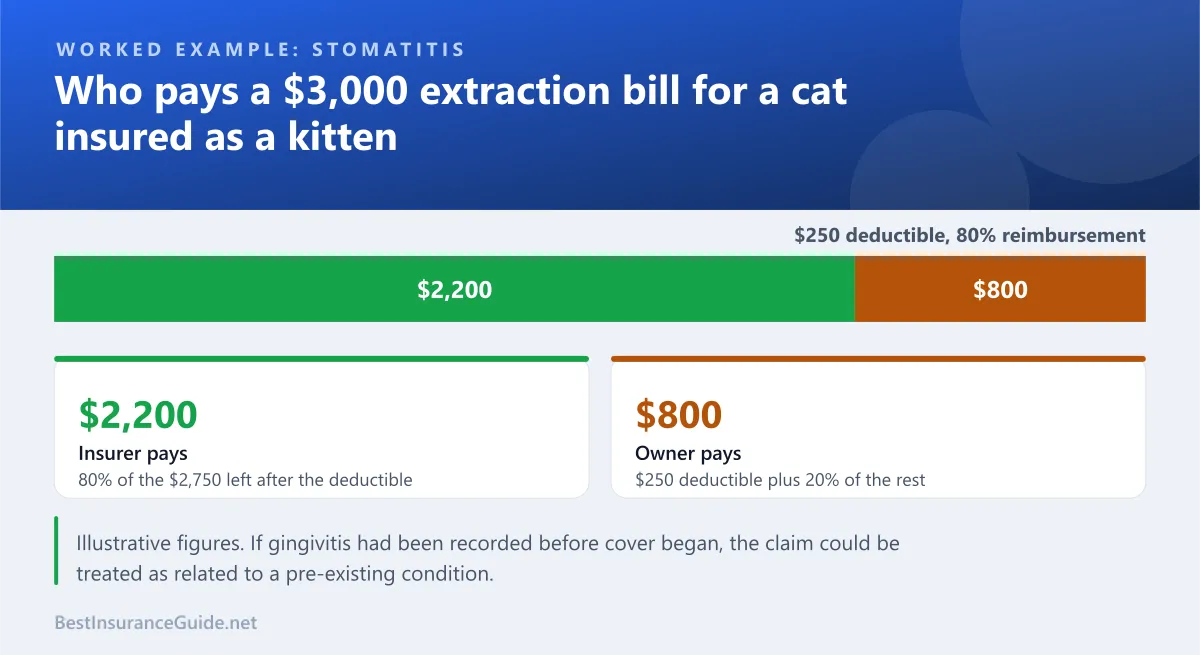
Now take Mochi’s sister, enrolled the same day but at four years old. Her first exam recorded “moderate gingivitis”. When she develops FCGS at five, the insurer may treat it as related to the pre-existing gum disease. The outcome then depends on the policy wording and the insurer’s assessment, and the owner could be paying most or all of the same $3,000.
Illustrative figures. Costs vary widely by region, clinic and the extent of treatment.
Cleaning: why it is not insurance, and what to do about it
Insurers treat routine cleaning as predictable maintenance, like vaccines. You know it is coming, so it is budgeted rather than insured.
Two ways to handle it:
- A wellness add-on. Spot’s sample preventive care options, for example, include a dental cleaning allowance line. Allowances are usually a portion of a full anaesthetic cleaning, so compare the add-on’s annual price with the allowance and what you would spend anyway.
- A cleaning fund. Set aside a small amount monthly for your cat’s next dental procedure.
Remember that a cleaning done to treat covered dental disease can be different from a routine cleaning. Spot’s wording, for example, excludes cleanings unless used to treat a covered illness. Ask your insurer how it distinguishes the two.
Signs of dental pain in cats
Cats rarely stop eating because of dental pain, so watch for subtler signs:
- Chewing on one side, or dropping food
- Swallowing kibble without chewing
- Drooling, sometimes with blood
- Bad breath that is genuinely unpleasant
- Pawing at the mouth or face
- Reluctance to be touched around the head
- Red, swollen gums, especially at the back of the mouth
- Reduced grooming, leaving a scruffy coat
Any of these is worth a vet appointment. Finding problems early often means fewer extractions, which is better for your cat and a smaller claim.
How to keep your cat’s dental cover working
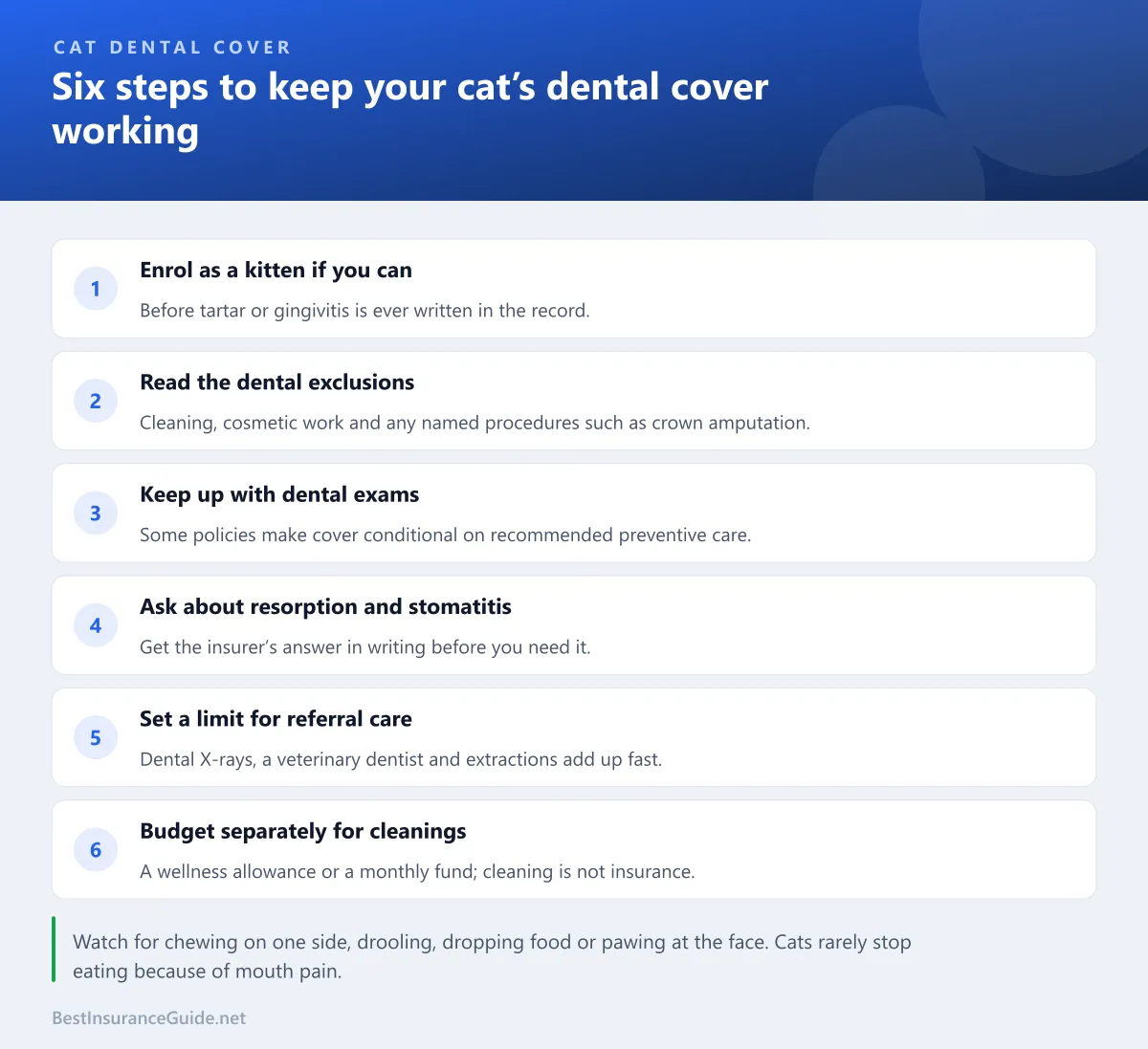
- Enrol early, ideally as a kitten, before tartar or gingivitis is ever recorded.
- Read the dental section of your policy, including exclusions and any care conditions.
- Keep up with recommended dental exams and keep the records.
- Ask about crown amputation and stomatitis in writing before you need them.
- Choose an annual limit that could cover a referral-level dental procedure.
- Consider a wellness add-on or cleaning fund for routine cleanings, since they are not insured.
A note on scope
Prevalence figures in this guide come from published veterinary literature and vary by study. Policy terms are quoted from two published sample policies to illustrate how dental cover differs, not to rate either insurer. Policies vary by state and change over time, and your own policy and declarations page take priority. Cost examples are illustrative, not quotes. Nothing here is veterinary, legal or financial advice. Whether your cat needs dental treatment, and which treatment, is for your veterinarian.
This site is independent and not affiliated with Spot, Fetch or any other insurer.
Related reading
Cat insurance explained covers the wider feline claim picture, including urinary and kidney disease. Pet insurance for senior cats explains why dental and other conditions of age make enrolment timing so important. Does pet insurance cover medication? covers the pain relief and anti-inflammatory medication that often follows dental surgery.