Does Pet Insurance Cover Medication? Prescriptions, Prescription Food and Supplements
Does pet insurance cover medication? Usually, for covered conditions. What real policies say about prescriptions, prescription food and supplements.

Table of contents
Medication is where a lot of pet insurance value hides, and where a lot of confusion lives. One-off antibiotics after an injury are easy. The harder questions come with long-term medication for allergies, arthritis, thyroid disease or diabetes, with prescription diets, and with supplements your vet recommends.
The short answer: accident and illness pet insurance usually covers prescription medication for a covered condition. The longer answer is that policies split sharply on prescription food, supplements and parasite treatment, and those splits can be worth hundreds of dollars a year.
To show how real policies differ, this guide compares the medication wording in two insurers’ published sample policies, Spot and Fetch. It then works through what long-term medication actually costs you with insurance, and how to claim. This site is independent and not affiliated with any insurer. Policy terms vary by state and over time, so your own policy is the final word.
The short answer
For most accident and illness policies:
- Covered: medication prescribed by a vet to treat a covered accident or illness, after the deductible, at your reimbursement percentage, up to your annual limit.
- Not covered: medication for pre-existing conditions, preventive medication such as flea, tick and heartworm prevention and dewormers, over-the-counter products, and experimental drugs.
- It depends: prescription food, supplements, compounded medication, and treatment of parasite-related illness.
The “it depends” list is where reading your policy pays off.
What two real policies say
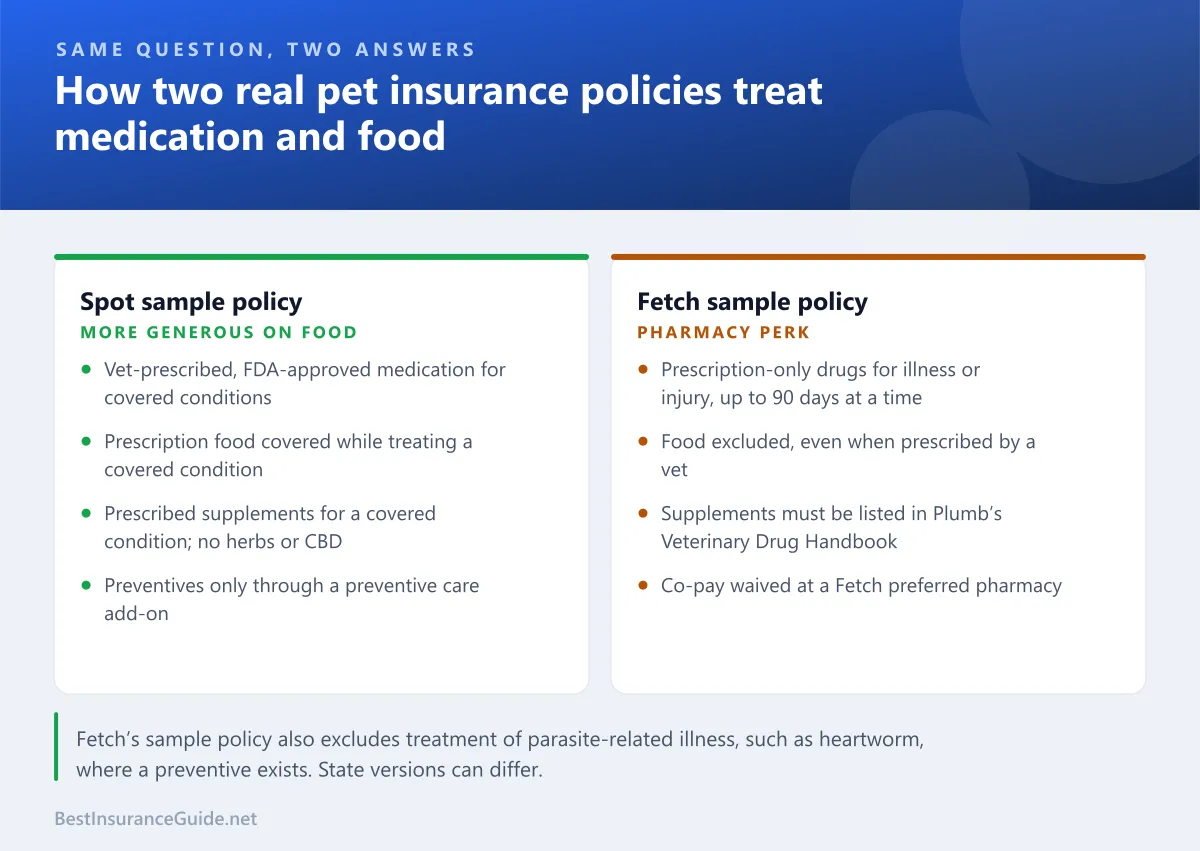
| Detail | Spot (sample policy) | Fetch (sample policy) |
|---|---|---|
| Prescription medication | Covered if prescribed by a vet and FDA-approved | Covered if only available by vet prescription, for an illness or injury, in quantities of 90 days or less |
| Prescription food | Covered to treat a covered condition; not for prevention or general health maintenance | Excluded, “including food prescribed by a veterinarian” |
| Supplements | Covered if vet-prescribed and formulated to treat a specific covered condition; excludes herbs, CBD and general vitamins | Covered if recognised as effective for a covered condition and listed in Plumb’s Veterinary Drug Handbook |
| Preventive medication | Excluded from core cover; preventive care add-on options include allowances | Excluded (heartworm, flea and tick prevention named) |
| Parasite-related illness | Not specifically excluded in the core wording we reviewed | Excluded where a preventive medication exists, including heartworm, fleas and ticks |
| Pharmacy perks | Possible access to preferred providers at discounted prices | At a Fetch preferred pharmacy, the deductible applies but the co-pay is waived |
Sources: Spot’s published sample accident and illness policy, underwritten by Independence American Insurance Company; Fetch’s sample policy form GPTM 050 1125 A, underwritten by AXIS Insurance Company. State versions can differ.
Neither policy is simply “better”. Spot is more generous on prescription food. Fetch’s preferred-pharmacy co-pay waiver can be valuable for a pet on expensive long-term medication. The point is that two mainstream insurers give different answers to the same question, so you cannot assume.
Prescription medication: the conditions that apply
Even where medication is covered, these conditions usually apply.
It must be for a covered condition. Medication for a condition that showed signs before your policy started, or during a waiting period, is excluded along with the condition itself.
It must be prescribed by a vet. Over-the-counter products, even if your vet suggested them, are generally not covered. Spot’s wording requires FDA approval. Fetch’s requires that the medication can only be obtained by veterinary prescription.
Quantity limits may apply. Fetch’s sample policy covers prescription pharmaceuticals in quantities of 90 days or less at a time. That matters if you were planning to buy a year’s supply at once.
It counts against your annual limit. Long-term medication can use up a low annual limit, especially alongside diagnostics and rechecks.
Compounded medication is mixed by a pharmacy into a specific form, such as a flavoured liquid or transdermal gel for a cat that will not take pills. If your policy requires FDA-approved drugs, ask before assuming a compounded version is covered.
Common medications and how they are usually treated
The same principles apply across drug types, but it helps to see them side by side. The table assumes an accident and illness policy and a condition that began after cover started.
| Medication | Typical treatment under a core policy | Watch for |
|---|---|---|
| Antibiotics or pain relief after an injury | Covered as part of the accident claim | Accident waiting period, if your policy has one |
| Post-surgical pain relief and antibiotics | Covered with the surgery | Bilateral-condition clauses for knee and hip surgery |
| Allergy and itch medication | Covered as an illness | Allergies noted before enrolment are pre-existing |
| Thyroid, kidney or heart medication | Covered as a chronic illness, renewed each year | Annual limit and per-condition limits |
| Insulin for diabetes | Covered as a chronic illness | Ask whether syringes and monitoring supplies count |
| Behavioural medication | Covered by some policies that include behavioural treatment | Many policies limit or exclude behavioural conditions |
| Flea, tick and heartworm prevention | Not covered by core policy | Wellness add-on allowances only |
General patterns only. Your policy’s definitions and exclusions decide each case.
The most common surprise is in the last two rows. Behavioural cover varies widely between insurers, and preventives are never core insurance.
Prescription food: the biggest split
Prescription diets, such as urinary, kidney, gastrointestinal and hypoallergenic foods, are often a central part of treatment, and they are expensive month after month.
Spot’s sample policy covers prescription pet food to treat a covered condition. It defines prescription food narrowly, as a manufactured, tested therapeutic diet prescribed for a specific covered condition. It excludes treats, maintenance diets, fresh or lightly cooked diets, homemade and raw diets, weight-loss diets and dental diets. It also excludes food used beyond the resolution of symptoms for prevention or general health maintenance, even if prescribed.
Fetch’s sample policy excludes “food, including food prescribed by a veterinarian, to treat or prevent illness or injury.”
Why this matters, with an example. A male cat has a urinary blockage, and his vet prescribes a urinary diet. Under a Spot-style wording, the diet can be claimed while it is treating the condition. If it is continued indefinitely as prevention after symptoms resolve, that later food is likely to be excluded. Under a Fetch-style wording, the diet is not covered at any stage, though the emergency treatment for the blockage is.
If your pet already needs, or is likely to need, a prescription diet, this one clause can outweigh a small difference in premium. Our cat insurance guide explains why urinary disease is one of the most common expensive cat claims.
Supplements, preventives and parasites
Supplements
Joint supplements, omega-3 fatty acids and probiotics are increasingly recommended by vets. Policies that cover them set conditions:
- Spot: must be vet-prescribed, formulated and tested, and part of treating a specific covered condition. Herbs, CBD and general health vitamins are excluded.
- Fetch: must be recognised as effective for treating a covered injury or illness, and listed in Plumb’s Veterinary Drug Handbook, a standard veterinary drug reference.
Preventive medication
Flea, tick and heartworm prevention and routine dewormers are routine care, not insurance. A wellness or preventive care add-on may reimburse part of the cost up to fixed allowances. Spot’s sample policy, for example, shows preventive care options with an annual allowance line for heartworm and flea prevention. Whether that is worth paying for depends on the add-on’s price against what you would spend anyway. Our guide on whether pet insurance covers vaccines explains how to run that calculation.
Treatment for parasite-related illness
This is a less obvious exclusion with real consequences. Fetch’s sample policy excludes treatment of parasites or parasite-related illness where a preventive medication exists, and names heartworms, fleas, ticks and several intestinal worms. Heartworm treatment can be expensive, so in areas where heartworm is common, it is worth knowing whether your policy would pay. Our Kentucky guide covers this in a high-risk state.
Long-term medication: what you actually get back
For a pet on daily medication for a covered chronic condition, the maths works like this each policy year:
- You pay the annual deductible first.
- Above that, the insurer pays its reimbursement percentage.
- Everything is capped by the annual limit.
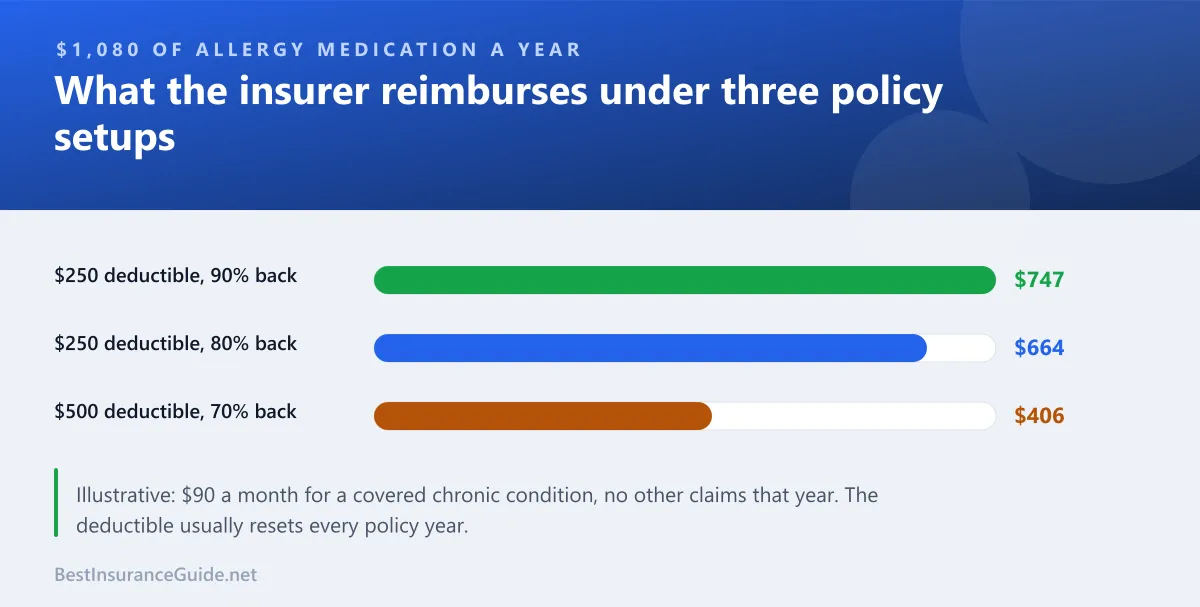
Worked example: a dog on allergy medication
A five-year-old dog develops allergic skin disease after his policy started, and his vet prescribes a daily medication. In this illustration it costs $90 a month, or $1,080 a year. Assume no other claims that year.
| Policy setup | You pay | Insurer pays |
|---|---|---|
| $250 deductible, 90% reimbursement | $333 | $747 |
| $250 deductible, 80% reimbursement | $416 | $664 |
| $500 deductible, 70% reimbursement | $674 | $406 |
Illustrative figures. In practice, rechecks, bloodwork and flare-ups add to the claim, and your deductible may already be met by other treatment.
Two lessons stand out. Chronic medication rewards a lower deductible and a higher reimbursement rate, because you claim every year. And the deductible usually resets each policy year, so you pay it again at every renewal for an ongoing condition.
How to claim for medication
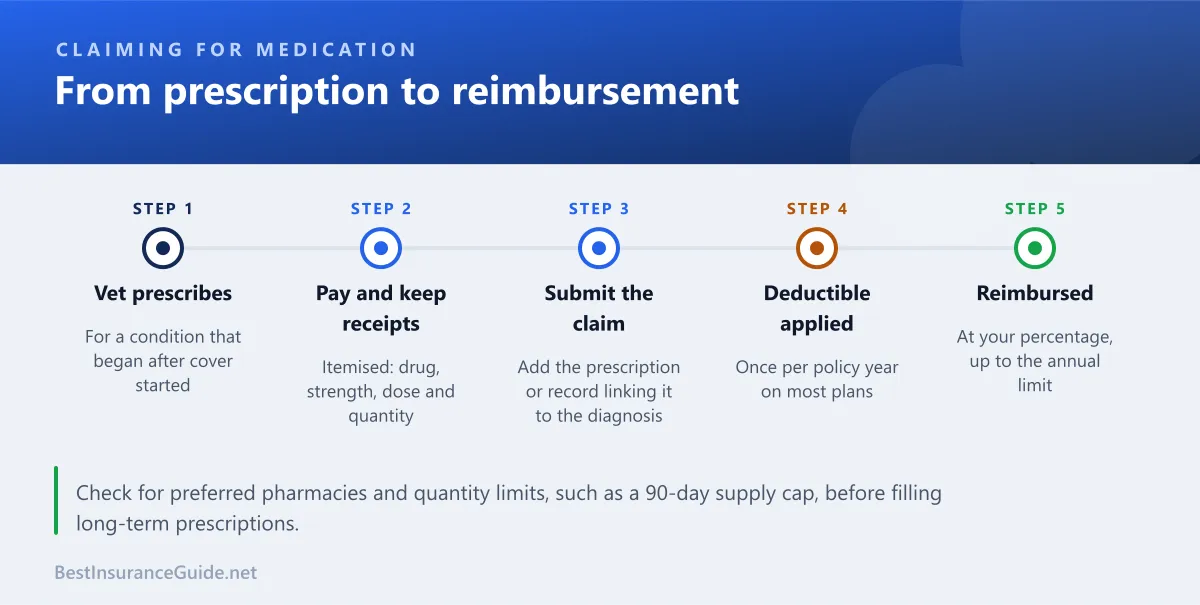
- Ask for an itemised invoice showing the drug name, strength, dose and quantity.
- If you use an outside pharmacy, keep the receipt and the prescription. Insurers may need both to link the drug to the diagnosis.
- Submit promptly. Policies set deadlines for claims, and many owners batch refills monthly or quarterly.
- Check whether your insurer has preferred pharmacies. Fetch’s sample policy waives the co-pay for prescriptions filled at a Fetch preferred pharmacy, though the deductible still applies.
- Keep a medication log with dates, refills and costs. It makes claims faster and helps if a question comes up later.
Ways to cut medication costs, insured or not
- Ask about generics. Many veterinary drugs have generic equivalents.
- Compare pharmacies. Your vet’s dispensary, online pet pharmacies and some human pharmacies may differ in price, so ask your vet to write a prescription you can fill elsewhere if needed.
- Buy in the quantities your policy covers. Under a 90-day rule, 90-day fills may be the sweet spot.
- Ask whether a different formulation is equally effective. Sometimes a tablet is much cheaper than a liquid or chew.
- Keep up with rechecks. Monitoring bloodwork can feel like an extra cost, but it keeps doses right and catches side effects early.
If the medication bill arrives before the reimbursement, vet payment plans can help with the gap.
Questions to ask before you buy
- Is prescription medication covered for all covered conditions, and are there quantity limits?
- Is prescription food covered, and for how long?
- Are supplements covered, and under what conditions?
- Are compounded medications covered?
- Is treatment of parasite-related illness covered?
- Do you have a preferred pharmacy with better terms?
- Is there a per-condition limit on top of the annual limit?
For pets already on medication, remember the starting rule: a condition being treated now is pre-existing. Our pet insurance for senior cats guide explains why that matters more as pets age.
A note on scope
This guide quotes medication, food and supplement wording from two published sample policies to illustrate how coverage differs. It is not a review or ranking of either insurer. Policies vary by state and change over time, and your own policy, declarations page and any endorsements take priority. Cost examples are illustrative, not quotes. Nothing here is veterinary, legal or financial advice. Medication choices belong with your veterinarian.
This site is independent and not affiliated with Spot, Fetch or any other insurer.
Related reading
Pet insurance cost guide explains how deductibles, reimbursement and limits interact. Dog dental insurance covers another area where the line between treatment and routine care decides what is paid.