What Does an Insurance Underwriter Do? The Person Who Sets Your Price
What an insurance underwriter does, what they check for life, home, auto and business cover, how long the underwriting process takes, and how to become one.

Table of contents

Every insurance policy you have ever bought was approved by someone you never spoke to. The agent took your details and the website gave you a quote, but the decision about whether the insurer would actually take you on, and at what price, belonged to an insurance underwriter.
Underwriters explain a lot of things that otherwise seem arbitrary: why the quote changed after you applied, why a life insurance application took six weeks, why a home insurer asked for photos of the roof, why one company declined you and another did not. Understanding what they do and what they look at is one of the most practical ways to get a better result from any application.
This guide covers what an insurance underwriter does, what they check for each type of insurance, how long underwriting takes, and what you can do to move it along. At the end there is a short section for anyone thinking about underwriting as a career.
What does an insurance underwriter do?
An underwriter’s job is to decide whether a risk fits the insurer’s appetite and, if it does, on what terms. In practice that means four things.
- Evaluate the application. They check what you have told the insurer: your age, health, driving record, property details, business operations, claims history.
- Verify it against outside records. They pull third-party data to confirm the application is accurate and to find anything it left out.
- Classify the risk. Every insurer has rules that sort applicants into rating classes. The underwriter decides which class you fall into.
- Make a decision. Approve as applied for, approve with changes (a higher premium, a higher deductible, an exclusion, a lower limit), or decline.
The underwriter does not invent the rules. Actuaries build the pricing models, and each insurer publishes underwriting guidelines setting out what it will accept. The underwriter applies those rules to you, and uses judgement where the rules leave room for it.
Underwriters versus agents, brokers and adjusters
These roles are easy to confuse.
| Role | Who they work for | What they do |
|---|---|---|
| Agent | The insurer (captive) or several insurers (independent) | Sells the policy, gathers your information, submits the application |
| Broker | Usually you | Shops your risk across insurers and negotiates on your behalf |
| Underwriter | The insurer | Decides whether to accept the risk and on what terms |
| Actuary | The insurer | Builds the pricing models and rating factors the underwriter uses |
| Claims adjuster | The insurer (or an independent firm) | Investigates and settles claims after a loss |
An agent or broker can argue your case, supply missing information and suggest other insurers. They cannot overrule the underwriter.
Automated underwriting versus a human underwriter
Most personal insurance today is underwritten by software first. When you get an instant car insurance quote, an algorithm has already pulled your driving record, claims history and, in most states, a credit-based insurance score, and applied the insurer’s rules in seconds. That is what makes it possible to get car insurance in minutes.
A human underwriter steps in when:
- the application falls outside the automated rules (an older roof, a prior claim, a medical condition, an unusual business);
- the data sources disagree with what you entered;
- the policy is large or complex, such as high life insurance face amounts or most commercial risks;
- an agent asks for an exception.
The US Bureau of Labor Statistics expects employment of underwriters to decline over the next decade precisely because automated underwriting software handles more routine decisions. What remains for people is the harder, higher-value judgement work.
What underwriters look at, by type of insurance
The questions change completely from one line of insurance to the next. This is the part most worth understanding before you apply.
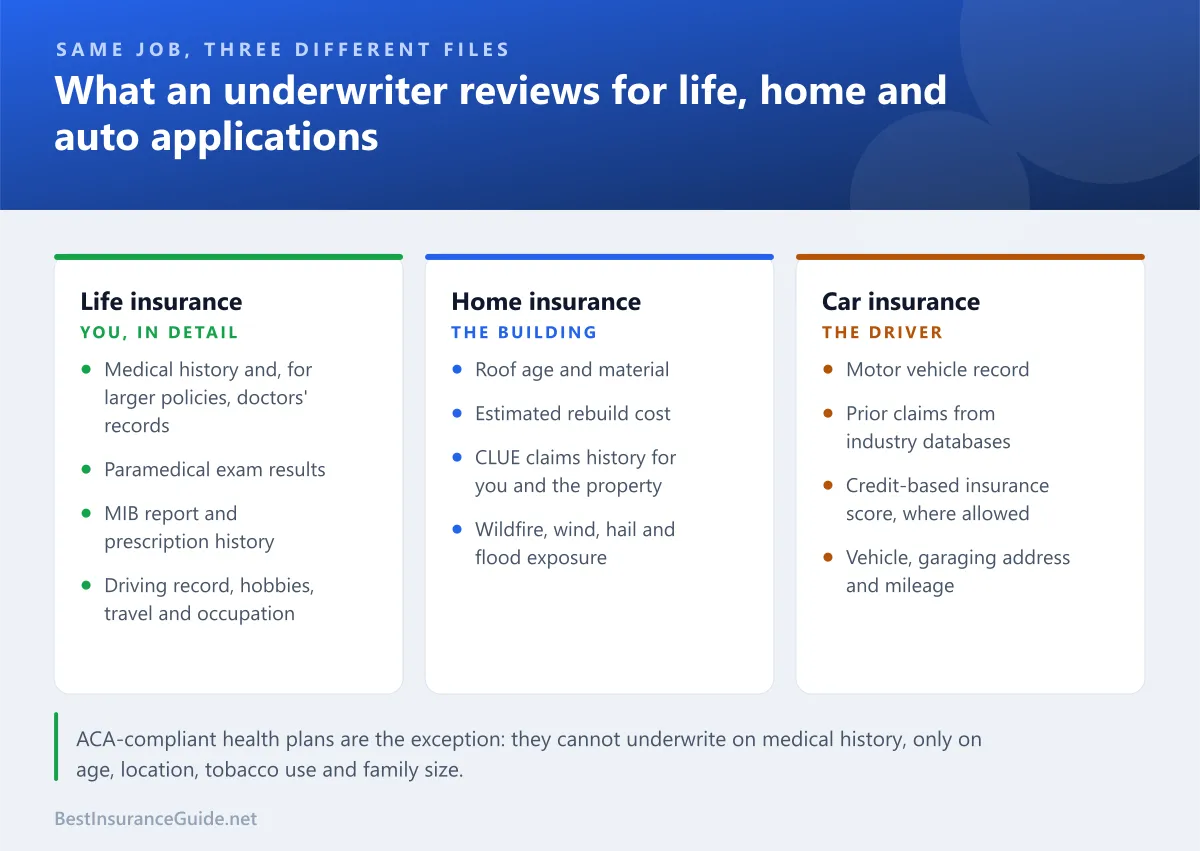
Life insurance
Life underwriting is the most detailed, because the insurer is committing to a large payment potentially decades away.
- Medical history, from your application and, for larger policies, from your doctors’ records.
- A paramedical exam for fully underwritten policies: height, weight, blood pressure, blood and urine samples.
- The MIB report. MIB is a data exchange that member insurers use to flag significant conditions disclosed on previous applications. It exists to catch applications that leave something out.
- Prescription history from pharmacy databases, which is often the fastest way for an insurer to confirm a condition.
- Motor vehicle record, because serious driving violations are a mortality risk.
- Lifestyle factors: tobacco use, dangerous hobbies, travel to high-risk countries, occupation.
- Financial justification: whether the amount of cover is reasonable for your income and obligations.
The result is a rating class, from preferred-best to standard to table-rated, and the class matters more to your premium than almost anything else. Conditions such as a past cancer diagnosis are underwritten case by case, as we cover in our guide to getting life insurance with cancer.
Home insurance
Property underwriting is about the building as much as the person.
- Roof age and material, one of the strongest factors in home underwriting and the most common reason a quote moves after application.
- Rebuild cost, estimated from square footage, construction type and finishes.
- Electrical, plumbing and heating systems, especially in older homes.
- The CLUE report, a claims history database insurers use to see past claims on you and on the property, typically going back several years.
- Location risk: wildfire, wind, hail, flood zone, distance to a fire hydrant and fire station.
- Liability hazards: pools, trampolines and some dog breeds, depending on the insurer.
- An inspection after the policy is issued, sometimes just exterior photos.
That post-issue inspection is why a home policy you were happy with can be changed or cancelled a month later. Our homeowners quote guide explains how to avoid most of those surprises by getting the details right up front.
Car insurance
- Motor vehicle record: violations, accidents and license suspensions.
- Claims history from shared industry databases.
- Credit-based insurance score, in states that allow it.
- The vehicle: repair cost, theft rate and safety record.
- Garaging address and annual mileage.
- Everyone in the household of driving age, whether or not you listed them.
Business insurance
Commercial underwriting is the most judgement-based. The underwriter will look at your operations, revenue, payroll, years in business, loss runs from previous insurers, contracts, safety programs and sometimes the premises in person. Two businesses with the same revenue can receive very different terms because one has a written safety program and five clean years of loss runs.
Health insurance
Individual and small group major medical plans that comply with the Affordable Care Act do not underwrite on health. Since 2014, those plans can only price on age, location, tobacco use and family size, and cannot decline you for a pre-existing condition. Life insurance, disability insurance, long-term care insurance and short-term health plans still use full medical underwriting.
How long does underwriting take?
This is one of the most searched questions about underwriting, and the answer depends almost entirely on the product.
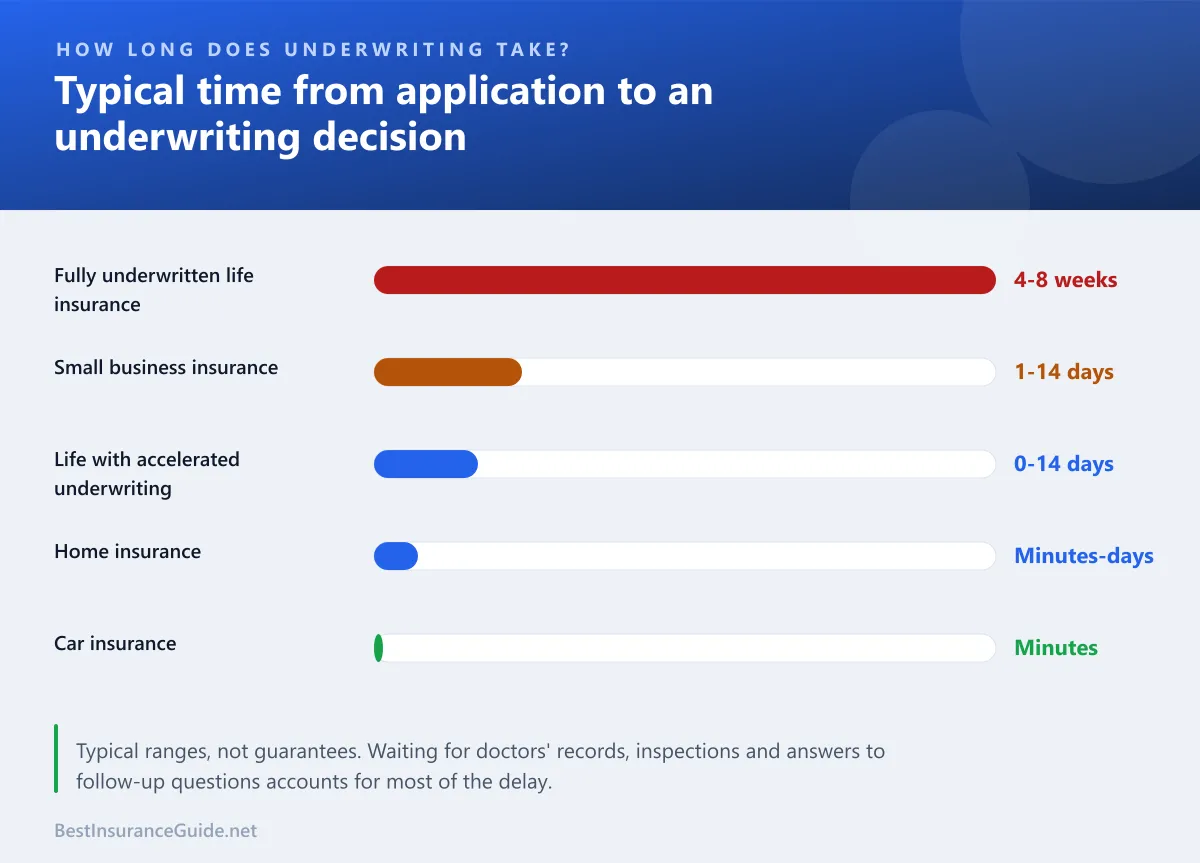
- Car insurance: minutes. Almost always automated. You can usually buy and print proof of insurance the same day.
- Home insurance: minutes to a few days. Most policies bind immediately on automated data, with an inspection in the weeks afterwards. Older homes, high values or coastal properties may need an underwriter review before binding.
- Small business insurance: same day to about two weeks. Simple risks such as a consultant’s general liability policy can be bound online. Contractors, restaurants and anything with employees or vehicles usually need a review.
- Life insurance with accelerated underwriting: same day to about two weeks. Many insurers now approve healthy applicants for moderate amounts without an exam, using prescription, MIB and motor vehicle data.
- Fully underwritten life insurance: typically four to eight weeks. The exam is quick. Waiting for doctors’ offices to send medical records is what takes the time.
If you have seen people asking how long underwriting takes for a mortgage, that is a different process. Mortgage underwriters assess whether you can repay a loan. Insurance underwriters assess the risk of a future claim. The two overlap only because your lender will require proof of home insurance before closing.
What slows the underwriting process down
- Missing or inconsistent information. An application that disagrees with CLUE, MIB or your driving record triggers a manual review.
- Attending physician statements. Requests for your medical records can sit with a doctor’s office for weeks.
- Inspections, for homes and for some commercial risks.
- Large amounts. Higher policy limits almost always mean a human review.
- Requests for more information that go unanswered because they were sent to the agent, not to you.
How to get through underwriting faster, and at a better price
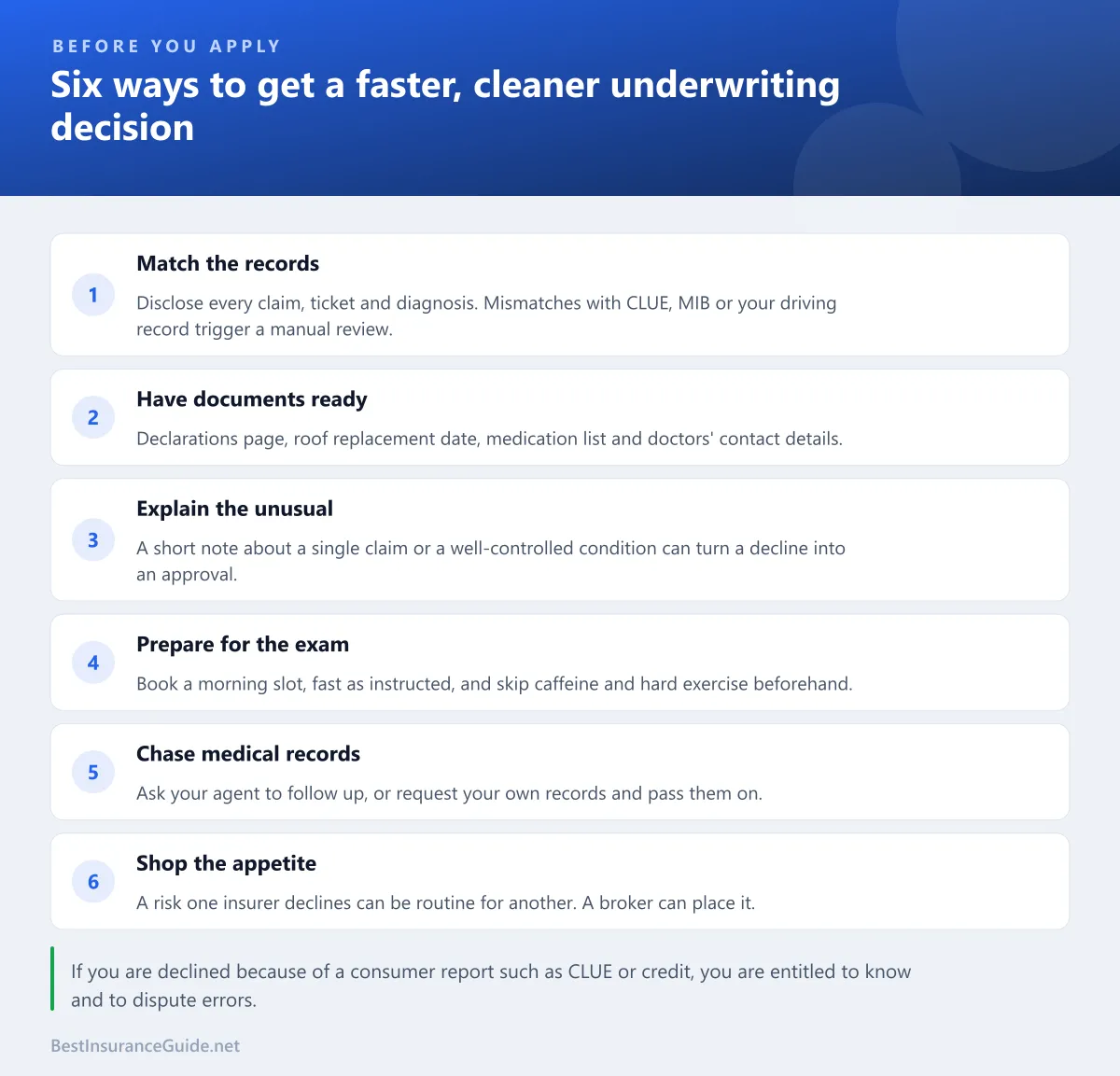
- Be accurate rather than optimistic. Underwriters will find the claim, the ticket or the diagnosis. An application that matches the records sails through; one that does not gets reviewed, and may be rated as misrepresentation.
- Have the documents ready. Your current declarations page, roof replacement date, list of medications and doctors’ contact details all save days.
- Explain anything unusual up front. A short note explaining a single claim, a condition that is well controlled or a one-off loss often turns a decline into an approval.
- For life insurance, schedule the exam well. Morning, fasted, rested, without caffeine or a hard workout beforehand. Blood pressure and lab results can shift your rating class.
- Ask your agent to chase attending physician statements. Many insurers will let you request your own records and pass them along faster than the doctor’s office will respond to them.
- Use a broker for difficult risks. Underwriting appetite varies between insurers. A risk one company declines can be routine for another. That is the core argument for comparing insurance quotes properly rather than accepting the first answer.
If you have been declined, ask for the reason. You are entitled to know if the decision was based on a consumer report such as your CLUE or credit report, and to dispute errors in it.
Can an underwriter change your policy after it starts?
Yes, within limits. For home and auto policies, most states allow a short underwriting period at the start of a new policy, commonly around 60 days, during which the insurer can cancel for almost any underwriting reason once it has reviewed inspections and records. After that, state laws generally restrict mid-term cancellation to specific reasons such as non-payment, fraud or material misrepresentation. The insurer can still choose not to renew, usually with advance written notice.
Life insurance works differently. Once the contestability period has passed, typically two years from issue, the insurer generally cannot rescind the policy for misstatements on the application, other than fraud in some states.
How to become an insurance underwriter
Underwriting is a steady, analytical career, and it is one of the few roles in insurance that does not usually require a state license.
- Pay. The Bureau of Labor Statistics reports a median annual wage of $81,370 for insurance underwriters as of May 2025.
- Outlook. BLS projects a 4% decline in employment from 2025 to 2035 as automation takes over routine decisions, but still around 6,800 openings a year from retirements and people changing jobs.
- Education. Most employers ask for a bachelor’s degree. Business, finance, economics and mathematics are common, but not required.
- Entry route. Many underwriters start as underwriting assistants or trainees, or move over from customer service, claims or agency roles.
- Designations. Property and casualty underwriters often earn the AINS or AU (Associate in Commercial Underwriting) early on, and later the CPCU, all through The Institutes. Life and health underwriters often pursue LOMA or similar credentials.
- Skills. Analysing data, reading financial statements, explaining decisions clearly to agents, and knowing when a rule should bend.
The work is shifting from routine personal lines toward complex commercial and specialty risks, and toward overseeing and refining the automated systems that handle simpler cases.
The bottom line
An insurance underwriter is the person, or increasingly the software, deciding whether your risk fits and what it should cost. You cannot control their guidelines, but you can control the quality of what they see: an accurate application, the right documents, an explanation for anything unusual, and a willingness to shop elsewhere if one insurer’s appetite does not fit you.
If you want to understand the pricing side of that decision, our guide to what drives your insurance premiums is the natural next step.
BestInsuranceGuide.net is an independent publisher and is not affiliated with any insurer. Salary and employment figures are from the US Bureau of Labor Statistics Occupational Outlook Handbook. Underwriting timelines are typical ranges and vary by insurer, state and individual circumstances.