How to Compare Insurance Quotes the Right Way (Without Overpaying)
Most quote comparisons measure nothing because the quotes aren't comparable. The five fields to match first, and how to check the insurer behind the price.

Table of contents

Most insurance comparisons measure nothing.
Not because people are careless, but because the thing being compared isn’t the same thing. One quote has a $1,000 deductible and another has $2,500. One includes replacement cost on contents and another quietly doesn’t. One shows a monthly figure that excludes a $310 down payment. Then someone picks the lowest number and calls it a saving.
Getting this right isn’t complicated. It just has to happen in the right order, and the price comparison is the last step rather than the first.
Fix these five before you request anything
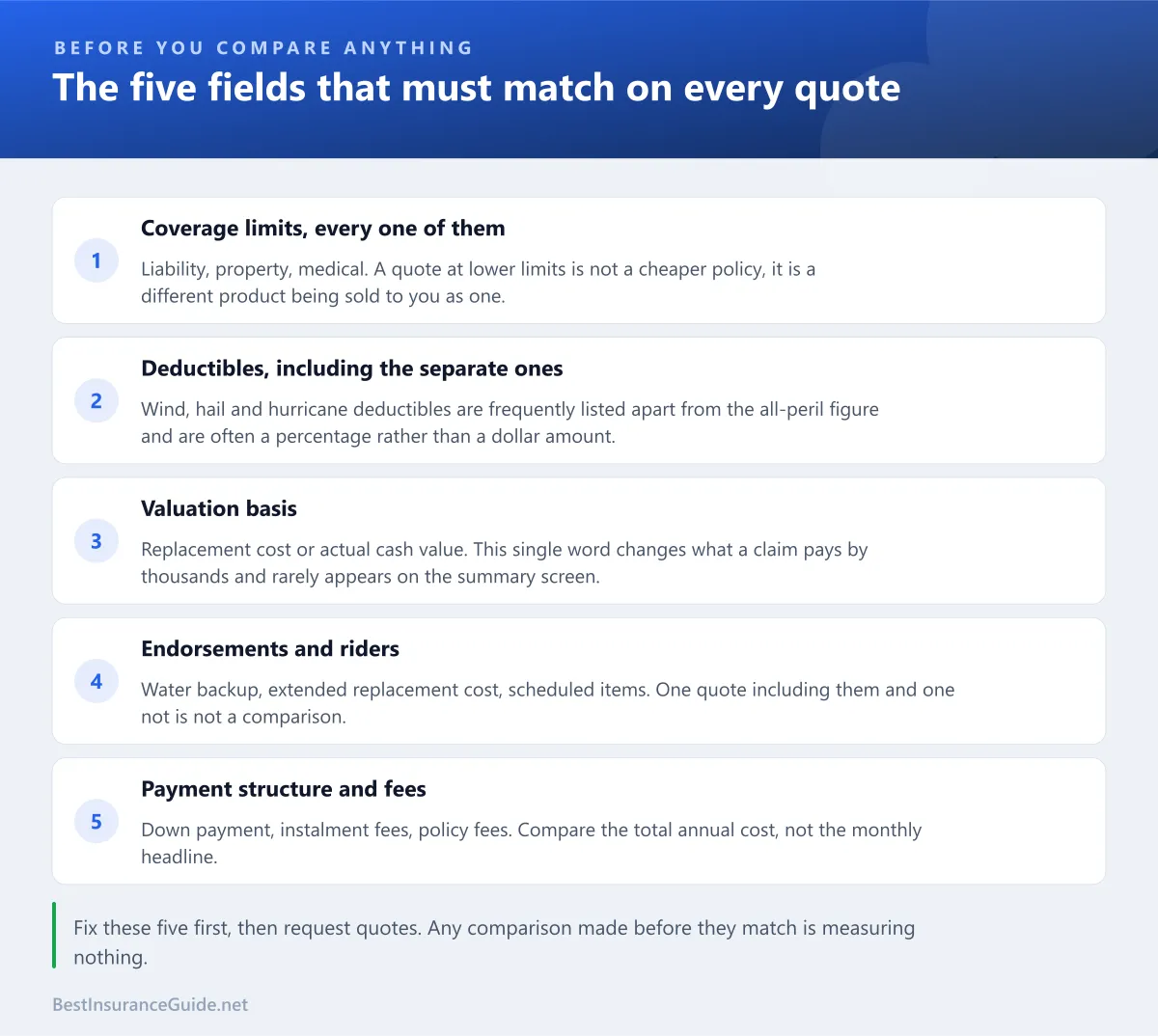
Write those five down on paper before you open a single quote form. Then give every insurer exactly the same numbers.
It sounds obvious. Almost nobody does it, because quote forms are designed to move you toward a price quickly and each one defaults differently.
Worked example: two quotes that look 27% apart
Same house, same owner, quoted the same week.
| Detail | Quote A | Quote B |
|---|---|---|
| Annual premium | $1,780 | $2,440 |
| Dwelling limit | $310,000 | $385,000 |
| All-peril deductible | $2,500 | $1,000 |
| Wind/hail deductible | 2% ($6,200) | $1,000 |
| Personal property basis | Actual cash value | Replacement cost |
| Water backup | Not included | $10,000 included |
| Extended replacement cost | No | 25% |
Quote A looks $660 cheaper. It’s a substantially smaller policy: $75,000 less dwelling cover, a hail deductible six times higher, depreciated contents, and two endorsements missing.
Re-quoted to match Quote B exactly, Carrier A came back at $2,510. The real gap was $70 the other way.
Nothing improper happened here. Carrier A’s form simply defaulted to a cheaper configuration, and the summary screen showed a premium rather than a policy.
Then compare the right things
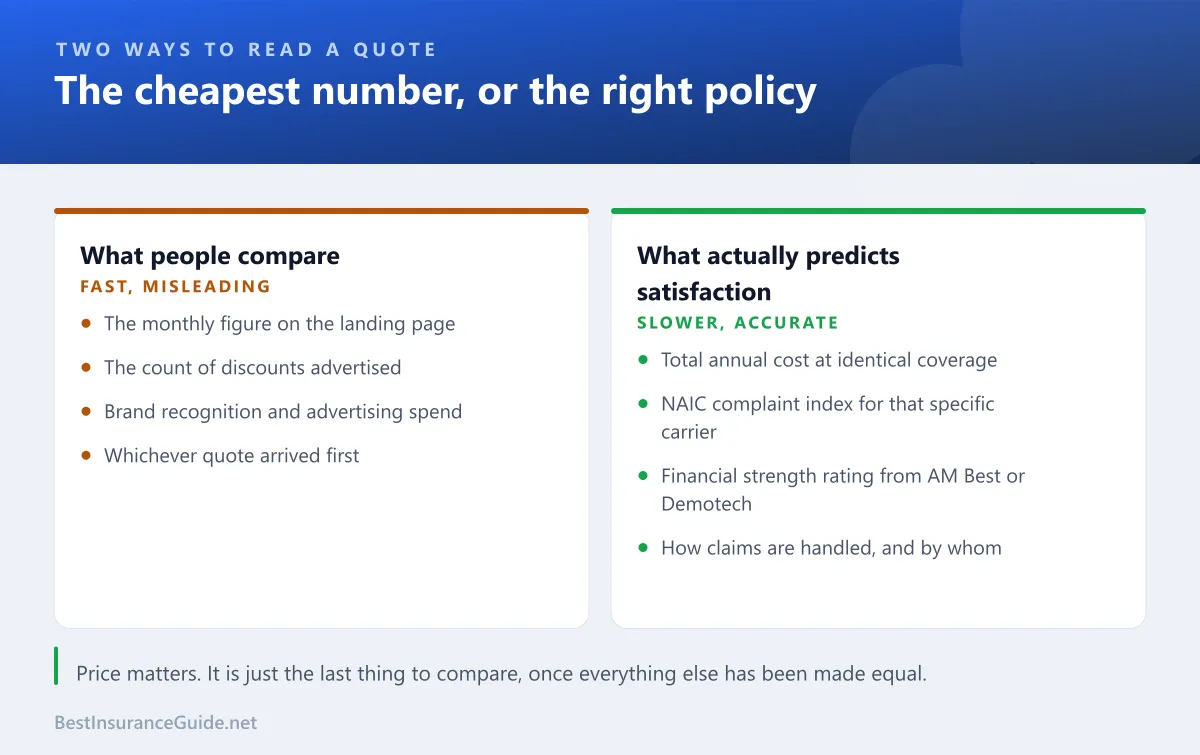
Price matters. It’s just the last thing to compare, once everything else has been made equal.
The reason is that an insurance policy is a promise to pay later, and the value of a promise depends on who’s making it. You don’t find out whether you bought well at purchase. You find out at claim time, usually years later, when the price you paid has stopped being interesting.
Check the company, not just the number
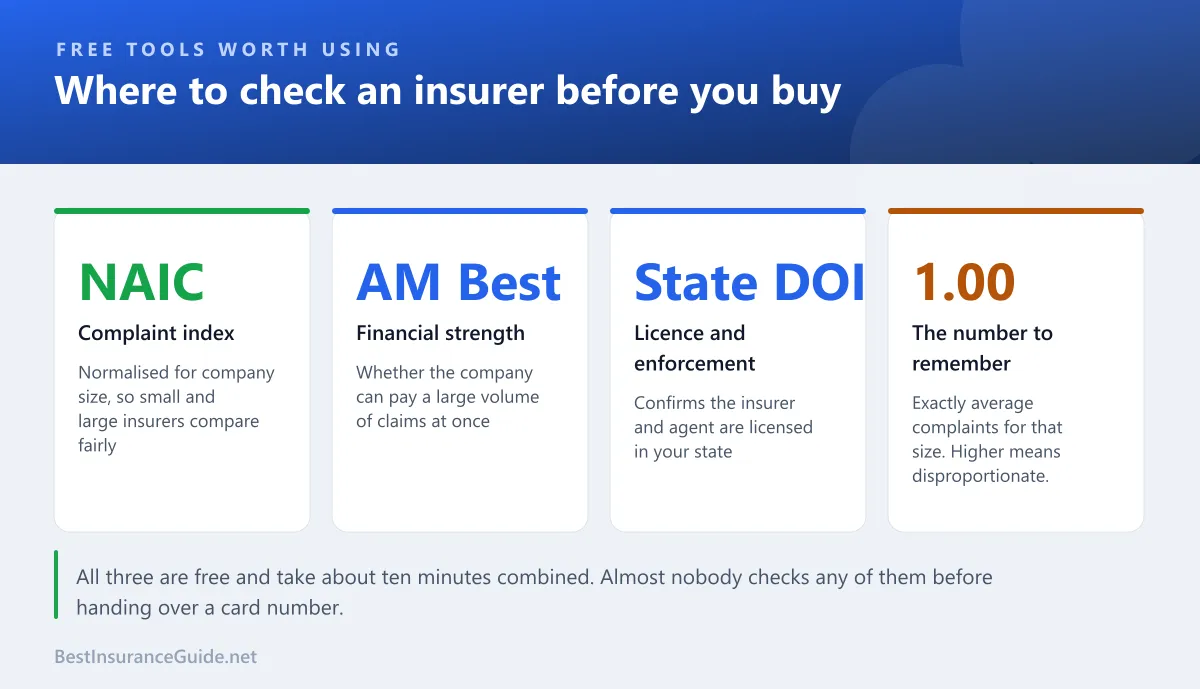
Ten minutes, all three free, and hardly anyone does it.
The NAIC Consumer Information Source publishes a complaint index for every licensed insurer. It normalises complaint volume against market share, so size doesn’t distort the comparison. 1.00 is exactly average. An insurer sitting at 3.40 is receiving more than three times the complaints you’d expect for its size, and that’s worth knowing before rather than after.
Financial strength ratings from AM Best or Demotech tell you whether the company can pay a large volume of claims at once. This matters most in catastrophe-exposed states, where a regional insurer can be perfectly solvent in normal years and badly stretched after one bad hurricane season.
Your state department of insurance confirms the licence and publishes enforcement actions.
Worked example: when the cheapest quote isn’t
Three genuinely like-for-like quotes on identical coverage.
| Detail | Carrier X | Carrier Y | Carrier Z |
|---|---|---|---|
| Annual premium | $1,640 | $1,795 | $1,830 |
| NAIC complaint index | 4.12 | 0.71 | 0.94 |
| AM Best rating | B | A | A+ |
| Average claim settlement | 41 days | 19 days | 22 days |
Carrier X saves $155 a year against Carrier Y. It also generates four times the expected complaints for its size and takes twice as long to settle.
If you never claim, X was the right answer and you saved $155. If you claim once in ten years on a $40,000 loss, the $1,550 you saved over that decade bought you a materially worse experience at exactly the moment it mattered.
That’s a judgement call rather than a rule. Just make it deliberately rather than by defaulting to the smallest number.
Where quotes legitimately differ
Even perfectly matched quotes vary, and it’s worth understanding why so you don’t chase a number that doesn’t exist.
Each insurer weights rating factors differently. One might penalise a recent claim heavily and barely notice your credit file; another does the reverse. One might love your postcode and another has taken losses there. This is why the same driver can be cheapest at one carrier and mid-pack at another with no obvious logic to it.
It’s also why re-shopping works. You aren’t looking for a universally cheap insurer. You’re looking for the one that happens to like your particular profile this year.
The mechanics, start to finish
- Find your current declarations page. It’s the template for everything else.
- Decide your five fields and write them down.
- Gather the underlying facts once. Roof age, mileage, claims history, upgrade dates. Same inputs to everyone.
- Get three to five quotes at those exact figures.
- Ask each carrier to read back every discount available, not whether you have them all.
- Check complaint index and financial strength on your top two.
- Ask about the total annual cost including fees, not the monthly figure.
- Then, and only then, compare price.
Worked example: what the process is worth
A household running the full exercise on auto and home together.
| Step | Effect |
|---|---|
| Starting combined annual premium | $4,310 |
| Corrected roof age on the home quote | −$390 |
| Two discounts surfaced by asking for the list | −$265 |
| Deductible raised $500 → $1,000 on both | −$310 |
| Switched home carrier after matching coverage | −$180 |
| New combined annual premium | $3,165 |
$1,145 a year, for roughly ninety minutes of work. Note that switching carriers was the smallest single item on that list. Most of the saving came from fixing their own file and asking better questions, which is the general pattern.
Things that quietly cost people money
Comparing monthly figures. Down payments, instalment fees and policy fees vary enormously between carriers and none of them show up in a monthly headline. Always compare the total annual cost.
Assuming discounts transfer. They don’t. Every discount has to be claimed again at the new carrier, and the new carrier may not offer the same ones. Our full discount list covers what to ask for.
Letting coverage lapse during a switch. Even a one-day gap creates a lapse, which is its own rating factor at your next renewal. Set the new policy’s start date before the old one’s end date, and cancel the old one in writing afterwards.
Only quoting at renewal time. Some carriers reward getting a quote seven to ten days before your current policy expires. Leaving it to the last day forfeits that.
Not re-quoting after life changes. Marriage, a house purchase, retirement, a move, a child leaving home. Each of those changes your rating profile and none of them reach your insurer automatically.
A note on comparison websites
They’re genuinely useful for a fast market sweep, and they’re not the whole market. Several large insurers don’t appear on them at all, and the quotes they return are often based on a shortened question set that misses discounts.
Use one to establish a range and identify two or three candidates, then quote those directly. The direct quote is frequently lower than the same carrier’s comparison-site figure, because the longer form captures more about you.
Comparing the insurer, not just the price
Two quotes can be identical on coverage and still represent very different products, because what you are buying is a promise to pay later.
Check the complaint index. The NAIC publishes a complaint ratio for every insurer, normalised for size. It is the single most useful public measure of how an insurer behaves at claim time, and it is free.
Check financial strength ratings. AM Best, S&P and Moody’s publish them. A cheap policy from a weakly rated carrier is a poor trade in a line where the payout may come years later.
Ask how claims are handled. In-house adjusters or contractors, a 24-hour line or business hours, an app or a phone tree. These differences are invisible on a quote and obvious during a loss.
Look at the repair network arrangements for auto and property. Some insurers steer to preferred shops with a guarantee, some allow free choice. Neither is wrong; know which you are buying.
Check renewal behaviour. Some insurers quote aggressively and increase sharply at first renewal. Asking existing customers, or simply reading the complaint index, gives you a signal.
Worked example: same coverage, different insurers
| Detail | Insurer A | Insurer B |
|---|---|---|
| Annual premium | $1,390 | $1,505 |
| Financial strength rating | B++ | A+ |
| NAIC complaint index | 1.9 (above average) | 0.6 (below average) |
| Claims line | Business hours | 24 hours |
| Choice of repair shop | Restricted | Free choice |
Insurer A is $115 cheaper. Insurer B is the better purchase, and the gap is small enough that the difference is a rounding error against one badly handled claim.
Price is the easiest thing to compare, which is why it dominates. It is rarely the most important.
Keeping a comparison you can reuse
The work of comparing quotes properly is mostly gathering, and gathering once beats gathering annually.
Build a single sheet with the coverage specification you have decided on: liability limits, deductibles, uninsured motorist limits, endorsements, dwelling and contents figures. That specification is the thing you quote against, and it does not change much year to year.
Then record each quote against it, plus the insurer’s financial strength rating and complaint index. Keep the declarations page of whatever you buy.
Next renewal, you are not starting from scratch. You are re-quoting a specification you already trust, which turns a two-hour job into twenty minutes and removes the main reason people skip it.
Two additions worth making to the sheet. Note the date of any rated event, so you know when a violation ages off and it becomes worth shopping again. And record what each insurer quoted last time, because the pattern of who is competitive for your profile tends to persist.
One caution: quoting too frequently with a broker who submits to many carriers can leave a trail of enquiries that some insurers view unfavourably. Quoting once a year or two, with matched coverage, is the sensible rhythm.
Do it once, properly, then diarise it
The single highest-value habit here is a calendar reminder a month before each renewal. Not because switching is always right, but because checking is the only way to know whether staying is.
Our guide to what drives your premiums covers the rating factors underneath any quote you’ll receive, and insurance basics covers the terms if any of the above was unfamiliar.
Set the reminder now. It takes eleven seconds and it’s worth more than the rest of this article.