Business Insurance in Charlotte NC: Growth, Contracts and the Three-Employee Rule
What Charlotte businesses need to insure, the North Carolina three-employee workers compensation threshold, contract requirements, and storm exposure.

Table of contents

Charlotte is one of the faster-growing business markets in the country, and growth interacts badly with a specific North Carolina rule that catches businesses just as they start hiring.
The three-employee threshold
North Carolina does not require workers compensation from the first employee. It generally requires it once a business has three or more employees, with exceptions for certain hazardous activities where the requirement applies sooner.
That threshold produces a specific problem in a growing market.
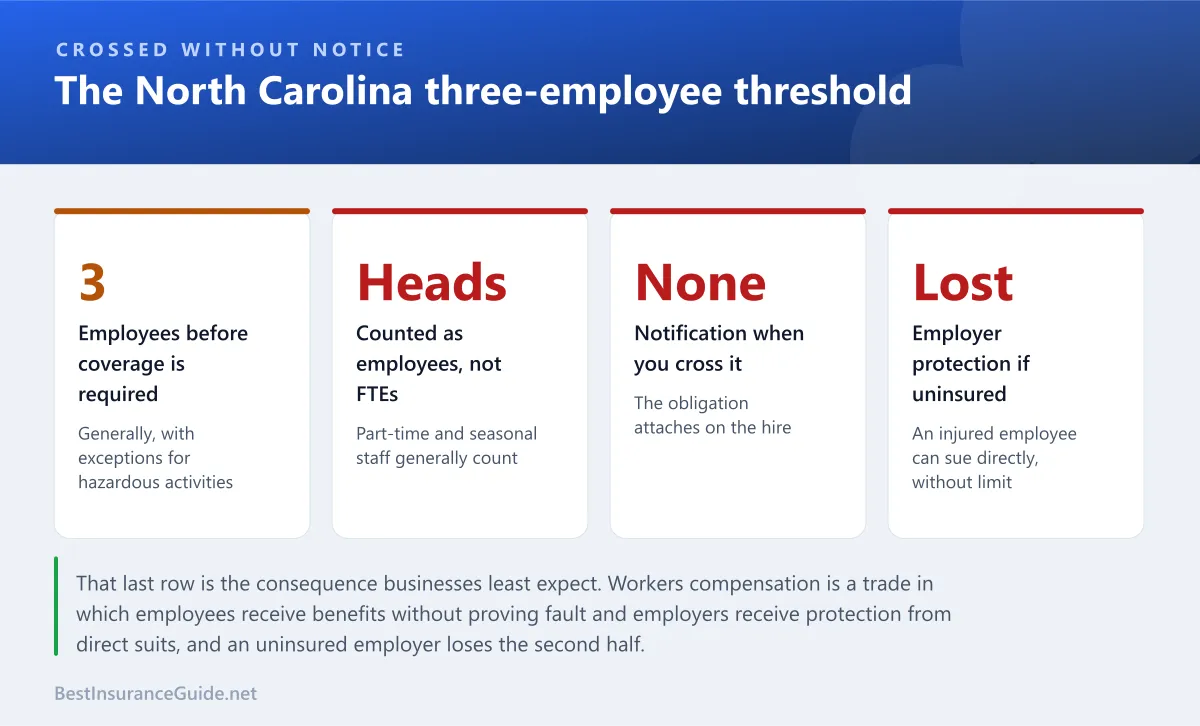
The count is of employees, not full-time equivalents. Part-time and seasonal staff generally count, which means a business with two full-time and two part-time workers is over the threshold while the owner believes it has two employees.
It moves with hiring, and nobody announces it. A business crossing from two to three employees on a Monday needs coverage from that point, and there is no notification mechanism.
The consequence of being uninsured is not just a penalty. It removes the protection workers compensation gives an employer against direct injury suits, which means an injured employee can sue the business directly with no statutory limit on the recovery.
Certain activities require coverage from the first employee, and the exceptions matter.
The practical instruction for any growing Charlotte business: know the threshold, count correctly, and arrange coverage before rather than after the hire that crosses it.
What Charlotte’s economy means for insurance
The city’s sector mix produces a recognisable set of programmes.
Financial and professional services, which dominate uptown. The critical coverage here is professional liability, alongside cyber liability, and general liability is largely a landlord requirement rather than the main exposure.
Construction and trades, driven by sustained development. Workers compensation classifications dominate the cost, subcontractor certificates dominate the risk management, and contract requirements dominate the limits.
Logistics and distribution, along the interstate corridors. Commercial auto is the largest severity exposure, and cargo and inland marine matter.
Healthcare and life sciences, with professional liability, cyber and regulatory exposures.
Hospitality and retail, where premises liability, liquor liability where applicable, and business income cover are the priorities.
Technology and startups, where professional liability, cyber and, once there is outside investment, directors and officers cover become relevant.
The contract requirements
As everywhere, most of a Charlotte business programme exists because somebody demanded it.
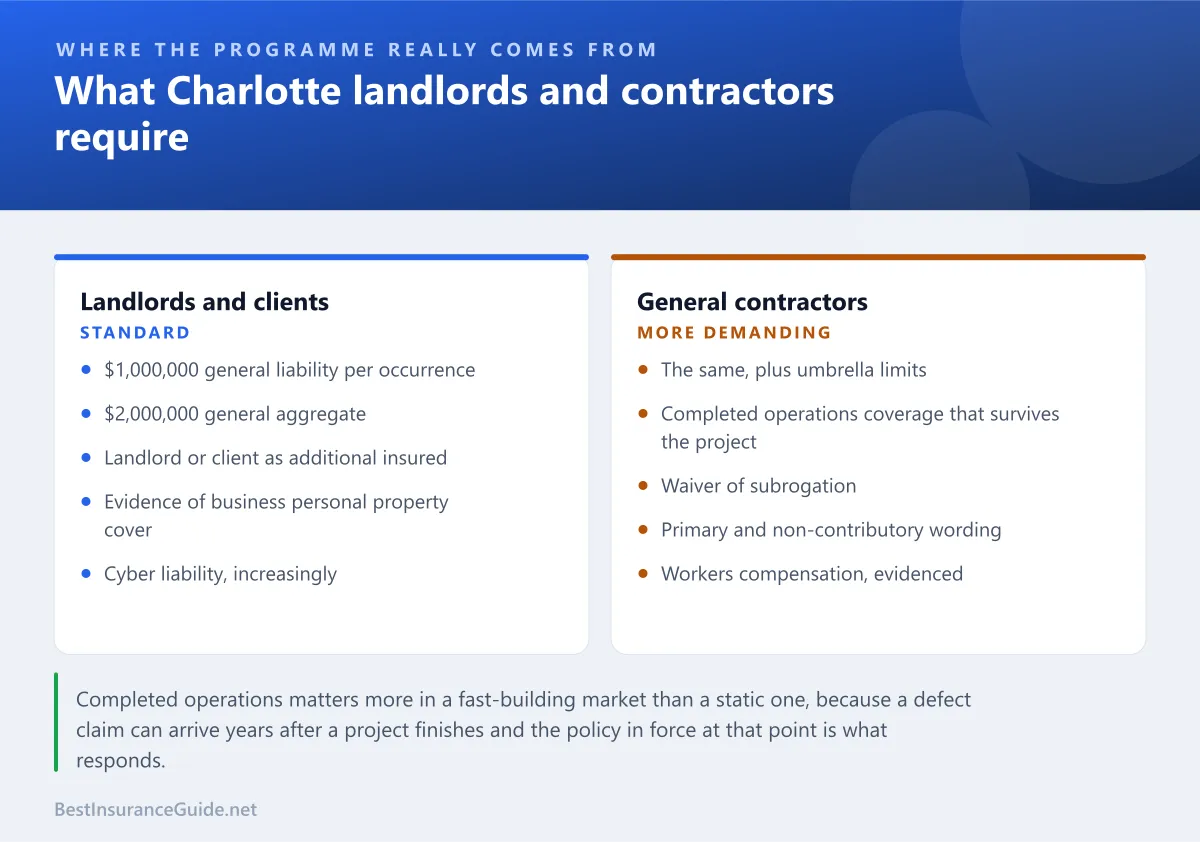
Commercial landlords require general liability at $1,000,000 per occurrence with additional insured status, and increasingly require evidence of business personal property cover.
General contractors require the same plus umbrella limits, waivers of subrogation, and completed operations coverage that survives project completion.
The city and county, for any public work, publish their own schedules and check them properly.
Larger clients increasingly require cyber liability and, for any advisory work, professional liability.
Two Charlotte-specific points. Development contracts frequently require higher limits than a small contractor expects, and completed operations coverage matters more here than in a static market, because a defect claim can arrive years after a project finishes and the policy in force at that point is what responds.
The weather exposure
Charlotte is inland, which removes storm surge and leaves several other things.
Tropical remnants, which reach the Piedmont as wind and heavy rainfall events days after landfall elsewhere. Inland flooding from these is a genuine exposure and is not covered by a property policy.
Hail and straight-line wind, which the region records regularly and which drive roof-focused property underwriting.
Winter ice events, less frequent than further north and more disruptive when they occur, producing both property damage and business interruption.
Falling trees, in a heavily wooded region.
All of which points at two coverages: business income and extra expense, which is the line most commonly bought too thin, and flood, which is a separate policy and is voluntary outside mapped high-risk zones where a substantial share of the damage actually occurs.
Building the programme
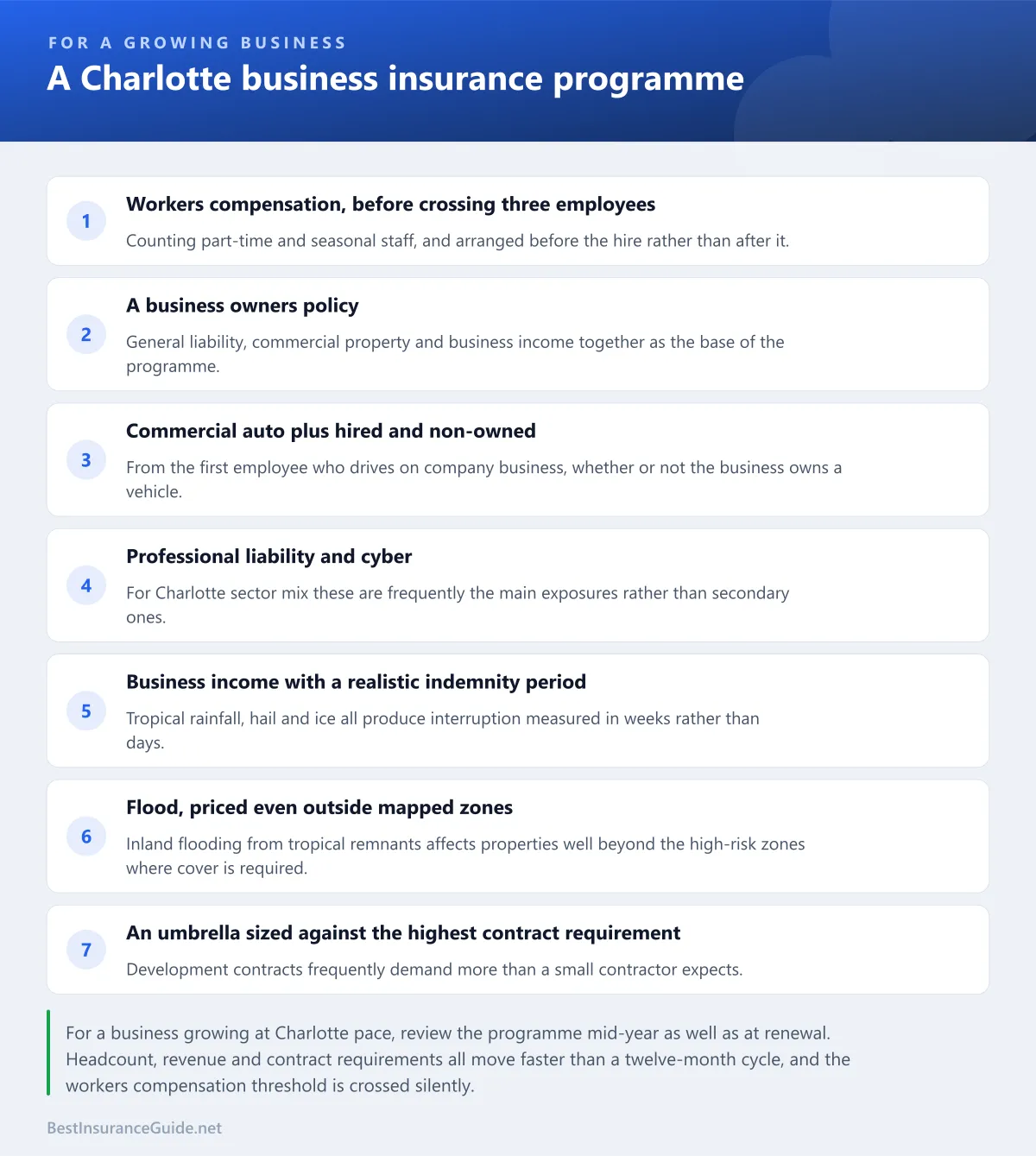
Workers compensation, once the threshold is met, and arranged before the hire that crosses it.
A business owners policy, packaging general liability, commercial property and business income.
Commercial auto, plus hired and non-owned auto for employees driving their own vehicles on company business.
Professional liability, for the substantial share of Charlotte businesses providing advice or professional services.
Cyber liability, for anybody holding customer data or taking payments.
Inland marine, for tools and equipment away from premises.
Employment practices liability, once there are employees.
A commercial umbrella, sized against the highest contract requirement, which our guide to business umbrella insurance covers.
Directors and officers cover, once there is a board or outside investment.
Managing the cost as you grow
Growth is what changes a Charlotte business programme, and four things move with it.
Payroll, which drives workers compensation, and where classification accuracy matters as roles diversify.
Revenue, which drives general liability.
Headcount, which triggers the workers compensation threshold and later makes employment practices liability relevant.
Contracts, which ratchet limit requirements upward as clients get larger.
The practical habit is a mid-year review as well as an annual one for any business growing quickly, because the annual cycle can leave a business uninsured against a requirement it acquired eight months earlier.
The short version
North Carolina generally requires workers compensation at three or more employees, counting part-time and seasonal staff, with certain activities requiring it sooner. In a fast-growing market that threshold is crossed without anybody noticing, and the consequence includes losing the employer’s protection against direct injury suits.
Everything else in a Charlotte programme comes from contracts: landlords, general contractors, the city and county, and larger clients, all of whom set limits and endorsements rather than the statute.
Charlotte’s inland position removes storm surge and leaves tropical rainfall, inland flooding, hail and ice, which points at business income cover and at flood as a separate purchase.
And for a growing business, review the programme mid-year as well as annually, because headcount, revenue and contract requirements all move faster than a renewal cycle.
For the excess layer, see business umbrella insurance, and for the programme generally, the business insurance checklist.
What changes as headcount grows
A growing business crosses several thresholds and none of them announce themselves.
At three employees, the North Carolina workers compensation requirement generally attaches, counting part-time staff.
At the first employee driving on company business, hired and non-owned auto becomes relevant, whether or not the business owns a vehicle.
At around ten to fifteen employees, employment practices liability moves from optional to sensible, because the frequency of employment claims rises with headcount and the cost of defending one is substantial regardless of merit.
At the first outside investment or a formal board, directors and officers liability becomes relevant.
At the first meaningful client contract, the limit requirements in that contract become the effective floor for the whole programme.
At the first physical location beyond the original, the property and business income schedule needs restating rather than assuming the existing policy extends.
Worked example: a three-year growth path
| Detail | Year one | Year two | Year three |
|---|---|---|---|
| Headcount | 2 | 5 | 14 |
| Workers compensation | Not required | Required | Required, with audit exposure |
| Hired and non-owned auto | Advisable | Necessary | Necessary |
| Employment practices liability | Not yet | Consider | Sensible |
| Umbrella limit driven by contracts | None | $1M | $2M to $5M |
| Cyber liability | If taking payments | Yes | Yes, and clients now require it |
Each row changed because the business grew rather than because anything went wrong, and a business reviewing only at renewal can be a year behind on several of them.
Two things a growing business should do
Set a mid-year review with your broker, not just an annual renewal meeting. In a market growing at Charlotte’s pace, headcount, revenue, vehicles and contract requirements all move faster than a twelve-month cycle, and the workers compensation threshold in particular is crossed without notice.
Keep a live contract register listing every signed agreement and the insurance requirements in each. It takes an hour to build and it converts a scattered set of obligations into a single checklist you can hand to a broker.
What to ask a broker
Am I over the workers compensation threshold, counting part-time and seasonal staff?
Does my general liability include products and completed operations, and does my additional insured endorsement extend to completed operations?
Do I have hired and non-owned auto, and does it cover the way my staff actually drive?
What is my business income limit and indemnity period, and is that realistic for a regional weather event?
Am I carrying flood cover, and what would it cost if I am not?
What endorsements are available that I do not currently hold?
That last question is the most productive one in any insurance conversation and it is almost never asked.
What drives the cost in the Charlotte market
Industry classification above all, with construction and transport at one end and professional services at the other.
Payroll and revenue, driving workers compensation and general liability.
Location within the metro, since ZIP-level experience affects property and auto rating just as it does personal lines.
Property construction and protection class, meaning how the building is built and its distance from fire services.
Roof age, which in a hail-exposed region is now a primary property underwriting factor.
Loss history, and specifically the workers compensation experience modification factor, which multiplies premium directly and improves over several years of good performance.
Fleet telematics and cameras, which carriers now credit meaningfully and which resolve the disputed liability claims that drive commercial auto severity.
The order to build it in
Count the employees first and arrange workers compensation before crossing the threshold rather than after.
A business owners policy next, for liability, property and business income.
Commercial auto and hired and non-owned, from the first employee who drives on company business.
Professional liability and cyber, which for Charlotte’s sector mix are frequently the main exposures rather than secondary ones.
Then the contract requirements, extracted from every signed agreement into one list.
Then the umbrella, sized against the highest of them.
Two more things worth knowing
Completed operations coverage survives the project and is what responds to a defect claim arriving years later. In a market building at Charlotte’s pace, that tail is real, and the policy in force when the claim arrives is what matters rather than the one that covered the work.
Certificates are checked properly here. The city, the county and the larger general contractors verify certificates rather than filing them, which means a gap between what a certificate says and what the policy provides surfaces before a claim rather than after it. That is an advantage as long as your paperwork matches your cover.
How other states set the threshold
North Carolina’s three-employee threshold matches Georgia, and both count part-time and seasonal staff toward it.
At the stricter end, Pennsylvania, New Jersey and Illinois attach from the first employee. Michigan uses a dual test, and Florida varies by industry.
A note on scope
Nothing here is legal advice. North Carolina workers compensation thresholds, exceptions, exemptions and enforcement practice are set by state law and regulation and change over time, and the rules include qualifications not covered here.
The North Carolina Industrial Commission publishes the authoritative workers compensation requirements, the North Carolina Department of Insurance publishes commercial guidance, and FEMA publishes flood zone determinations. Your contracts and policy documents are the authoritative statement of what you must hold and what you hold. This site is independent and not affiliated with any insurer.