Older Mobile Home Insurance: Why 1976 Matters and How to Get Covered
Insurance for older mobile homes: why pre-1976 HUD Code homes are hard to insure, actual cash value vs replacement cost, and upgrades that help.

Table of contents

Mobile and manufactured homes are an affordable way to own a home, and many are decades old and still perfectly livable. Insuring one of those older homes is a different story. Owners of a 1970s or 1980s mobile home often find that the first insurer declines, the second will only pay a depreciated value, and the third wants photos of the tie-downs before it will quote.
This guide explains why older mobile home insurance is harder to find, the importance of the 1976 HUD Code, what coverage for older mobile homes typically looks like, and the practical steps and upgrades that make an older home easier and cheaper to insure.
Why older mobile homes are harder to insure
Insurers price risk based on how likely a home is to suffer a loss and how much that loss will cost. Older mobile homes score poorly on both.
- Construction standards. Homes built before 1976 were not subject to national construction standards, and even later homes were built to wind standards that were strengthened in 1994.
- Wind vulnerability. Lighter construction and older anchoring systems make older homes more vulnerable to high winds and tornadoes.
- Fire risk. Older electrical systems, including aluminum branch wiring used in some homes built in the 1960s and 1970s, and older heating appliances raise fire risk.
- Water damage. Aging plumbing, including polybutylene pipes installed in many homes in the 1980s and 1990s, and worn roofs raise the risk of leaks.
- Valuation. Older mobile homes depreciate, and their market value can be far below what it would cost to replace them. That gap makes insurers reluctant to offer replacement cost coverage.
Why 1976 matters: the HUD Code
The most important date for any mobile home owner is June 15, 1976. That is when the federal Manufactured Home Construction and Safety Standards, commonly called the HUD Code, took effect.
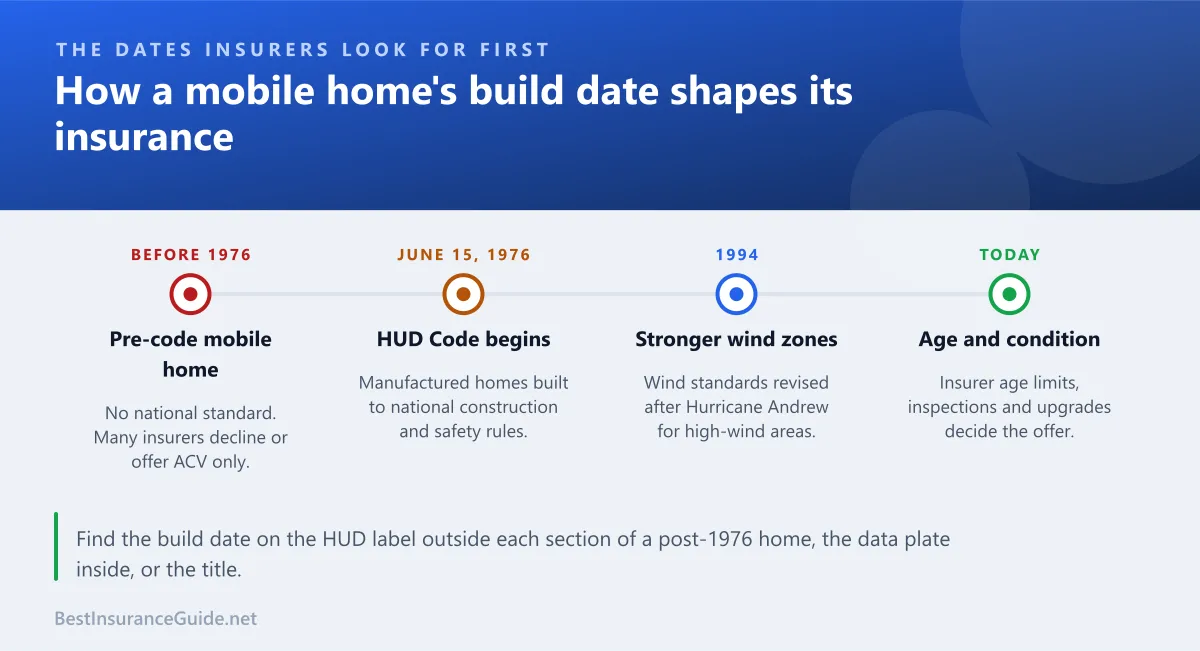
- Homes built before June 15, 1976 are, technically, mobile homes. They were built to whatever standards the manufacturer or state applied, which varied widely.
- Homes built on or after that date are manufactured homes, built to a single national code covering design, construction, fire safety, energy efficiency, plumbing, heating and electrical systems. Each carries a HUD certification label.
- After Hurricane Andrew in 1992, HUD strengthened the wind standards, with revised wind zone requirements taking effect in 1994. Homes built for the higher wind zones, typically coastal areas, must withstand much stronger winds.
In everyday speech, and in many insurance products, “mobile home” and “manufactured home” are used interchangeably. For insurance, the build date matters more than the label. Many standard insurers will not write a pre-HUD Code home at all, and some set their own age cutoffs for later homes.
You can usually find the build date on the HUD label (a metal plate on the exterior of each section of post-1976 homes) or the data plate inside the home, often in a kitchen cabinet or bedroom closet. For older homes, the title usually shows the year.
What older mobile home insurance covers
Mobile home insurance generally mirrors a homeowners policy, with coverage for:
- The dwelling: the home and attached structures such as porches and carports.
- Other structures: detached sheds and garages.
- Personal property: furniture, clothing and belongings.
- Loss of use: extra living costs if a covered loss makes the home uninhabitable.
- Personal liability and medical payments for injuries to others.
Some mobile home policies add coverage that a standard homeowners policy does not, such as trip collision coverage while the home is being moved, and coverage for debris removal, which can be expensive after a total loss.
Actual cash value vs replacement cost
This is the biggest difference for older homes. Many insurers only offer actual cash value coverage on older mobile homes, meaning the insurer deducts depreciation from any claim.
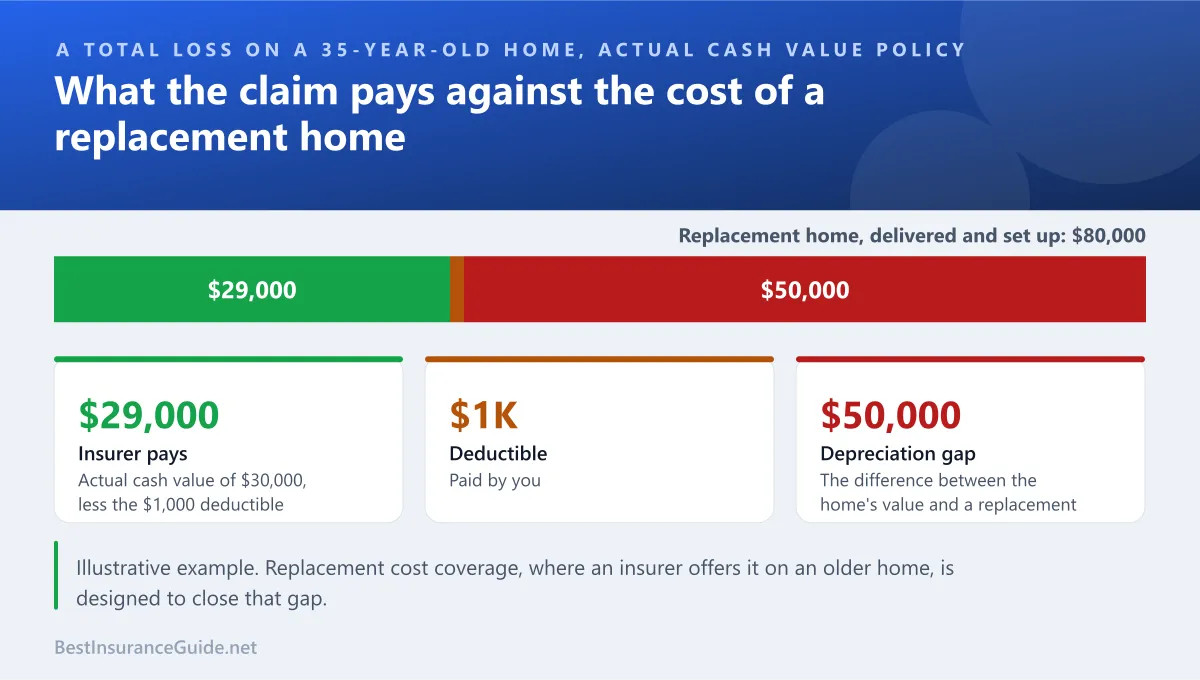
For example, suppose a total loss would cost $80,000 to replace with a comparable manufactured home, delivered and set up, but the insurer values the 35-year-old home at $30,000 after depreciation. With a $1,000 deductible, an actual cash value policy would pay $29,000, leaving a large gap between the claim and the cost of a replacement home.
Some insurers offer replacement cost on newer or well-maintained older homes, sometimes with an age limit or a condition inspection. Where it is available, it is usually worth the extra premium. Our guide to replacement cost vs actual cash value explains the difference in detail.
What is usually not covered
- Flood, which needs a separate flood policy. Manufactured homes are eligible for NFIP flood insurance. See our guide to flood damage and renters insurance for how flood policies and waiting periods work.
- Earthquake, which needs separate coverage where available.
- Wear, tear and deterioration, including roof and plumbing failures caused by age rather than a sudden event.
- Pest and rodent damage.
- The land, whether you own it or rent a lot.
Where to find insurance for older mobile homes
If a standard homeowners insurer declines your older home, you still have options.
- Specialty mobile and manufactured home insurers. Several insurers focus on manufactured housing and have more flexible age rules.
- Independent agents and brokers. An agent who works with several insurers can shop your home to the carriers most likely to accept it. Our guide to insurance brokers and agents explains how they differ.
- Surplus lines insurers, which can cover risks that standard insurers decline, usually at a higher price and with fewer consumer protections.
- State insurers of last resort, such as FAIR plans and state wind pools in some states, which provide basic coverage when the private market will not.
- Community or lender programs. Some mobile home communities and lenders can point you to insurers that already write homes in the community.
When comparing quotes, check whether each is actual cash value or replacement cost, what the wind or hurricane deductible is, and whether there are age or condition requirements that could lead to non-renewal later. Our guide to comparing insurance quotes covers how to line them up fairly.
Upgrades that make an older mobile home easier to insure
Insurers focus on the same few systems again and again. Upgrading them, and documenting the work, can turn a decline into an offer and an actual cash value offer into replacement cost.
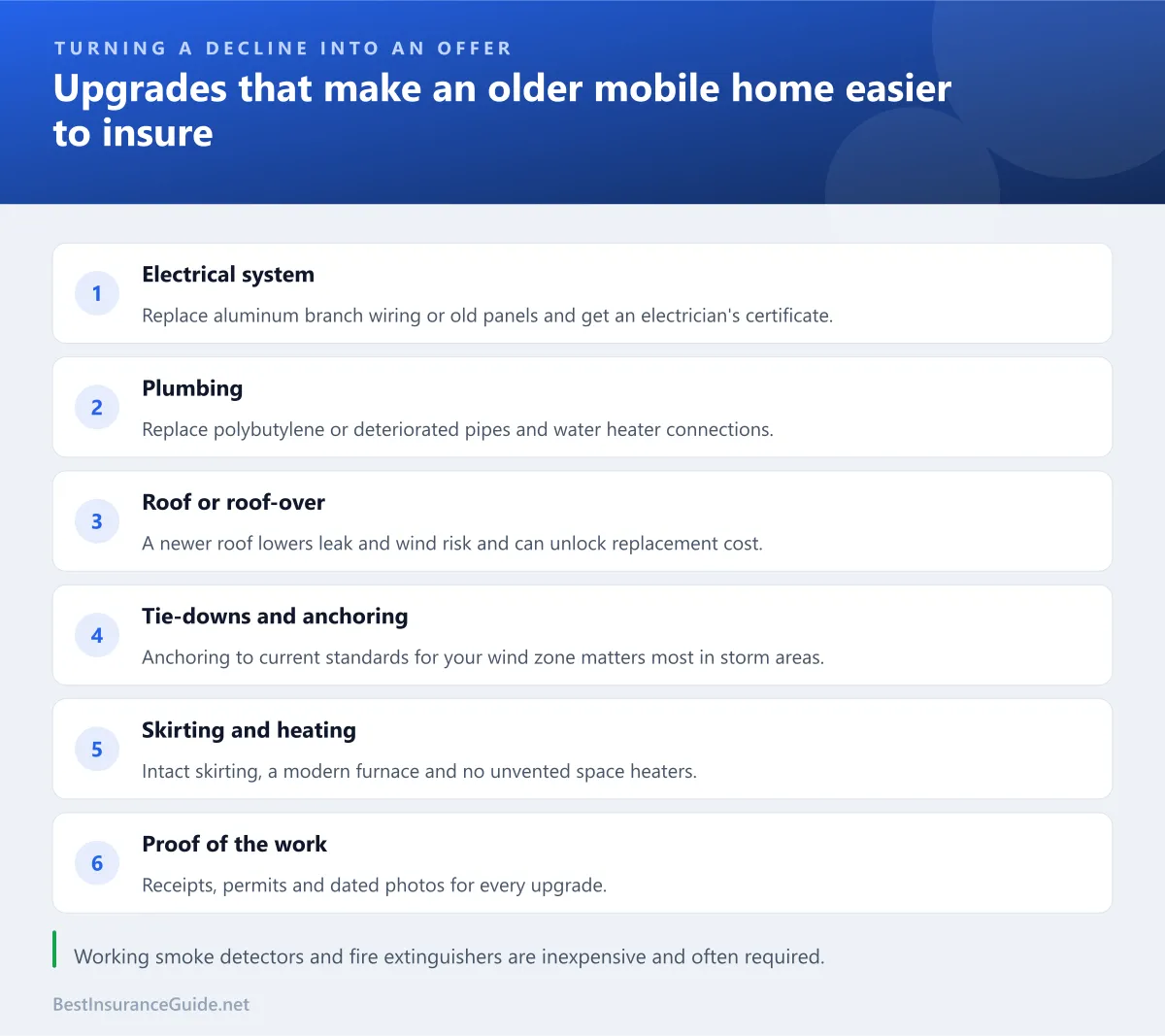
- Electrical. Replace aluminum branch wiring or old panels, and have a licensed electrician certify the system.
- Plumbing. Replace polybutylene or deteriorated pipes and water heater connections.
- Roof. A new roof or a professionally installed roof-over reduces leak and wind risk, and newer roofs are often required for replacement cost.
- Tie-downs and anchoring. Proper anchoring to current standards for your wind zone is one of the most important factors in wind-prone areas.
- Skirting. Intact skirting keeps animals out and protects plumbing from freezing.
- Heating. Replace old furnaces and remove unvented space heaters.
- Safety equipment. Working smoke detectors, fire extinguishers and, where applicable, carbon monoxide detectors.
- Documentation. Keep receipts, permits and photos of every upgrade, with dates.
Preparing for an insurer’s inspection
Insurers writing older mobile homes often inspect them, either with an inspector on site or by asking you for photos. A little preparation makes a real difference.
- Photograph the exterior from all four sides, including the roof line, skirting and any additions such as porches or carports.
- Show the anchoring: photos of tie-down straps and anchors, and any certificate from an installer.
- Show the electrical panel and water heater, with labels or receipts for any replacements.
- Clear hazards: remove debris, secure loose skirting, trim overhanging branches and fix obvious leaks before the inspection.
- Have documents ready: the title, HUD label or data plate details, and receipts for upgrades.
Additions are a common problem. Porches, carports and room additions that were not built to code or not properly attached can lead to exclusions or a decline. If an addition was built professionally, keep the permit.
Keeping your policy at renewal
Getting an older mobile home insured is only half the task. Insurers can non-renew at the end of the policy term, usually with advance written notice, and older homes are more exposed to that.
- Maintain the home visibly. Roof condition, skirting and exterior paint are what an inspector notices first.
- Report upgrades to your insurer as you make them; they may improve your terms at renewal.
- Avoid small claims close to the deductible. A claims history can matter more for older homes, whose insurers have less appetite for repeat losses.
- Watch for wind deductible changes. In coastal states, insurers may raise hurricane or wind deductibles at renewal, which changes how much a storm would cost you.
- Start shopping early if you receive a non-renewal notice, since older homes have fewer insurers to choose from and a new policy may require an inspection.
How much does older mobile home insurance cost?
There is no reliable single figure, because older mobile home premiums vary hugely by state, wind zone, the home’s value and condition, and the insurer. Two points are consistent:
- Coastal and tornado-prone locations cost more, and may carry separate wind or hurricane deductibles.
- Actual cash value policies cost less than replacement cost, but they pay less too. Compare the premium against what each would pay after a total loss, not just the price.
Discounts to ask about
Older mobile home owners have fewer discounts available than site-built homeowners, but several are worth asking for:
- Bundling the home with an auto policy from the same insurer.
- Protective devices such as smoke detectors, fire extinguishers, deadbolts and monitored alarms.
- Tie-down or wind mitigation credits in states that offer them for properly anchored homes.
- Claims-free and paid-in-full discounts.
- Community location, where some insurers price homes in managed communities more favorably.
Your claims history and, in most states, a credit-based insurance score also affect the price. See our guide to the insurance score.
Mobile home communities and financed homes
Mobile home communities often require residents to carry liability insurance, and sometimes property coverage, as a condition of the lot lease. Check your lease for required limits and whether the community must be listed on your policy.
Financed homes require insurance by the lender, who will usually be listed on the policy as a loss payee or mortgagee and may require a minimum amount of coverage. Older homes are less often financed, but if yours is, the lender’s requirements come first.
Real property or personal property?
How your home is titled affects how it is insured.
- A mobile home on a rented lot is usually titled like a vehicle and treated as personal property. It is typically insured on a mobile or manufactured home policy.
- A home permanently affixed to land you own, with the title converted to real property where your state allows it, may be eligible for a standard homeowners policy and treated more like a site-built home.
Converting to real property can open more insurance and financing options, but the rules vary by state and the process has costs. Check with your state’s titling agency.
The bottom line
Older mobile homes can be insured, but the build date shapes everything. Homes built before the June 15, 1976 HUD Code face the most restrictions, and homes built before the 1994 wind standards face tougher terms in coastal areas. Expect fewer insurers, more actual cash value policies and more inspections, and improve your options by upgrading the electrical, plumbing, roof and anchoring, documenting the work, and shopping through an agent who knows the manufactured home market.
BestInsuranceGuide.net is an independent publisher and is not affiliated with HUD or any insurer. The worked example is illustrative. Coverage availability, age limits and settlement terms vary by insurer and state.