Insurance 101: How Insurance Works, Policy Terms, and How to Buy
How insurance works, the four numbers on every policy, worked examples of deductibles and limits, and how to buy your first policy without overpaying.

Table of contents

Insurance is one of the largest recurring costs most households have, and one of the least understood.
That combination is expensive. People buy the wrong amount, choose deductibles they couldn’t actually pay, claim when they shouldn’t, and never read the two pages that say what they haven’t bought. None of that is stupidity. It’s that nobody teaches this, and the industry writes its documents for lawyers rather than customers.
Here’s the whole thing from the ground up.
Why insurance works at all
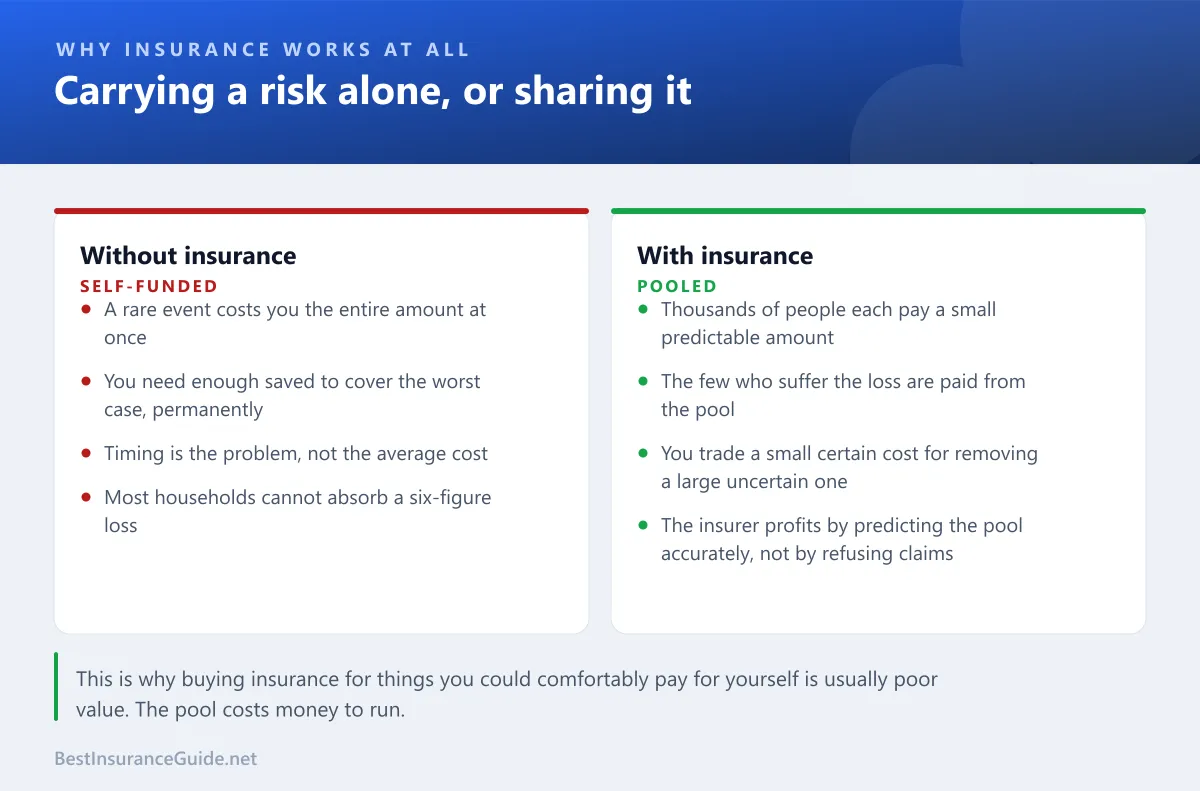
The mechanism is risk pooling, and it’s simpler than it sounds.
Say a particular kind of house fire costs $200,000 and happens to roughly one house in 800 each year. On average, the cost per house per year is $250. But averages don’t help you, because you won’t have an average year. You’ll have 799 years where nothing happens and one where you need $200,000 immediately.
So 800 households each put in $250 plus a bit for running costs, and whoever the fire happens to gets paid from the pool. Nobody has to keep $200,000 in reserve permanently.
Two things follow from that, and they explain most good and bad insurance decisions.
Insurance is for losses you couldn’t absorb. The pool costs money to run, so on average you pay slightly more than the expected loss. That’s a good trade when the loss would be financially serious and a poor one when it wouldn’t. It’s why liability cover is excellent value and an extended warranty on a $300 appliance isn’t.
The insurer profits by predicting the pool accurately. Not by refusing claims, which is a common assumption. A carrier that denies valid claims loses customers, attracts regulatory attention and accumulates a bad complaint index. The business model is pricing risk correctly, which is why they ask so many questions.
The four numbers on every policy
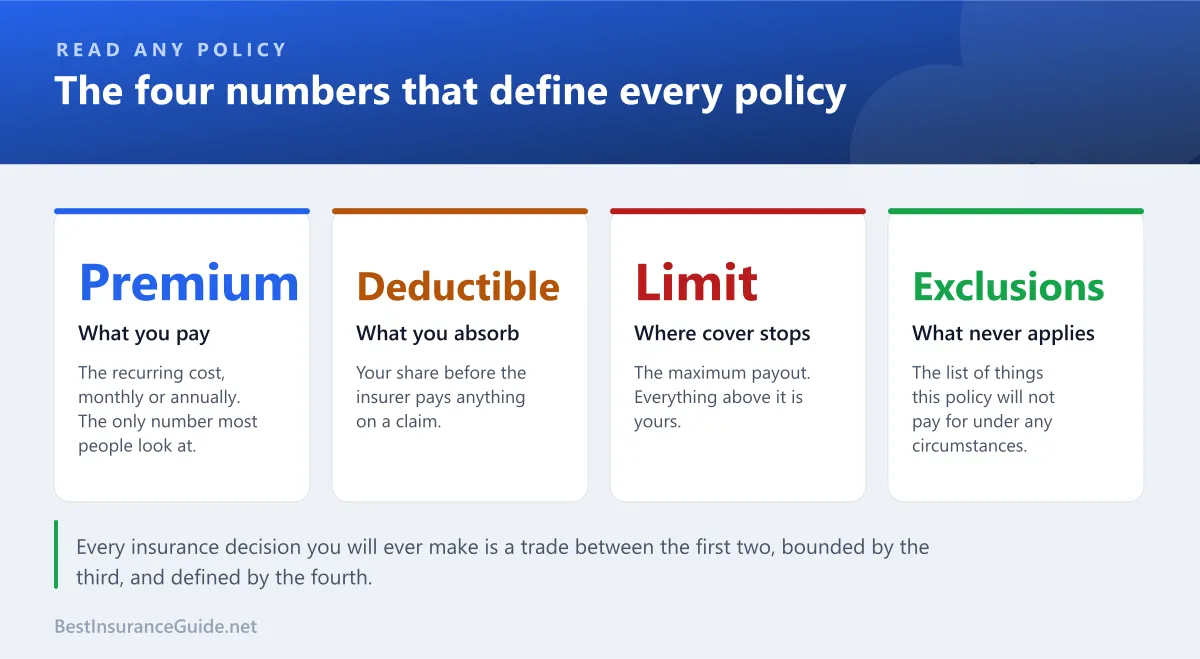
Whatever you’re buying, from a $14-a-month renters policy to commercial cover, it’s these four. Learn to find them and most of the confusion goes.
Premium is what you pay. It’s the only number most people look at, and it’s the least informative of the four on its own.
Deductible is what you absorb before the insurer pays. It’s the main lever you control.
Limit is where cover stops. Everything above it is yours to pay.
Exclusions are the things the policy never pays for. This section is usually short and almost nobody reads it.
Worked example: how a claim actually settles
A $6,400 claim on a policy with a $1,000 deductible and a $50,000 limit.
| Step | Amount |
|---|---|
| Loss assessed at | $6,400 |
| Less your deductible | −$1,000 |
| Insurer pays | $5,400 |
| Remaining limit for the policy period | $44,600 |
Straightforward. Now the same loss on three different policy configurations:
| Configuration | You pay | Insurer pays |
|---|---|---|
| $500 deductible, $50,000 limit | $500 | $5,900 |
| $2,500 deductible, $50,000 limit | $2,500 | $3,900 |
| $1,000 deductible, $5,000 limit | $1,000 | $4,000, limit exhausted |
| $1,000 deductible, loss excluded | $6,400 | $0 |
That last row is the one worth remembering. A generous limit and a low deductible are worth nothing if the cause of loss is on the exclusions page.
The deductible trade, with numbers
Raising your deductible lowers your premium. The question is always how far to go, and the answer is a cash-flow question rather than a maths question.
Worked example: where the break-even sits
Auto policy, same coverage throughout.
| Deductible | Annual premium | Saved per year | Extra exposure | Years to break even |
|---|---|---|---|---|
| $250 | $1,720 | — | — | — |
| $500 | $1,595 | $125 | $250 | 2.0 |
| $1,000 | $1,455 | $265 | $750 | 2.8 |
| $2,000 | $1,310 | $410 | $1,750 | 4.3 |
Every one of those break-evens is shorter than the average gap between claims, which for most drivers runs eight to ten years. On paper the $2,000 deductible wins comfortably.
The reason it’s still wrong for a lot of people: a deductible you can’t fund turns a covered claim into an uncovered one. If $2,000 isn’t sitting somewhere accessible, the policy doesn’t work when you need it, and you end up borrowing at credit card rates to unlock a claim. The rule I’d use is to set the deductible at the largest amount you could pay tomorrow without borrowing, and no higher.
When not to claim
This surprises people, and it’s one of the most valuable things in this article.
Worked example: a small claim that costs money
A $2,900 claim on a policy with a $1,000 deductible. Net payout: $1,900.
| Year | Premium without claim | Premium with claim | Difference |
|---|---|---|---|
| 1 | $1,455 | $1,935 | +$480 |
| 2 | $1,455 | $1,820 | +$365 |
| 3 | $1,455 | $1,690 | +$235 |
| 4 | $1,455 | $1,530 | +$75 |
| Total | +$1,155 |
They received $1,900 and paid back $1,155 across four renewals, plus lost their claims-free discount. Net benefit: about $745, and their record now shows a claim that affects every quote they request for the next five years.
At around $2,900 that’s still marginally worth claiming. At $1,600 it clearly isn’t. As a rough test: if the claim is less than about twice your deductible, work out the surcharge before you file. Ask your agent what a claim of that size would do to your renewal. They can usually tell you.
This is also the real argument for a higher deductible. It’s not just the premium saving, it’s that it removes the temptation to file claims that cost more than they pay.
The main types, briefly
Auto. Liability (damage you cause to others), collision (your car in a crash), comprehensive (theft, weather, animals, glass). Liability is legally required nearly everywhere. Our guides on discounts and young drivers go deeper.
Home and renters. Structure, contents, liability and living costs. What home insurance covers and the renters guide cover both.
Health. Premium, deductible, copay, coinsurance and out-of-pocket maximum interacting in ways that deserve their own article, which is here.
Life. Term (cover for a set period, cheap) versus permanent (lifelong, builds cash value, expensive). Life insurance basics and term vs whole life cover the choice.
Everything else. Travel, pet, business, motorcycle. Same four numbers, different subject matter.
Buying your first policy
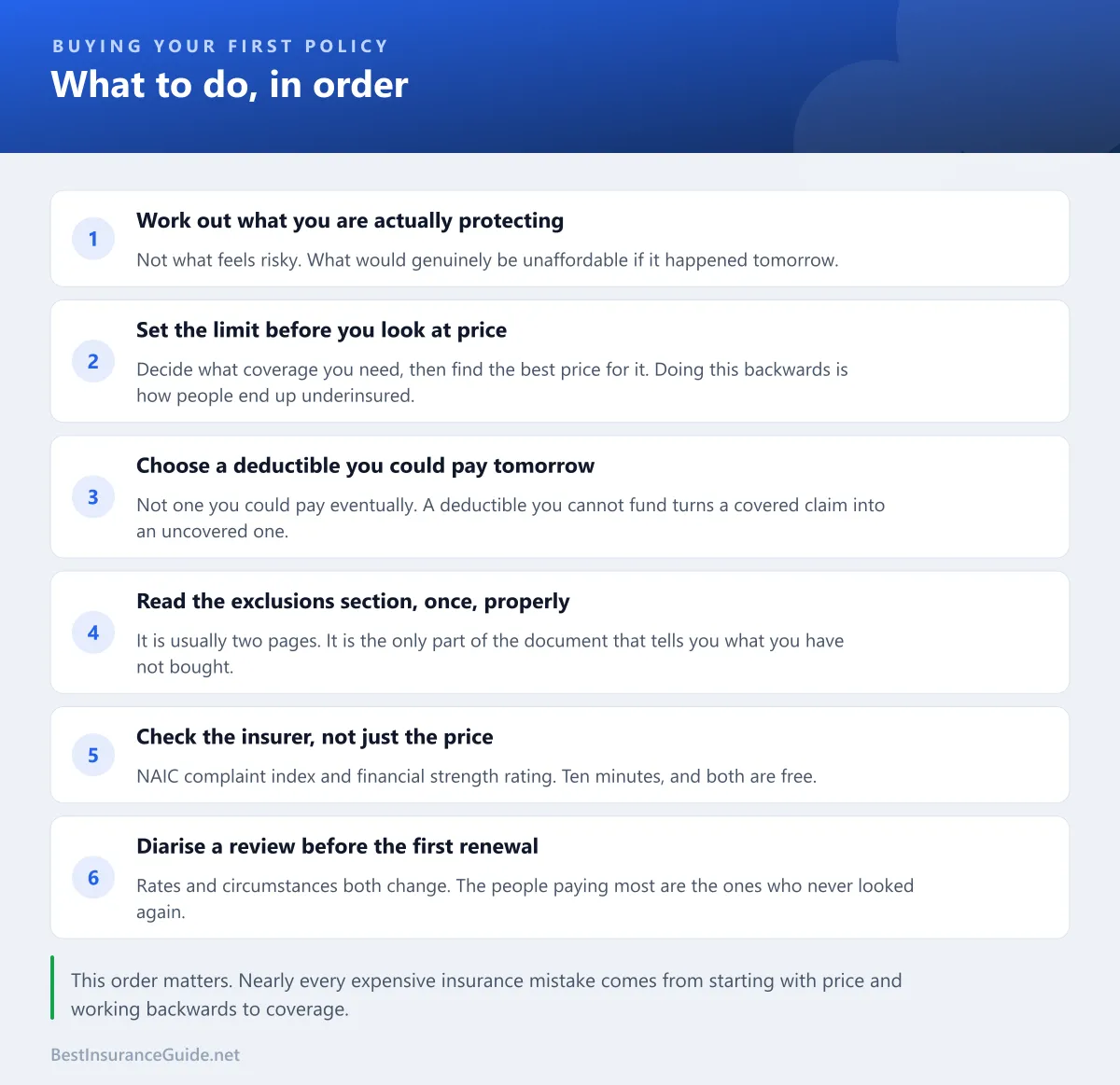
The order on that list is the important part. Nearly every expensive insurance mistake comes from starting with price and working backwards to coverage, because that’s how you end up with a policy that’s cheap precisely because it doesn’t cover much.
Decide what you need. Then find the best price for that. Not the other way round.
Terms worth knowing
- Declarations page. The two-page summary of your coverages, limits and deductibles. The most useful document you own.
- Endorsement or rider. An add-on that changes the standard policy, such as water backup.
- Actual cash value. Pays after depreciation.
- Replacement cost. Pays what it costs to buy again today.
- Coinsurance. In property, a clause requiring you to insure to a percentage of full value or claims are reduced proportionally. In health, the percentage you pay after the deductible.
- Underwriting. The insurer assessing and pricing your specific risk.
- Subrogation. Your insurer recovering from whoever was actually at fault after paying you.
- Lapse. A gap in coverage. It’s a rating factor in its own right and makes your next policy more expensive.
Where to check anything
Three free sources, all worth ten minutes:
The NAIC Consumer Information Source for complaint indexes. Your state department of insurance for licences and enforcement. The Insurance Information Institute for plain-English explanations of almost any coverage question.
If you do one thing
Find the declarations page for whatever policy you already have and locate those four numbers on it: premium, deductible, limit, exclusions.
Most people have never done this. It takes about five minutes, and it’s the difference between owning an insurance policy and merely paying for one.
Then read the exclusions page. It’s short, and it’s the only part of the document that tells you what you haven’t bought.