Renters Insurance Guide: Cheap Protection Everyone Should Have
Renters insurance runs $15-$30 a month. What it covers, what claims actually pay out, and how to set a contents limit you can defend to an adjuster.

Table of contents

Renters insurance is the best value in the entire insurance market and hardly anyone under 30 has it.
For roughly the price of a couple of takeaway coffees a month you cover everything you own, plus a liability exposure that could otherwise follow you around for years. The reason people skip it isn’t cost. It’s that they assume the landlord has it handled.
They don’t. That’s the whole article, really, but the details matter.
Your landlord’s policy is not your policy
Here’s the misunderstanding that costs renters the most.
Your landlord insures the building: the structure, the roof, the common areas, and their own liability as an owner. Their policy also covers their lost rental income if the place becomes unrentable.
It covers nothing you own. Not one thing.
Picture a fire starting in the flat above yours, caused by a neighbour you’ve never met. The landlord’s insurer rebuilds the building. Your neighbour’s policy, if they have one, handles their liability. Your furniture, laptop, clothes, bike and everything else are simply gone, and whose fault it was makes no difference to your bank balance.
It runs the other way too. Leave a tap running, water comes through the ceiling below, and that’s your liability. In a multi-storey building those bills reach five figures without much effort.
What the policy actually does
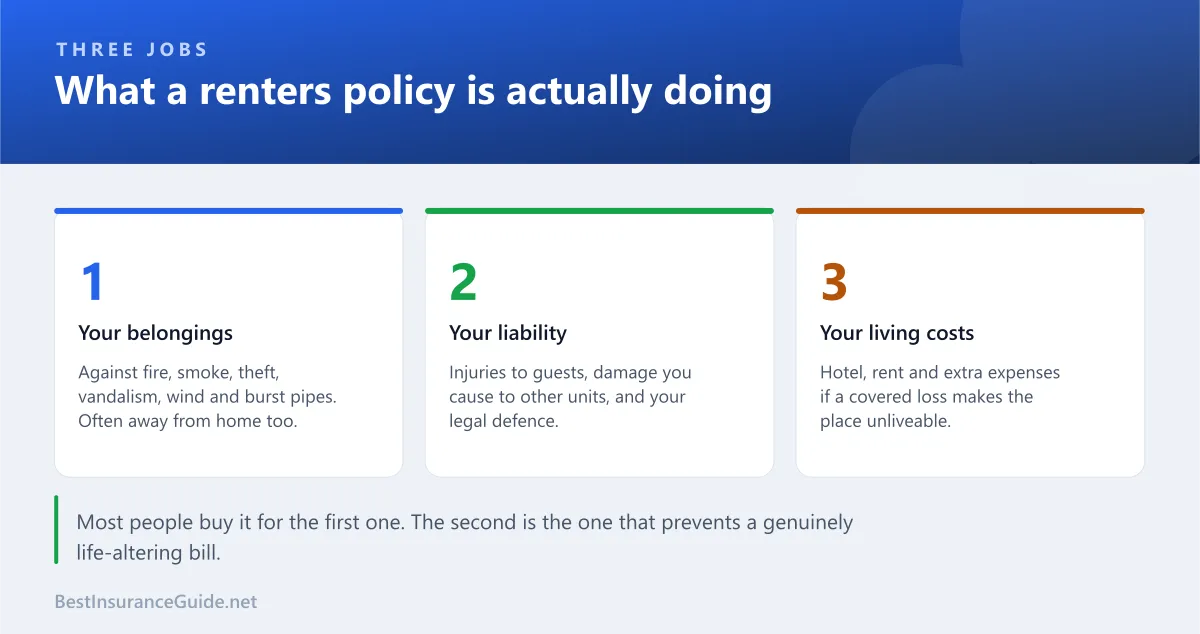
Most people buy it for the first one. The second is the one that prevents a genuinely life-altering bill.
Personal property covers your belongings against a defined list of perils: fire, smoke, theft, vandalism, wind, lightning, and water damage from burst pipes. Note what’s absent. Flooding isn’t there, ever. Coverage usually follows you away from home, so a laptop stolen from a café or a car is normally covered.
Liability typically starts around $100,000. If a guest is injured in your flat, or your dog bites someone, or you damage another unit, this pays their costs, your legal defence, and any settlement up to your limit. For anyone in their twenties this is frequently worth more than everything they own put together, because one lawsuit can outlast a decade of savings.
Loss of use pays for a hotel, a short-term rental, and the extra costs of being displaced. It’s the coverage nobody thinks about until they’re standing outside a building they can’t go back into.
Medical payments to others is a small no-fault amount for minor guest injuries, there to settle a twisted ankle before it becomes a liability claim.
Worked example: the liability side, which nobody plans for
A tenant on the third floor runs a bath, gets distracted by a phone call, and floods two flats below.
| Item | Cost |
|---|---|
| Downstairs neighbour: flooring, ceiling, plastering | $14,200 |
| Downstairs neighbour: damaged furniture and electronics | $6,800 |
| Second-floor flat: ceiling and light fittings | $4,300 |
| Landlord: structural drying and remediation | $9,500 |
| Total claimed against the tenant | $34,800 |
Their own belongings were barely touched. The claim that mattered was entirely liability, and a $100,000 limit absorbed all of it. Without a policy, that’s $34,800 owed personally by someone who was on the phone for four minutes.
This is the coverage people would never buy on its own and the one most likely to save them.
The one setting to get right
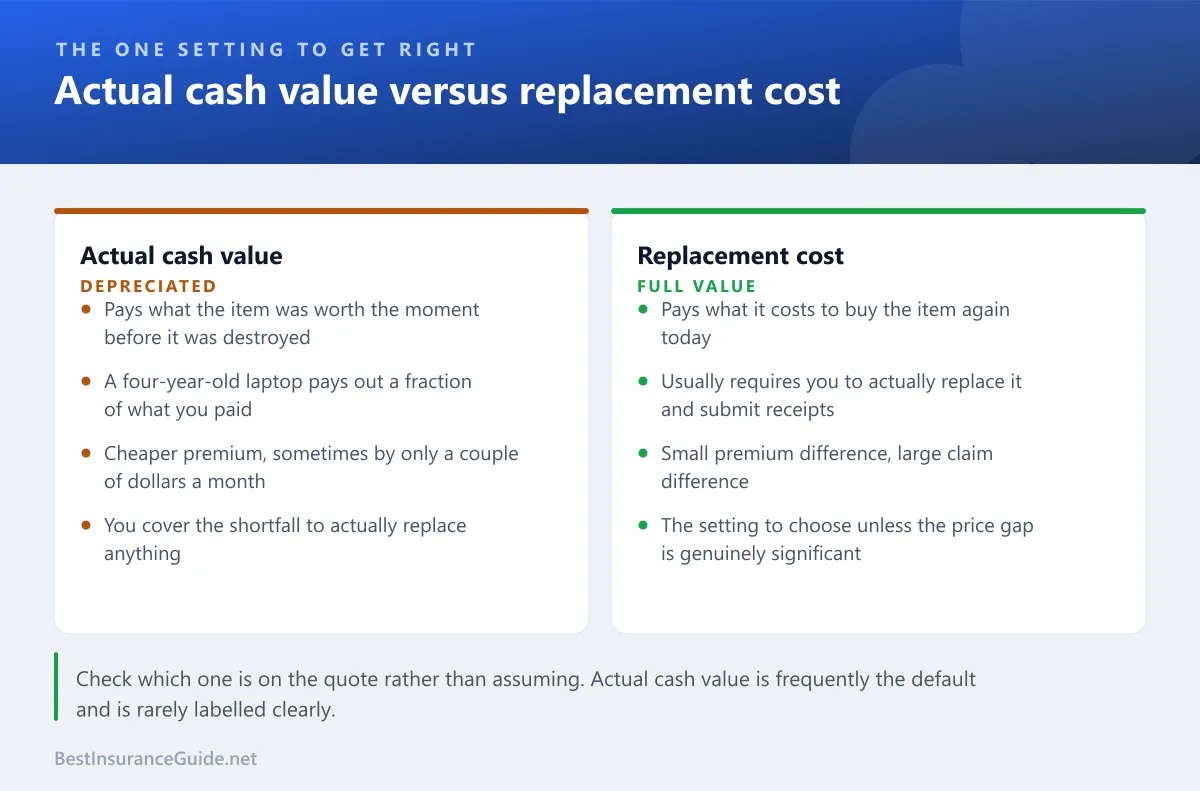
If you change nothing else on the quote, change this.
Worked example: a break-in, settled two ways
A ground-floor flat, forced entry through a window, four items gone.
| Item | Paid | Age | Replacement today | ACV after depreciation |
|---|---|---|---|---|
| Laptop | $1,500 | 3 yrs | $1,400 | $450 |
| Bicycle | $900 | 5 yrs | $950 | $290 |
| Games console and games | $700 | 4 yrs | $600 | $170 |
| Jewellery, unscheduled | $1,100 | — | $1,100 | $1,100 |
| Total | $4,200 | $4,050 | $2,010 |
With a $500 deductible:
- Replacement cost: $4,050 − $500 = $3,550
- Actual cash value: $2,010 − $500 = $1,510
A difference of $2,040 on one fairly modest burglary. The premium gap between the two settings is usually $2 to $4 a month.
Actual cash value is frequently the default on cheap quotes and it’s rarely labelled clearly. Check the quote rather than assuming.
What it doesn’t cover
- Flooding. Rising water is excluded from every renters policy. Renters can buy contents-only cover through the National Flood Insurance Program, which a lot of tenants don’t realise exists.
- Earthquake. Separate policy or endorsement.
- Sewer and drain backup. Needs an endorsement, worth having in older buildings and basement flats.
- Your roommate’s belongings. A policy covers the named insured and relatives. Roommates need their own, and putting both names on one policy is more trouble than it’s worth when you move out at different times.
- High-value items above the sublimit. Jewellery, cameras, instruments and collectibles have per-category caps. Schedule anything significant.
- Damage from your own neglect. Not fixing something you knew about isn’t a sudden loss.
Setting a contents limit you can actually defend
Everyone underestimates what they own.
Worked example: a one-bedroom flat, counted properly
Someone who would confidently tell you they own “maybe fifteen thousand dollars of stuff.”
| Category | Replacement cost |
|---|---|
| Clothing, shoes, coats | $6,400 |
| Kitchen: appliances, cookware, crockery, cutlery | $3,900 |
| Furniture: bed, sofa, table, chairs, shelving | $7,200 |
| Electronics: laptop, phone, TV, console, audio | $5,100 |
| Bedding, towels, curtains, rugs | $1,800 |
| Bike, sports and outdoor gear | $2,300 |
| Books, tools, kitchen small appliances, misc | $2,600 |
| Jewellery and watches | $2,900 |
| Total | $32,200 |
More than double the guess, and none of it extravagant. Clothing is the category people undercount worst, because nobody has ever priced replacing an entire wardrobe at once.
The premium difference between $20,000 and $35,000 of contents cover is typically $3 to $6 a month. The coverage difference is $15,000.
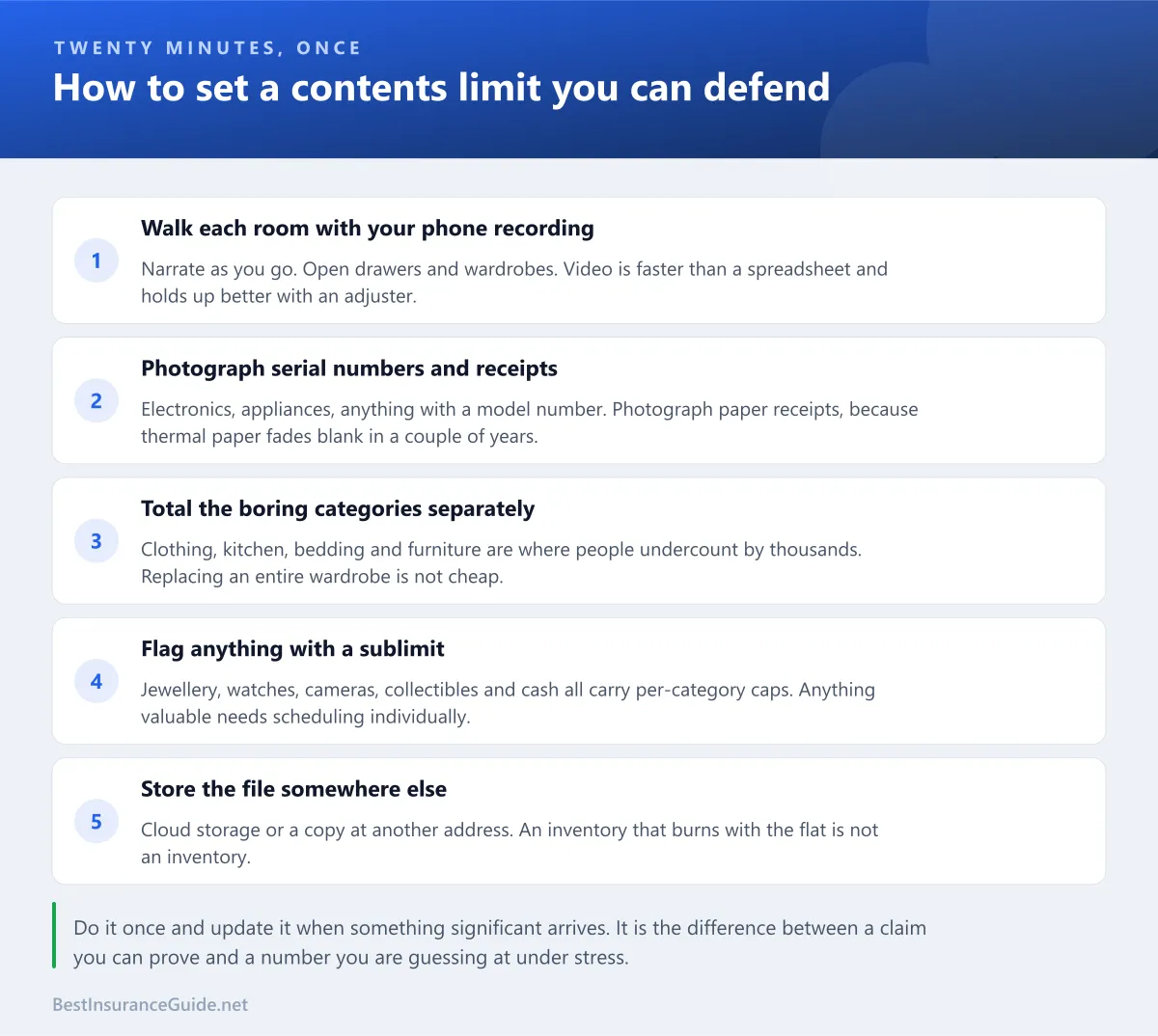
The video method is the one I’d actually recommend for building this, because it takes twenty minutes rather than an evening with a spreadsheet, and it holds up better with an adjuster. Walk each room narrating what things are and roughly when you bought them. Open the wardrobe. Open the cupboards. Then put it in cloud storage, because an inventory that burns with the flat isn’t an inventory.
What it costs, and how to pay less
Expect roughly $15 to $30 a month. It moves with your city, your building, your deductible and how much cover you buy.
The biggest saving by far is bundling with an existing auto policy.
Worked example: renters cover that pays for itself
A driver with a $1,640 annual auto premium adds a renters policy.
| Before | After | |
|---|---|---|
| Auto premium | $1,640 | $1,443 |
| Renters premium | $0 | $186 |
| Annual total | $1,640 | $1,629 |
The multi-policy discount cut the auto premium by $197. The renters policy costs $186. They are $11 a year better off and now have $35,000 of contents cover and $100,000 of liability that they didn’t have before.
That’s not a universal outcome, but it’s common enough that quoting renters cover with your auto insurer should always be the first call.
After that: raise the deductible if you could absorb it, claim protective device discounts (smoke detectors, deadbolts, monitored alarms, water leak sensors), pay annually to skip instalment fees, and ask about a claims-free discount.
What doesn’t work is buying too little coverage. Cutting contents from $35,000 to $20,000 saves a few dollars a month and leaves a $15,000 hole, as the inventory above shows.
When it earns its keep
The scenarios worth keeping in mind, because they’re the ones that actually happen:
A kitchen fire two floors up, and the water used to put it out comes through your ceiling. A break-in while you’re at work. A guest slipping on your stairs. A pipe bursting in January. A bike taken from a shared hallway. A laptop lifted from a car.
None of those are dramatic. All of them are expensive without a policy, and all of them are a phone call and a deductible with one.
If you’re in Ohio specifically, our Ohio renters insurance guide covers state lease requirements and the water backup issue in older housing stock there. For the wider picture on limits and deductibles, what insurance actually covers is a good starting point.
Worth doing this week
Get three quotes at the same contents limit, the same liability limit, the same deductible, and replacement cost on all three. Start with whoever insures your car.
The whole exercise takes about half an hour and it’s the highest return on effort available anywhere in personal finance. Then spend twenty minutes on the inventory video and you’re done for a couple of years.