How to Use Insurance Calculators to Estimate Costs and Coverage
Insurance calculators give a fast, defensible estimate. Which inputs move the answer most, worked examples of each tool, and where an estimate stops.

Table of contents

An insurance calculator won’t tell you what a policy costs. It will tell you roughly what you should be buying and roughly what that ought to cost, which is a genuinely useful thing to know before anyone quotes you.
The gap between those two ideas is where most people misuse them. Here’s what each of our tools is actually for, which inputs change the answer most, and how far to trust the result.
Six tools, three jobs
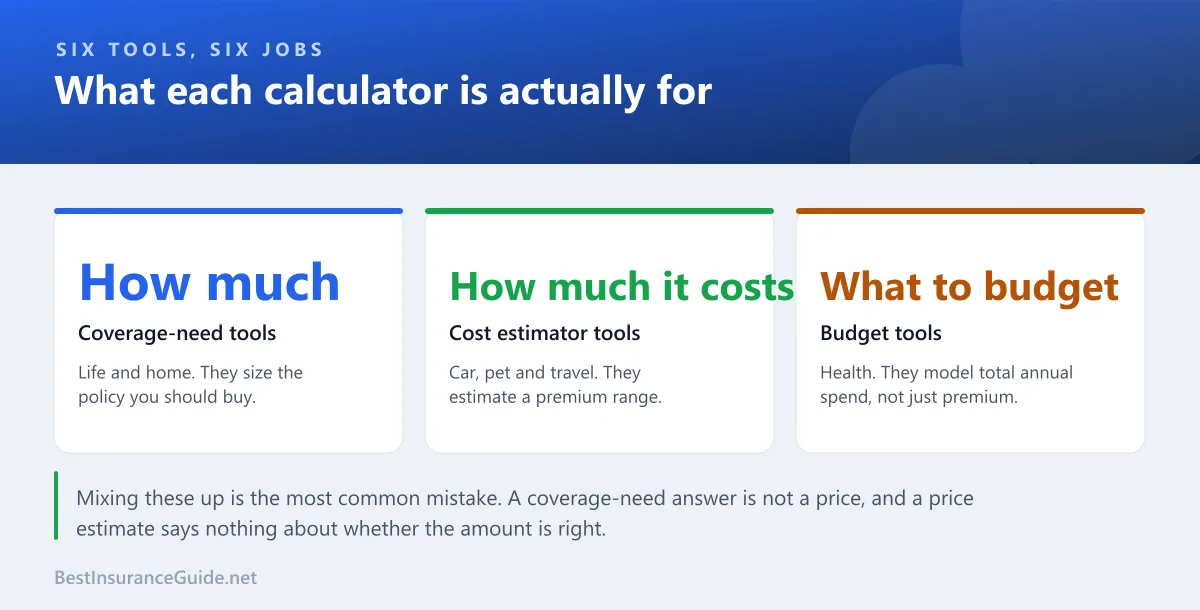
Mixing these up is the most common mistake. A coverage-need answer isn’t a price, and a price estimate says nothing about whether the amount is right.
Our life insurance need and home insurance coverage tools answer how much. The car, pet and travel tools answer how much it costs. The health insurance budget tool answers what to set aside, which is different again because health costs aren’t just premium.
The inputs that actually matter
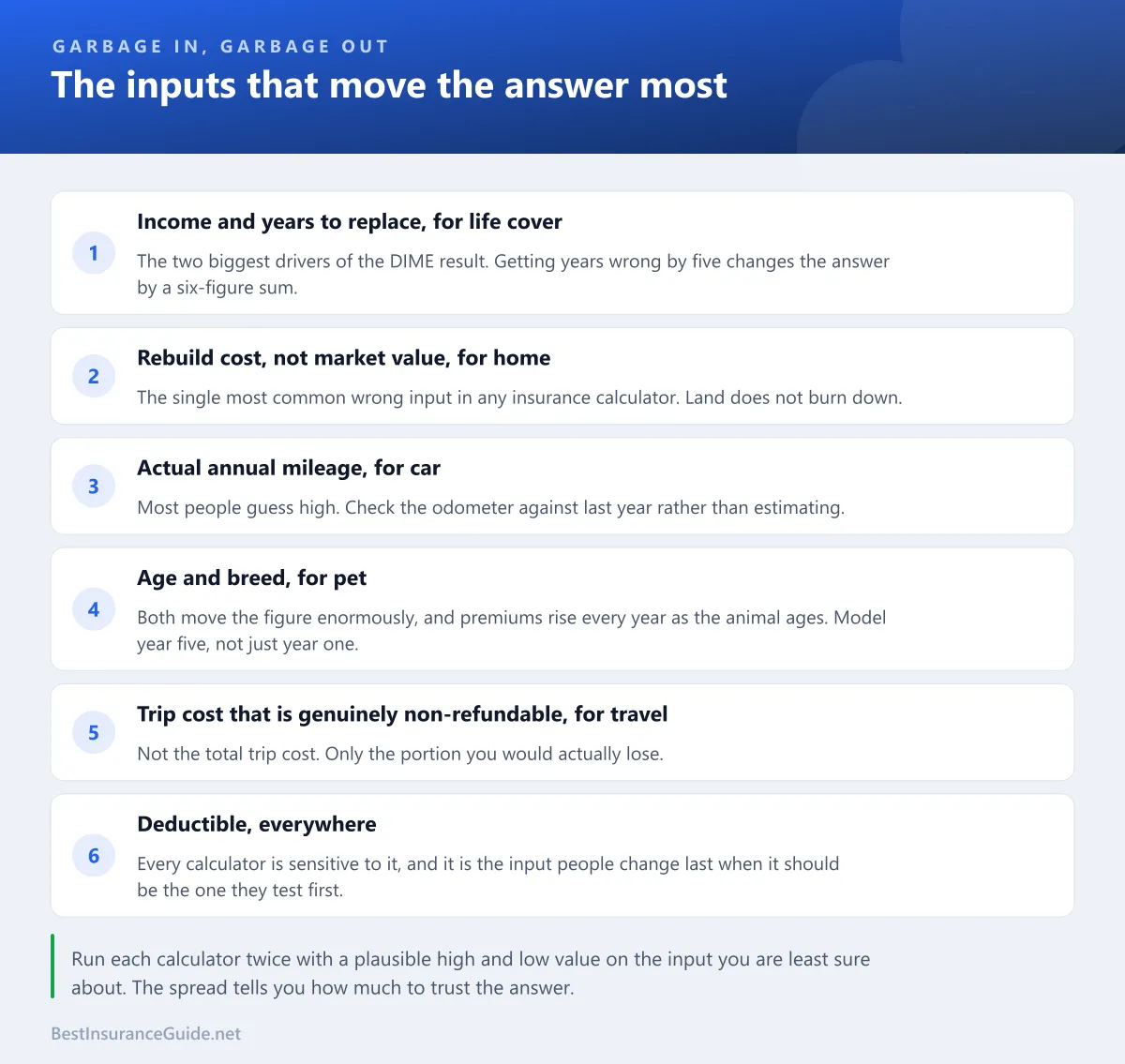
Garbage in, garbage out applies more here than most places, because these tools are deliberately simple. A few inputs carry nearly all the weight.
Worked example: life cover, and how much “years” matters
The DIME method run for a 38-year-old earning $78,000, with a $240,000 mortgage, $18,000 of other debt and two children.
| Component | Calculation | Amount |
|---|---|---|
| Debt | Credit cards, car loan | $18,000 |
| Income replacement | $78,000 × 15 years | $1,170,000 |
| Mortgage | Outstanding balance | $240,000 |
| Education | 2 children × $110,000 | $220,000 |
| Subtotal | $1,648,000 | |
| Less existing cover and savings | −$210,000 | |
| Recommended cover | $1,438,000 |
Now change one input. Same person, income replaced for 10 years instead of 15:
| Years replaced | Income component | Recommended cover |
|---|---|---|
| 10 years | $780,000 | $1,048,000 |
| 15 years | $1,170,000 | $1,438,000 |
| 20 years | $1,560,000 | $1,828,000 |
A five-year assumption swings the answer by $390,000. That’s the input to think hardest about, and the honest way to choose is to ask how long your family would realistically need support: until the youngest child finishes education is the usual anchor.
Rebuild cost, the input people get wrong
The home coverage calculator asks for rebuild cost, and a large share of people enter what their house is worth. Those are different numbers, sometimes by a factor of two.
Worked example: what entering market value does
A house that would sell for $620,000 in a metro area where land carries much of the value. Actual rebuild cost is $340,000.
| Input used | Dwelling limit set | Annual premium | Outcome |
|---|---|---|---|
| Market value, $620,000 | $620,000 | $3,180 | Paying for $280,000 of cover that can never be claimed |
| Rebuild cost, $340,000 | $340,000 | $2,140 | Correctly insured |
$1,040 a year for coverage that’s structurally unclaimable, because land doesn’t burn down.
It runs the other way too. In rural areas with high construction costs and low property prices, insuring to market value leaves you underinsured, which then triggers the coinsurance penalty covered in our home insurance guide.
Test your uncertainty
The most useful habit with any of these tools takes an extra thirty seconds: run it twice, with a plausible high and low value on the input you’re least sure about.
Worked example: pet insurance across a dog’s life
People run the pet calculator once, at the age their dog is now, and budget from that. Premiums rise every year as the animal ages, which is the thing the single run doesn’t show.
A medium-breed dog, $5,000 annual limit, $250 deductible, 80% reimbursement.
| Dog’s age | Estimated monthly premium |
|---|---|
| 1 year | $34 |
| 4 years | $47 |
| 7 years | $78 |
| 10 years | $126 |
| 12 years | $168 |
Someone budgeting from the year-one figure is planning around $408 a year. The lifetime average is closer to $900, and the last few years alone run past $1,500 annually.
Run the tool at your pet’s current age and at ten years old. The second number is the one that determines whether you’ll still be holding the policy when it matters most. Our pet insurance cost guide covers this in more depth.
Where an estimate stops
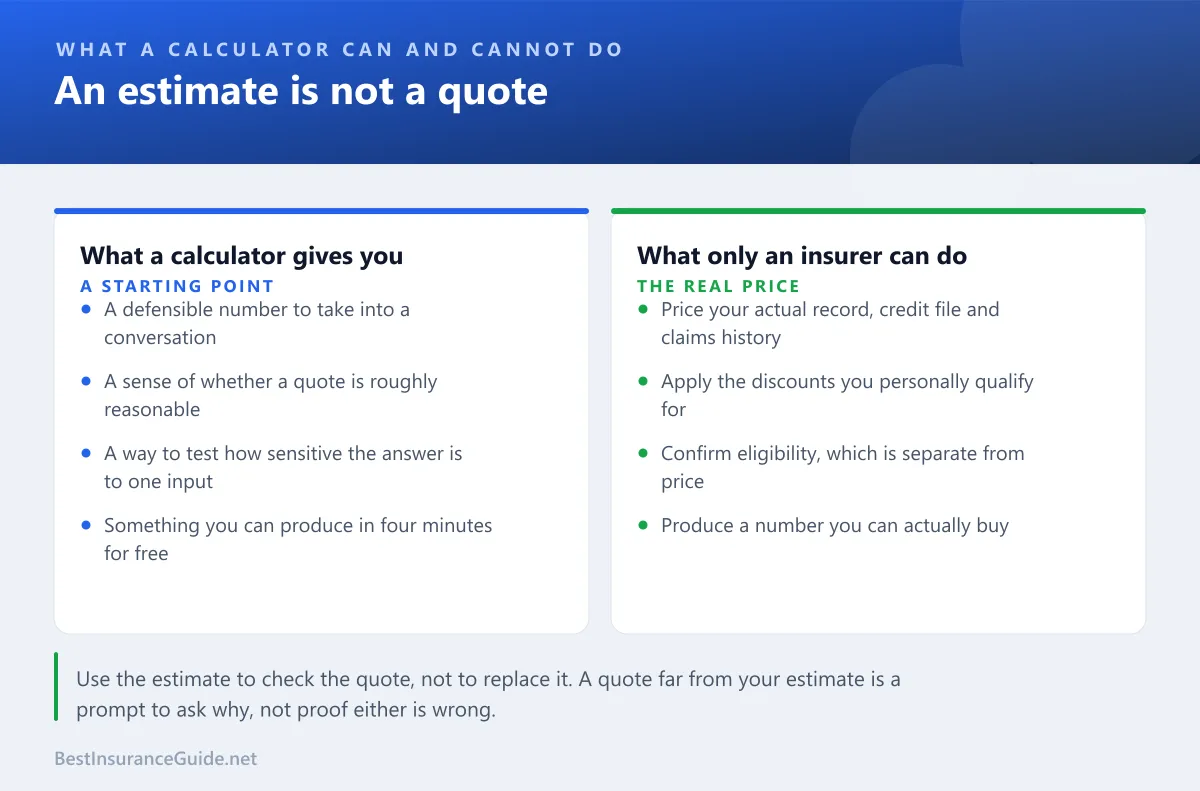
A calculator prices a generic profile. An insurer prices you: your record, your claims history, your credit file where permitted, your postcode, and the specific discounts you qualify for.
A gap of 20 to 30 percent in either direction is normal. Much more than that is worth asking about, and the asking is the point.
Worked example: using the estimate as a check
A driver estimates $1,450 a year on the car calculator. Three quotes come back:
| Carrier | Quote | Gap vs estimate | What it turned out to be |
|---|---|---|---|
| A | $1,390 | −4% | Reasonable, as expected |
| B | $1,610 | +11% | Reasonable, different weighting |
| C | $2,840 | +96% | Rated on an old address, never updated |
Without the estimate, Carrier C’s quote is just a high number and you move on. With it, the size of the gap prompts the question, and the question surfaced a stale address on file. That’s what the estimate is for.
Using each tool well
Life insurance need. Be honest about years of income replacement and don’t forget to subtract existing employer cover, which people routinely overestimate. Employer cover typically ends when the job does.
Home insurance coverage. Rebuild cost only. If you don’t know it, your insurer’s estimate or a local builder’s per-square-foot figure will both get you closer than the sale price.
Car insurance cost. Check the odometer rather than guessing mileage. Most people overestimate by thousands of miles a year, and the low-mileage band is a real discount.
Pet insurance cost. Run it at current age and at ten years. Breed matters enormously for the larger dogs.
Travel insurance budget. Enter only the genuinely non-refundable portion of the trip. Refundable hotel nights don’t need insuring.
Health insurance budget. Model total annual spend, not premium. A low-premium high-deductible plan can cost more overall than a higher-premium one if you use it. Our health insurance terms guide explains the interaction.
What calculators can’t do
They can’t confirm you’re eligible, which is separate from price and matters most in life and health. They can’t apply your discounts. They can’t see your claims history. And they can’t tell you whether a particular insurer is any good, which our comparison guide covers.
None of that makes them less useful. It just means the output is a starting point you carry into a conversation, rather than an answer you act on alone.
The right sequence
Run the calculator first. Write the number down. Then get quotes, and compare each against your estimate.
Doing it in that order means you walk into the conversation with a defensible figure and a reason to ask questions. Doing it the other way round means anchoring on whatever the first insurer told you, which is exactly what the estimate was supposed to protect you from.