Life Insurance Basics: How Much You Need and What It Costs
How to size a life insurance policy with the DIME method, who actually needs cover, what delay costs, and how to buy without overpaying.

Table of contents

Life insurance is one of the few financial products people buy without any idea what the right amount is.
Ask most policyholders why they hold $250,000 rather than $600,000 and the honest answer is that it was the number on the form, or roughly what the payment felt affordable at. That’s how people end up either badly underinsured or paying for cover nobody needs.
Here’s how to work out the amount, whether you need it at all, and what it should cost.
Do you actually need it?
Worth answering first, because a meaningful number of people who buy life insurance shouldn’t have.
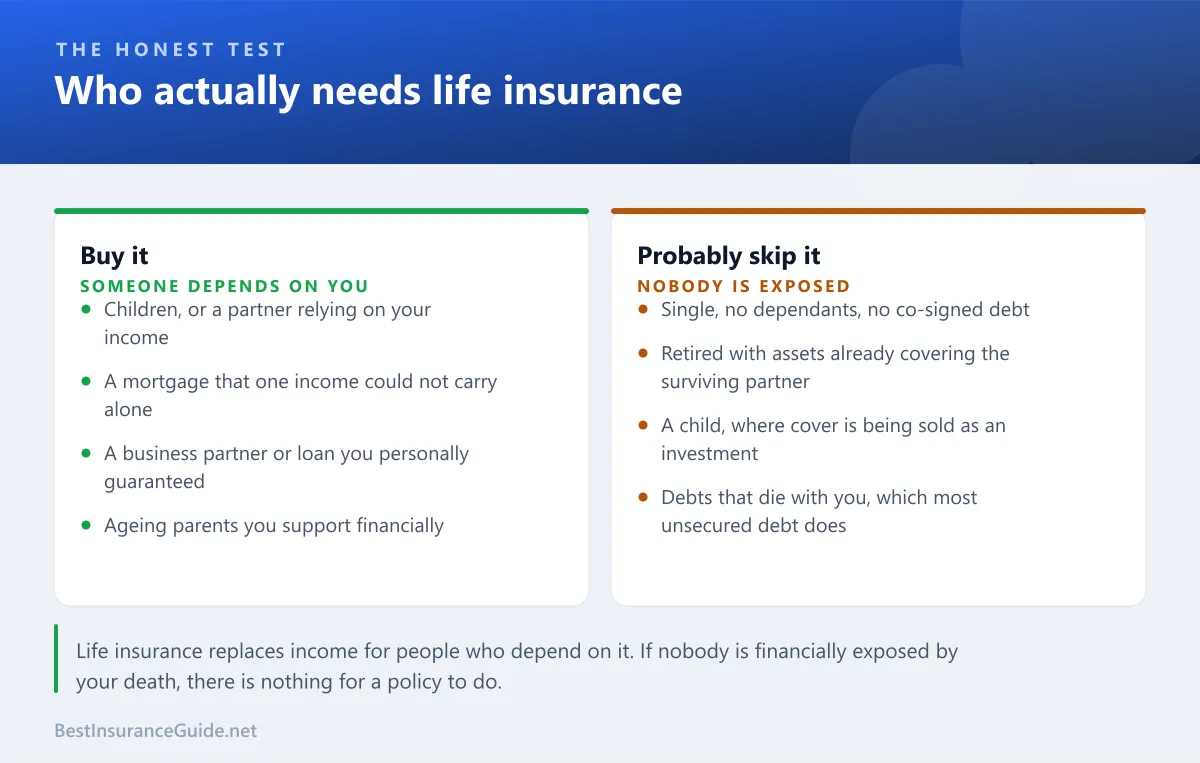
Life insurance replaces income for people who depend on it. That’s the whole function. If nobody is financially exposed by your death, there’s nothing for a policy to do.
The most common misplaced fear is leaving debts behind. Most unsecured debt (credit cards, personal loans, medical bills) dies with the estate. It doesn’t transfer to your family unless they co-signed or live in a community property state where specific rules apply. Federal student loans are discharged on death. Private student loans sometimes aren’t, which is one of the few genuine exceptions worth checking.
The clearest cases for cover are a partner who couldn’t carry the mortgage alone, children who’d need raising, and any debt someone else signed for.
Sizing the policy
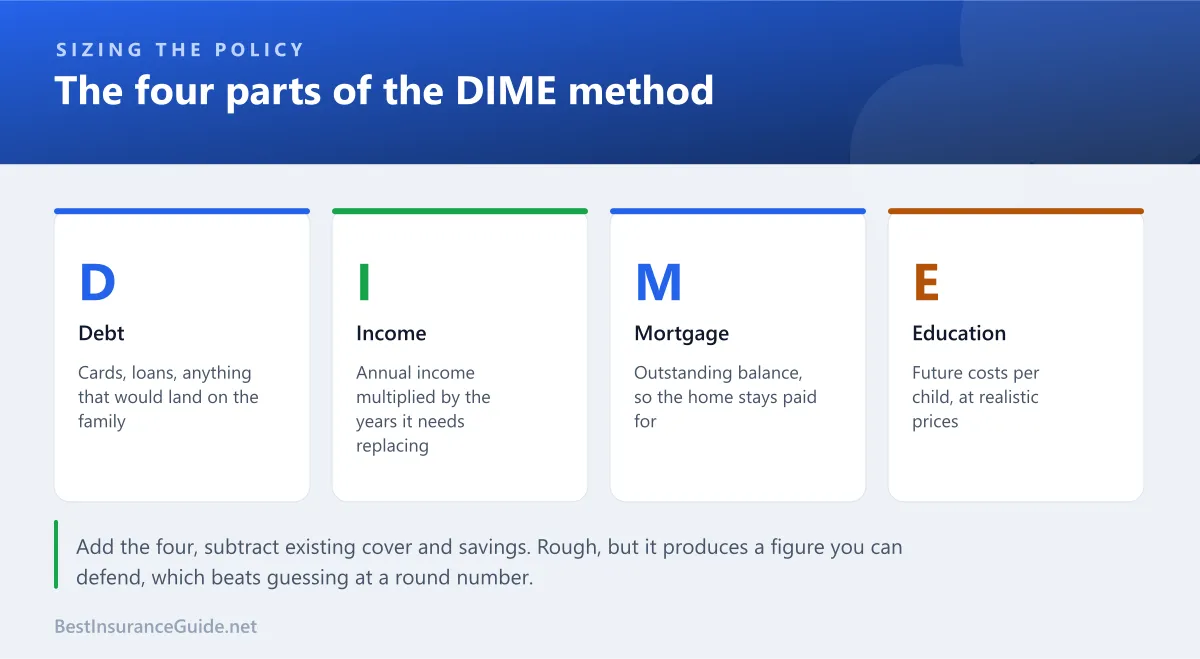
DIME is rough, and rough is fine. What matters is producing a figure you can defend rather than accepting whichever number an application form defaults to.
Worked example: a full DIME calculation
A 36-year-old earning $82,000, married with two children aged 4 and 7. Partner works part-time earning $24,000.
| Component | Working | Amount |
|---|---|---|
| Debt | Car loan $14,000, cards $6,000 | $20,000 |
| Income | $82,000 × 16 years (until youngest is 20) | $1,312,000 |
| Mortgage | Outstanding balance | $268,000 |
| Education | 2 × $115,000 | $230,000 |
| Subtotal | $1,830,000 | |
| Less employer cover (2× salary) | −$164,000 | |
| Less savings and investments | −$96,000 | |
| Cover needed | $1,570,000 |
Most people’s instinct before running this is somewhere around $500,000. The gap between instinct and arithmetic is the entire reason to do the exercise.
A word on that employer line. It’s subtracted here because it exists today, but it disappears the day the job does, which is frequently the same period the family is under most strain. If you’d rather be conservative, leave it out of the subtraction entirely and treat it as a buffer.
Worked example: what the “years” assumption does
The income component dominates the total, and it hinges on one judgement call.
| Years of income replaced | Income component | Total cover needed |
|---|---|---|
| 10 | $820,000 | $1,078,000 |
| 16 (to youngest turning 20) | $1,312,000 | $1,570,000 |
| 25 (to retirement age) | $2,050,000 | $2,308,000 |
A $1.2 million swing on one assumption. The usual anchor is “until the youngest finishes education,” because that’s when the dependency genuinely ends. Replacing income to your own retirement age overinsures for most families, since the surviving partner typically returns to fuller earnings.
What it costs
Term life is cheaper than almost everyone expects, and the surprise runs in the useful direction.
For a healthy 35-year-old non-smoker, a 20-year term policy with a $500,000 benefit commonly sits around $30 to $45 a month. That’s less than most phone bills, for the thing standing between your family and losing the house.
Worked example: what waiting costs
Same person, same $750,000 policy, 20-year term. Only the age at purchase changes.
| Age at purchase | Monthly premium | 20-year total |
|---|---|---|
| 30 | $41 | $9,840 |
| 35 | $54 | $12,960 |
| 40 | $82 | $19,680 |
| 45 | $137 | $32,880 |
| 50 | $228 | $54,720 |
Waiting from 30 to 40 costs roughly $9,840 more over the life of the policy, for identical cover. Waiting to 50 more than quintuples it.
And that assumes your health stays as it is. It’s the second variable, and unlike age it can move suddenly. A diagnosis between 35 and 40 doesn’t just raise the price, it can remove the option entirely. This is the strongest argument in the whole subject: buy it while you’re healthy, because health is the one input you can’t get back.
Term or permanent
Briefly here, because it deserves its own treatment and has one: our term vs whole life comparison works through the full trade-off with cost figures.
The short version. Term covers a set period, has no cash value, and is dramatically cheaper. Permanent covers your whole life, builds cash value, and costs five to fifteen times more for the same death benefit.
For the job most people are buying life insurance to do (replacing income while children grow up and a mortgage gets paid down) term does it better and far more cheaply. The need genuinely expires, so cover that expires with it is the right shape.
Permanent cover solves different problems: estate liquidity, a lifelong dependant, business continuity. Real problems, but not the ones most families have.
Buying it in the right order
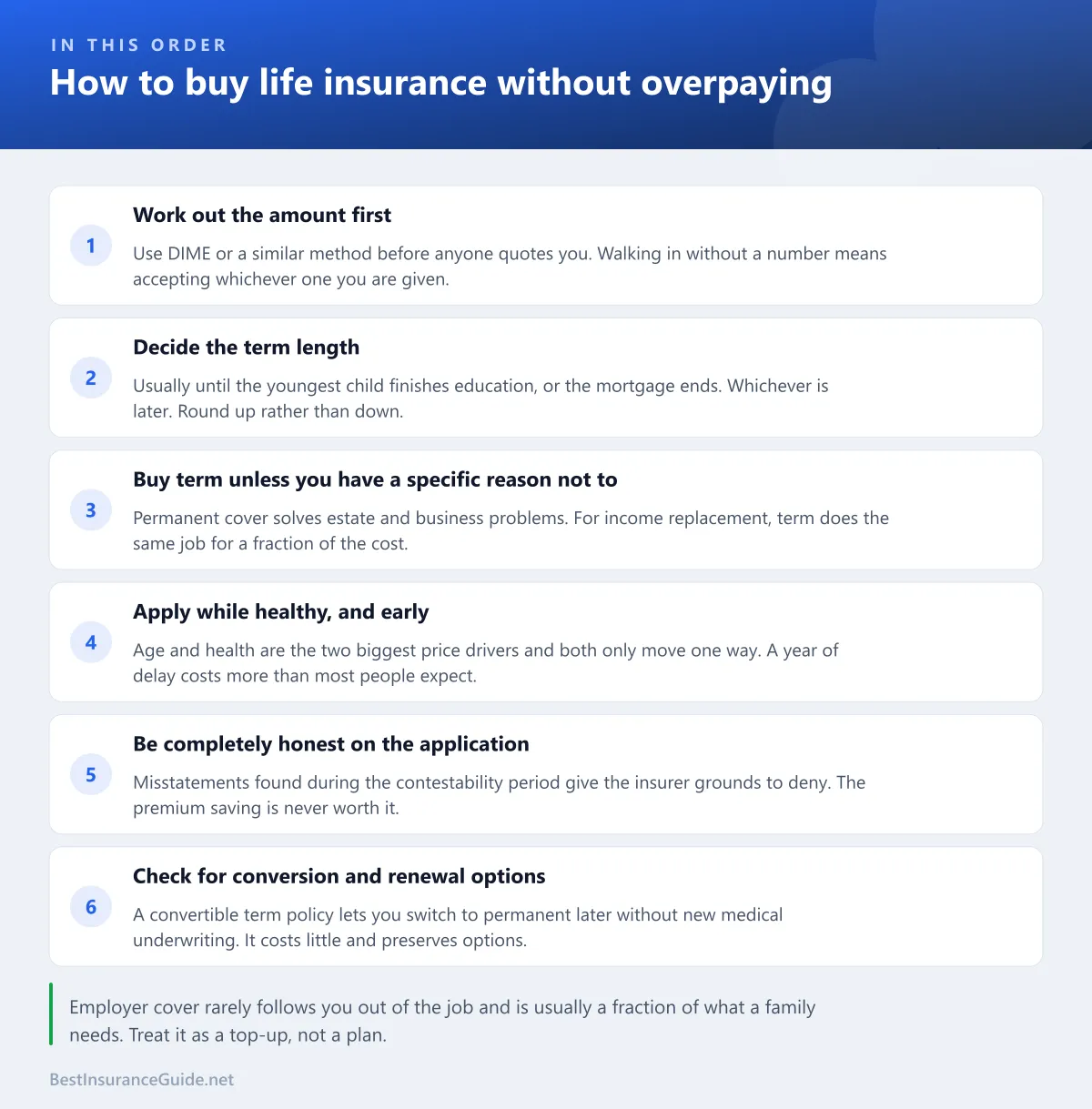
Two of those deserve expansion.
Be completely honest on the application. Insurers verify with medical records, prescription databases and sometimes a paramedical exam. Understating tobacco use or omitting a condition doesn’t usually get caught at application. It gets caught during the two-year contestability period, when a claim is investigated, and that’s the worst possible moment for it to surface.
Worked example: what a misstatement costs
Someone declares non-smoker while smoking occasionally, saving $61 a month on a $600,000 policy.
| Honest application | Misstated | |
|---|---|---|
| Monthly premium | $118 | $57 |
| Saved over 3 years | — | $2,196 |
| Death within contestability period | $600,000 paid | Claim investigated, likely denied |
| Outcome for the family | Mortgage cleared | Premiums refunded, cover gone |
Two thousand dollars saved against a $600,000 risk of the policy not working. There is no version of that trade that makes sense.
Check for conversion options. A convertible term policy lets you switch to permanent cover later without new medical underwriting. It usually costs little or nothing extra and preserves an option you may want if your circumstances change or your health does. It’s the single most underrated feature in a term policy.
Common mistakes
Relying only on employer cover. Typically one to two times salary, against a need closer to ten. And it ends with the job.
Insuring only the earner. A stay-at-home parent’s work has real replacement cost. Childcare, household management and the earning capacity the surviving partner loses while covering both roles. $250,000 to $400,000 of cover on a non-earning parent is not unusual and is frequently overlooked.
Buying decreasing-term mortgage cover by default. It’s cheap because the benefit falls as the mortgage does. Level term at the full DIME figure covers the mortgage and everything else, often for a similar premium.
Naming the estate as beneficiary. Proceeds then go through probate, which delays payment and can expose them to creditors. Name people directly, and review beneficiaries after any marriage, divorce or birth. This is the most common administrative error in the whole product.
Buying once and never revisiting. A policy sized at the birth of your first child is wrong by the third. Review every three to five years, and after any major life change.
Getting started
Run the numbers first. Our life insurance need calculator does the DIME arithmetic, and our guide to using insurance calculators covers testing how sensitive the answer is to the years assumption.
Then get quotes from three insurers at that figure and term. Check each carrier’s complaint index and financial strength using the approach in our comparison guide — with life insurance the payout may be forty years away, so the company’s durability matters more here than in any other line.
The one thing to take away
If you have people who depend on your income and you don’t have cover, the cost of sorting it out goes up every single year, and one bad medical result can close the door entirely.
The arithmetic above takes twenty minutes. The application takes a few weeks. Doing it this month rather than next year is worth more than any amount of shopping around.