Car Insurance for Young Drivers: Why It's Expensive and How to Save
Young drivers pay the most of any age group. Why it happens, what each saving lever is actually worth, and when to move off a parent's policy onto your own.

Table of contents

There’s no gentle way to put this: if you’re 17 and shopping for your first policy, the number coming back is going to be worse than you expect.
It’s also temporary, and there’s more you can do about it than most people realise. But start with why the number looks like that, because it explains which of the usual advice actually works and which is noise.
The rate isn’t about you
Insurance pricing is actuarial. It doesn’t assess whether you are a careful driver, because it can’t. It assesses what happens on average to a large group of people who look like you on paper, and charges accordingly.
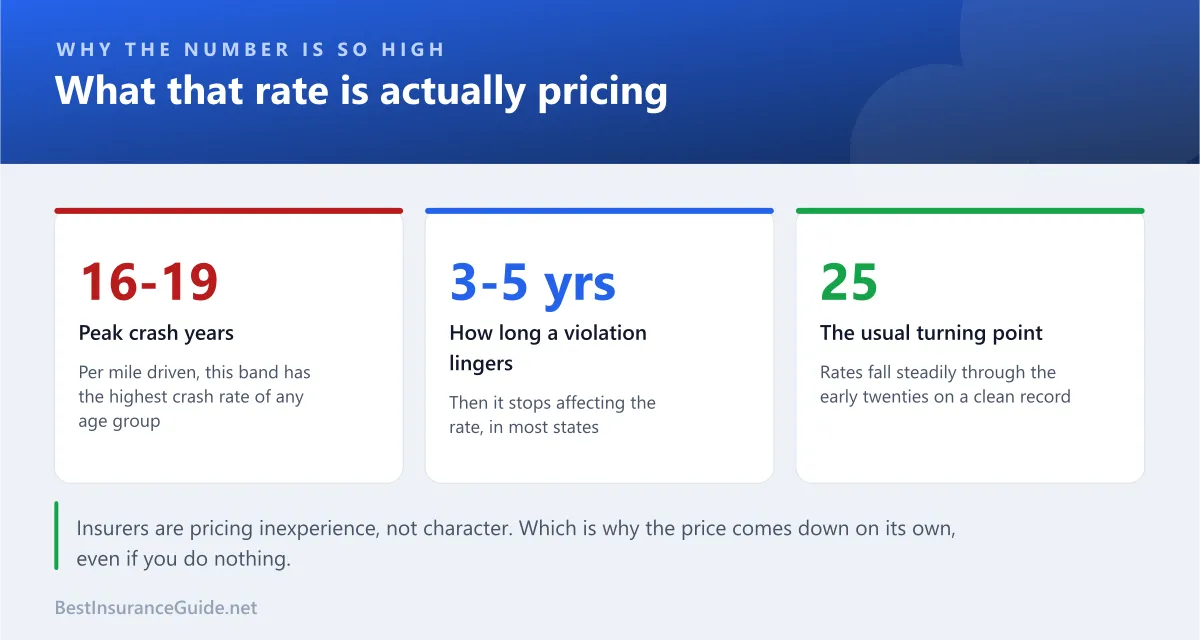
Per mile driven, the 16 to 19 band crashes more than any other age group. Not because young drivers are worse people, but because judgement in unfamiliar situations is built through repetition, and a new driver hasn’t had the repetitions. Reading a road surface that’s about to be slippery. Knowing what the car three ahead is about to do. Judging how much room you actually need. All of that is pattern-matching against experience you don’t have on day one.
Two useful things fall out of that.
The price drops on its own. You don’t have to do anything except keep a clean record and let time pass. That’s genuinely how it works, and it makes patience a real strategy here.
And a violation at this age is unusually expensive, because it lands on top of an already high base rate and sticks for three to five years. At 18 that’s a large fraction of your driving life so far.
Worked example: what a single ticket costs
A 19-year-old paying $2,900 a year picks up a speeding ticket for 15 over. The surcharge is 22%, applied for three years.
- Year one: $2,900 → $3,538 (+$638)
- Year two: roughly $3,400 as the base rate drifts down with age (+$610)
- Year three: roughly $3,250 (+$580)
- Three-year cost of the ticket: about $1,828, plus the fine itself
The fine was $180. The insurance consequence was ten times larger, and it arrives quietly across three renewals rather than as a single bill anyone notices. This is the actual argument for a defensive driving course, which in many states removes the point before it reaches the insurer.
What actually moves the number
Most advice about young driver insurance is a list of discounts. Discounts matter, but they’re not first, and putting them first is why people end up disappointed.
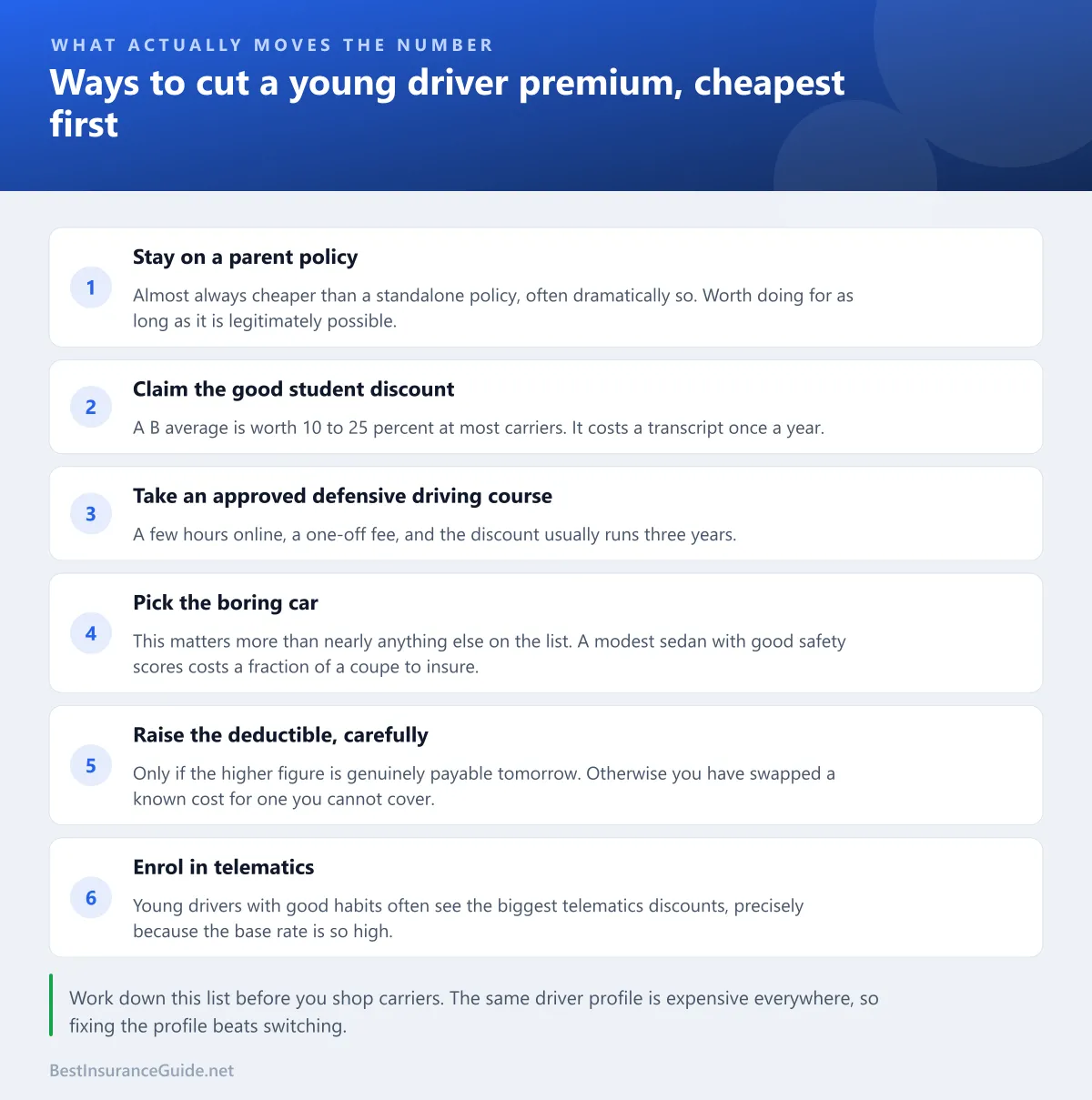
I’d flag the fourth item as the one people underestimate.
The car is not a small decision. Two 18-year-olds with identical records, same city, same coverage, can pay wildly different premiums purely on what they drive.
Worked example: same driver, four cars
An 18-year-old male, clean record, added to a family policy in a mid-size Midwest city, full coverage with a $1,000 deductible. Only the vehicle changes.
| Vehicle | Why it rates that way | Annual premium |
|---|---|---|
| 2019 Toyota Corolla | Cheap panels, strong safety scores, boring claims history | $2,240 |
| 2020 Honda CR-V | Small SUV, good scores, slightly higher repair cost | $2,410 |
| 2018 Subaru WRX | Performance badge, turbo, high theft and claims rates | $4,120 |
| 2021 Ford Mustang GT | High power, two doors, expensive to repair | $4,780 |
The gap between the Corolla and the Mustang is $2,540 a year, which over four years of college is more than the difference in purchase price between the two cars.
If you’re buying a first car and the insurance quote isn’t part of the shopping process, you’re making a several-thousand-dollar decision blind. Get quotes on two or three candidates before you buy.
Telematics is often the single biggest win at this age, for a slightly counterintuitive reason: the discount is a percentage of a very large base rate. Twenty percent off a young driver’s premium is worth far more in dollars than twenty percent off their parents’. If the program can only discount and not surcharge, it’s close to a free option.
Worked example: stacking what’s available
Same 18-year-old, on the Corolla, added to the family policy. Starting figure $2,240.
| Step | Lever | Running annual premium |
|---|---|---|
| Start | Added to parents’ policy | $2,240 |
| 1 | Good student, B average, 16% | $1,882 |
| 2 | Defensive driving course, 8% | $1,731 |
| 3 | Telematics after 6 months, 21% | $1,367 |
| 4 | Deductible $500 → $1,000 | $1,268 |
$2,240 down to $1,268, a 43% reduction, without switching insurer. The three discounts cost a transcript, $35 and five hours, and six months of app data.
Compare that with the same driver on a standalone policy of their own, which would have started nearer $4,600 before any discounts. Which brings us to the decision that matters most.
Staying on a parent’s policy
This is where most families leave money on the table, usually by splitting too early.
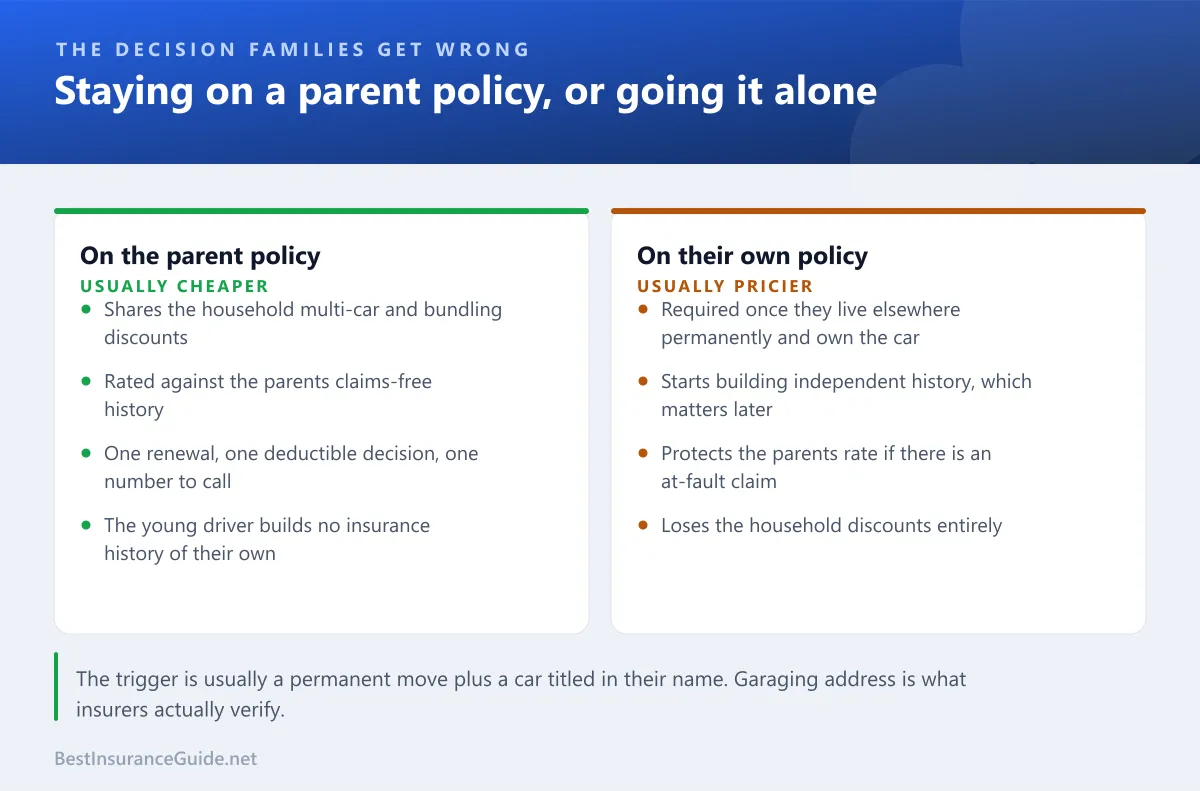
The savings from staying on a household policy are typically larger than every discount in the previous section combined. A young driver added to an existing policy picks up the household multi-car discount, any bundling with home or renters cover, and gets rated in the context of the parents’ claims history rather than from a standing start.
Worked example: together versus apart
A two-adult household paying $1,680 a year for two cars adds an 18-year-old with their own third vehicle.
Option A, added to the family policy:
- Household premium rises from $1,680 to $3,910
- Incremental cost of the young driver: $2,230 a year
Option B, young driver takes their own policy:
- Parents’ policy stays at $1,680, minus the multi-car discount they lose on the third car: $1,745
- Young driver’s standalone policy: $4,320
- Household total: $6,065, against $3,910 for Option A
- Option B costs $2,155 a year more
Over three years that’s about $6,500 for the privilege of separate paperwork. The honest counterweight is that an at-fault claim by the young driver will affect the parents’ rates under Option A, and that’s worth discussing openly in advance rather than discovering afterwards.
When you do have to split. The trigger isn’t turning 18 or 21. It’s usually a permanent move to a different address plus a car titled in the young driver’s own name. Garaging address is what insurers actually verify, and misrepresenting it, keeping a car insured at a parent’s address when it genuinely lives at a college apartment all year, is fraud. A claim is exactly when they check.
One nuance worth knowing: a student at college more than 100 miles from home without a car often qualifies for a distant student discount on the parents’ policy rather than needing their own. Ask about it by name.
Minimum limits at this age
Every young driver gets pointed toward state minimum coverage because it’s the cheapest number on screen. It’s worth understanding what that buys.
Minimum limits are a legal floor, mostly written decades ago against vehicle and medical costs that have since roughly doubled. A typical minimum property damage limit won’t cover a single new vehicle. Anything above the limit is a personal debt, and a judgment against a 19-year-old follows them well into their thirties.
Worked example: where minimum limits run out
A 20-year-old with 25/50/25 limits rear-ends a two-year-old SUV at a junction. Two occupants go to hospital, one with a fractured wrist requiring surgery.
| Item | Cost | Policy pays | Shortfall |
|---|---|---|---|
| SUV, declared a total loss | $41,000 | $25,000 | $16,000 |
| Driver’s medical, surgery and follow-up | $38,000 | $25,000 | $13,000 |
| Passenger’s medical | $9,500 | $9,500 | $0 |
| Total | $88,500 | $59,500 | $29,000 |
That $29,000 is a personal debt, pursuable against wages. Moving to 100/300/100 limits on this driver’s policy would have cost roughly $310 a year more and covered the entire claim.
The counterargument people make is that a young driver has no assets worth protecting. True right up until they have wages worth garnishing, which happens sooner than the argument assumes.
Price the next tier before dismissing it. If the budget genuinely won’t stretch, buy minimum limits and revisit at the very next renewal. Just do it knowingly rather than by default.
What to do in what order
Starting from nothing, this is the sequence I’d follow:
- Decide the car before the policy, and quote insurance on your shortlist.
- Stay on the household policy if there’s any legitimate way to.
- Claim the good student discount, and put the annual transcript in your calendar.
- Take a defensive driving course. A few hours, and the discount runs years.
- Ask about telematics, and specifically whether it can raise your rate.
- Get three quotes at identical limits, then choose.
- Re-shop every renewal, without exception.
That last one matters more here than for any other driver. Your risk profile is changing fast, and insurers reprice at different speeds. The carrier that was cheapest at 17 is frequently not cheapest at 20, and nobody is going to write and tell you.
Our full discount list covers everything worth asking for, and what drives your premiums explains the rating factors underneath it all.
It does get better
The thing worth holding onto is that this is a phase with an end date. Rates ease through the early twenties and drop noticeably around 25 for anyone who’s kept a clean record.
Which reframes the goal. The job right now isn’t finding a cheap policy, because there isn’t one. It’s getting through the next few years without a claim or a violation, so that when the rates come down you’re standing in the right place to catch them.