Home Insurance: What It Actually Covers (and What It Doesn't)
A standard home policy is six coverages and a long exclusion list. What each covers, where claims fall short, and which endorsements are actually worth buying.

Table of contents

Most people find out what their home insurance covers on the worst day of the year to be finding out.
It’s worth an hour before that. The policy isn’t as complicated as it looks. Underneath the legal language it’s six buckets of money and a list of things that don’t qualify, and once you can see that shape, most of the confusing parts stop being confusing.
The six coverages
A standard homeowners policy, usually an HO-3, is built from lettered coverages. Four of them deal with property.
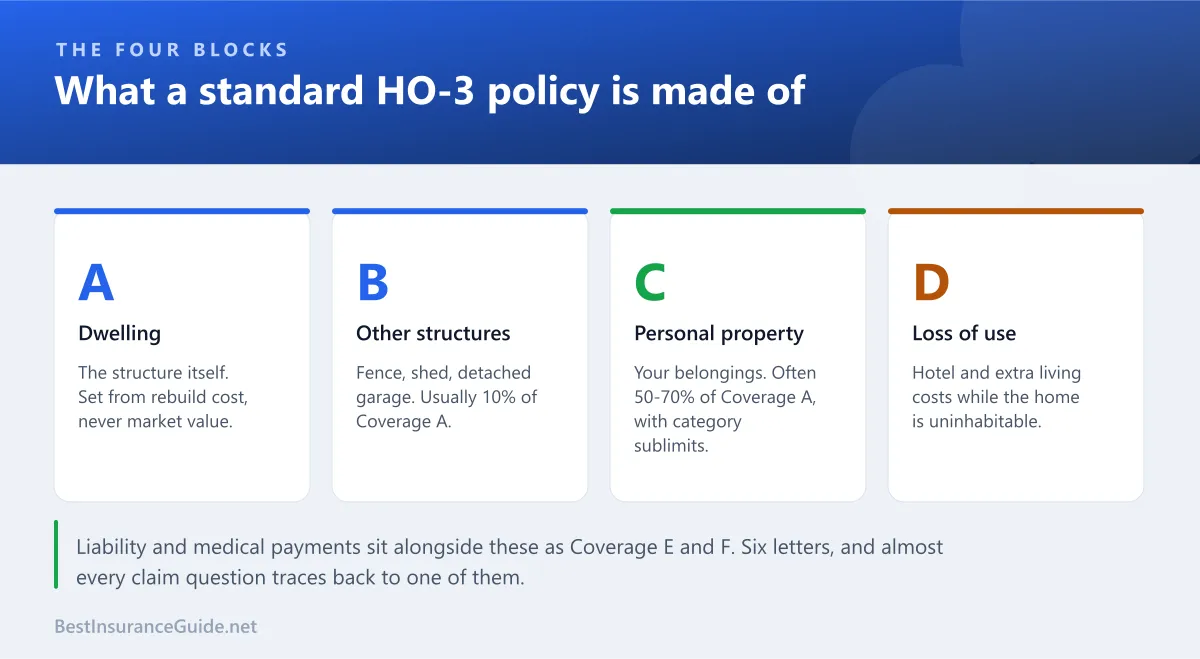
Coverage A, the dwelling. The building itself and anything permanently attached: walls, roof, floors, built-in appliances, plumbing, wiring. This limit anchors the whole policy, because most of the others are calculated as a percentage of it.
Coverage B, other structures. Detached garage, shed, fence, driveway gates. Usually set at 10% of Coverage A automatically. If you’ve built a workshop or a substantial detached garage since buying the policy, that 10% may be nowhere near enough.
Coverage C, personal property. Everything you own inside. Typically 50% to 70% of Coverage A, and it carries per-category sublimits that catch people out constantly. Jewellery might be capped at $1,500 total regardless of your overall limit. Cash is often capped around $200. Firearms, silverware, business equipment and collectibles each have their own caps.
Coverage D, loss of use. Hotels, restaurant meals above your normal grocery spend, storage, the extra cost of a rental while the house is repaired. People consistently underestimate how long a serious repair takes. Six to twelve months is normal after a significant fire.
Then two liability coverages sit alongside. Coverage E is personal liability, paying if someone is injured at your home or you damage someone else’s property, and it covers your legal defence. Coverage F is medical payments, a small no-fault amount for minor guest injuries, designed to settle small incidents before they become claims.
Worked example: how the percentages cascade
A house with a rebuild cost of $380,000, on a standard policy with default percentages.
| Coverage | Basis | Limit |
|---|---|---|
| A — Dwelling | Rebuild cost | $380,000 |
| B — Other structures | 10% of A | $38,000 |
| C — Personal property | 55% of A | $209,000 |
| D — Loss of use | 30% of A | $114,000 |
| E — Personal liability | Chosen separately | $300,000 |
| F — Medical payments | Chosen separately | $5,000 |
Notice what happens if Coverage A is set too low. Get the dwelling limit wrong by 20% and every one of B, C and D is silently 20% short too. A single wrong number at the top cascades through four coverages, which is why the dwelling limit is the one to check first and check properly.
Setting the dwelling limit
This is the number that goes wrong most often, and it goes wrong in both directions.
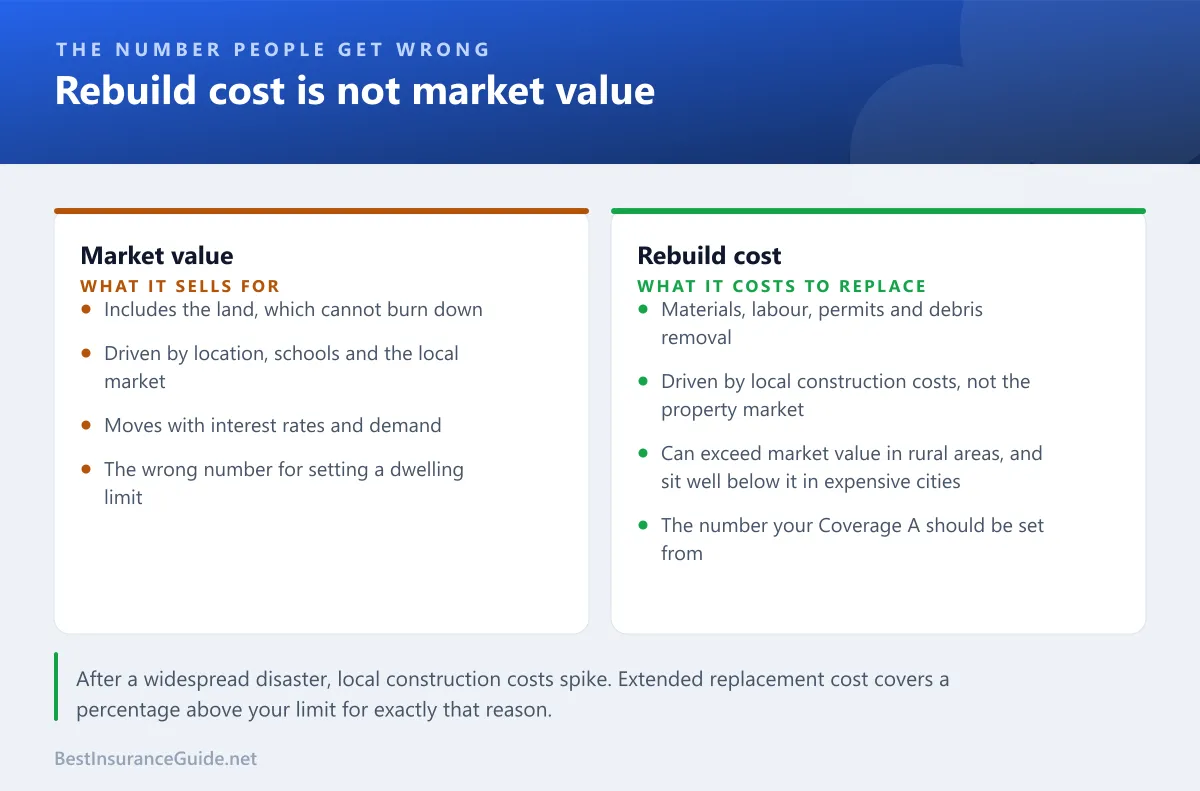
In an expensive metro area, a modest house can have a rebuild cost well below what it would sell for, because land is carrying most of the price. Insure to market value there and you’re paying for coverage you can never claim.
In a rural area with high construction costs and low property prices, the reverse happens, and that’s the dangerous version.
Worked example: the same house in two markets
A 2,100 square foot family home, same specification, same build quality.
| Coastal metro | Rural county | |
|---|---|---|
| Market value | $840,000 | $215,000 |
| Land value within that | $520,000 | $35,000 |
| Actual rebuild cost | $320,000 | $290,000 |
| Insured to market value | Over-insured by $520,000 | Under-insured by $75,000 |
The metro owner pays premium on half a million dollars of coverage that can never be claimed, because land doesn’t burn. The rural owner has a $75,000 hole they won’t discover until they need it.
Worked example: the 80% rule bites on small claims too
Most policies contain a coinsurance clause requiring you to insure to at least 80% of rebuild cost. This is the part people miss: the penalty applies to every claim, not just total losses.
A house with a $400,000 rebuild cost. The 80% threshold is $320,000. The owner has Coverage A set at $240,000, because they insured to a figure from 2016 and never revisited it.
A kitchen fire does $60,000 of damage. Deductible is $1,000.
- Required coverage: $320,000
- Actual coverage: $240,000
- Coinsurance ratio: 240,000 ÷ 320,000 = 75%
- Claim payment: $60,000 × 75% = $45,000
- Less deductible: $44,000 paid
- Owner covers: $16,000
Nothing was destroyed beyond the kitchen. The house didn’t burn down. They were still $16,000 short, because the policy penalises the underinsurance proportionally on the way through.
Ask your insurer what rebuild estimate they used and which construction cost data it came from. If the figure looks stale, push back and get it recalculated.
What it doesn’t cover
Every homeowner should read this list once.

Flood is the big one. No standard policy anywhere covers rising water. Not a bit of it. The Insurance Information Institute’s material on flood insurance is worth reading if you’re anywhere that could conceivably take water, and “conceivably” is doing real work in that sentence. A meaningful share of flood claims come from properties outside designated high-risk zones. There’s typically a 30-day waiting period before a new flood policy starts, so buying it while a storm is forecast doesn’t work.
Sewer and drain backup is the one I’d push hardest on. Excluded as standard, the endorsement usually costs very little, and backups are common in older housing stock and anywhere with combined sewer systems. With a finished basement, treat it as essential.
Gradual damage is where a lot of denied claims live. A pipe that bursts is sudden and covered. A pipe weeping behind a wall for eight months is a maintenance failure. Insurers do make that distinction, and the resulting mold usually falls under the same reasoning.
Replacement cost, and the version above it
Two settings matter on the property side.
Actual cash value pays what your possessions were worth after depreciation. Replacement cost pays what a comparable new one costs today.
Worked example: a burglary, settled two ways
Three items taken. Purchase prices and ages as shown.
| Item | Paid | Age | Replacement cost today | ACV after depreciation |
|---|---|---|---|---|
| Laptop | $1,800 | 4 yrs | $1,650 | $430 |
| Television | $1,200 | 6 yrs | $900 | $180 |
| Camera and lenses | $2,400 | 5 yrs | $2,300 | $760 |
| Total | $5,400 | $4,850 | $1,370 |
With a $1,000 deductible, replacement cost settles at $3,850. Actual cash value settles at $370.
The premium difference between the two settings on a typical policy is somewhere around $60 to $110 a year. This single claim is worth roughly forty years of that difference.
On the dwelling side there’s a further step: extended replacement cost, paying a percentage above your Coverage A limit, commonly 25% or 50%. It exists because construction costs spike locally after a widespread disaster, when every damaged house in the county competes for the same contractors and materials. It’s one of the few endorsements protecting you against underinsurance that isn’t your fault, and it’s the one I’d buy first after water backup.
Endorsements worth the money
Beyond those two, it depends on the house:
- Scheduled personal property for anything above a category sublimit. Rings, cameras, instruments, art. Usually needs an appraisal, often comes with no deductible.
- Service line coverage for the buried pipes and cables between the street and your house. Excluded as standard, and the repair means digging up your garden.
- Ordinance or law coverage if the house predates current building codes. Without it the insurer pays to rebuild what was there, not what code now requires, and you fund the upgrade.
- Equipment breakdown for HVAC, water heaters and major appliances failing mechanically rather than being damaged.
Worked example: the jewellery sublimit
A wedding ring appraised at $9,400 is stolen in a burglary. The policy has $250,000 of personal property cover and a standard $1,500 jewellery sublimit for theft.
- Loss: $9,400
- Policy pays: $1,500
- Shortfall: $7,900
Scheduling that ring separately would have cost roughly $95 a year, usually with no deductible and broader cover including accidental loss, which theft-only sublimits don’t include. Eighty-three years of that endorsement equals this one claim.
Keeping the premium down without gutting the policy
The deductible is the strongest lever.
| Deductible | Annual premium | Saved vs $1,000 | Break-even |
|---|---|---|---|
| $1,000 | $2,180 | — | — |
| $2,500 | $1,930 | $250 | 6.0 years |
| $5,000 | $1,690 | $490 | 8.2 years |
Home claims are less frequent than auto claims, so those break-even periods are more favourable than they look. The condition is the same though: only raise it if the higher figure is genuinely payable tomorrow.
After that: bundle with auto, fit and declare protective devices (monitored alarms and water leak sensors both earn real reductions now), report roof and system upgrades with dates, and re-shop at renewal rather than accepting the increase.
What I wouldn’t do is cut the dwelling limit, drop water backup, or move to actual cash value. Those aren’t savings. They’re deferred costs at a much worse exchange rate, as the examples above show.
Our guide on what drives your premiums covers the rating side, and if you’re shopping, how to compare quotes properly covers doing it without fooling yourself.
Before your next renewal
Pull the declarations page and check four things: the dwelling limit against a current rebuild estimate, whether personal property is replacement cost or actual cash value, whether water backup is listed, and what your wind or hail deductible is separately from the all-peril one.
Fifteen minutes. It’s also where most of the unpleasant surprises in this article would have been caught years before they became surprises.