Health Insurance Terms Explained: Premiums, Deductibles and Copays
Premiums, deductibles, copays, coinsurance and the out-of-pocket maximum, explained with worked examples of how a year of medical bills actually settles.

Table of contents

Health insurance is the only insurance where you can hold a policy for years, use it regularly, and still not understand how it pays.
That’s not the customer’s fault. Five different numbers interact in a specific order, and the plan documents describe each one separately without ever showing you how a real year adds up.
So this walks through the terms, then runs actual years of medical bills through actual plans, because that’s the only way the interaction becomes obvious.
The five numbers
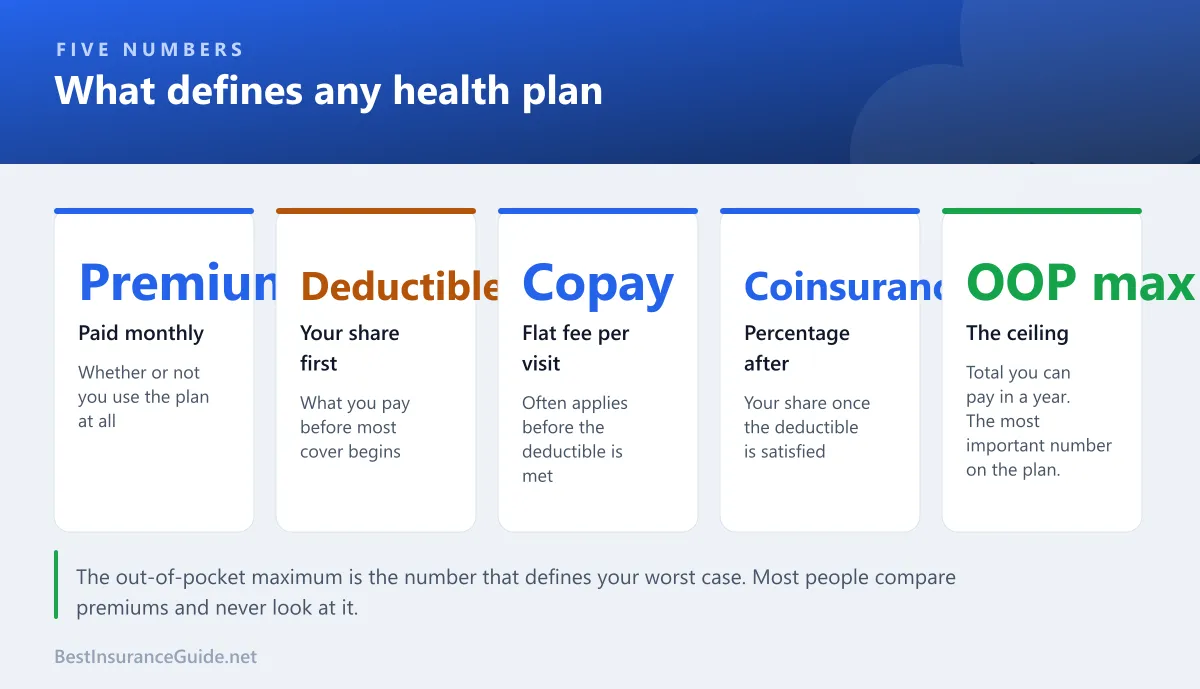
Premium is what you pay monthly for the plan to exist. You pay it whether or not you see a doctor all year, and it does not count toward your deductible or out-of-pocket maximum.
Deductible is what you pay before most coverage begins.
Copay is a flat fee for a specific service. Often applies before the deductible is met.
Coinsurance is your percentage share after the deductible is satisfied. An 80/20 plan pays 80% and leaves you 20%.
Out-of-pocket maximum is the ceiling. Once you reach it, the plan pays 100% of covered in-network care for the rest of the year.
That last one is the number to compare plans on, and almost nobody does. It defines your worst case, which is the entire thing you’re buying.
The order costs are applied in
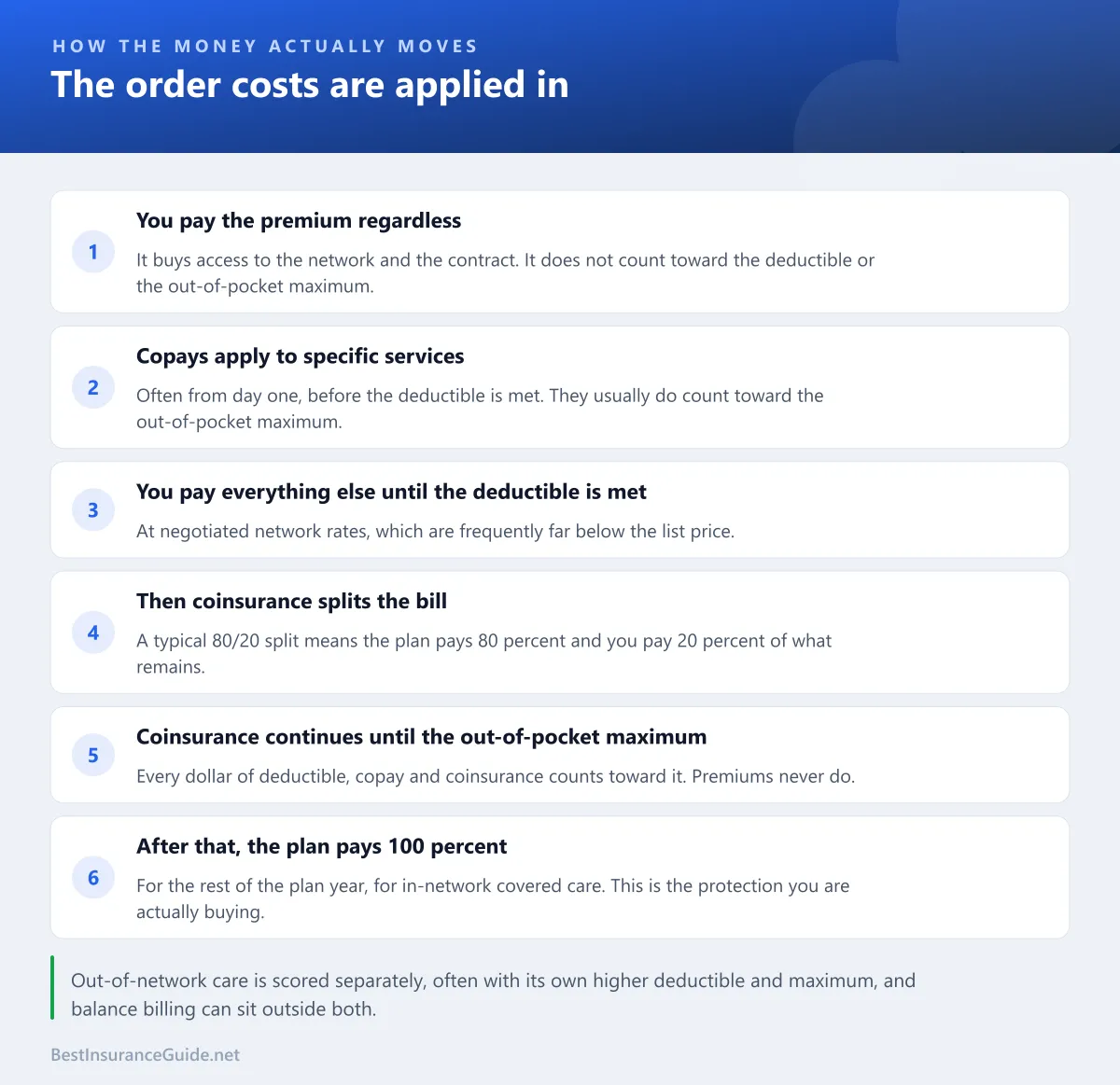
Worked example: a full year, step by step
A plan with a $2,500 deductible, 20% coinsurance, $30 primary care copays, and a $7,000 out-of-pocket maximum. Premium is $340 a month.
Someone has a reasonably eventful year.
| Event | Billed (network rate) | How it’s applied | You pay | Running deductible |
|---|---|---|---|---|
| 3 GP visits | $390 | $30 copay each | $90 | $0 |
| Blood work | $420 | Deductible | $420 | $420 |
| MRI | $1,900 | Deductible | $1,900 | $2,320 |
| Specialist consult | $310 | $180 deductible, then 20% of $130 | $206 | $2,500 met |
| Outpatient surgery | $14,200 | 20% coinsurance | $2,840 | — |
| Physio, 8 sessions | $1,600 | 20% coinsurance | $320 | — |
| Totals | $18,820 | $5,776 |
Plus $4,080 in premiums. Total cost for the year: $9,856.
Two things worth pulling out.
The GP copays didn’t touch the deductible. After three visits and $90 paid, the deductible was still fully intact at $2,500. That’s the single most common surprise in health insurance, and it’s why “I’ve been paying all year” doesn’t mean what people assume.
And they never reached the $7,000 out-of-pocket maximum, stopping at $5,776. Had the surgery been more complex, everything past $7,000 would have been free.
The plan choice
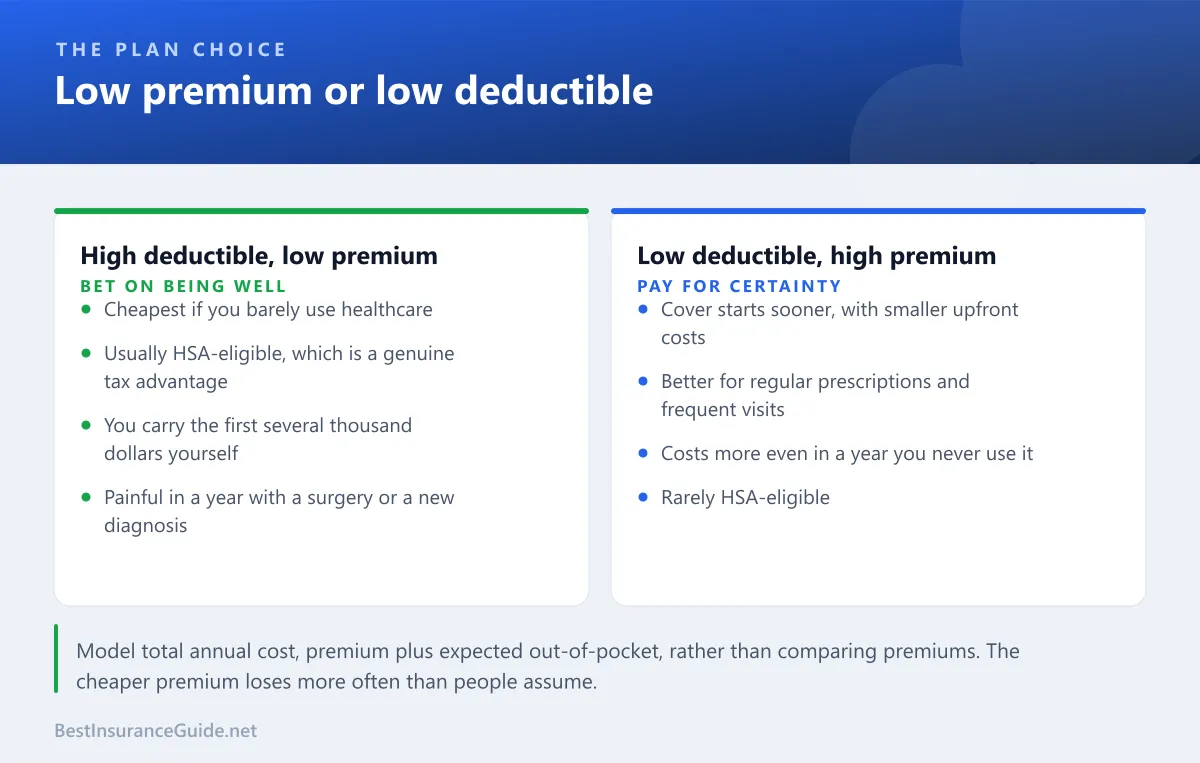
This is the decision most people get wrong, because they compare premiums.
Worked example: two plans, three different years
Same person choosing between:
- Plan A: $210/month premium, $6,000 deductible, $7,500 OOP max, HSA-eligible
- Plan B: $465/month premium, $1,000 deductible, $4,500 OOP max
| Plan A total | Plan B total | |
|---|---|---|
| A healthy year. One physical, one minor illness. $600 of care. | $2,520 + $600 = $3,120 | $5,580 + $340 = $5,920 |
| A moderate year. $9,000 of care: imaging, a procedure, follow-ups. | $2,520 + $6,600 = $9,120 | $5,580 + $2,600 = $8,180 |
| A bad year. $80,000 of care: surgery and a hospital stay. | $2,520 + $7,500 = $10,020 | $5,580 + $4,500 = $10,080 |
Plan A wins the healthy year by $2,800. Plan B wins the moderate year by $940. In the catastrophic year they’re within $60 of each other, which is the point most people miss entirely: once you blow through the out-of-pocket maximum, the plans converge.
So the choice is really about the middle scenario and about cash flow. Can you fund $6,000 if it lands in February? If yes, Plan A is usually the better bet across several years. If no, Plan B’s certainty is worth paying for.
Add the HSA and Plan A strengthens further, which brings us to the next bit.
HSAs, which are genuinely worth understanding
A Health Savings Account is available only alongside a qualifying high-deductible plan, and it’s the only account in the US tax code with three tax advantages at once: contributions reduce taxable income, growth is untaxed, and withdrawals for medical costs are untaxed.
Worked example: the tax effect
Someone in the 24% federal bracket contributing $4,000 a year to an HSA.
| Without HSA | With HSA | |
|---|---|---|
| Income set aside for medical costs | $4,000 | $4,000 |
| Federal tax paid on it | $960 | $0 |
| FICA (if via payroll deduction) | $306 | $0 |
| Effective cost of $4,000 of medical spending | $5,266 of gross income | $4,000 |
Roughly $1,266 a year in tax saved, which frequently exceeds the entire premium difference between an HDHP and a low-deductible plan.
Unused balances roll over indefinitely and the account is yours if you change jobs, which is what separates it from a Flexible Spending Account, where unused money is generally forfeited at year end.
Networks, and the mistake that costs most
In-network providers have contracted rates with your insurer. Out-of-network providers haven’t.
Out-of-network care typically carries its own separate deductible and its own separate out-of-pocket maximum, both usually much higher. And historically it exposed patients to balance billing, where the provider bills you the gap between their list price and what your insurer paid.
The federal No Surprises Act now protects against most surprise balance bills for emergency care and for out-of-network providers at in-network facilities, which was the situation that ruined people financially. It doesn’t cover care you choose to receive out-of-network.
Worked example: the same procedure, in and out of network
An outpatient procedure with a $22,000 list price.
| In-network | Out-of-network | |
|---|---|---|
| Negotiated rate | $9,400 | None; $22,000 stands |
| Applies to which deductible | $2,500 (met) | Separate $5,000 (unmet) |
| Deductible paid | $0 | $5,000 |
| Coinsurance | 20% of $9,400 = $1,880 | 40% of $17,000 = $6,800 |
| You pay | $1,880 | $11,800 |
The negotiated rate alone cut the bill by more than half before any cost-sharing applied. That discount is a large part of what you’re buying, and it’s invisible on the plan summary.
Check network status before any scheduled care. Ask specifically about the anaesthetist, the radiologist and the pathologist, who are frequently billed separately and are frequently out-of-network at an in-network hospital.
Metal tiers, briefly
Bronze, silver, gold and platinum describe how costs split between you and the plan. They say nothing about care quality or network breadth.
Bronze covers roughly 60% of average costs, silver 70%, gold 80%, platinum 90%. Lower tiers mean lower premiums and higher out-of-pocket exposure.
One thing worth knowing: cost-sharing reductions only apply to silver plans. If your income qualifies you for them, a silver plan can end up with better cost-sharing than a gold plan at a lower premium. It’s the single most valuable quirk in the marketplace and it’s easy to miss when sorting by price.
Terms worth knowing
- Explanation of Benefits. Not a bill. It shows what was billed, what the plan paid and what you owe.
- Prior authorisation. Approval required before certain care. Skipping it can void coverage for that service.
- Formulary. The list of covered prescriptions, tiered by cost. Check it if you take anything regularly.
- Preventive care. Most ACA-compliant plans cover a defined list at no cost, before the deductible. Annual physicals, screenings, vaccinations. Use it, it’s already paid for.
- Open enrolment. The annual window to change plans. Outside it you need a qualifying life event.
What to actually do
Compare plans on total expected annual cost, not premium: twelve months of premium, plus your realistic out-of-pocket spend, with the out-of-pocket maximum as your worst case.
Our health insurance budget calculator models that, and our guide to using insurance calculators covers testing the assumptions.
Then check that your doctors and any regular prescriptions are in-network and on the formulary before enrolling, because switching back mid-year usually isn’t possible.
If any of the underlying vocabulary was new, our insurance basics guide covers deductibles and limits in the general case, and what drives premiums explains why health pricing works differently from every other line.