Auto Insurance Discounts: The Complete List Most Drivers Miss
Most insurers offer 20+ auto insurance discounts and most drivers claim five. The full list, what each is actually worth, and how to audit your own policy.

Table of contents

Your insurer probably offers more than twenty discounts. You’re probably claiming five.
That gap is where the money is, and it exists for a mundane reason: nobody at the insurance company is going to call you. Discounts aren’t a reward they hand out for good behaviour. They’re a pricing mechanism, and most of them sit there until you ask.
The Insurance Information Institute has a good primer on what determines the price of your auto insurance if you want the underwriting view. What follows is the practical one: the full list, what each is actually worth in dollars, and how to audit your own policy without losing an afternoon to hold music.
Start with the four that move real money
Most discount lists are alphabetical, which is useless. Here’s the honest ranking.
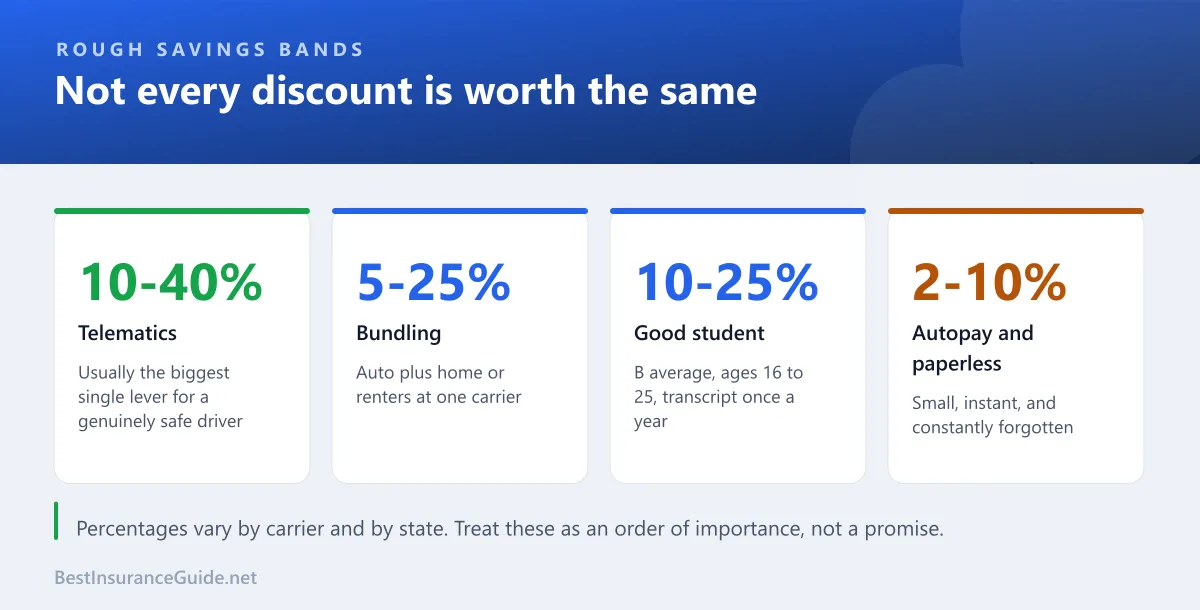
Telematics is usually the biggest one available, and it’s the only discount here that responds to what you do rather than who you are. More on it below, because it deserves a closer look than the rest.
Bundling means putting auto and home, renters or life at the same carrier. It’s the most heavily advertised discount in the industry, for a reason that isn’t entirely about you: bundled customers switch less. It’s still genuinely worth having. If you rent, our renters insurance guide covers why adding a policy that costs $14 a month can pay for itself in the auto discount alone.
Good student applies to full-time students roughly 16 to 25 holding a B average. You’ll need a transcript once a year. Given that young drivers pay the highest rates of any group, this is one of the few levers that meaningfully changes that number.
Homeowner status earns a discount at many carriers even when the house is insured elsewhere. Insurers read homeownership as financial stability. They won’t know unless you tell them, and most quote forms never ask.
Then there’s the claims-free discount, which arrives on its own after three to five years without an at-fault claim, and vanishes the moment you have one.
Worked example: what stacking actually looks like
Numbers make this concrete. Take a driver we’ll call Marcus: 34, married, two cars, decent record, renting an apartment in a mid-size city. His starting six-month premium on two vehicles is $1,180, so $2,360 a year.
Here’s what happens as each discount lands. Note that they don’t simply add up, because most insurers apply them sequentially against the running total rather than all against the original.
| Step | Discount | Applied to | Running six-month premium |
|---|---|---|---|
| Start | — | — | $1,180 |
| 1 | Multi-car, 12% | $1,180 | $1,038 |
| 2 | Renters bundle, 9% | $1,038 | $945 |
| 3 | Married, 6% | $945 | $888 |
| 4 | Paid in full, 5% | $888 | $844 |
| 5 | Paperless + autopay, 3% | $844 | $818 |
| 6 | Telematics, 18% | $818 | $671 |
Final: $671 every six months, or $1,342 a year. That’s $1,018 saved against the starting number, a 43% reduction, and Marcus didn’t change insurer, change car, or drive differently. He answered questions nobody had asked him.
Two things worth pulling out of that table.
The first is the sequencing. Add those percentages up naively and you get 53%, but the actual reduction is 43%. Percentages applied one after another against a shrinking base always land lower than the sum suggests. When a carrier advertises “save up to 40% with our discounts,” this is the arithmetic underneath.
The second is that renters policy in step 2. It costs Marcus about $170 a year. It cut his auto premium by $186 annually. He is being paid $16 a year to insure his belongings, which is not how anyone expects insurance to work.
The middle of the list
These are smaller. They also take about ninety seconds each, which is a very good rate of return on your time.
- Multi-car. Two or more vehicles on one policy.
- Defensive driving course. A few hours online, a one-off fee, and the discount usually runs three years. Some states require insurers to offer it.
- Anti-theft devices. Factory immobilisers often count. So do aftermarket alarms and tracking systems.
- Safety features. Automatic emergency braking, lane departure warning, blind spot monitoring. Newer cars usually get this automatically. Cars from roughly 2015 to 2019 often don’t, because the insurer’s vehicle data is incomplete for that window.
- Low mileage. Under roughly 7,500 miles a year at most carriers. Worth revisiting if you started working from home and never mentioned it.
- Autopay, paperless and paid-in-full. Small, instant, and the most commonly missed on the entire list.
- Early quote. Getting your quote seven to ten days before the current policy expires. Several carriers reward this and almost nobody knows.
Worked example: the defensive driving course
This one gets dismissed as trivial, so here’s the maths.
A driver paying $1,600 a year takes an approved online course. It costs $35 and takes about five hours. The discount is 8%, and it runs for three years.
- Saving: $128 a year × 3 years = $384
- Cost: $35
- Net: $349
That’s roughly $70 an hour for the time spent, tax-free, and the course also removes points from your licence in a lot of states, which protects you from a much larger surcharge later. If you’re over 55, many states mandate a mature driver discount for completing one, and it’s frequently larger.
And the ones nobody advertises
Situational discounts depend entirely on carrier and state, so the only way to find them is to ask directly.
Military and veteran status. Federal employees. Membership of professional associations, alumni groups, credit unions and warehouse clubs. Occupational discounts for teachers, nurses, engineers and first responders. Senior discounts, usually from 55. A discount for students at college more than 100 miles from home without a car. Loyalty discounts after several years, worth less than shopping around but still worth claiming.
Nobody will volunteer these. Ask what you might qualify for based on your job, your memberships and your household, and make them go looking.
Telematics deserves a closer look
This is the one I’d think hardest about, because it’s the only discount that can move in both directions.
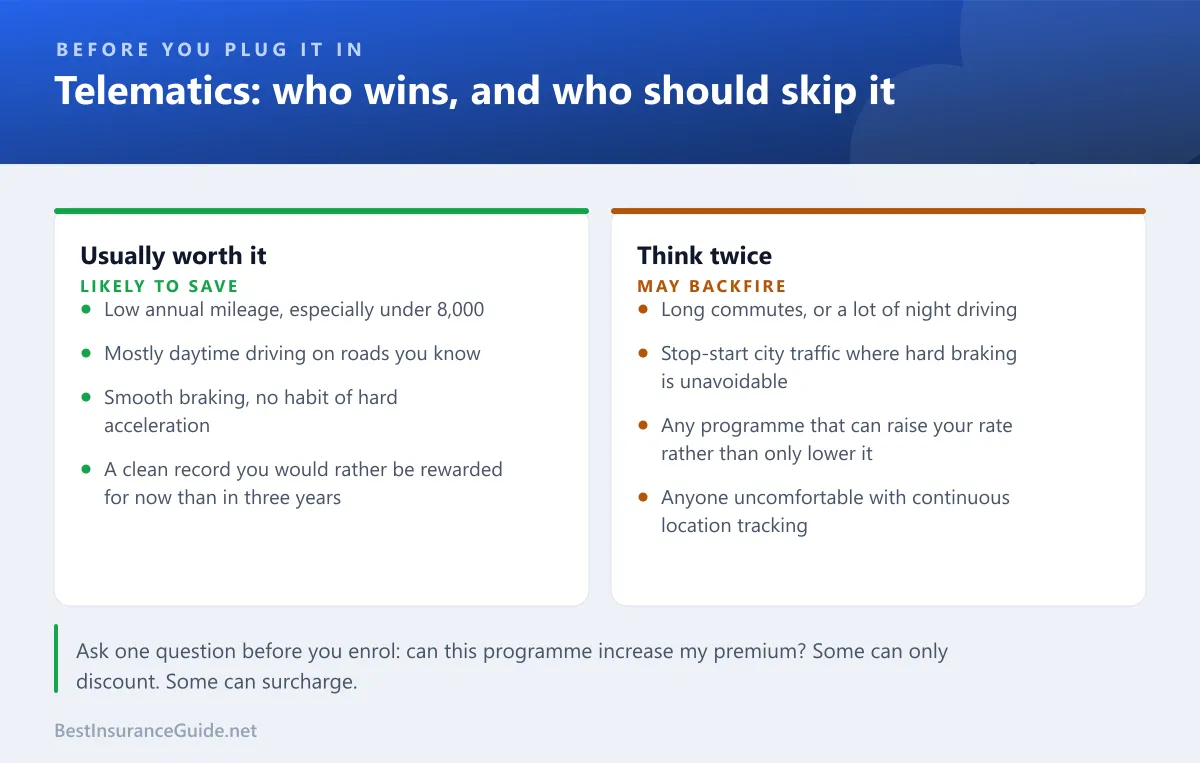
The programs vary more than the marketing suggests. Some can only reduce your premium. Others can raise it if the data goes badly, and “badly” isn’t always what you’d assume. Hard braking is the metric that catches people out, because it can’t tell the difference between reckless driving and stopping properly for a child who ran into the road.
Worked example: two drivers, same program
Both enrol in a program offering an initial 10% participation discount, then a final adjustment between −30% and +15% after a six-month monitoring period. Both start at $1,400 a year.
Priya commutes eleven miles each way through suburban streets, drives about 7,200 miles a year, rarely drives after 10pm. Her score comes back strong.
- Participation discount: $1,400 → $1,260
- Final adjustment, −26%: $1,260 → $932
- Saved: $468 a year
Dan drives 19,000 miles a year, much of it stop-start city traffic, with a regular late shift finishing at 11:30pm. His braking events are frequent and a third of his mileage lands in the late-night bracket the program scores hardest.
- Participation discount: $1,400 → $1,260
- Final adjustment, +11%: $1,260 → $1,399
- Saved: $1 a year, and he’s now sharing continuous location data for nothing
Dan didn’t do anything wrong. He drives in conditions the program scores badly, and no amount of careful driving changes the mileage or the shift pattern. This is why the two questions below matter more than the advertised discount.
Before you enrol, get these answered in writing:
- Can this program raise my rate, or only lower it?
- What happens to the discount if I stop participating partway through?
If it’s discount-only and you drive under 8,000 miles a year mostly in daylight, enrol. It’s usually the largest single reduction available. If you look like Dan, run the numbers first.
Auditing your own policy
Here’s the part that actually saves money, and it takes about fifteen minutes once a year.
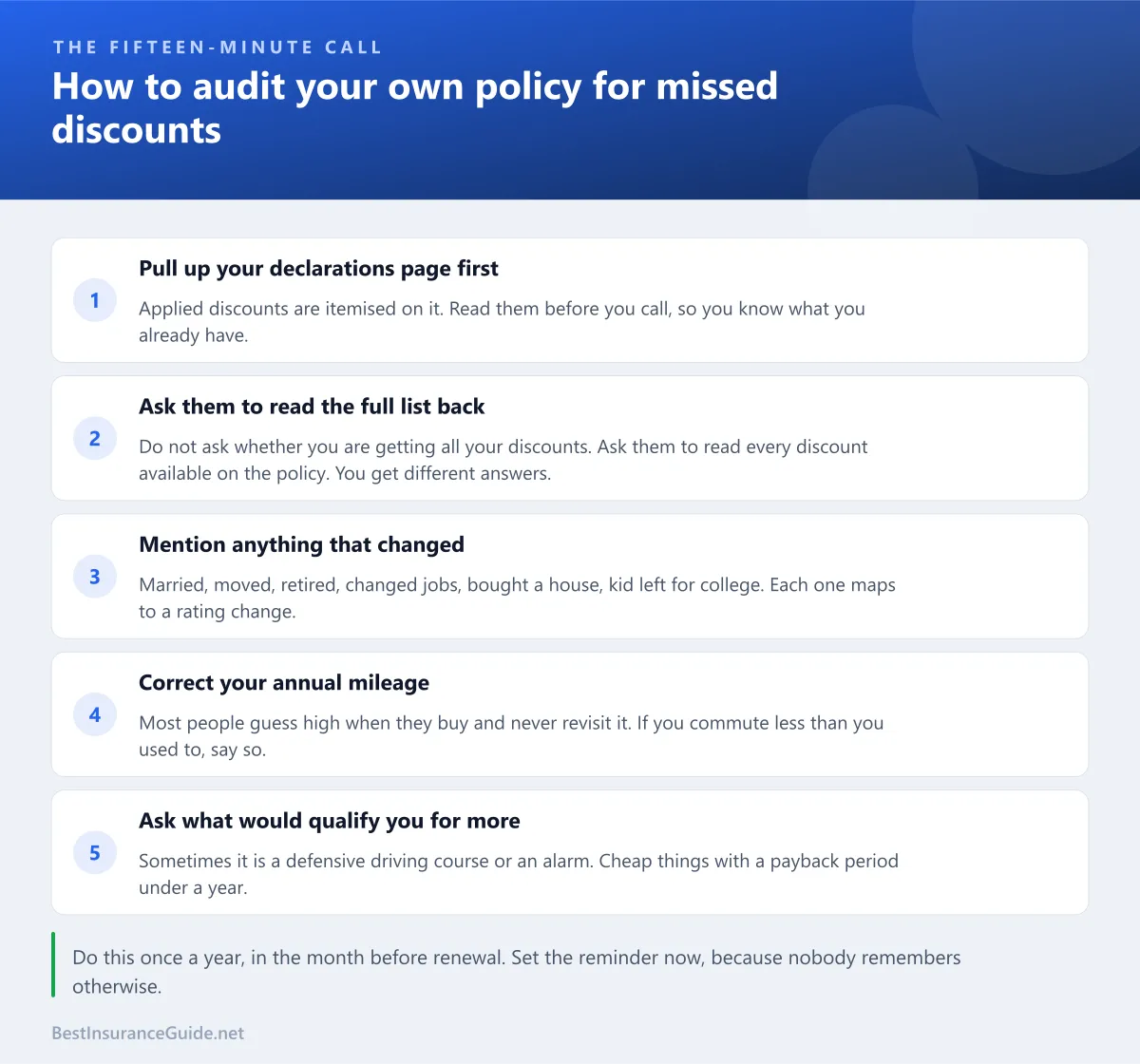
The phrasing on step two matters more than it looks. “Am I getting all my discounts?” invites a yes. “Please read me every discount available on this policy” produces a list, and then you can work through it. That exact difference in wording routinely surfaces something worth a few hundred dollars a year.
Worked example: the mileage correction
A reader moved to hybrid working in 2023 and never updated her policy. Her declarations page still said 15,000 annual miles. Her actual figure was closer to 5,400.
One phone call moved her into the low-mileage band and triggered a usage review:
- Low mileage discount: 11%
- Reclassified from “commute” to “pleasure” use: further 6%
- Combined effect on a $1,520 premium: $268 a year
The call took nine minutes. She’d been overpaying for two and a half years, which is about $670 of nothing.
On life changes generally, the ones that move rates most are marriage, moving house, retiring, changing jobs, buying a home, and a child moving out or back in. None of those reach your insurer automatically. Marriage alone is worth a meaningful reduction at most carriers and people routinely go years without mentioning it.
Where people lose money
A few patterns come up over and over.
Assuming discounts carry across when you switch. They don’t. Every discount has to be claimed again, and the new carrier may not offer the same ones. This is the single most common way people end up paying more after moving to a “cheaper” quote.
Chasing discounts instead of the total price. A policy with nine discounts applied can easily cost more than one with three. The percentage is meaningless without the base rate it comes off.
Here’s what that looks like side by side, same driver, same coverage:
| Carrier A | Carrier B | |
|---|---|---|
| Base annual rate | $1,900 | $1,420 |
| Discounts applied | 9 | 3 |
| Total discount | 34% | 12% |
| Final annual premium | $1,254 | $1,250 |
Carrier A looks dramatically better on every marketing metric and costs four dollars more. Compare final annual premiums at identical coverage, always. Our guide on comparing insurance quotes properly covers doing that without fooling yourself.
Cutting coverage and calling it a discount. Dropping to state minimum limits isn’t a saving, it’s a transfer of risk onto yourself. Same with dropping collision on a car you couldn’t afford to replace tomorrow.
Never re-shopping. Insurers reprice their books constantly. The carrier that was cheapest three years ago has no obligation to still be cheapest, and won’t tell you when it isn’t.
What about the deductible?
Strictly it isn’t a discount, but it’s usually a bigger lever than most of them, so it belongs here.
| Deductible | Annual premium | Saved vs $500 | Extra risk vs $500 | Break-even |
|---|---|---|---|---|
| $500 | $1,540 | — | — | — |
| $1,000 | $1,412 | $128 | $500 | 3.9 years |
| $2,000 | $1,298 | $242 | $1,500 | 6.2 years |
Read the break-even column as “how long you’d need to go without a claim for this to have been worth it.” Most drivers file a claim every eight to ten years, so both of those look reasonable on paper.
The catch is the risk column, not the break-even column. Raising your deductible is only sensible if the higher number is genuinely payable tomorrow, without a credit card. Otherwise you’ve swapped a known annual cost for an unaffordable emergency one, which is the opposite of what insurance is for.
One last thing
Pull out your declarations page tonight and read the discount section. Not the premium, the discount list.
Most people have never looked at it. A fair number will find something obvious missing, and a few will find a discount they lost at some renewal without ever being told. That’s a five-minute job with a better hourly rate than almost anything else you’ll do this week.
For the wider picture on what sets your rate in the first place, our guide to what really drives your premiums covers the factors underneath all of this. If there’s a driver under 25 in the household, car insurance for young drivers goes deeper on the discounts that actually apply at that age.