Motorcycle Insurance in Pennsylvania: You Keep Full Tort Rights
Pennsylvania motorcyclists keep full tort rights even under a limited tort auto policy, and are exempt from medical benefits. What that means for cover.

Table of contents
Pennsylvania has two motorcycle-specific rules that most riders have never heard of, and one of them is genuinely in your favour.
What the state requires
Pennsylvania requires liability insurance, at minimum limits of:
- $15,000 bodily injury per injured person
- $30,000 bodily injury per accident
- $5,000 property damage
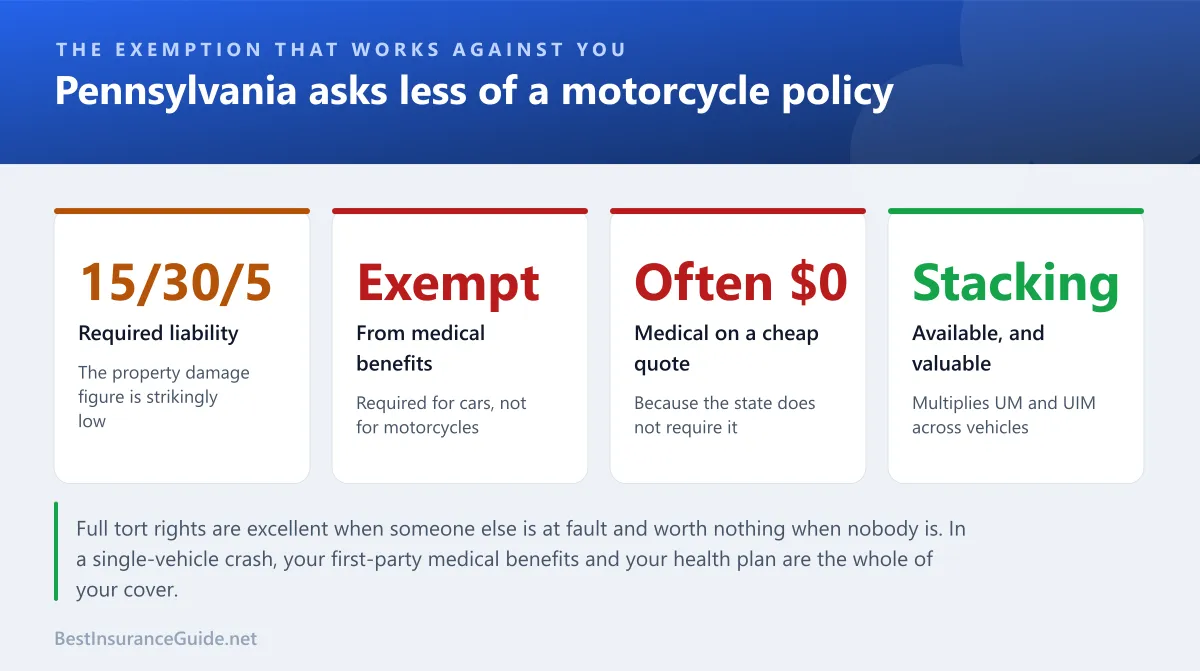
Written 15/30/5. That property damage figure is strikingly low against modern vehicle values, and a single at-fault collision with a newer car will exceed it comfortably.
Helmets are required for riders under 21. Riders 21 and over may go without provided they have either held a motorcycle licence for at least two years or completed an approved safety course. Eye protection is required unless the bike has a windscreen.
The tort rule that favours riders
Pennsylvania offers car owners a choice between limited tort and full tort.
Limited tort costs less and restricts the ability to sue for pain and suffering except in defined circumstances, principally serious injury. Full tort costs more and preserves the full right to claim.
Here is the part that matters: the limited tort election does not apply to injuries sustained while operating a motorcycle.
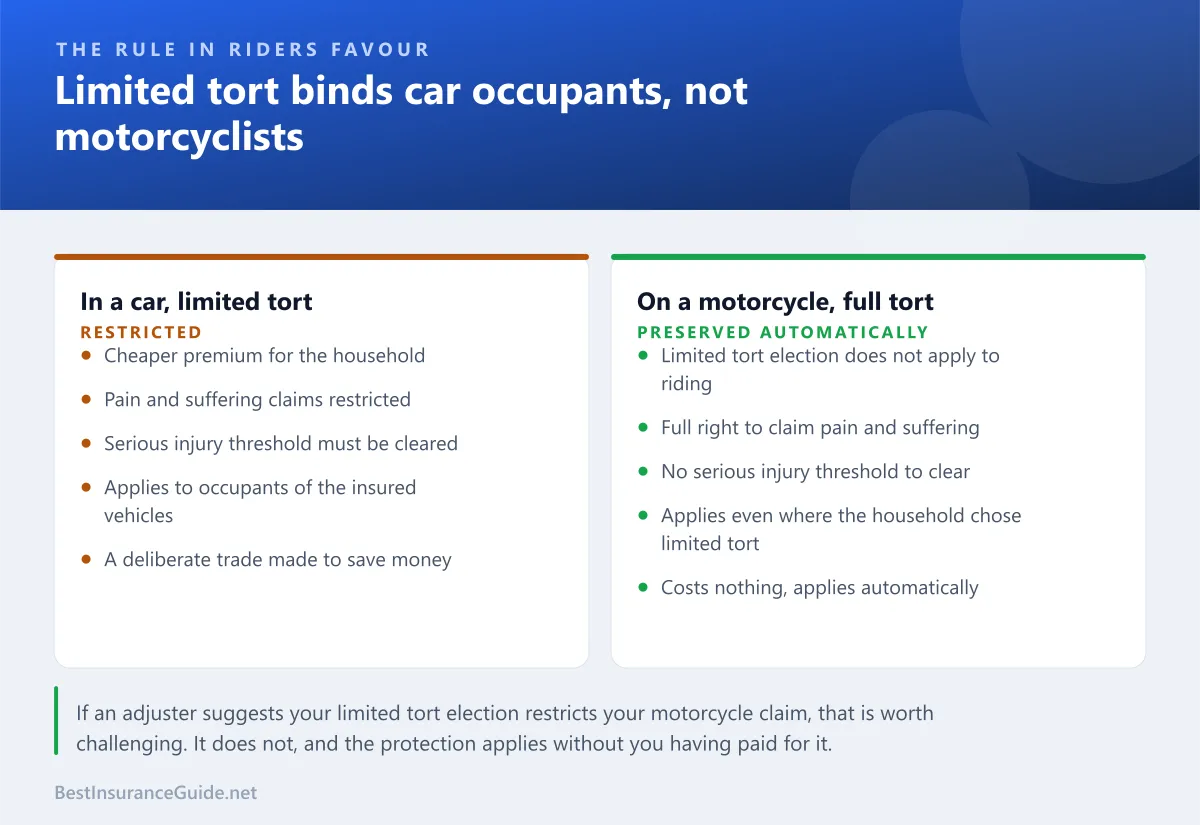
A rider whose household auto policy elected limited tort, to save money on the cars, still retains full tort rights when riding. They can claim for pain and suffering without needing to clear the serious injury threshold.
That is a genuinely valuable protection and it costs nothing, because it applies automatically.
Two practical points follow.
Do not let anyone tell you that your limited tort election limits your motorcycle claim. It does not. If an adjuster suggests otherwise, that is worth challenging.
It does not reduce the need for your own coverage. Full tort rights are only useful if the at-fault party has assets or insurance to claim against, which brings us to the second rule.
The exemption that works against riders
Pennsylvania requires car owners to carry first-party medical benefits, which pay the policyholder’s medical costs regardless of fault.
Motorcycles are exempt from that requirement.
The consequence is direct: a motorcycle policy in Pennsylvania does not automatically include medical coverage, and a policy bought on price frequently does not include it at all.
Pennsylvania is a fault state for motorcycle claims. So in a single-vehicle crash — a deer strike, gravel, a diesel spill, a low-side on a wet corner — there is no other party to claim against, and no required medical benefit to fall back on.
What responds is:
Your own first-party medical benefits, if you bought them.
Your health insurance, subject to its deductible, coinsurance and any motorcycle-related exclusions.
That gap is the single most important thing for a Pennsylvania rider to close, and it is closed by deliberately buying medical benefits on the motorcycle policy rather than assuming they are there.
Worked example: a single-vehicle crash
A rider loses the bike on a wet rural road. No other vehicle involved.
| Item | Amount |
|---|---|
| Air ambulance and emergency treatment | $31,000 |
| Orthopaedic surgery and hospitalisation | $58,000 |
| Rehabilitation over four months | $22,000 |
| Total medical | $111,000 |
| Liability coverage available | $0, no third party |
| Full tort rights | Worth nothing, no defendant |
| First-party medical benefits, if carried at $25,000 | $25,000 |
| Health insurance, after deductible and coinsurance | Balance, subject to out-of-pocket maximum |
Full tort rights are excellent when someone else is at fault. They are worth precisely nothing when nobody is, which is why the medical benefits question outranks it in practice.
What to carry above the minimum
First-party medical benefits, at a meaningful level. The most important optional coverage in Pennsylvania specifically, because of the exemption.
Uninsured and underinsured motorist coverage. Pennsylvania minimums are $15,000 per person, which a serious motorcycle injury exhausts almost immediately. UM and UIM are the coverages that pay when the at-fault driver has nothing or too little, and Pennsylvania insurers must offer them.
Pennsylvania also permits stacking of UM and UIM across multiple vehicles on a policy, which multiplies the available limit. Stacked cover costs more and provides substantially more, and you must reject stacking in writing. For a household with cars and a motorcycle this is worth asking about specifically.
Liability well above 15/30/5, particularly the property damage element.
Comprehensive and collision if the bike has value or is financed.
Custom parts and accessories, since standard policies cap aftermarket work low. Our guide to custom motorcycle insurance covers scheduling and agreed value.
The winter question
Pennsylvania has a genuine off-season, and the same logic applies as in Ohio and Michigan.
Reducing coverage is sensible. Cancelling is not. A lapse breaks continuous coverage, which is a rated factor, and raises the next premium by more than the winter saving.
Ask for a lay-up or storage arrangement: keep comprehensive against theft, fire and water damage, reduce or suspend collision and liability while the bike is off the road, and restore full cover in spring.
A stored bike is still exposed to theft and to burst pipes or flooding in a garage, and comprehensive is the cheaper of the two physical damage coverages.
What moves a Pennsylvania premium
Philadelphia and Pittsburgh price above rural counties, following claim costs, traffic density and theft rates.
Bike type, with sport bikes well above cruisers and touring machines.
Rider age and experience, with a steep youth curve and a loading in the first years that mirrors the helmet law’s two-year provision.
Shortened riding season, which reduces annual exposure and enables the lay-up option.
Storage and security, since garaged bikes cost less and are stolen less.
Safety course completion, which produces a discount and also satisfies the helmet exemption for riders over 21.
The short version
Pennsylvania requires 15/30/5 liability, and helmets for riders under 21 or those with less than two years of licensure who have not completed a safety course.
Two motorcycle-specific rules matter more than the minimums. Your household’s limited tort election does not bind you when riding, so you keep full tort rights and the ability to claim for pain and suffering. And motorcycles are exempt from the first-party medical benefits requirement, which means your policy probably does not include medical cover unless you asked for it.
Buy the medical benefits. Full tort rights are valuable when someone else is at fault and worthless in a single-vehicle crash, which is exactly where the medical gap opens.
Then carry UM and UIM, ask about stacking, raise the property damage limit well above $5,000, and use storage cover over winter rather than cancelling.
For how other states handle the same questions, see motorcycle insurance by state.
Stacking, and why it matters here
Pennsylvania permits stacking of uninsured and underinsured motorist coverage, and it is one of the more valuable features available to a rider with more than one vehicle.
Stacked coverage multiplies your UM or UIM limit by the number of vehicles on the policy. Three vehicles with $100,000 of stacked UIM produces $300,000 of available cover.
Unstacked coverage does not. The limit is the limit regardless of how many vehicles you insure.
Stacked cover costs more, and you must reject stacking in writing to go without it. That written rejection is a document worth finding, because a great many people have signed one without understanding what it did.
Worked example: stacked against unstacked
A household with two cars and a motorcycle, $100,000 UIM. The rider is seriously injured by a driver carrying Pennsylvania minimums.
| Stacked | Unstacked | |
|---|---|---|
| At-fault driver’s limit | $15,000 | $15,000 |
| Your UIM limit available | $300,000 | $100,000 |
| Injuries and losses | $260,000 | $260,000 |
| Total recovered | $260,000 | $115,000 |
A $145,000 difference from an election most policyholders do not remember making.
If you hold multiple vehicles in Pennsylvania and ride, check whether you stacked. If you rejected it, reconsider at renewal, because the incremental premium is small relative to that gap.
Comparing quotes properly in Pennsylvania
Match five fields before comparing price: bodily injury liability, property damage, uninsured and underinsured motorist limits, comprehensive deductible and collision deductible.
Then three Pennsylvania-specific questions.
Does this quote include first-party medical benefits, and at what level? Because motorcycles are exempt from the requirement, a cheap quote frequently omits it entirely, and that is the coverage that responds in a single-vehicle crash.
Is uninsured and underinsured motorist stacked or unstacked?
What is the custom parts and accessories limit?
Our guide to comparing insurance quotes the right way sets out the general discipline. The Pennsylvania point is that two motorcycle quotes can differ enormously in what they actually contain, because the state requires less of a motorcycle policy than of a car policy.
Rural roads, and where Pennsylvania crashes happen
Pennsylvania has some of the best riding in the Northeast and a road environment that produces a particular claim profile.
Deer. Pennsylvania has one of the highest deer collision rates in the country. On a motorcycle that is a serious injury event rather than a bodywork claim, and it is a single-vehicle crash for insurance purposes, so there is no third party to claim against.
Agricultural traffic and road debris. Rural routes carry mud, spilled aggregate and diesel, all of which reduce traction without warning.
Older road surfaces. Freeze-thaw damage, patched repairs and edge breaks are common on secondary roads.
Winding low-visibility routes. The riding that makes Pennsylvania appealing also produces limited sightlines and blind crests.
Every one of these tends toward the crash where nobody else is involved. That matters because it is exactly the scenario where full tort rights are worth nothing and first-party medical benefits are worth everything.
If you ride Pennsylvania’s rural routes regularly, that is the strongest possible argument for buying medical benefits properly rather than accepting a quote that omits them.
What to do after a crash
Report to police, particularly where injury or significant damage is involved.
Photograph the scene widely before vehicles move, including road surface conditions if debris or spillage contributed.
Get witness details, since rider-blame assumptions are common.
Report to your insurer promptly regardless of fault.
See a doctor the same day. With full tort rights preserved, the medical record is what evidences the claim, and gaps in treatment are read as evidence that an injury resolved.
Do not accept an early settlement on an injury claim before the medical picture is clear. Full tort rights allow a pain and suffering claim, and signing a release forecloses it permanently.
Our guide to what to do after a car accident that was not your fault sets out the general sequence.
Comparable states
Pennsylvania exempts motorcycles from the medical benefits requirement and does not bind riders to the limited tort election, which places it alongside Massachusetts and Michigan as a state where the no-fault system treats riders differently from drivers. Ohio is the closest neighbour geographically with an entirely different structure.
A note on scope and sources
Pennsylvania’s financial responsibility requirements, tort election rules, medical benefits exemption for motorcycles and helmet provisions are set by statute and administered by PennDOT, with insurance regulated by the Pennsylvania Insurance Department.
The tort and stacking provisions in particular are technical and have been litigated, so confirm the current position with the Insurance Department and take legal advice on any actual claim. Premium and cost figures here are illustrative rather than quotes. Nothing here is legal advice, and this site is independent and not affiliated with any insurer.