Classic Motorcycle Insurance: Agreed Value Is the Whole Point
Classic motorcycle insurance uses agreed value rather than actual cash value. Eligibility, mileage limits, storage conditions and when it is worth switching.

Table of contents
If you own an older motorcycle and insure it on a standard policy, there is a good chance you are paying for a settlement you would find unacceptable.
The problem with actual cash value
A standard motorcycle policy settles a total loss at actual cash value: what the bike was worth immediately before the crash, determined by the insurer after the event.
For a three-year-old commuter that works fine. For anything older, restored, rare or appreciating, it frequently does not, for three reasons.
Valuation guides lag the market. The data insurers reference on older machines is thin, and it tends to track condition-average examples rather than good ones.
Restoration is invisible to a depreciation model. Two thousand hours and twelve thousand dollars of work does not show up as a higher book value. The bike is still a 1974 whatever.
Originality and specification are not captured. Matching numbers, correct components, documented provenance and low mileage all affect what a bike is worth and none of it appears in a standard valuation.
The result is the settlement conversation nobody wants: you say the bike was worth $18,000, the insurer’s data says $7,400, and you are arguing after the loss with no agreed reference point.
What agreed value does
Classic and collector policies settle at an agreed value: a figure you and the insurer fix when the policy is written.
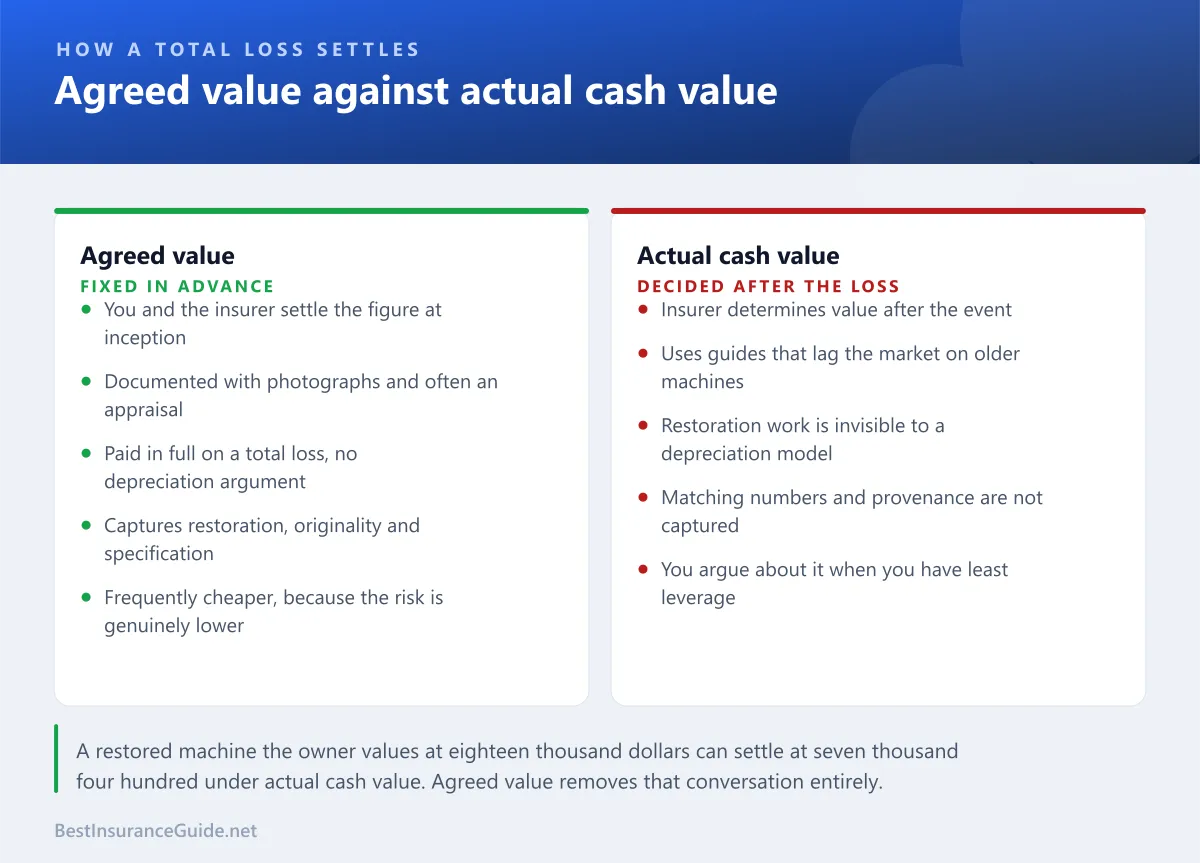
You document the bike, the insurer accepts a figure, and that figure is what is paid on a total loss. No depreciation argument, no post-loss valuation dispute, no reliance on a guide that has never seen your machine.
The documentation usually involves photographs from several angles, details of the specification and any restoration, receipts for significant work, and for higher values an appraisal.
Worked example: the same bike, two policies
A restored 1970s machine, insured for three years, then stolen.
| Standard policy | Classic policy | |
|---|---|---|
| Annual premium | $480 | $310 |
| Basis of settlement | Actual cash value | Agreed value |
| Owner’s view of value | $18,000 | $18,000 |
| Insurer’s post-loss valuation | $7,400 | Not applicable |
| Settlement | $7,400 | $18,000 |
| Shortfall | $10,600 | $0 |
Cheaper premium, better settlement. That combination is unusual in insurance and it exists because the underwriting assumptions are genuinely different.
Why it costs less
Classic policies are cheaper because the risk is genuinely lower, and the conditions are how the insurer secures that.
Limited annual mileage. These bikes are ridden a few thousand miles a year at most, not commuted on daily.
Secure storage. A locked garage or similar, which reduces theft dramatically.
Pleasure use. No commuting, no delivery, no daily transport.
Older, careful owners. Most classic policies carry a minimum rider age and require a clean record.
Another vehicle available. Many insurers require you to have a daily driver, precisely so the classic is not doing that job.
The premium reflects a bike that spends most of its life in a garage and is ridden carefully on dry weekends. If that is not your bike, classic cover is the wrong product and misrepresenting it creates a claims problem.
Eligibility and conditions
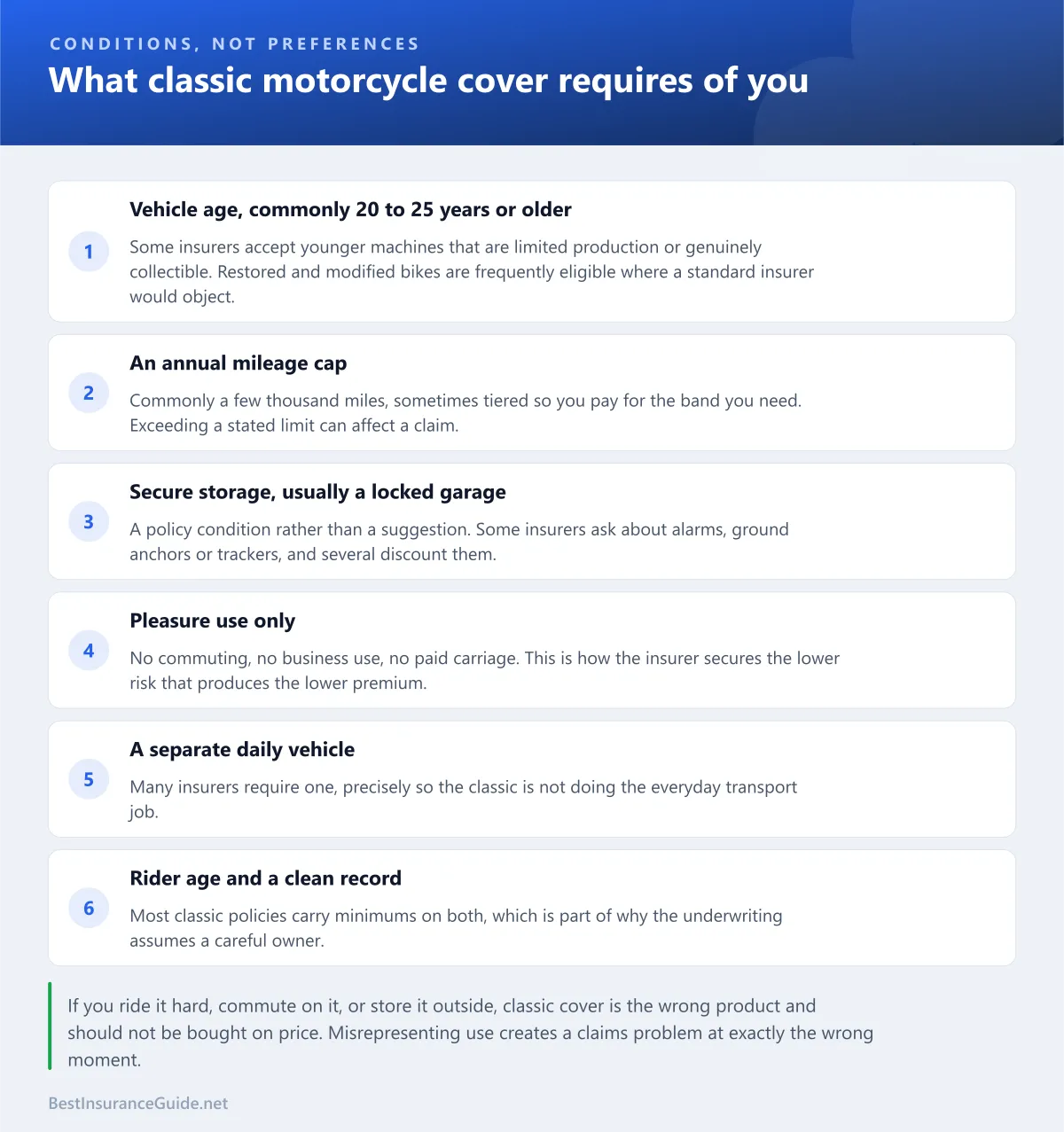
Requirements vary between insurers, and the common ones are:
Vehicle age, frequently 20 to 25 years or older, though some insurers accept younger machines that are limited production or genuinely collectible.
Annual mileage cap, commonly a few thousand miles, sometimes tiered so you pay for the band you need.
Secure storage, generally a locked garage. Some insurers ask about alarms, ground anchors or trackers.
Usage restrictions, typically excluding commuting, business use and any paid carriage.
Rider age and record, with minimums on both.
A separate daily vehicle, so the classic is not primary transport.
Condition, since a project bike in pieces and a finished machine are underwritten differently, and some insurers offer specific restoration cover for the former.
Read those as policy conditions rather than preferences. Exceeding a mileage limit or storing the bike outside contrary to the schedule can affect a claim, and it is the sort of thing an insurer checks after a theft.
Restoration and parts cover
Two features worth asking about specifically, because they address problems standard policies handle badly.
Spare parts cover. Many classic policies include an amount for spares, tools and parts stored with the bike. On a machine you maintain yourself, that stock can be worth thousands, and a standard motorcycle policy covers none of it. Your homeowners contents cover may, subject to its own limits, but the classic policy version is usually cleaner.
Restoration or agreed value uplift. If you are actively restoring, the value rises during the policy year. Some insurers will accommodate this with periodic revaluation or a rising agreed value; others require you to notify and re-rate. Ask before you start, because the gap between the agreed value and the finished bike is uninsured otherwise.
Laid-up cover during a rebuild, where the bike is not roadworthy, is usually available at a reduced premium covering fire and theft only.
When classic cover is the wrong answer
It is not always the better product, and three situations argue against it.
You ride it a lot. If the bike does eight thousand miles a year, or you commute on it, the mileage and usage conditions will not fit and the policy is the wrong shape.
It is your only vehicle. Most insurers require another daily vehicle, and being honest about that at application avoids a problem later.
The bike is not actually valuable. An old machine in average condition worth $2,500 does not need agreed value, and the administrative effort of documentation and appraisal is not worth it. Standard liability plus comprehensive is fine.
There is also a middle option worth knowing: some standard insurers will write agreed value or stated value on an ordinary motorcycle policy for an additional premium. If you want the settlement certainty without the mileage and storage conditions, ask your existing insurer before moving to a specialist.
Modified and custom bikes
Classic policies frequently suit modified machines better than standard cover does, because the specialist market is used to underwriting non-original bikes.
A standard policy caps aftermarket parts and accessories at a low figure, frequently a couple of thousand dollars, which is well below what a built bike represents. A classic or specialist policy will usually agree a value for the machine as it actually is, including the modifications.
Our guide to custom motorcycle insurance covers scheduling parts and documenting a build in detail, and much of it applies here. The difference is that agreed value handles the whole machine as one figure rather than trying to schedule each component.
What to do
Establish a realistic value. Comparable sales, a marque specialist’s view, or a formal appraisal for higher-value machines.
Photograph everything, including the engine and frame numbers, the specification details, and any restoration work in progress and completed.
Keep receipts, particularly for significant mechanical and cosmetic work.
Be honest about mileage and use. Optimistic answers here are the most common cause of a disputed classic claim.
Review the agreed value annually. Classic values move, and a figure agreed five years ago may now be well below the market.
Check what happens on a partial loss, not just a total one, since repair authorisation on a rare machine can be more contentious than the total loss figure.
The short version
A standard policy settles an older motorcycle at actual cash value, determined after the loss using data that does not see restoration, originality or condition. On anything collectible that produces a settlement well below what the bike is worth.
Classic cover fixes the figure in advance through agreed value, and it frequently costs less, because it assumes low mileage, secure storage and pleasure use.
Those assumptions are policy conditions rather than preferences. If you ride it hard, commute on it, or store it outside, classic cover is the wrong product and should not be bought on price.
Document the bike properly, agree a realistic value, review it annually, and ask specifically about spare parts cover and how restoration in progress is handled.
For state-by-state requirements, see motorcycle insurance by state, and for scheduling aftermarket work on a modern machine, custom motorcycle insurance.
Claiming on a classic policy
The claim process differs from a standard policy in ways worth knowing before you need it.
Report promptly and precisely. Classic insurers frequently handle claims in-house with staff who know the market, which is a genuine advantage. Give them the documentation you assembled at inception.
Repair authorisation is the contentious part, not the total loss figure. Agreed value settles a total loss cleanly. A partial loss on a rare machine raises harder questions: whether original parts can be sourced, whether a repair or replacement is appropriate, and who does the work.
Ask about choice of repairer before you buy. Some specialist insurers allow you to nominate a marque specialist; others direct to their own network. On a classic machine that distinction matters considerably more than it does on a modern bike.
Understand how a repaired bike affects future value. Some policies address diminished value on a collectible; most do not. Ask.
Keep the agreed value current. A five-year-old figure on an appreciating machine is a shortfall waiting to happen, and most insurers will revise it on request with updated evidence.
Storing a classic properly
Because storage is a policy condition rather than a suggestion, it is worth doing well.
A locked garage or similar secure structure, as specified in the schedule. Ground anchors and a good chain for anything valuable. A cover, both for protection and because a bike nobody can see is a bike nobody targets. Consider a tracker on higher-value machines, which some insurers require and several discount.
Two practical points beyond security. Damp is the enemy of a stored classic, and a dehumidifier or a breathable cover prevents corrosion claims that are frequently excluded as gradual damage anyway. And if the storage address changes, tell the insurer, because the policy was rated on where the bike is kept.
Insuring a project bike
A machine in pieces is a different underwriting question from a finished one, and standard classic cover frequently does not fit.
Laid-up or storage-only cover is what most insurers offer for a restoration in progress: fire and theft while the bike is off the road, at a substantially reduced premium, with no road use permitted.
Agreed value rises during the project, and the figure agreed at the start of a two-year rebuild will be well below the finished machine. Ask how the insurer handles this. Some allow periodic revaluation, some require notification at milestones, and some simply want a new figure when it goes back on the road.
Parts in transit and in storage are frequently the largest uninsured exposure on a restoration. A crate of unobtainable components sitting in a garage may fall under homeowners contents, subject to its limits and exclusions, or under a spare parts extension on the classic policy. Confirm which, because the sums involved can be substantial.
Document as you go. Photographs at each stage, receipts for every part and every hour of paid work, and a written specification. That record is what supports the agreed value when the bike is finished, and reconstructing it afterwards is close to impossible.
When the bike is roadworthy, tell the insurer before you ride it. Storage-only cover does not become road cover because the project finished.
Related reading
Average motorcycle insurance cost covers what drives ordinary motorcycle pricing and why published averages mean so little. Custom motorcycle insurance covers the same agreed value question for a modified bike, where the schedule of parts matters as much as the valuation.
A note on scope
Eligibility criteria, mileage limits, storage requirements and agreed value processes vary considerably between specialist insurers and change over time. The figures here are illustrative rather than any particular company’s terms.
Read the policy conditions in full before switching, particularly the mileage cap, usage restrictions and storage requirements, since those are the terms most likely to be tested at claim time. This site is independent and not affiliated with any insurer.