Average Motorcycle Insurance Cost: Why the Number Means Nothing
Motorcycle insurance ranges hugely by bike, rider and state. What sets the price, whether it is expensive, and the levers that actually reduce a premium.

Table of contents
Searching for the average cost of motorcycle insurance produces a number, and that number will not tell you what you will pay. The spread here is wider than in almost any other personal insurance line.
Why an average is useless
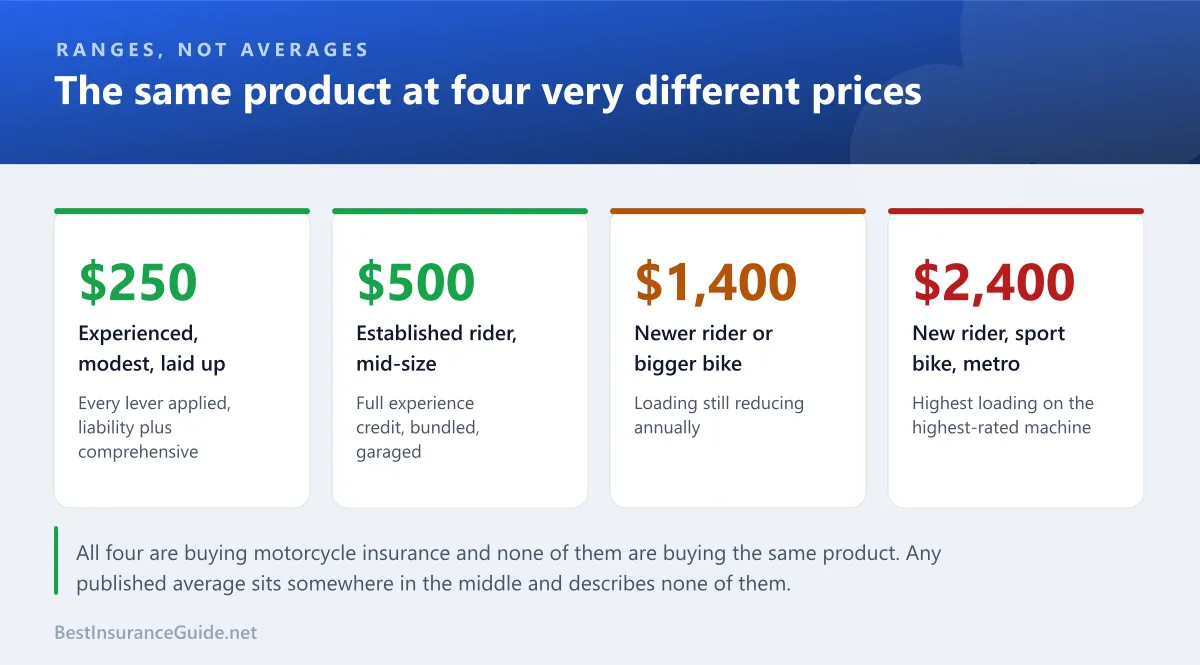
Two riders, same state, same year, can pay ten times apart.
A 55-year-old on a fifteen-year-old cruiser, liability only, garaged, safety course completed, laid up over winter. Against a 19-year-old on a new litre sport bike, full coverage, parked on the street in a large metro, riding year-round.
Both are “motorcycle insurance”. They are not remotely the same product being priced.
What actually sets the price
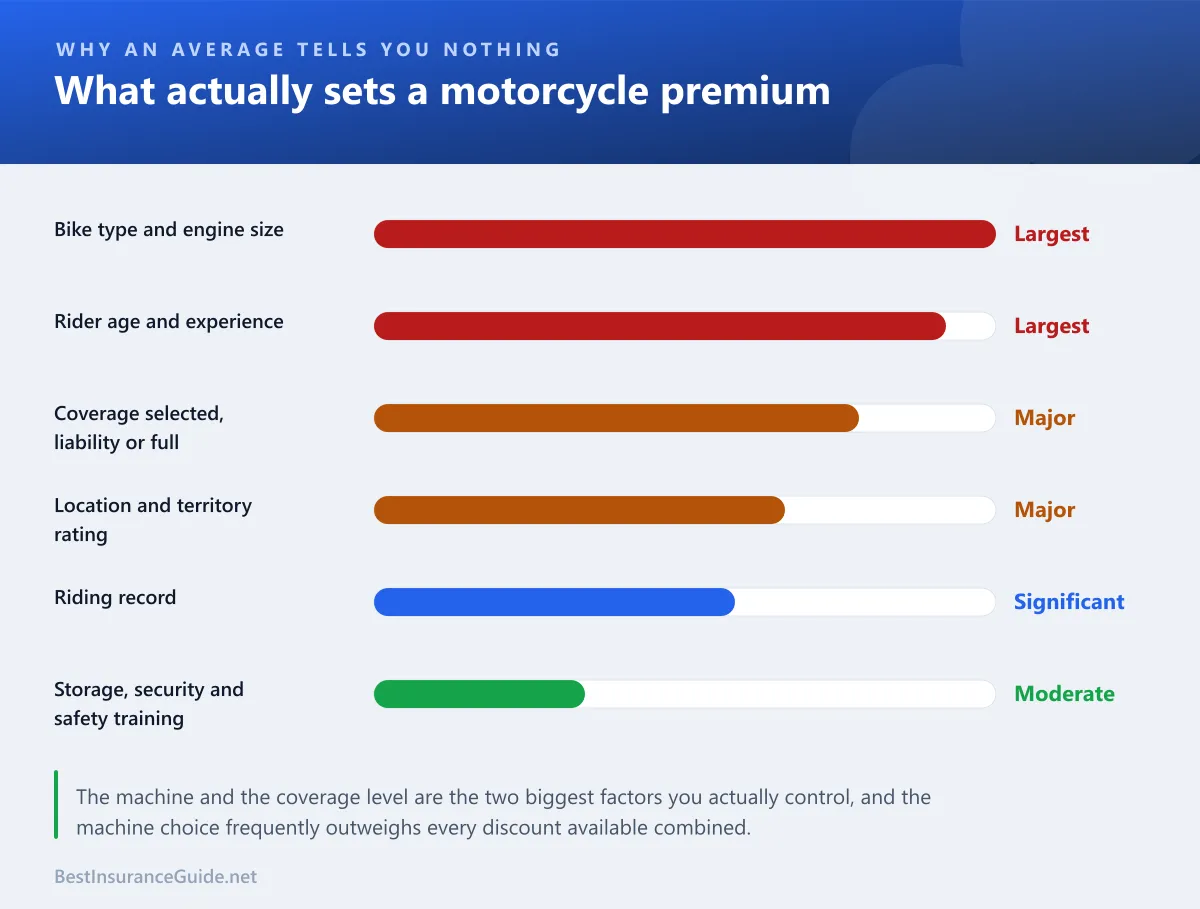
Bike type and engine size. The largest single factor after the rider. Sport bikes cost substantially more than cruisers or touring machines of identical value, because they are ridden faster, crash harder and are stolen far more often. A supersport and a mid-size cruiser worth the same money are not priced the same.
Rider age and experience. The youth curve on motorcycles is steeper than on cars. A newly licensed teenager on a powerful bike is close to the most expensive risk in personal lines insurance. Experience matters independently of age, which is why a 45-year-old first-time rider still pays a loading.
Riding record. Violations and at-fault claims move the price sharply, and motorcycle-specific violations move it further.
Location. Territory rating is significant. Urban postcodes carry higher claim frequency, higher repair costs and much higher theft rates than rural ones, and the intra-state spread frequently exceeds the gap between two states.
State rules. Minimum liability requirements, helmet laws and whether motorcycles receive any no-fault medical benefit all shift the floor. Our motorcycle insurance by state guide covers how much these differ.
Riding season. A bike parked for five northern months carries less annual exposure than one ridden year-round in Florida, and northern riders can use a lay-up arrangement that southern riders cannot.
Coverage selected. Liability-only against full coverage is frequently a three or four times difference, and it is the largest choice you actually control.
Storage and security. Garaging reduces both premium and theft risk, and disc locks, ground anchors and trackers attract discounts with several insurers.
Liability-only against full coverage
This is the decision that moves the number most, and it deserves an honest framing.
Liability-only covers injury and damage you cause to others. It pays nothing toward your bike and, unless you add it, nothing toward your own injuries.
Full coverage adds comprehensive and collision for the bike itself.
The usual test for dropping comprehensive and collision is whether the annual premium for them exceeds roughly ten per cent of the bike’s value. Below that, you are paying a meaningful share of the machine’s worth each year to insure it, and self-insuring becomes defensible.
Two cautions on that test.
A lender will require full coverage regardless of the arithmetic, for as long as there is finance outstanding.
Comprehensive is the cheaper half and covers theft. Dropping collision on an older bike while keeping comprehensive is frequently the right answer, because theft is the most common motorcycle comprehensive claim nationally and comprehensive costs less than collision.
The coverage people wrongly economise on
Cutting the wrong line to save money is the most expensive mistake in motorcycle insurance.
Uninsured and underinsured motorist coverage is inexpensive and it is the coverage most likely to matter. On a motorcycle your own injuries are the dominant exposure, and a driver carrying state minimums cannot fund a serious one. Declining UM to save a modest amount is a poor trade in every state.
Medical payments coverage is likewise cheap and, in several states, is the only thing standing between you and your health plan’s deductible after a single-vehicle crash. In Florida and Massachusetts, where motorcycles get no PIP, and in Pennsylvania, where they are exempt from the medical benefits requirement, it matters more still.
Liability limits should not be cut to the state floor. Minimums protect other people badly and you not at all, and a serious injury claim against you is a personal debt above your limit.
The levers that reliably work
In rough order of effect.
Complete an approved safety course. One of the most dependable discounts available, it frequently lasts several years, and in several states it also satisfies helmet or licensing requirements.
Garage the bike. Reduces premium and materially reduces theft risk.
Raise the deductible on comprehensive and collision, if you could absorb it.
Bundle with home or auto. Multi-policy discounts on motorcycles are frequently proportionally large.
Use a lay-up or storage period if you have a real off-season, keeping comprehensive while reducing the rest. Never cancel outright, because breaking continuous coverage costs more than the winter saving.
Ask about low-mileage or pleasure-use rating. Genuinely low annual mileage attracts real discounts with insurers that offer it, and it is rarely volunteered.
Choose the bike deliberately. Quote insurance on two or three candidate machines before buying. The difference between a supersport and a mid-size cruiser can exceed the price difference between them.
Maintain continuous coverage. A gap resets a rated factor and follows you for a year or more.
Worked example: the same rider, two decisions
A 28-year-old with a clean record, in a mid-sized metro.
| Supersport, full cover, street parked | Mid-size cruiser, liability plus comprehensive, garaged | |
|---|---|---|
| Base premium | $1,840 | $520 |
| Safety course discount | -$150 | -$70 |
| Multi-policy discount | -$180 | -$60 |
| Higher deductible | -$120 | -$40 |
| Annual premium | $1,390 | $350 |
Neither column is wrong. They are different decisions about what to ride and what to insure, and the machine choice did more than every discount combined.
Why your premium went up
If a renewal jumped, the useful response is to find out which of these applies before shopping.
A claim or violation, which will age off on a schedule, commonly three to five years.
A move, since territory is a strong rating factor.
A change of bike, particularly to a sport machine.
An age band shift, which usually works in your favour after the mid-twenties.
A lapse, which is the most expensive and the most avoidable.
A general rate revision filed by the insurer with your state, which affects everyone on the book rather than you specifically.
Ask your insurer which it was. If it is a general revision, shopping is likely to help. If it is a claim on your own record, every insurer will see it and shopping helps less.
The short version
There is no useful average motorcycle insurance cost, because the range runs from a couple of hundred dollars to several thousand for riders who are all technically buying the same product.
The factors that move it most are the machine, the rider’s age and experience, the postcode, and whether you buy liability-only or full coverage. The first and last of those are entirely within your control, and the machine choice frequently outweighs every discount available.
Cut cost by taking the safety course, garaging the bike, raising deductibles, bundling, laying up over winter and choosing the bike with an insurance quote in hand. Do not cut it by declining uninsured motorist coverage or by dropping liability to the state minimum, because those are the lines that protect you rather than the insurer.
For state-by-state requirements and how much they differ, see motorcycle insurance by state.
Comparing quotes so the number means something
Most riders compare motorcycle quotes badly, and the failure is always the same: comparing prices for policies that are not the same policy.
Match six fields across every quote before you look at a single premium.
Bodily injury liability limits. Property damage liability. Uninsured motorist limits. Underinsured motorist limits. Comprehensive deductible. Collision deductible.
A quote that arrives $200 cheaper is very frequently a quote written at state minimums with uninsured motorist declined, which is not a cheaper version of the same product. It is a thinner one.
Then ask five questions that do not appear on a comparison page.
What is the custom parts and accessories limit, and can it be raised?
Is there a lay-up or storage arrangement available, and does comprehensive remain in force during it?
What safety course discount applies, and for how long?
Is agreed value available, particularly on an older or modified machine?
How does the renewal behave? Some insurers quote aggressively for new business and increase sharply at the first renewal.
Our guide to comparing insurance quotes the right way sets out this discipline in general terms across every line of insurance, and motorcycles are where it matters most, because the coverage differences between cheap and adequate are larger here than almost anywhere.
What to check on the policy you buy
Once you have chosen, read the declarations page against what you were quoted.
Confirm every limit and deductible matches. Confirm the discounts you were promised actually appear. Confirm any custom parts schedule is attached. Confirm the lienholder is listed if the bike is financed. And confirm the effective date and time, because policies start at a specific hour rather than merely a date.
Discounts drop off between quote and issue more often than anyone admits, and they are straightforward to reinstate if you catch them in the first weeks rather than at renewal.
What it costs across a riding life
Premiums do not stay still, and seeing the shape helps with decisions that look expensive in year one.
| Stage | Indicative annual premium | Why |
|---|---|---|
| Newly licensed, first bike | $1,400 to $2,400 | Inexperience loading plus, usually, a bigger bike than sensible |
| Years 2 to 4, clean record | $800 to $1,400 | Experience accruing, loading reducing annually |
| Years 5 to 10, established | $450 to $900 | Full experience credit, safety course, bundling |
| Experienced, modest bike, lay-up | $250 to $500 | Every lever applied |
Two things follow.
The first years are the expensive ones and they pass. A rider who maintains continuous coverage and a clean record moves down that table automatically. A rider who lapses restarts part of it.
The machine choice compounds. Choosing a supersport at the start means paying the highest loading on the highest-rated bike simultaneously, and the effect persists for years rather than resetting when you sell it.
Whether to insure an older bike at all
For a bike worth $2,000 to $3,000, the arithmetic on physical damage cover is genuinely marginal.
The usual test is whether comprehensive and collision together exceed roughly ten per cent of the bike’s value annually. Below that, self-insuring the machine is defensible.
Three qualifications.
Keep comprehensive even when dropping collision. It is the cheaper half, it covers theft, which is the most common motorcycle comprehensive claim, and it covers fire, weather and animal strikes.
Never drop liability or uninsured motorist on the basis that the bike is cheap. Those protect people, not property, and the value of the bike is irrelevant to what a serious injury costs.
A lender overrides the arithmetic for as long as finance is outstanding.
Related reading
Two situations sit outside the ordinary pricing picture. Classic motorcycle insurance covers agreed value cover for an older machine, where a standard policy would settle at depreciated market value. Motorcycle insurance by state covers how much of the spread is simply where the bike is registered.
A note on scope
Premium figures throughout this article are illustrative, chosen to show the relative weight of the factors rather than to predict a quote. Actual pricing depends on your state, postcode, machine, riding record, age, coverage selections and, in most states, a credit-based insurance score.
Quote your own circumstances with several insurers using matched coverage before comparing anything, since a cheaper quote with lower limits is not a cheaper policy. This site is independent and not affiliated with any insurer.