What to Do After a Car Accident That Wasn't Your Fault
What to do after a car accident that wasn't your fault: what to document, whether to claim on your own policy, and how to recover your deductible.

Table of contents
Being hit by someone else feels like it should be simple. They were wrong, their insurer pays, you get on with your life.
Often it is that simple. When it is not, the reason is nearly always something that happened, or failed to happen, in the first hour.
At the scene
Safety first, then documentation. Move vehicles out of live traffic if they are drivable and it is safe. Hazard lights on. Check everyone for injuries.
Call the police. Some jurisdictions will not attend minor damage-only collisions, but call anyway and note the reference number. An official report is the strongest single piece of evidence in a disputed claim, and disputes about who did what are extremely common once the adrenaline fades.
Photograph before anything moves, if it is safe to wait.
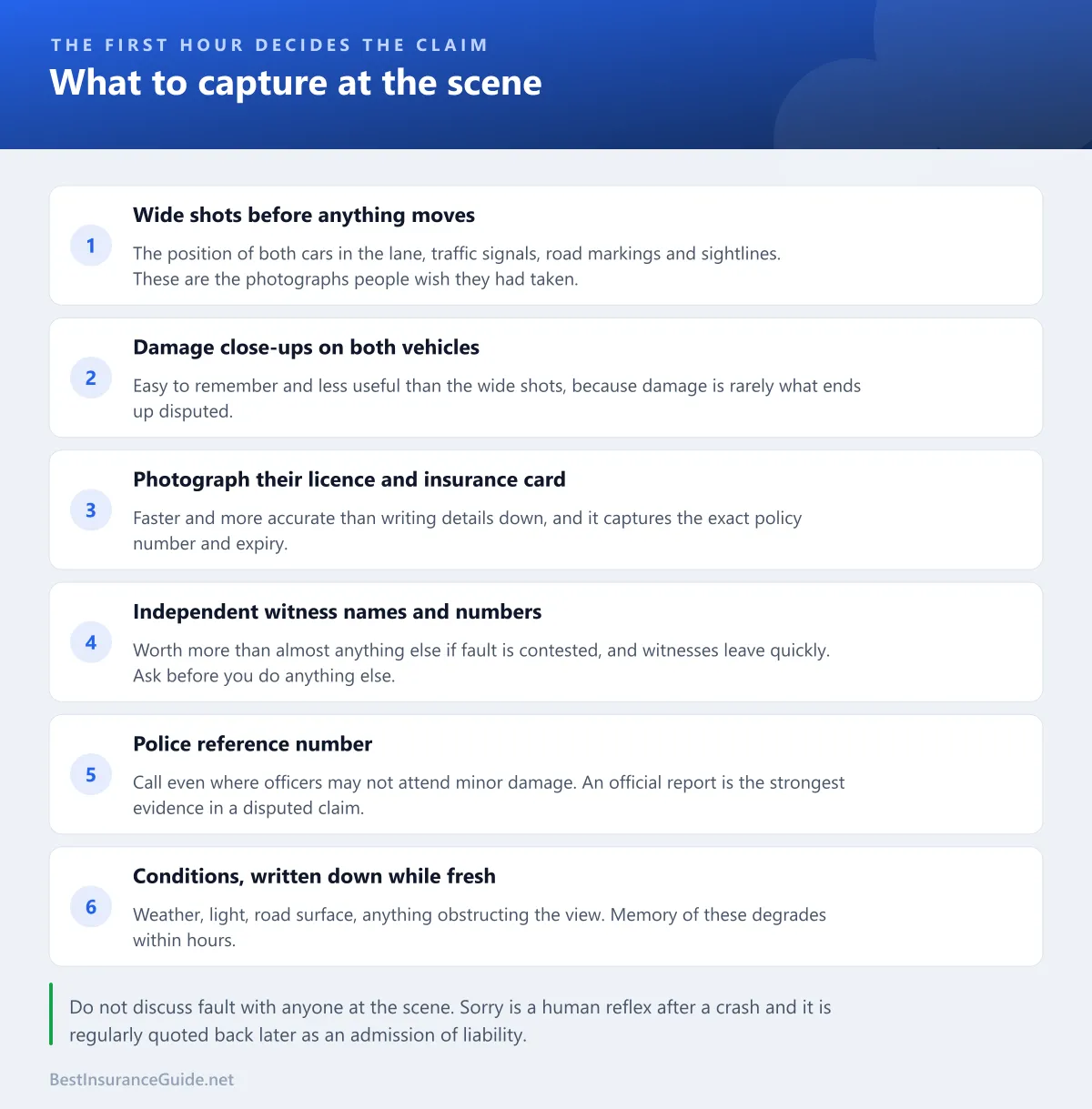
The photographs people wish they had taken are almost always the wide shots: the position of both cars in the lane, the traffic signals, the road markings, the sightlines. Damage close-ups are easy to remember and less useful, because damage is rarely what is disputed.
Exchange details properly. Name, address, phone, insurer, policy number, licence number, plate. Photograph their licence and insurance card rather than writing it down.
Get witnesses. A name and mobile number from an independent witness is worth more than almost anything else if fault is contested. Witnesses leave quickly, so ask early.
Do not discuss fault. Not with the other driver, not with a bystander. “Sorry” at a crash scene is human reflex and is regularly quoted back as an admission. State facts if asked by police; offer conclusions to nobody.
Note the conditions. Weather, light, road surface, anything obstructing the view. Write it down while it is fresh.
In the first 48 hours
Report to your own insurer, even though it was not your fault. This surprises people, but your policy requires prompt notice of any accident regardless of blame, and failing to report can create problems later if the other driver’s account differs from yours. Reporting is not the same as claiming.
See a doctor if there is any chance of injury. Soft tissue injuries commonly present a day or two later. A gap between the accident and the first medical record is the most effective argument an insurer has for saying the injury came from somewhere else.
Start a file. Every document, every reference number, and a log of every call with the date, the name of the person, and what was said. Claims are administered by many different people over months, and your log is often more complete than theirs.
Be careful with the other insurer. Their adjuster will call, usually quickly and pleasantly. You are generally not obliged to give a recorded statement, and there is rarely any advantage to doing so. Provide the basic facts in writing. If anyone is injured, take advice before saying anything on record.
Also be careful about early settlement offers. A quick cheque before the medical picture is clear is usually a bargain for them, and signing a release closes the claim permanently.
Whose policy should you claim on?
This is the real decision, and both options are legitimate.
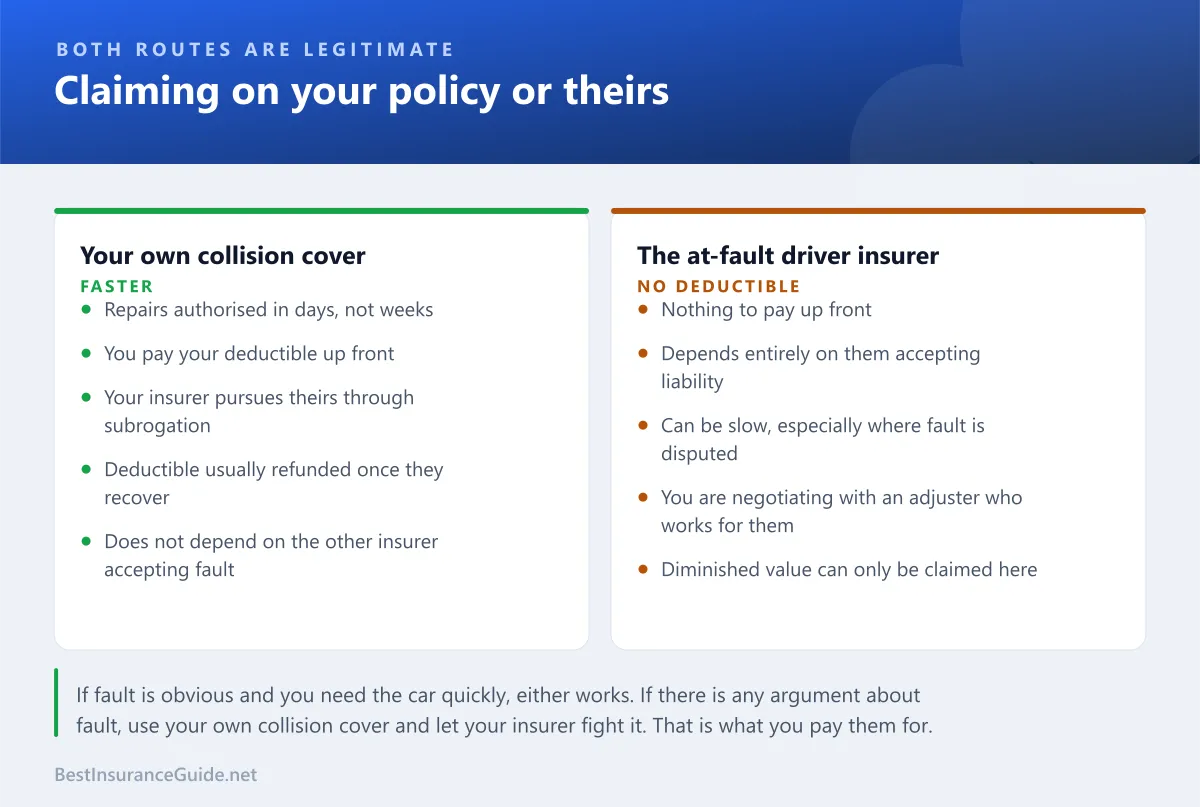
Claiming on your own collision coverage is faster. Your insurer pays for repairs less your deductible, and gets on with it. They then pursue the at-fault insurer through subrogation, and when they recover, they refund your deductible.
Claiming against the at-fault driver’s insurer avoids paying a deductible at all. It is slower, and it depends entirely on their insurer accepting liability. If fault is disputed, you can wait a long time with a damaged car.
The practical rule: if fault is obvious and undisputed and you need the car quickly, either works. If there is any argument about fault, or the other insurer is slow, use your own collision coverage and let your insurer fight it. That is what you have been paying them for.
Worked example: the same repair, two routes
| Your own collision | Their liability | |
|---|---|---|
| Repair cost | $7,300 | $7,300 |
| You pay up front | $1,000 deductible | $0 |
| Time to authorisation | Days | Often weeks |
| Depends on their insurer accepting fault | No | Yes |
| Deductible refunded after subrogation | Usually, in full | N/A |
| Net cost if subrogation succeeds | $0 | $0 |
Same destination. One route is quicker and costs you the deductible temporarily.
If they have no insurance, this is what uninsured motorist coverage exists for, and it is the coverage most worth carrying. Underinsured motorist cover does the same job when their limits are too low to cover your losses, which with state-minimum policies happens often.
Will your premium go up?
It should not. Most insurers do not surcharge not-at-fault accidents, and many states restrict the practice by regulation.
Two honest caveats. Some insurers consider claim frequency at renewal irrespective of fault, and a driver with several claims of any kind may see an effect. And if fault is later assessed as shared, the treatment changes.
It is a fair question to ask your insurer directly before filing: how does a not-at-fault claim affect my renewal? Ask, and note the answer in your file.
The money nobody offers you
Several legitimate recoveries are simply not volunteered. You have to ask.
Diminished value. A repaired car is worth less than one that was never hit, because the accident is on its history. Many states allow a diminished value claim against the at-fault driver’s insurer, particularly for newer vehicles. It is almost never offered proactively, and it can be worth thousands on a late-model car. You generally cannot claim it from your own insurer.
Rental and loss of use. The at-fault insurer should cover a comparable rental while your car is repaired. If you carry rental reimbursement on your own policy, that fills the gap while liability is being sorted. Ask for a comparable vehicle, not the cheapest available.
Out-of-pocket costs. Towing, storage, taxis, a car seat that must be replaced after a collision, and time off work for medical appointments. Keep receipts for everything.
Medical costs regardless of fault. If you carry medical payments coverage, or personal injury protection in a no-fault state, that pays your medical bills immediately without waiting for liability to be resolved. Use it. It does not stop you recovering from the at-fault driver later.
Total loss valuations are negotiable. If your car is written off, the first offer is an opening position. Comparable local listings, service records and recent work are all legitimate evidence for a higher figure. Our guide to how gap insurance works covers what happens when that valuation lands below your loan balance.
If they dispute fault
It happens more than people expect, and it is why the scene evidence matters.
Get the police report and read it. If it contains an error, most departments have a process for requesting a correction or adding a supplemental statement.
Chase the witnesses early, while memories are fresh and phone numbers still work.
Look for footage. Dashcams, doorbell cameras on nearby houses, business CCTV. Most retention windows are short, often days, so ask immediately.
Escalate rather than argue in circles. If an adjuster is unresponsive or unreasonable, ask for a supervisor. If that fails, your state department of insurance takes complaints and insurers respond to them.
Consider a lawyer where there are meaningful injuries, disputed liability with real money at stake, or a low settlement offer you cannot move. Most personal injury work is contingency-based. For property damage alone it is usually unnecessary.
Mind the deadlines. Your policy requires prompt notice. Legal claims have statutes of limitations that vary by state and by type of claim, and they are absolute.
The short version
At the scene: safety, police, wide-angle photographs, witness details, no discussion of fault.
In the first two days: report to your own insurer regardless of blame, see a doctor if there is any doubt, start a file, and be cautious about recorded statements.
Then decide whose policy to claim on. Use your own collision cover when fault is disputed or speed matters, and let subrogation refund your deductible.
Finally, ask for the things nobody offers: diminished value, a comparable rental, out-of-pocket costs, and a properly evidenced total loss valuation.
For the coverages that determine how well any of this goes, insurance 101 covers limits and deductibles, and does insurance follow the car or the driver explains whose policy responds when someone else was driving.