Motorcycle Insurance in Massachusetts: No PIP, Universal Helmets
Massachusetts excludes motorcycles from PIP despite being a no-fault state. Universal helmet law, compulsory uninsured motorist cover and lay-up over winter.

Table of contents

Massachusetts combines two features that pull in opposite directions for riders: unusually protective compulsory coverage, and a no-fault system that leaves motorcyclists out of the part that matters most.
What the state requires
Massachusetts requires a set of compulsory coverages rather than a single liability line:
Compulsory bodily injury liability, for injuries you cause to others.
Compulsory uninsured motorist coverage, which is genuinely unusual nationally and works in riders’ favour.
Property damage liability, for damage you cause to others’ property.
The compulsory limits are low relative to what a serious motorcycle injury costs, so as everywhere they are a floor rather than a plan.
All riders and passengers must wear an approved helmet, regardless of age or experience. Massachusetts has a universal helmet law with no coverage-linked exemption of the kind used in Florida, Texas or Pennsylvania.
The PIP gap
Massachusetts is a no-fault state. Car owners carry personal injury protection, which pays their own medical costs and a portion of lost wages regardless of who caused the crash.
Motorcycles are excluded from PIP.
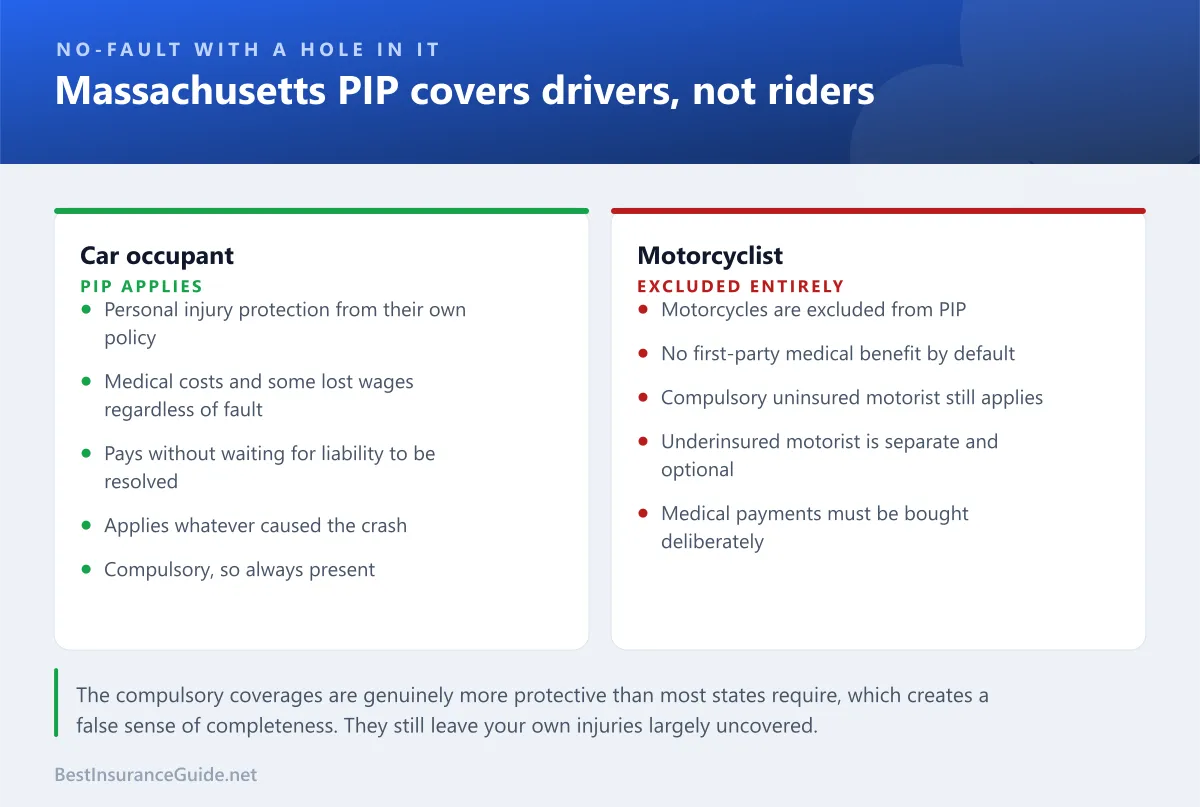
That means a motorcyclist injured on a Massachusetts road does not receive PIP from their motorcycle policy, and in most circumstances does not receive it from anywhere else either. A car driver in the same crash, on the same road, would.
The consequence is the same one that appears in Florida and, differently, in Michigan: your own injuries are the dominant financial risk on a motorcycle, and the state system does not cover them.
Two coverages close it.
Medical payments coverage pays your medical bills regardless of fault and without waiting for liability to be resolved. It is optional and it is the closest thing a Massachusetts rider has to PIP. Buy it at a level that reflects what an orthopaedic injury actually costs rather than a token amount.
Underinsured motorist coverage, which is separate from the compulsory uninsured motorist cover and is optional. Given how low the compulsory limits are, this is where a serious claim is actually funded.
Worked example: a crash with a minimum-limits driver
A rider is struck by a driver carrying Massachusetts compulsory minimums. Injuries and losses total $165,000.
| Source | Amount |
|---|---|
| At-fault driver’s compulsory bodily injury limit | $20,000 |
| Rider’s PIP | $0, motorcycles excluded |
| Rider’s underinsured motorist, $100,000 | $80,000 |
| Rider’s medical payments, $25,000 | $25,000 |
| Total recovered | $125,000 |
| Shortfall | $40,000 |
Without medical payments and underinsured motorist cover, the recovery on $165,000 of loss would have been $20,000.
The compulsory uninsured motorist coverage is genuinely valuable, but it responds when the other driver has no insurance. It does not fill the gap when they have too little, which is the far more common situation.
The universal helmet law
Massachusetts requires all riders and passengers to wear an approved helmet, with no exemption tied to age, experience, safety course or insurance coverage.
Three consequences.
There is no coverage condition to get wrong. Riders in Florida, Texas and Pennsylvania rely on exemptions tied to medical coverage or licensure, and a meaningful number do so without confirming they qualify. Massachusetts removes that entirely.
Head injury severity is lower where helmet use is universal, which reduces claim costs across the rider population and works modestly in riders’ favour on price.
It applies to visitors. Riders touring through from New Hampshire, which has no adult helmet requirement, are subject to Massachusetts law while in Massachusetts. That catches people on New England routes.
The short season and the lay-up decision
Massachusetts has a genuine off-season, and every autumn riders consider cancelling.
Do not cancel. The reasoning is the same as in Ohio, Michigan and Pennsylvania, and it is consistent.
A lapse breaks continuous coverage, which is a rated factor, and produces worse pricing for a year or more. Meanwhile a stored bike remains exposed to theft, fire, water damage from a burst pipe, and damage from a collapsed shelf or a garage break-in. All of those are comprehensive claims, and comprehensive is the cheaper of the two physical damage coverages.
Ask for a lay-up or storage arrangement: keep comprehensive in force, reduce or suspend collision and liability while the bike is off the road, and restore full cover in spring. Most insurers writing in New England offer one and it is rarely volunteered.
New England adds one specific storage consideration: winter flooding and burst pipes in older garages and basements are a genuine source of comprehensive claims on stored bikes.
What moves a Massachusetts premium
Boston and the eastern metro price above the west. Traffic density, claim costs and theft rates all concentrate there.
Massachusetts has historically been an expensive insurance state, and motorcycle pricing reflects the same local claim environment.
Bike type, with sport bikes well above cruisers and touring machines.
Rider age and experience, with a steep youth curve.
Short riding season, which reduces annual exposure relative to Florida or Georgia and enables the lay-up option.
Storage and security, since garaged bikes cost less and are stolen less.
Safety course completion, which produces a discount with most insurers even though it does not affect the helmet requirement here.
Riding into other New England states
Worth a note because it is common and the rules change at every border.
Your policy travels with you, and most policies contain an out-of-state provision that automatically raises limits to meet the requirements of whichever state you are riding in. That protects your legal compliance. It does not raise your limits generally, so if your Massachusetts limits are low you remain underinsured everywhere.
Helmet rules differ sharply. New Hampshire has no adult helmet requirement, Connecticut requires helmets under 18, and Massachusetts requires them universally. The law that applies is the law of the state you are physically in.
For a rider doing New England routes regularly, the practical answer is to carry limits sized for the most expensive state you ride in rather than the one you registered in.
The short version
Massachusetts requires compulsory bodily injury liability, compulsory uninsured motorist coverage and property damage liability, and requires a helmet for every rider and passenger regardless of age.
The compulsory uninsured motorist cover is a genuine advantage and rare nationally. The gap is that Massachusetts operates a no-fault PIP system and excludes motorcycles from it, so your own injuries are unprotected unless you buy medical payments coverage deliberately.
Buy medical payments at a meaningful level, add underinsured motorist cover on top of the compulsory uninsured cover, and raise liability well above the compulsory minimums.
Then use a storage arrangement over winter rather than cancelling, because a lapse costs more than the five months of premium it saves.
For how other states handle the same questions, see motorcycle insurance by state.
Merit rating, and how violations affect you
Massachusetts operates a merit rating system that assigns points for at-fault accidents and certain traffic violations, and those points affect premiums across the market rather than only with your current insurer.
Three consequences for a rider.
Points follow you. Because the system is statewide, switching insurers does not escape a surchargeable event in the way it might elsewhere.
Surcharges have a defined life. Points reduce and drop off over time with a clean record, which means the timing of shopping matters. Re-quoting after a surcharge ages off is more productive than shopping while it is live.
You can appeal. Massachusetts provides a process for appealing a surcharge where you believe an accident was not your fault or the determination was wrong. There is a deadline, and it is worth using if the determination looks wrong, because the premium effect runs for years.
Check your own record if a renewal jumped unexpectedly, because a surchargeable event you had forgotten is a common explanation, and the fix is an appeal rather than shopping.
Comparing quotes properly in Massachusetts
Match five fields before comparing price: bodily injury liability, property damage, uninsured motorist, underinsured motorist and the two physical damage deductibles.
Then four Massachusetts-specific questions.
Does this quote include medical payments coverage, and at what limit? Because motorcycles get no PIP here, this is the coverage that responds first, and a price-driven quote frequently omits it.
Is underinsured motorist coverage included? The compulsory cover is uninsured motorist, which is a different thing, and the underinsured version is what fills the far more common gap.
Is there a lay-up or storage arrangement, and does comprehensive stay in force?
What is the custom parts and accessories limit?
Our guide to comparing insurance quotes the right way covers the general method. The Massachusetts-specific point is that the compulsory coverages create a false sense of completeness: they are genuinely more protective than most states require, and they still leave your own injuries largely uncovered.
The riding year, practically
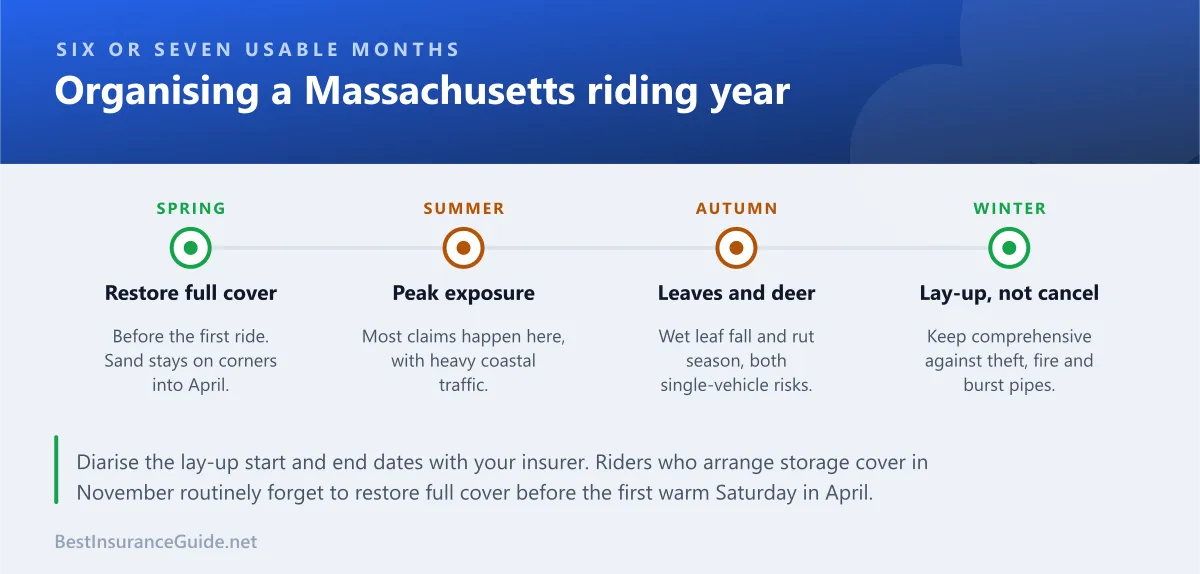
Massachusetts riders get roughly six to seven usable months, and organising the year around that saves money and trouble.
Spring. Sand and aggregate remain on the roads well into April, collecting on the inside of corners and at intersections. Restore full cover before the first ride rather than after, because a policy still in lay-up does not cover a road accident.
Summer. Peak exposure, peak traffic, and coastal routes with heavy tourist traffic. This is when most claims happen.
Autumn. Leaf fall creates a genuinely slippery surface, particularly when wet, and deer activity peaks through the rut. Both produce single-vehicle crashes.
Winter. Lay-up. Keep comprehensive, reduce the rest, and store the bike properly.
Two practical points around the transitions. Diarise the lay-up start and end dates with your insurer so there is no window where the bike is ridden on storage-only cover. And check the policy before the first spring ride, because riders who arranged lay-up in November frequently forget to restore full cover in April.
What to do after a crash
Report to police, and note that Massachusetts requires operator crash reports in defined circumstances involving injury or damage above a threshold.
Photograph widely before anything moves.
Get witness details.
Report to your insurer promptly. Massachusetts merit rating means the fault determination has consequences beyond the immediate claim, and engaging early matters.
See a doctor the same day if there is any possibility of injury. With no PIP available to you, the medical record supports both your medical payments claim and any claim against the at-fault party.
Consider appealing a surcharge if you believe a fault determination is wrong. There is a defined process and a deadline, and the premium effect runs for years.
A note on figures and sources
Premium figures here are illustrative rather than quotes. Confirm Massachusetts compulsory coverage requirements, current minimum limits and the merit rating rules with the Registry of Motor Vehicles and the Division of Insurance, since they change from time to time.
Comparable states
Massachusetts excludes motorcycles from personal injury protection while operating a no-fault system, which it shares with Michigan and, in a different form, Pennsylvania. Its universal helmet law matches Georgia.
A note on scope and sources
Massachusetts compulsory coverage requirements, minimum limits, the treatment of motorcycles under the no-fault statute and the universal helmet law are set by statute and administered by the Massachusetts Registry of Motor Vehicles, with insurance regulated by the Massachusetts Division of Insurance.
Confirm the current compulsory limits and the PIP position with those agencies rather than relying on any article. Premium and cost figures here are illustrative rather than quotes. Nothing here is legal advice, and this site is independent and not affiliated with any insurer.